



Pilot Plant Glass Reactor
(1)1L/2L/3L/5L---Standard/Liftable
(2)10L/20L/30L/50L/100L/150L/200L---Standard/EX-Proof
***Price List for whole above, inquire us to get
2. Customization:
(1)Design support
(2)Directly supply the Senior R&D organic intermediate, shorten your R&D time and cost.
(3)Share the advanced purifying technology with you
(4)Supply the high quality chemicals and analysis reagent
(5)We want to assist you on Chemical Engineering (Auto CAD, Aspen plus etc.)
3. Assurance:
(1)CE and ISO certification Registered
(2)Trademark: ACHIEVE CHEM(since 2008)
(3)Replacement parts within 1-year for free
Description
Technical Parameters
Pilot Plant Glass Reactor is a device used for conducting chemical reactions and process development during the pilot stage. It is typically used to validate laboratory scale research results, evaluate the feasibility of new processes, and prepare for industrial production.
Pilot plant reactors typically have a larger reaction capacity than laboratory scale, typically between 10 and 2000 liters. They are usually designed to simulate industrial production conditions, including the control of parameters such as temperature, pressure, and stirring speed. These reactors are usually made of high-temperature and corrosion-resistant materials, such as pilot plant stainless steel reactor, or other special alloys, to meet the requirements of various chemical reactions.
The use of pilot plant reactor for pilot stage research and development can help identify potential problems in industrial production processes, optimize reaction conditions, identify potential safety hazards in advance, and provide important references for industrial scale production. Such devices are typically used for process development and improvement in fields such as chemical, pharmaceutical, and new materials. The pilot plant reactor is a device used for conducting chemical reactions and process development during the pilot plant stage. It is typically used to validate laboratory scale research results, evaluate the feasibility of new processes, and prepare for industrial production.


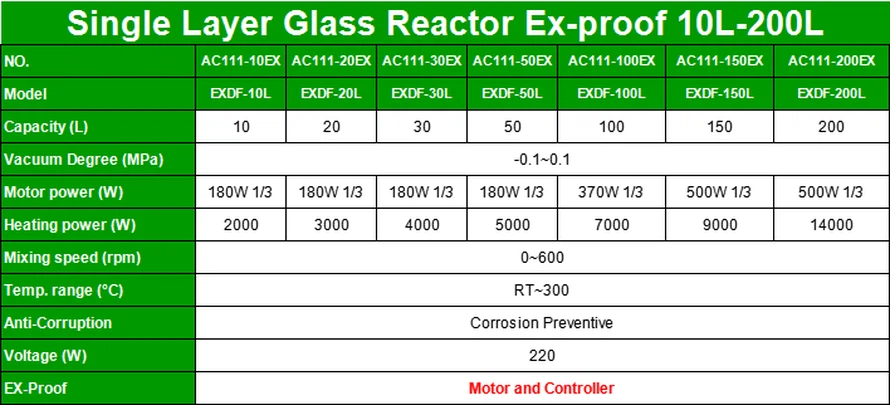
Introduction
It is a type of pilot plant reactor and is also a chemical reactor used in the laboratory and pilot stage. It is usually made of glass material, with a smaller volume and lower production capacity, suitable for small-scale experiments and the development of experimental processes.
It is mainly used to simulate and evaluate the feasibility and effectiveness of chemical reactions in laboratory environments. It can be used for synthesizing new compounds, catalyst research, drug development, chemical process optimization, and other fields. This type of reactor usually has a sealed design that can control parameters such as reaction temperature, stirring speed, gas inlet and outlet.
It can also be equipped with sensors and monitoring systems to monitor key indicators such as temperature, pressure, and pH value in real-time during the reaction process.
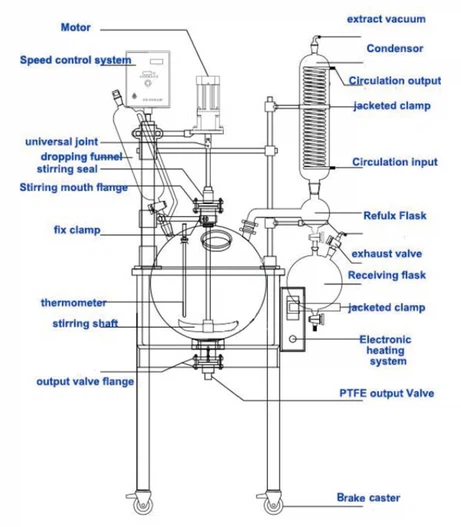
Overall, a pilot plant glass reactor is an experimental equipment used for small-scale chemical reaction experiments and process development. The experimental results can evaluate and guide the design and operation of large-scale production processes.
As described at the beginning of the article, the capacity of the glass pilot plant is usually above 10 liters, but it is limited by the glass manufacturing process. The maximum capacity of the product is usually only 200 liters, depending on the experimental requirements and application field. Different manufacturers and laboratories may provide product with different specifications and capacities to meet various experimental and pilot requirements.
Generally speaking, smaller capacity it are suitable for small-scale experiments and preliminary process development, while larger capacity it are more suitable for pilot and larger scale experiments. When selecting a suitable capacity product, factors such as the characteristics of the reactants, reaction conditions, production requirements, and available space in laboratories or industrial production facilities need to be considered.
Product Comparsion

There may indeed be some differences in structure and design between pilot plant glass reactor and large or small glass reactors. These differences are mainly reflected in the following aspects:
Capacity and size
Pilot
The capacity of pilot glass reactors is usually between small and large glass reactors to adapt to the transition stage from small-scale to industrial production. Therefore, its size is correspondingly located between these two.
Small
Small glass reactors are mainly used for laboratory scale experiments and research, with small capacity and corresponding small size, making them easy to operate and observe.
Large
Large glass reactors are suitable for industrial production, with large capacity and size, requiring corresponding support and fixing devices.
Structure and Design
Mixing system
The pilot glass reactor may use more complex mixing methods, such as magnetic stirring or mechanical stirring, to ensure sufficient mixing of reactants. The design and installation position of the agitator may also be adjusted according to the specific requirements of the reactor.
Heating and cooling system
The pilot glass reactor may require a more efficient heating and cooling system to control the temperature during the reaction process.
The design of the jacket, selection of heating medium, and cooling methods (such as water cooling, air cooling, etc.) may all be optimized according to the specific requirements of the reactor.
Sealing and protective devices
The pilot glass reactor requires higher sealing performance to prevent reactant leakage and air entry.
The sealing device may adopt mechanical sealing or magnetic sealing methods, and be equipped with corresponding safety valves and pressure gauges to monitor and control the pressure changes inside the kettle.
Observation and operation devices
The pilot glass reactor may need to be equipped with more observation and operation devices, such as observation windows, manholes, lighting devices, etc., to facilitate operators to observe the reaction inside the reactor and perform corresponding operations.
The pilot glass reactor may be more complex in structure as it needs to meet more functional and operational requirements. For example, more precise control systems, more efficient mixing systems, and safer protective measures may be required.
Product Types
|
|
|

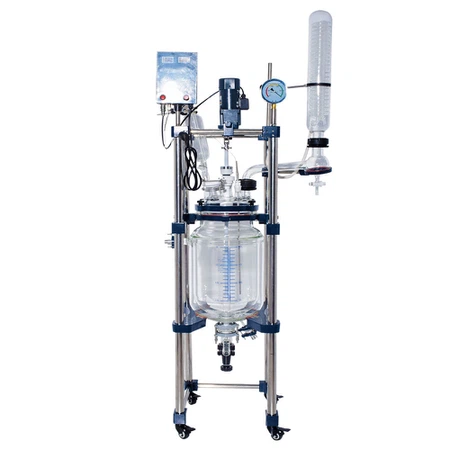
- The capacity of it is usually between small and large reactors, meeting the needs of scaling up validation from small-scale experiments to industrial production.
- The capacity size can be customized according to the actual needs of experiments or production, with high flexibility.
- Observation window design: The pilot glass reactor is made of transparent glass material, which has good observability. The large observation window allows the experimenter to visually observe the reaction process, timely detect and adjust reaction conditions.
- Easy to operate: The entire set of glass instruments is produced using the universal industry standard G3.3 (referred to as GG17 in China) high borosilicate explosion-proof glass, which has good chemical and physical properties. At the same time, the overall stainless steel column mobile fixed composite frame and structural stainless steel loading tray make the experimental operation more convenient and stable.
- Multi functional interface design: Four or five port reactor cover design, convenient for cleaning and assembling various reflux, distillation, temperature measurement, feeding, extraction/liquid, nitrogen filling and other devices. This design enables the product to adapt to various experimental and production needs.
- Material adaptability: Glass components are made of high-temperature resistant borosilicate glass material, which has good corrosion resistance and solvent resistance. This enables the pilot glass reactor to be suitable for various chemical substances and solvents.
- Efficient stirring and heat transfer: The product adopts an efficient stirring system and heat transfer design, which can quickly transfer heat to the material and improve reaction efficiency. Meanwhile, this design also helps to reduce energy consumption and waste emissions.
- Safety and Environmental Protection: Equipped with vacuum gauges and condensers, it can recover gases and solvents generated during the reaction process, reducing environmental pollution. Meanwhile, safety devices such as safety valves and pressure gauges can ensure the safety of the experimental process.
A pilot plant glass reactor is a versatile and essential piece of equipment used in chemical, pharmaceutical, and biochemical industries for research, development, and small-scale production. It is designed to simulate larger industrial processes, allowing scientists and engineers to test reactions, optimize procedures, and scale up production efficiently. The reactor's transparent glass construction provides clear visibility of the reaction mixture, enabling real-time observation of color changes, phase transitions, and other critical parameters. This feature is invaluable for monitoring reaction progress and making immediate adjustments.
Constructed from high-quality borosilicate glass, these reactors offer excellent chemical resistance to a wide range of substances, including acids, bases, and solvents, ensuring durability and safety during experiments. They are equipped with precise temperature control systems, typically using jackets that circulate heating or cooling fluids, to maintain optimal reaction conditions. Additionally, many models feature advanced stirring mechanisms with variable speed controls to ensure thorough mixing and uniform heat distribution.
Pilot plant glass reactors come in various sizes, typically ranging from 1 liter to 100 liters, accommodating different scales of experimentation. They often include multiple ports for adding reagents, sampling, and connecting ancillary equipment like condensers, distillation columns, or pressure relief systems. Safety features such as overpressure protection and leak-proof designs are standard to prevent accidents and ensure operator safety.
These reactors are indispensable for process development, where they help identify the most efficient reaction conditions, evaluate catalyst performance, and assess the stability and yield of products. By enabling experiments under controlled and observable conditions, they play a crucial role in advancing research and facilitating the transition from laboratory-scale discoveries to commercial-scale production.
Hot Tags: pilot plant glass reactor, China pilot plant glass reactor manufacturers, suppliers, factory, High Pressure Batch Reactor, Hydrothermal Autoclave Reactor With Teflon Chamber 100ml, Hydrothermal Reactor Autoclave, Molecular Distillation Unit, Jacketed Lab Reactor, High Pressure Reactor Vessel
Previous
Shortpath DistillationNext
20L Glass ReactorSend Inquiry


