



Molecular Distillation Apparatus
(1) Laboratory Test (<20L)
NCF-10A, NCF-20A, NCF-30A, NCF-50A
(2) Pilot Production (20L<100L)
NCF-100, NCF-200 (3) Industrial Production (100L<300L)
NCF-500
2. Customization:
(1)Design support
(2)Directly supply the Senior R&D organic intermediate, shorten your R&D time and cost.
(3)Share the advanced purifying technology with you
(4)Supply the high quality chemicals and analysis reagent
(5)We want to assist you on Chemical Engineering (Auto CAD, Aspen plus etc.)
3. Assurance:
(1)CE and ISO certification Registered
(2)Trademark: ACHIEVE CHEM(since 2008)
(3)Replacement parts within 1-year for free
Description
Technical Parameters
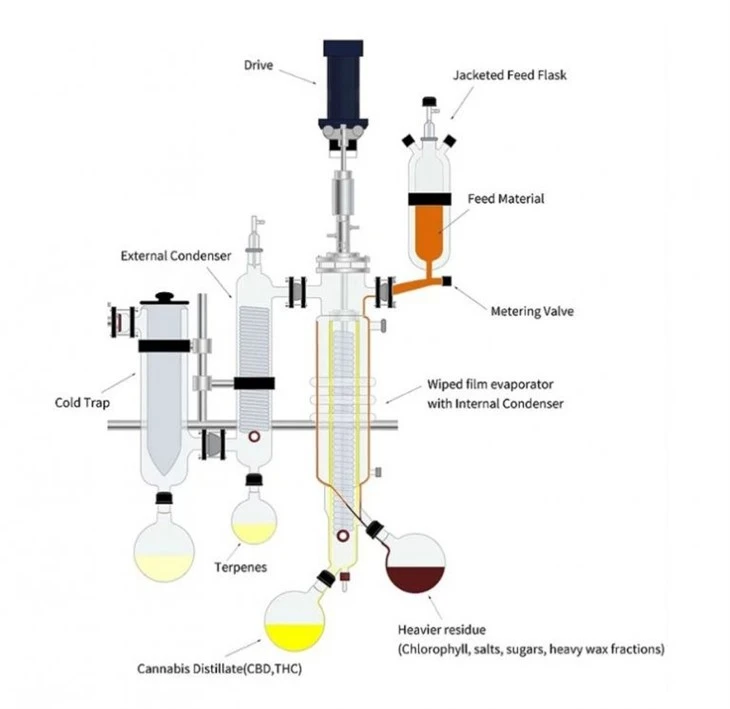
A molecular distillation apparatus is a complete set of chemical equipment. Usually composed of several key components: evaporation Flask, distillation column, condenser, vacuum pump, collection flask, feed and discharge system.


Product Introduction

Within a molecular distillation apparatus, the set of chemical equipment contains:
◆ Evaporation Flask (Wiped Film Evaporator): This is where the initial process takes place. The evaporation flask is typically a cylindrical container that is heated to cause the substances inside to evaporate. It often has a built-in wiper mechanism which helps to create a thin film of the material to be distilled on the inner surface of the flask. This thin film promotes a uniform temperature and efficient evaporation.
◆ Distillation Column: This is a tall, vertical component of the molecular distillation apparatus where the separation of substances takes place. It is usually filled with packing material to increase the surface area for distillation and to promote the interaction between the ascending vapor and the descending condensate. This allows for the efficient separation of compounds based on their respective boiling points.
◆ Condenser: After the substances are evaporated and separated in the distillation column, the vapor enters the condenser. The condenser is usually a coiled tube where the vapor is cooled and condensed back into a liquid form. It's often surrounded by a container through which coolant is circulated to remove heat from the vapor.
◆ Vacuum Pump: Molecular distillation often takes place under reduced pressure to lower the boiling points of the substances being distilled. The vacuum pump is used to create this low-pressure environment, which helps to prevent the decomposition of thermally sensitive molecules.
◆ Collection Flask: This is where the distilled substances are collected after condensation. There may be multiple collection flasks in a molecular distillation apparatus, allowing for the collection of different fractions or compounds separated during the distillation process.
◆ Feed and discharge system: This is where the raw material is fed into the system and the residues are discharged. It's usually equipped with a precise metering pump to ensure accurate and continuous feed.
Each of these components plays a crucial role in the molecular distillation process, working together to separate compounds based on their molecular weights and boiling points.
Principles of Molecular Distillation
Molecular distillation exploits the inherent differences in the molecular properties of various components in a liquid mixture. The fundamental principle lies in the different free path lengths of molecules in the liquid phase. When a liquid mixture is heated under vacuum, the lighter molecules with shorter free paths tend to evaporate more rapidly and travel a shorter distance before condensing, while heavier molecules with longer free paths require more energy and time to evaporate and often do not reach the condensation surface.
The process operates under high vacuum conditions (typically 0.001 to 10 mbar), ensuring that the average free path of vapor molecules is sufficiently large to traverse the short distance between the evaporation and condensation surfaces without significant collisions. This allows for the direct condensation of light molecules on the condenser, achieving a high degree of separation.
Structure of Molecular Distillation Apparatus
The Molecular Distillation Apparatus 2000 comprises several critical components, including a heating kettle, condenser, separation cup, vacuum pump, and associated piping and valves. The heating kettle serves as the evaporation chamber, where the liquid mixture is heated to induce evaporation. The condenser, positioned in close proximity to the evaporation surface, captures the evaporating molecules and condenses them into a separate fraction. The separation cup collects the condensed product, while the vacuum pump maintains the required low-pressure environment.
◆ Heating Kettle: The heart of the apparatus, the heating kettle contains the liquid mixture to be separated. It is equipped with heating elements that raise the temperature of the mixture, causing evaporation.
◆ Condenser: Located in close proximity to the evaporation surface, the condenser rapidly cools and condenses the evaporating molecules. Its design ensures efficient heat transfer and minimal loss of volatile components.
◆ Separation Cup: This component collects the condensed product, separating it from the residual mixture in the heating kettle.
◆ Vacuum Pump: Maintains the high vacuum environment necessary for molecular distillation, ensuring that the vapor molecules have a sufficiently long mean free path.
◆ Tail Gas Treatment System: Advanced models, such as the Molecular Distillation Apparatus 2000, often incorporate a tail gas treatment system to filter out organic compounds, water, and acidic substances, protecting the vacuum pump and enhancing overall efficiency.
Applications
There are five most common types of molecular distillation: simple distillation, fractional distillation, steam distillation, vacuum distillation, short path distillation.

◆ Simple Distillation: This technique is used when the boiling points of the components in a mixture differ by at least 70°C. It separates the components based on their boiling points.
Simple distillation is a versatile and useful method for separating components with differing boiling points. However, it requires a large difference in boiling points between the components being separated, making it less effective for separating complex mixtures. In these cases, fractional distillation, vacuum distillation, or steam distillation may be more appropriate.

◆ Fractional Distillation: This technique is used when the boiling points of the components in a mixture are closer together (less than 70°C). It separates the components by using a fractionating column to provide more surface area allowing for repeated vaporization and condensation cycles. Fractional distillation is a distillation technique used for separating components from a mixture with closer boiling points than those typically separated by simple distillation.
It is characterized by the use of a fractionating column, which allows more surface area for vaporization and condensation, increasing the efficiency of the process. Fractional distillation is commonly used in the separation and purification of various chemicals, including the separation of crude oil into its different components, due to its cost-effectiveness and scalability for industrial applications.

◆ Steam Distillation: This technique is used when the substances to be distilled are heat-sensitive or do not mix well with water. They can be extracted by passing steam through the mixture to cause vaporization, followed by condensation of the steam and the vaporized components. Steam distillation is a specialized distillation technique that uses steam as a carrying agent to extract volatile compounds from mixtures.
It is commonly used for the extraction of essential oils from plants due to its gentle nature that preserves the quality of the aromatic compounds. Steam distillation is also suitable for separating mixtures with components of differing solubilities in water. Its applications primarily revolve around the extraction of natural products and the purification of organic compounds to maintain their integrity and functionality.

◆ Vacuum Distillation: This technique is used to reduce the boiling point of the components by lowering the pressure, making it possible to distill substances that would normally decompose at their normal boiling point. Vacuum distillation is a distillation technique that operates at reduced pressures to separate components at lower temperatures, minimizing thermal degradation or decomposition. It finds applications in the purification of heat-sensitive compounds, such as solvents and lubricants, where maintaining their integrity is crucial.
Vacuum distillation is also widely used in the petroleum industry to refine crude oil and produce high-quality fuels. By operating under reduced pressure, vacuum distillation provides an effective and gentle method for separating components in various industries.

◆ Short Path Distillation: This technique is used for the separation of compounds with very high boiling points or those that can be thermally unstable. It involves passing the vapors through a short path with high vacuum conditions to create a short distance between the evaporator and the condenser. Short path distillation is a specialized distillation technique that utilizes a short path and operates under high vacuum to achieve high levels of separation and purification.
It is commonly employed in applications such as essential oil extraction, purification of high-boiling-point substances, and production of pharmaceutical ingredients. The technique's ability to maintain low temperatures and minimize thermal degradation makes it a preferred choice for obtaining highly pure and valuable products.
Conclusion
The Molecular Distillation Apparatus 2000 represents the state-of-the-art in molecular distillation technology, offering a highly efficient and gentle solution for the separation of liquid mixtures. Its unique design and operational principles enable precise separation of even closely related compounds, making it an invaluable tool in various industries.
While the high initial investment and maintenance costs may be a concern, the benefits of low operating temperatures, high separation efficiency, and versatility make it a worthwhile investment for many applications. With continued advancements in technology, the Molecular Distillation Apparatus 2000 and its successors will continue to play a crucial role in the separation and purification of complex liquid mixtures.

Go to the next page and see more about shortpath distillation to unlock more surprises and features.
Hot Tags: molecular distillation apparatus, China molecular distillation apparatus manufacturers, suppliers, factory, Crystallization Reactor, High Pressure Laboratory Reactor, Glass Lab Reactor, Stainless Steel Reactor, 20l Rotary Evaporator, Hydrothermal Autoclave Reactor With Teflon Chamber 100ml
Previous
Rotary Evaporator ExtractionSend Inquiry


