



Evaporation & Distillation Equipment
Achieve Chem provides evaporation and distillation systems for solvent removal, concentration, purification, fractionation and thermal separation across laboratory, pilot-scale and process applications.
Our equipment range includes rotary evaporators, molecular distillation systems, short path distillation units and distillation columns for different separation requirements, operating scales and material characteristics.
Whether you are recovering solvents from a laboratory flask, separating heat-sensitive compounds or developing a continuous distillation process, we can help you select an appropriate system based on your feed material, throughput, boiling range and separation target.


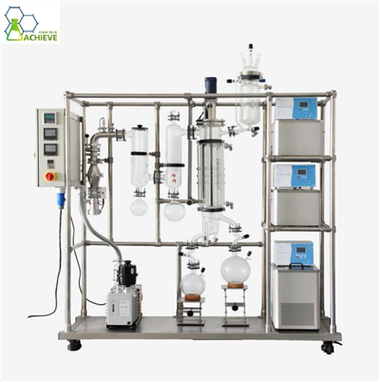


Evaporation & Distillation Equipment Comparison
| Equipment | Main Purpose | Typical Scale | Best Suited For |
|---|---|---|---|
| Rotary Evaporator | Solvent evaporation and concentration | Laboratory | Solvent removal, concentration and recovery |
| Molecular Distillation | High-vacuum separation | Laboratory to industrial | Heat-sensitive and high-boiling materials |
| Short Path Distillation | Gentle thermal separation | Laboratory to pilot scale | High-boiling and temperature-sensitive compounds |
| Distillation Column | Fractionation and continuous separation | Laboratory to industrial | Solvent recovery and component separation |
The best choice depends on feed properties, boiling range, thermal stability, throughput and required separation efficiency.
Applications of Evaporation & Distillation Equipment
Evaporation and distillation technologies are used across chemical research, pharmaceutical development, natural product processing and industrial separation.
Solvent Recovery
Recover and reuse valuable solvents from laboratory or process streams through controlled evaporation and condensation.
Solvent Removal
Remove volatile solvents from solutions and concentrates while controlling temperature and vacuum conditions.
Concentration
Increase the concentration of dissolved compounds before further purification, formulation or analysis.
Thermal Separation
Separate components according to differences in volatility and boiling behavior.
Fractionation
Distillation columns can separate complex mixtures into different fractions according to their relative volatility.
Natural Product Processing
Rotary evaporation, short path distillation and molecular distillation can be used in the processing and purification of natural extracts, oils and other botanical materials.
Pharmaceutical Processing
Vacuum-based separation technologies can support laboratory research, intermediate purification and process development for temperature-sensitive compounds.
Specialty Chemical Purification
High-vacuum distillation systems can be used to purify specialty chemicals and high-boiling materials where conventional atmospheric distillation is unsuitable.
Process Development and Scale-Up
Laboratory and pilot-scale evaporation and distillation systems can be used to evaluate separation conditions before larger-scale process implementation.
Separation Technologies
Achieve Chem's evaporation and distillation equipment covers several separation approaches, allowing users to select a technology based on material characteristics and process objectives.
Vacuum Evaporation
Vacuum operation lowers the boiling temperature of volatile components, making it useful for solvent removal and concentration where excessive heat exposure should be avoided.
Short-Path Separation
Short-path configurations minimize the vapor travel distance between the evaporator and condenser. This can reduce residence time and support the processing of temperature-sensitive materials.
Molecular Distillation
Molecular distillation operates under high vacuum with a very short residence time. It is used for specialized separation of high-boiling and thermally sensitive substances.
Fractional Distillation
Distillation columns provide repeated vapor-liquid contact for separating components with different volatilities, making them suitable for fractionation and solvent recovery.
Condensation and Recovery
Appropriate condenser and collection systems allow evaporated components to be recovered rather than discharged, which can improve material utilization and process control.
Separation Technologies
Achieve Chem's evaporation and distillation equipment covers several separation approaches, allowing users to select a technology based on material characteristics and process objectives.
Vacuum Evaporation
Vacuum operation lowers the boiling temperature of volatile components, making it useful for solvent removal and concentration where excessive heat exposure should be avoided.
Short-Path Separation
Short-path configurations minimize the vapor travel distance between the evaporator and condenser. This can reduce residence time and support the processing of temperature-sensitive materials.
Molecular Distillation
Molecular distillation operates under high vacuum with a very short residence time. It is used for specialized separation of high-boiling and thermally sensitive substances.
Fractional Distillation
Distillation columns provide repeated vapor-liquid contact for separating components with different volatilities, making them suitable for fractionation and solvent recovery.
Condensation and Recovery
Appropriate condenser and collection systems allow evaporated components to be recovered rather than discharged, which can improve material utilization and process control.
Need Help Choosing an Evaporation or Distillation System?
Tell us what you need to separate and we can help identify a suitable equipment configuration.
For a preliminary recommendation, provide:
Feed material
Approximate feed volume or throughput
Boiling point or boiling range
Desired operating temperature
Heat sensitivity of the product
Required vacuum level, if known
Target product purity
Solvent or component to be recovered
Laboratory, pilot or production scale
You do not need to have every specification ready.
Send us your process information and our team can recommend a suitable evaporation or distillation solution.
[Request a Quote] [Discuss Your Process]
Frequently Asked Questions
What is the difference between evaporation and distillation?
Evaporation is generally used to remove a volatile component, often to concentrate a solution. Distillation separates components based primarily on differences in volatility or boiling behavior and can be used for fractionation and purification.
What equipment is used for solvent evaporation?
Rotary evaporators are commonly used for laboratory-scale solvent evaporation, concentration and solvent recovery. The appropriate configuration depends on the solvent, volume and required evaporation rate.
When should I use a rotary evaporator?
A rotary evaporator is suitable when you need to remove or recover volatile solvents under reduced pressure, particularly during laboratory-scale concentration and sample preparation.
What is molecular distillation used for?
Molecular distillation is used for high-vacuum separation of high-boiling or heat-sensitive materials where conventional distillation may expose the product to excessive temperature or residence time.
What is the difference between molecular distillation and short path distillation?
Both technologies use vacuum and short vapor travel paths. Molecular distillation emphasizes extremely high vacuum and very short residence time, while short path distillation is commonly used as a broader category of short-distance vacuum distillation equipment for laboratory and pilot-scale applications.
When is a distillation column required?
A distillation column is appropriate when a mixture needs to be separated into multiple fractions or when continuous separation and higher throughput are required.
Can evaporation and distillation equipment be customized?
Yes. Equipment configuration can be adapted according to feed properties, capacity, vacuum requirements, heating and cooling requirements, condenser configuration, collection system and control requirements.
Can these systems be used for heat-sensitive materials?
Vacuum evaporation, short path distillation and molecular distillation can reduce the temperature required for separation. The appropriate technology depends on the thermal stability and physical properties of the material.
Do you supply laboratory and pilot-scale equipment?
Yes. Equipment can be selected for laboratory research, process development and pilot-scale applications, depending on the required throughput and separation process.
How do I choose between a rotary evaporator and a distillation system?
Start with the separation objective. If you mainly need solvent removal or concentration, a rotary evaporator may be appropriate. If you need component separation or fractionation, a distillation system may be more suitable.
We're professional evaporation & distillation equipment manufacturers and suppliers in China, specialized in providing high quality products. We warmly welcome you to buy bulk customized evaporation & distillation equipment from our factory. For price consultation, contact us.