


Laboratory Rotary Evaporators & Vacuum Evaporation Equipment

Laboratory Rotary Evaporators & Vacuum Evaporation Equipment
Laboratory Rotary Evaporators & Vacuum Evaporation Equipment

Laboratory Rotary Evaporators & Vacuum Evaporation Equipment
Laboratory Rotary Evaporators & Vacuum Evaporation Equipment

Laboratory Rotary Evaporators & Vacuum Evaporation Equipment

Laboratory Rotary Evaporators & Vacuum Evaporation Equipment
Laboratory Rotary Evaporators & Vacuum Evaporation Equipment
(1)Lab scale:1L/2L/3L/5L
(2)Pilot scale:/10L/20L/30L/50L/100L---Ex-proof system are optional
***Price List for whole above, inquire us to get
2. Customization:
(1)Design support
(2)Double vertical Glass condenser
(3)Double collect bottle
(4)Over heating protect syste
(5)Customized ATEX ex-proof system
3. Assurance:
(1)CE and ISO certification Registered
(2)Trademark: Achieve Chem(since 2008)
(3) 13months free warrranty
4) Professional Engineer can speak English taking by calling
Description
Technical Parameters
Laboratory Rotary Evaporators for Controlled Solvent Removal
Achieve Chem supplies laboratory rotary evaporators from 1L to 50L for solvent evaporation, concentration, vacuum distillation and solvent recovery. The systems are designed for research laboratories, process development and small-scale production where controlled temperature, vacuum and evaporation conditions are required.
Choose from manual or electric lifting configurations and different capacities to match your process requirements. Complete system configuration and application-based customization are available.
Available capacities: 1L, 2L, 3L, 5L, 10L, 20L, 30L and 50L
Typical applications: Solvent Removal · Concentration · Vacuum Distillation · Extraction · Purification · Solvent Recovery

Need Help Choosing a Rotary Evaporator?
Tell us your capacity, solvent and application. Our engineers will recommend a suitable configuration.
Request a Configuration & Quote
Laboratory Rotary Evaporators for Research and Process Development
Achieve Chem laboratory rotary evaporators are designed for controlled solvent removal, concentration, vacuum distillation and solvent recovery in laboratory and pilot-scale applications.
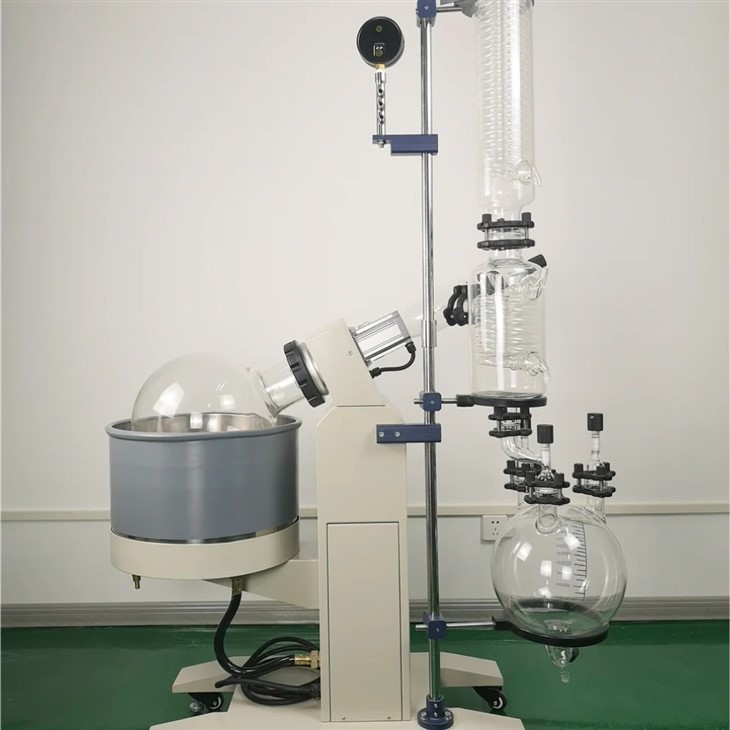
During operation, the rotating evaporation flask forms a thin liquid film on the inner wall. Under reduced pressure, the solvent can evaporate at a lower temperature, while the condenser collects the vapor for recovery. This configuration provides controlled evaporation conditions and helps reduce unnecessary thermal exposure to temperature-sensitive materials.
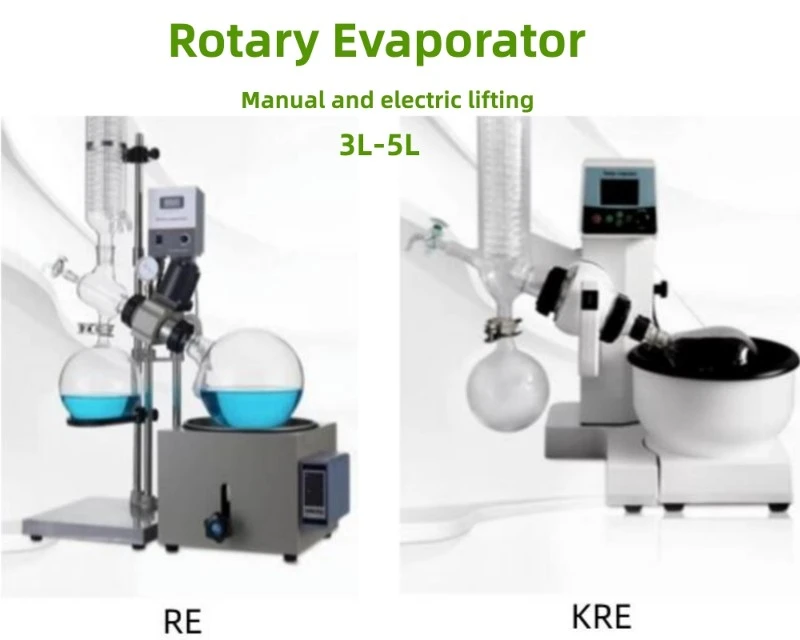
Our laboratory rotary evaporator range covers 1L to 50L capacities, allowing users to select equipment according to batch size, solvent volume and process requirements. Manual and electric lifting configurations are available for different operating preferences.
The system can be configured with compatible heating, vacuum and condensation components to create a complete evaporation setup. For projects with specific solvent, throughput, temperature or vacuum requirements, Achieve Chem can provide configuration recommendations and customized equipment solutions.

What Can a Rotary Evaporator Be Used For?
Laboratory rotary evaporators are commonly used for:
Removing organic solvents from reaction mixtures
Concentrating extracts and laboratory samples
Vacuum distillation of solvents
Solvent recovery and collection
Sample preparation before analysis
Purification and separation of laboratory compounds
Concentration of pharmaceutical and natural product extracts
Process development and scale-up studies
The appropriate configuration depends on the solvent properties, required evaporation rate, operating temperature, vacuum level and batch volume.
|
|
|

|
Model |
Evaporating Flask (L) |
Receiving Flask (L) |
Vacuum Degree (MPa) |
Heating Method |
Temp. Control Range (°C) |
Temp. Resolution (°C) |
Heating Power(W) |
Motor Power(W) |
Rotating Speed (rpm) |
Lifting Method |
Timer Setting(H) |
|
KRE-3L |
3 |
1 |
-0.1 |
Water and oil bath |
RT~120 |
±1 |
2000 |
60 |
0~120 |
Electric |
/ |
|
KRE-5L |
5 |
2 |
-0.1 |
Water and oil bath |
RT~120 |
±1 |
2000 |
60 |
0~120 |
Electric |
/ |
|
KRE-10L |
10 |
5 |
-0.1 |
Water and oil bath |
RT~99 |
±1 |
3000 |
250 |
0~120 |
Electric |
1~99 |
|
KRE-20L |
20 |
10 |
-0.1 |
Water and oil bath |
RT~99 |
±1 |
5300 |
250 |
0~120 |
Electric |
1~99 |
|
KRE-30L |
30 |
10 |
-0.1 |
Water and oil bath |
RT~99 |
±1 |
6000 |
250 |
0~120 |
Electric |
1~99 |
|
KRE-50L |
50 |
20 |
-0.1 |
Water and oil bath |
RT~99 |
±1 |
7500 |
250 |
0~120 |
Electric |
1~99 |
Not Sure Which Model You Need?
Send us your required capacity and application. We can help you compare suitable laboratory rotary evaporator configurations.
Key Features
1. 1L–50L Capacity Range
Configurations are available from 1L laboratory units to 50L larger-volume systems, covering routine laboratory work, process development and scale-up applications.
2. Manual or Electric Lifting
Different lifting configurations are available to match equipment size, operating frequency and user preference.
3. Vacuum-Assisted Evaporation
Reduced-pressure operation allows solvents to evaporate at lower temperatures, making the system suitable for controlled solvent removal and concentration.
4. Efficient Vapor Condensation
The condenser is designed to condense evaporated solvent and direct it into the receiving flask for collection and recovery.
5. Visible Evaporation Process
The glass components allow operators to observe the material during evaporation, helping monitor foaming, boiling and process changes.
6. Flexible System Configuration
Heating, vacuum and condensation components can be configured according to the selected evaporator model and application requirements.
7. Laboratory to Pilot-Scale Applications
The capacity range supports laboratory research as well as process development and scale-up work.
8. Application-Based Customization
For specific solvents, batch sizes or process requirements, Achieve Chem can recommend suitable configurations and provide customized equipment solutions.


Applications
Achieve Chem laboratory rotary evaporators are used across research, development and small-scale processing environments.
Pharmaceutical Research
Concentration of extracts, solvent removal and preparation of samples for further purification or analysis.
Chemical Synthesis
Removal and recovery of organic solvents after synthesis, extraction and reaction processes.
Natural Products & Extraction
Concentration of plant extracts and other solvent-based extracts while maintaining controlled evaporation conditions.
Biotechnology
Concentration and preparation of laboratory samples where controlled solvent removal is required.
Academic & Research Laboratories
Routine evaporation, vacuum distillation, sample concentration and method development.
Process Development
Evaluation of evaporation conditions before moving from laboratory-scale work toward larger production equipment.
How to Choose a Laboratory Rotary Evaporator
Selecting a rotary evaporator should not be based on flask capacity alone. The solvent, batch volume, required evaporation rate, operating temperature and vacuum conditions should all be considered.
For small laboratory samples
A 1L or 2L system is generally suitable for method development, analytical work and small-batch experiments.
For routine laboratory evaporation
3L and 5L models provide additional working volume for regular solvent removal and concentration.
For process development
10L and 20L configurations are suitable when a larger batch volume or scale-up study is required.
For pilot-scale work
30L and 50L systems can be considered for higher-volume evaporation and process development.

If you provide the following information, we can recommend a suitable configuration:
Material or solvent type
Batch volume
Target concentration
Required evaporation rate
Operating temperature
Vacuum requirement
Preferred lifting method
Frequently Asked Questions
What is a laboratory rotary evaporator used for?
A laboratory rotary evaporator is primarily used for controlled solvent removal, concentration, vacuum distillation and solvent recovery. It is widely used in chemical, pharmaceutical, biotechnology and research laboratories.
What sizes of rotary evaporators are available?
Achieve Chem offers laboratory rotary evaporator capacities from 1L to 50L, including 1L, 2L, 3L, 5L, 10L, 20L, 30L and 50L configurations.
What is the advantage of vacuum evaporation?
Vacuum operation lowers the boiling point of the solvent, allowing evaporation at a lower temperature. This can be useful when processing temperature-sensitive materials or when controlled solvent removal is required.
Should I choose manual or electric lifting?
Manual lifting can be suitable for basic laboratory operation, while electric lifting provides greater convenience for larger equipment and frequent operation. The appropriate configuration depends on the model and operating requirements.
Can the rotary evaporator be customized?
Yes. Achieve Chem can provide configuration recommendations and customized solutions based on capacity, solvent, batch volume, heating, vacuum and condensation requirements.
What information should I provide when requesting a quotation?
Please provide the required capacity, material or solvent, batch volume, desired operating conditions and any specific vacuum, heating or automation requirements. Our team can then recommend a suitable configuration and quotation.
Can you supply a complete rotary evaporation system?
Yes. Depending on the application, the rotary evaporator can be configured together with compatible heating, vacuum and condensation equipment to form a complete laboratory evaporation system.
What is the difference between a rotary evaporator and a general evaporator?
A rotary evaporator is specifically designed for laboratory-scale evaporation and vacuum distillation. The rotating flask creates a thin liquid film, increasing the effective evaporation area and allowing controlled solvent removal under reduced pressure.


Request a Laboratory Rotary Evaporator Quote
Tell us your required capacity, solvent, batch volume and operating conditions.
We will review your requirements and provide a suitable equipment configuration and quotation.
Hot Tags: Laboratory Rotary Evaporators & Vacuum Evaporation Equipment, China Laboratory Rotary Evaporators & Vacuum Evaporation Equipment manufacturers, suppliers, factory, Double Glass Reactor, Hydrothermal Autoclave Reactor With Teflon Chamber 100ml, Teflon Lined Hydrothermal Autoclave, High Pressure Reactor Vessel, Rotating Evaporator, Chemglass Jacketed Reactor
Send Inquiry


