



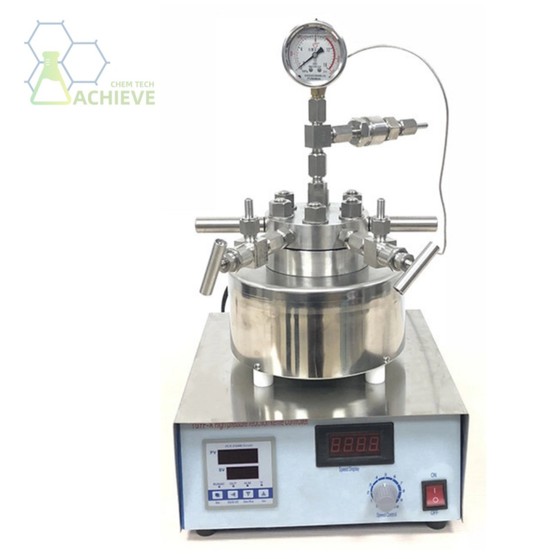
High Pressure High Temperature Reactor
2. Volume: 0.1-50L
3. Suitable for alkylation, amination, bromination, carboxylation, chlorination, and catalytic reduction
4. Stainless steel framework
5. Setting Temperature up to 350°C
6. Voltage: 220V 50/60Hz
7. Manufacturer: ACHIEVE CHEM Xi’an Factory
8. 16 years experiences on Chemical Equipment
9. CE and ISO certification
10. Professional shipping
Description
Technical Parameters
High pressure high temperature reactor is a device designed for high pressure and high temperature chemical reaction. It usually consists of pressure-resistant steel layer, heater, cooler, agitator, sensor, safety equipment and so on. In the field of chemistry covers a wide range of areas such as petrochemicals, food and medicine, environmental protection and fine chemicals, etc. Its high efficiency, reliability and safety provide important support for chemical reactions in these fields.

We provide High pressure high temperature reactor, please refer to the following website for detailed specifications and product information.
Product: https://www.achievechem.com/chemical-equipment/high-pressure-high-temperature-reactor.html
Products Introduction
To determine whether a high pressure high temperature reactor can withstand high-pressure and high-temperature conditions, the following considerations and verifications are usually required:
|
◆ Material selection: Choose pressure-resistant materials suitable for working under high pressure and high temperature conditions, such as pressure-resistant steel. For specific reaction conditions, it is necessary to ensure that the material has sufficient tensile strength, heat resistance and corrosion resistance.
◆ Pressure vessel design: Design and calculate the pressure vessel according to the expected maximum pressure and temperature. This includes determining the wall thickness of the container, the support and connection mode of the internal structure of the container, etc. The design process usually follows the relevant international or industrial standards, such as ASME (american society of mechanical engineers) code.
◆ Strength calculation: The strength of the container is evaluated through the calculation of stress and deformation. This includes stress analysis, fatigue life analysis and consideration of thermal expansion effect of different parts. The calculation process can be simulated and verified by engineering software such as finite element analysis (FEA).
◆ Safety valve and protection device: Safety valve is set on the high-pressure laboratory reactor to release excessive pressure, and other protection devices, such as overflow device, temperature sensor and emergency stop device, need to be considered.
◆ Experimental verification: Before the actual operation, a series of experimental verification, such as pressure test, temperature cycle test and safety performance test, are needed to ensure that the high-pressure reactor can work stably and reliably. |
|
Products Parameter
TGYF Desktop High Pressure Reactor
|
Model |
AC1231-A0.05 |
AC1231-A0.1 |
AC1231-A0.25 |
AC1231-A0.5 |
AC1231-B0.05 |
AC1231-B0.1 |
AC1231-B0.25 |
AC1231-B0.5 |
AC1231-C0.05 |
AC1231-C0.1 |
AC1231-C0.25 |
AC1231-C0.5 |
|
Capacity (L) |
0.05 |
0.1 |
0.25 |
0.5 |
0.05 |
0.1 |
0.25 |
0.5 |
0.05 |
0.1 |
0.25 |
0.5 |
|
Stirring Method |
Magnetic Stirring |
Mechanical Stirring |
||||||||||
|
Setting Pressure (MPa) |
22 |
|||||||||||
|
Setting Temperature (°C) |
350 |
|||||||||||
|
Stirring Speed (r/min) |
0~2000 |
0~1800 |
1800 |
|||||||||
|
Heating Power (KW) |
0.6 |
0.6 |
0.8 |
1.5 |
0.6 |
0.6 |
0.8 |
1.5 |
0.6 |
0.6 |
0.8 |
1.5 |
Products Features
Mechanical stirring and magnetic stirring are two common stirring methods, and there are some differences between them in realizing stirring effect and application scenarios.
|
|
◆ Principle: Mechanical stirring is to provide mechanical energy through mechanical equipment (such as stirrers, paddles, etc.), and transfer the energy to the liquid or mixture to make it flow and stir. Magnetic stirring is to use the magnetic field generated by a rotating magneton (magneton) with magnetic force to drive the magneton to rotate in the container through the magnet outside the container, so as to realize the stirring effect. ◆ Stirring mode: Mechanical stirring usually uses rotating stirring devices, such as paddles, scrapers, screws, etc., to shear, stir and mix liquids or mixtures. Magnetic stirring realizes the stirring of liquid by transferring magnetic force through the container wall without direct contact with liquid through magnetic force transfer and eddy current effect. ◆ Operation requirements: Mechanical stirring requires additional mechanical devices and power transmission systems, and usually requires motors or transmission devices to drive the agitator. However, magnetic stirring does not require mechanical parts to enter the liquid, which reduces the pollution and maintenance requirements of the stirred materials. ◆ Application scenario: Mechanical stirring is suitable for most stirring requirements, especially for materials with high viscosity and large particles or reaction processes with certain shear requirements. Magnetic stirring is suitable for environments that require high purity of materials, such as biomedicine, food and cosmetics, because no mechanical parts enter the liquid. |

Knowledge
ASME (american society of mechanical engineers) has formulated a series of specifications and standards, which are applicable to the design, manufacture and operation of high pressure high temperature reactors. The following are some common related specifications:
◆ Asme boiler and pressure vessel code: This code includes many parts, among which Section VIII-Division 1 and Division 2 are usually used for the design of high-pressure and high-temperature reactors. These specifications cover the design, material selection, manufacture, inspection and testing of containers.
◆ Asme b31.3 process piping (ASME b31.3 process piping specification): This specification is applicable to the design and construction of inlet and outlet piping systems of high pressure and high temperature reactors. It includes the calculation of pressure, temperature and other parameters of pipeline system, material selection, welding, supporting and testing.
◆ Asme PCC-1 bolted flange joint assembly: This specification provides guidance for the design, installation, fastening and inspection of bolted flange joints in high pressure and high temperature reactors.
In addition, there are other ASME codes and standards related to high-pressure and high-temperature reactors, including ASME B16.5 (steel flange and flange connection standard), ASME B16.34 (valve specification), ASME PTC 19.3 TW (temperature measurement guide) and so on.
Case Studies
► Case Study 1: Synthetic Diamond Production via HPHT Reactors
Industry: Materials Science
Company: Element Six (De Beers Group)
Objective: Produce industrial-grade diamonds for cutting tools, electronics, and optics.
● Background
Synthetic diamonds are manufactured using HPHT reactors that mimic the geological conditions under which natural diamonds form. Element Six, a leader in superhard materials, employs a belt press reactor design, applying pressures up to 6 GPa and temperatures of 1,400–1,600°C to convert graphite into diamond.
● Process Details
Feedstock Preparation: High-purity graphite is mixed with a metal catalyst (e.g., nickel, cobalt) to lower the diamond formation temperature.
Reactor Setup: The graphite-catalyst mixture is placed in a metal capsule, which is compressed between two anvils in a hydraulic press. Electrical heating elements raise the temperature.
Growth Phase: Diamond crystals nucleate and grow over 24–72 hours. Post-growth, the material undergoes acid treatment to remove the metal catalyst.
● Outcomes
Quality Control: HPHT reactors produce diamonds with controlled size, purity, and orientation, critical for applications like drill bits and semiconductor substrates.
Economics: While energy-intensive, HPHT diamond synthesis is cost-effective for industrial applications due to scalability and consistent quality.
Innovation: Element Six's 2021 partnership with quantum computing firms to develop HPHT-grown diamond defect centers for quantum sensors demonstrates cross-industry applicability.
● Challenges
Equipment Cost: Belt press reactors require multi-million-dollar investments and specialized maintenance.
Energy Consumption: High temperatures demand substantial electrical power, increasing operational costs.
► Case Study 2: Fischer-Tropsch Synthesis for Synthetic Fuels
Industry: Energy
Company: Sasol (South Africa)
Objective: Convert coal and natural gas into liquid hydrocarbons (synthetic fuels).
● Background
Sasol's Secunda plant, the world's largest coal-to-liquids facility, relies on HPHT reactors for Fischer-Tropsch (FT) synthesis. Operating at 20–30 MPa and 200–350°C, the process transforms synthesis gas (CO + H₂) into diesel, gasoline, and waxes.
● Process Details
Gasification: Coal or natural gas is converted into synthesis gas via partial oxidation or steam reforming.
FT Reaction: The gas mixture is fed into a fixed-bed or slurry-phase HPHT reactor containing an iron or cobalt catalyst.
Product Separation: Hydrocarbons are fractionated into fuels, with wax byproducts upgraded via hydrocracking.
● Outcomes
Energy Security: Sasol's plants reduce South Africa's reliance on imported oil, supplying 30% of the nation's fuels.
Efficiency: Modern reactors achieve 60–70% carbon efficiency, a significant improvement over early designs.
Scalability: The Secunda plant processes 45 million tons of coal annually, demonstrating industrial-scale viability.
● Challenges
Carbon Emissions: The process emits 14–18 kg CO₂ per barrel of fuel, necessitating carbon capture and storage (CCS) integration.
Catalyst Deactivation: Sulfur and other impurities in feedstocks poison catalysts, requiring costly purification steps.
► Case Study 3: Hydrothermal Liquefaction of Biomass for Biofuels
Industry: Renewable Energy
Company: Steeper Energy (Denmark)
Objective: Convert woody biomass into bio-crude oil via HPHT hydrothermal liquefaction (HTL).
● Background
HTL mimics natural oil formation by subjecting biomass to 20–30 MPa and 300–370°C in water, breaking down lignocellulosic structures into a liquid phase without prior drying. Steeper Energy's Hydrofaction™ process addresses the challenge of wet biomass processing, where traditional pyrolysis methods are inefficient.
● Process Details
Feedstock Preparation: Woody biomass (e.g., sawdust, agricultural residues) is mixed with water and loaded into an HPHT reactor.
Reaction: At 300°C and 20 MPa, water acts as a solvent, catalyst, and reactant, depolymerizing biomass into bio-crude.
Product Upgrading: The bio-crude is refined into drop-in fuels via hydrotreating.
● Outcomes
Sustainability: The process achieves 70–80% carbon retention in bio-crude, with potential for net-negative emissions when paired with CCS.
Economic Viability: Steeper Energy's 2023 pilot plant in Denmark demonstrated a 30% reduction in biofuel production costs compared to conventional methods.
● Challenges
Feedstock Variability: Biomass composition affects process efficiency, requiring flexible reactor designs.
Water Usage: HTL consumes significant water, posing challenges in water-scarce regions.
► Case Study 4: Hydrogenation of Lignin in HPHT Reactors
Industry: Chemical Processing
Research Institution: Fraunhofer Institute for Chemical Technology (Germany)
Objective: Develop a process to convert lignin (a byproduct of biorefineries) into value-added chemicals.
● Process Details
Reactor Setup: A 500 mL batch HPHT reactor (20 MPa, 250°C) with a palladium-on-carbon catalyst.
Reaction: Lignin is hydrogenated in the presence of hydrogen gas, breaking aromatic rings into cycloalkanes and alkanes.
Product Analysis: GC-MS identified cyclohexane, methylcyclohexane, and decane as primary products.
● Outcomes
Conversion Efficiency: Achieved 85% lignin conversion with 70% selectivity to cycloalkanes.
Scale-Up Potential: The study demonstrated that HPHT conditions accelerate reaction rates, reducing processing time from days to hours.
● Challenges
Catalyst Deactivation: Pd/C catalysts deactivated after 5 cycles due to coke deposition, necessitating regeneration protocols.
Economic Feasibility: The high cost of hydrogen and catalyst regeneration limits large-scale adoption.
Hot Tags: high pressure high temperature reactor, China high pressure high temperature reactor manufacturers, suppliers, factory, Lab Rotary Evaporator, Hydrothermal Synthesis Autoclave Reactor, Hydrothermal Autoclave Reactor With Teflon Chamber 100ml, 5l Glass Reactor, Double Jacketed Glass Reactor, 1l Short Path Distillation Kit
Previous
High Pressure Laboratory ReactorSend Inquiry


