



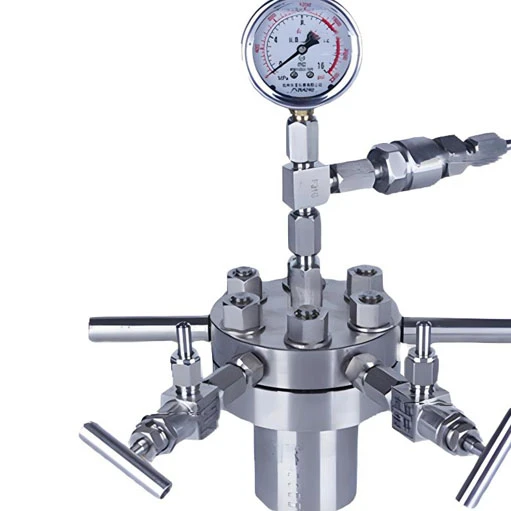
High Pressure Reactor Vessel
2. Volume: 0.1L-50L
3. Suitable for alkylation, amination, bromination, carboxylation, chlorination, and catalytic reduction
4. Stainless steel framework
5. Setting Temperature: 350°C
6. Voltage (V/Hz): 220V 50/60Hz
7. Manufacturer: ACHIEVE CHEM Xi’an Factory
8. 16 years experiences on Chemical Equipment
9. CE and ISO certification
10. Professional shipping
Description
Technical Parameters
High pressure reactor vessel is a kind of equipment used for chemical reaction under high pressure and high temperature.The design purpose of high-pressure reaction kettle is to control the chemical reaction process at high temperature and high pressure,so as to study the reaction kinetics, reaction mechanism and synthesis of new materials.
The autoclave can be used for various hydrogenation reactions.
◆ Hydrogenation: Organic compounds are reacted with hydrogen at high pressure and high temperature,and noble metal catalysts (such as platinum,palladium,ruthenium,etc.) are usually used to convert organic compounds containing double bonds or triple bonds into saturated compounds,such as alcohols,aldehydes,ketones,olefins,etc.
◆ Ammonia synthesis: nitrogen reacts with hydrogen at high pressure and high temperature,and metal catalysts such as iron and molybdenum are used to generate ammonia gas under the action of the catalyst.This is the main method to prepare ammonia in industry.
◆ Dehydroaromatization: Aromatic compounds are reacted with hydrogen at high pressure and high temperature,and transition metal catalysts (such as molybdenum,tungsten,nickel,etc.) are usually used to break the aromatic ring and remove hydrogen to produce corresponding non-aromatic compounds.
◆ Carbonyl reduction: organic compounds containing carbonyl groups (ketones,aldehydes,acids,etc.) react with hydrogen at high pressure and high temperature,and the carbonyl groups are reduced to corresponding alcohols or aldehydes by catalysts (such as iron and palladium).
◆ Reduction of organic nitrogen compounds: organic nitrogen compounds containing amino groups (–-NH2),imino groups (–NR) and nitrile groups (–CN) react with hydrogen at high pressure and high temperature,and are reduced to corresponding amines or imines by using appropriate catalysts (such as palladium and platinum).

We offer this product, please refer to the following website for detailed specifications and product information.
Product: https://www.achievechem.com/chemical-equipment/high-pressure-reactor.html
Products Parameter
CJF Series High Pressure Stirred Autoclave/Reactor
|
Model |
AC1232-0.05 |
AC1232-0.1 |
AC1232-0.25 |
AC1232-0.5 |
AC1232-1 |
AC1232-2 |
AC1232-3 |
AC1232-5 |
AC1232-10 |
AC1232-20 |
AC1232-30 |
|
Capacity (L) |
0.05 |
0.1 |
0.25 |
0.5 |
1 |
2 |
3 |
5 |
10 |
20 |
30 |
|
Setting Pressure (MPa) |
22 |
||||||||||
|
Setting Temperature (°C) |
350 |
||||||||||
|
Accuracy of Temperature Control (°C) |
±1 |
||||||||||
|
Heating Method |
General electric heating,others are far-infrared,thermal oil,steam,circulating water,etc. |
||||||||||
|
Stirring Torque (N/CM) |
120 |
||||||||||
|
Heating Power (KW) |
0.6 |
0.8 |
1.5 |
2 |
2.5 |
4 |
7 |
10 |
|||
|
Temperature Controller |
Real-time display and adjust the speed,temperature,time,with standard PID automatic temperature adjustment meter. |
||||||||||
|
Working Environment |
Ambient Temperature 0-50°C,Relative Humidity 30-80%. |
||||||||||
|
Voltage (V/Hz) |
220 50/60 |
||||||||||
- No lifting device;
- Meet safety standard;
- Ceramic liner or PTFE liner (optional);
- Bottom drain valve is available (optional);
- Material cooling and magnetic stirrer cooling are standard configuration;
- We can add safety valve,drain valve and receiver;
- Big capacity can be customized as your demands;
- Customized configuration is available.
 |
 |
 |
 |
Required materials
As a key component of the nuclear reactor, the material selection of the equipment is directly related to the safety and stability of the reactor. These materials not only need to withstand extremely high pressures and temperatures, but also must have excellent corrosion resistance, radiation resistance and good mechanical properties. Below is a detailed analysis of the materials used in high-pressure reactor vessels:
Overview of the reactor vessel
A reactor vessel, also known as a reactor pressure vessel, is a closed vessel that houses a nuclear reactor and withstands its enormous operating pressure. It contains the reactor's active area and other essential equipment and is one of the most critical safety barriers in a nuclear power plant. The structure of the reactor vessel varies with different pile types, but it is usually composed of the container body and the top cover, the container body is welded by the lower flange (including the nozzle section), the cylinder and the hemispherical lower head, and the top cover is welded by the hemispherical upper head and the upper flange (or the integrated top cover).
Commonly used materials for high-pressure reactor vessels
Steel pressure vessel material
Steel pressure vessels are the most common type of high-pressure reactor vessels, with a wide selection of materials, including a variety of low-alloy high-strength steels and special alloy steels.
SA508 Series steel: SA508 steel is a low alloy high strength steel widely used in nuclear reactor pressure vessels. It has good mechanical properties and welding properties, and can meet the high requirements of reactor materials. SA508 series steel can obtain different microstructure and mechanical properties after different heat treatment processes to adapt to different reactor operating conditions. For example, SA508-Ⅲ steel has excellent impact toughness and radiation resistance after specific heat treatment, which is suitable for reactor pressure vessels under high pressure, high temperature and strong radiation environment.
16MND5 steel: 16MND5 is a Mn-Ni-Mo type low alloy steel with high strength, good toughness and heat resistance. It is mainly used in nuclear power engineering evaporator, pressure regulator, pressure vessel and head, support components and other key equipment manufacturing. 16MND5 steel can maintain stable mechanical and chemical properties at high temperatures and is not prone to oxidation or corrosion. In addition, it also has good welding performance and radiation resistance, and can maintain stable performance in a nuclear radiation environment.
20MnMoNi55 steel: This material can provide high tensile strength and yield strength, to ensure that under the complex working conditions of the reactor pressure vessel, the fasteners can withstand greater tension and stress, and maintain the reliability and stability of the connection. At the same time, it also has good toughness, high temperature performance and excellent chemical properties (such as corrosion resistance), and can adapt to the working environment of the reactor pressure vessel.
Prestressed concrete pressure vessel materials
Prestressed concrete pressure vessel is another important type of high pressure reactor vessel, which is mainly used in specific types of nuclear reactors such as gas cooled reactors. The materials of prestressed concrete pressure vessel mainly include concrete and prestressed steel bundle.
Concrete: The concrete used in prestressed concrete pressure vessels is usually concrete with high strength, low shrinkage and low creep. This concrete has excellent mechanical properties and durability, and can withstand pressure under high pressure and high temperature environments. At the same time, the concrete also has good thermal insulation properties, which can effectively prevent the heat transfer inside the reactor.
Prestressed steel bundles: Prestressed steel bundles are the main bearing members in prestressed concrete pressure vessels. It is made of high-strength steel wire or steel strand, which is tensioned and anchored on the wall and head of the container drum to form a prestressed system. The prestressed steel bundle is able to withstand the enormous pressure inside the container and transfer it to the external structure of the container. Due to the large number of prestressed steel bundles (nearly a thousand), even if the individual steel bundles are damaged, it will not affect the stress state of the entire container, so it has a high degree of safety.
The relationship between material selection and reactor type
Different reactor types have different requirements for the material selection of the equipment.For example, light water reactors (including pressurized water reactors and boiling water reactors) usually use steel pressure vessels, because steel pressure vessels have good mechanical properties and welding properties, and can meet the high requirements of light water reactors for materials. The gas cooled reactor is more inclined to use the prestressed concrete pressure vessel, because the prestressed concrete pressure vessel has better thermal insulation performance and higher safety.
The importance and challenge of material selection
The material selection of high pressure reactor vessel is very important to the safety and stability of the reactor. If the material is improperly selected or has defects, it may cause the container to break or leak under high pressure, high temperature and strong irradiation environment, resulting in serious nuclear accidents. Therefore, in the process of material selection, it is necessary to fully consider the mechanical properties of materials, corrosion resistance, radiation resistance and manufacturing and welding processes.
However, material selection also presents many challenges. For example, as reactor power increases and operating conditions deteriorate, so do the requirements for materials. At the same time, different reactor types have different restrictions and requirements on the selection of materials. Therefore, a lot of testing and research work is required during the material selection process to ensure that the selected material can meet the demanding requirements of the reactor.
operation Tips
When using this device, it is very important to ensure safety. The following are some safety matters in the use of high-pressure reactors:

◆ Familiar with the operation manual: Before operating the autoclave,read and understand the operation manual in detail,and be familiar with the usage, precautions and safe operation steps of the equipment.
◆ Preparation of working environment:Ensure that the working environment is clean and tidy,and maintain proper ventilation.Avoid operating around inflammable,explosive or dangerous chemicals.
◆ Personal protective equipment: Wear appropriate personal protective equipment,such as laboratory uniforms,protective glasses,acid alkali resistant gloves,etc.,to protect skin and eyes from chemical substances.
Risks that will be faced during operation
◆ Design defect risk
Design defect is one of the important sources of safety risk of high pressure reactor vessel. Unreasonable structural design,improper material selection and insufficient safety margin may lead to safety accidents such as rupture and leakage of high-pressure reactor vessels under pressure. Therefore,when designing and manufacturing high-pressure reactor vessels,it is necessary to strictly comply with national and industry standards and specifications to ensure the structural rationality,material applicability and safety and reliability of the vessels.
◆ Risk of operation error
Operation error is also an important factor in the safety risk of high-pressure reactor vessels. Operators are not familiar with the use rules of high-pressure reactor vessels,misoperation,illegal operation,etc.,may lead to safety accidents. For example,misfeeding (including excessive feed speed,out of control ratio,or wrong sequence) can lead to rapid exothermic reaction,heat accumulation causing local overheating,decomposition,or even explosion. Therefore,for the operators of high-pressure reactor vessels,strict training and assessment must be carried out to ensure that they are proficient in vessel operating procedures and safety knowledge. At the same time,a sound operating procedure and safety management system should be established to regulate the behavior of operators.
◆ Material aging risk
Long-term exposure to harsh environments such as high pressure and high temperature will lead to reduced performance and accelerated aging of container materials,which will increase the risk of safety accidents such as container rupture and leakage. For example,in high temperature and high pressure environments,damage such as creep and fatigue may occur to container materials,resulting in a significant decline in material strength and toughness. Therefore,for high-pressure reactor vessels,material performance testing and safety assessment must be conducted regularly to discover and deal with material aging problems in time. At the same time,the maintenance and maintenance of the container should also be strengthened to extend its service life.
◆ External environmental risks
High-pressure reactor vessels may also face external environmental risks,such as physical damage to the container from natural disasters (such as earthquakes,floods,etc.),and threats from external fire sources or high temperature environments to flammable and explosive materials in the container. These risks can lead to serious safety incidents such as container rupture,leakage or explosion. Therefore,it is necessary to strengthen the safety supervision and management of high-pressure reactor vessels to ensure their safe operation.
◆ Other risks
In addition to the above four aspects,high-pressure reactor vessels may also face other safety risks,such as increased safety risks caused by aging or damage to equipment,safety accessories (such as safety valves,burst disks,pressure gauges,etc.) failure to release pressure in time or provide accurate parameters. These risks may pose a threat to the safe operation of high-pressure reactor vessels.
Safety margin
Definition and calculation
Definition
The safety margin reflects the size of the strength reserve of the container when it is under pressure,that is,how much additional load the container can withstand without damage after reaching the design load.
Calculation
Safety margin = (maximum failure load - design load)/design load. Among them,the maximum damage load is the maximum load that the container can bear under the limit conditions,and the design load is the load that the container can bear under normal working conditions.
Significance
Ensure safety
The existence of a safety margin can ensure that the container has an adequate safety reserve when it is subjected to the design load,even in extreme cases,it can guarantee the structural integrity and tightness of the container,and prevent the leakage of radioactive materials.
Improve reliability
By reasonably setting the safety margin,the reliability and service life of the high-pressure reactor vessel can be improved,and the risk of safety accidents caused by factors such as material aging and fatigue can be reduced.
Optimal design
The setting of the safety margin can also provide a basis for the optimal design of the container. Under the premise of ensuring safety,by adjusting the design load and safety margin reasonably,the structure and material selection of the container can be optimized,and the manufacturing cost can be reduced.
Influencing factor
Material properties
The material properties of the container directly affect its maximum damage load. High-strength,corrosion-resistant materials can significantly increase the carrying capacity of the container,thereby increasing the safety margin.
Structural design
The structural design of the container is also an important factor affecting the safety margin. Reasonable structural design can optimize the load distribution and improve the overall strength and stability of the vessel.
Manufacturing process
The quality of the manufacturing process will also affect the safety margin of the container. A good manufacturing process ensures dimensional accuracy,surface quality and internal defect control of the container,thereby increasing its carrying capacity.
Operating environment
The operating environment of the container (such as temperature,pressure,radiation,etc.) will also have an impact on its safety margin. In harsh environments such as high temperature and high pressure,the material properties and structural stability of the container may decrease,resulting in a reduced safety margin.
Application and evaluation
Application
In the design and manufacture process of high pressure reactor vessel,the safety margin should be set reasonably according to the actual situation. This includes considering multiple factors such as the material properties of the container,structural design,manufacturing process,and operating environment.
Assessment
Regular assessment of the safety margin of the high-pressure reactor vessel is an important measure to ensure its safe operation. The evaluation includes the inspection and testing of the material properties,structural integrity,sealing performance,etc.,as well as the adjustment and optimization of the safety margin based on the test results.
Hot Tags: high pressure reactor vessel, China high pressure reactor vessel manufacturers, suppliers, factory, Rotary Evaporator Distillation, Laboratory Rotary Evaporator, High Pressure High Temperature Reactor, Hydrothermal Reactor Autoclave, High Pressure Lab Reactor, Rotovap Machine
Send Inquiry


