


How Is The Chemical Reaction Carried Out in A Hydrothermal Synthesis Autoclave?
Feb 07, 2025
Leave a message
As an important laboratory equipment, hydrothermal synthesis autoclave has a wide application prospect in chemistry, material science, life science and other fields. Its unique working principle and structural characteristics make it able to promote the chemical reaction under high temperature and pressure conditions, and obtain products that are difficult to obtain at normal temperature and pressure. In the future, with the continuous development of science and technology and the constant change of experimental needs, the structure and function of hydrothermal synthesis autoclave will also continue to improve and upgrade, providing more efficient and convenient experimental means for scientific research. At the same time, we also hope that more researchers can use this equipment to carry out innovative research work, and promote the continuous development of chemistry, materials science and other fields.
We provide hydrothermal synthesis autoclave, please refer to the following website for detailed specifications and product information.
Product:https://www.achievechem.com/chemical-equipment/hydrothermal-synthesis-autoclave-reactor.html
The basic principle of hydrothermal synthesis autoclave
The basic principle of hydrothermal synthesis autoclave is to add reactants and solvents in a closed container, increase the temperature and pressure, so that the reactants can carry out chemical reactions under hydrothermal conditions. This reaction method takes advantage of the special properties of water at high temperature and pressure, such as enhanced polarity, increased solubility, and faster reaction speed, so as to obtain products that are difficult to obtain at normal temperature and pressure.
Structure and function of hydrothermal synthesis autoclave
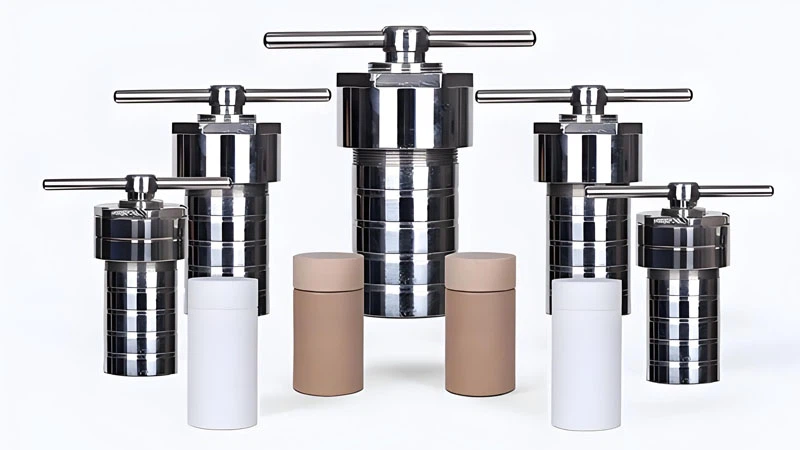
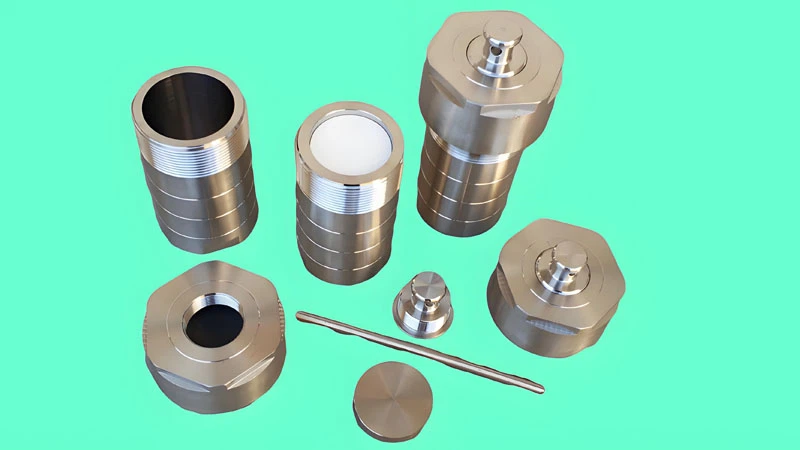
Hydrothermal synthesis autoclave is usually composed of a body, a sealing device, a heating device, a stirring device, a pressure control system and a safety protection device. These components work together to provide a stable, controlled environment for chemical reactions.

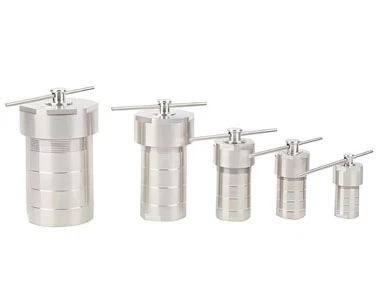
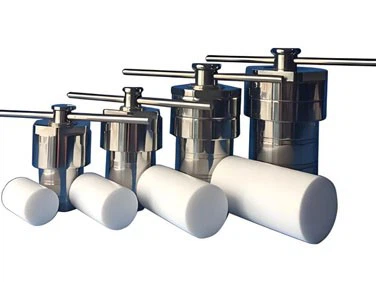
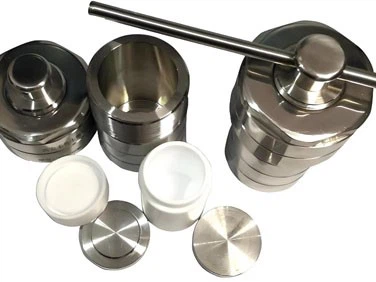
Kettle body: The kettle body is the place where the reaction takes place, usually made of high-strength stainless steel material, which can withstand pressure under high temperature and pressure. The reactor body is provided with a reaction chamber for containing reactants and solvents.
Sealing device: The sealing device is a key component to ensure that the reaction takes place in a closed environment. It is usually made of elastic materials that are resistant to high temperature and pressure, such as polytetrafluoroethylene (PTFE), to ensure that gases and liquids do not leak during the reaction process.
Heating device: The heating device is used to provide the temperature conditions required for the reaction. It usually uses electric heating, and uniformly heats the reactor through the built-in electric heating element. The design of the heating unit takes into account the size and shape of the reactor to ensure uniformity and efficiency of heating.
Stirring device: The stirring device is used to ensure that the reactants are evenly mixed in the reaction chamber to improve the reaction efficiency and product quality. The stirring device is usually composed of a stirring paddle, a motor and a transmission device, etc., which can adjust the mixing speed and direction according to needs.
Pressure control system: The pressure control system is used to monitor and control the pressure in the reactor. It is usually composed of components such as pressure sensors, controllers and actuators, which can precisely adjust the pressure value in the reactor according to the preset pressure range and experimental requirements.
Safety guard: Safety guard is used to ensure the safety of the experimenter during operation. It usually includes explosion-proof devices, emergency stop buttons, safety shields and other components to protect the experimental personnel from injury in emergency situations.
Chemical reaction process in hydrothermal synthesis autoclave
In hydrothermal synthesis autoclaves, the chemical reaction usually follows the following steps:
Preparing materials
First, the experimenter needs to weigh the required reactants and solvents and add them to the reactor. The types and proportions of reactants depend on the specific chemical reaction.
Fill the reactor
Load the weighed reactants and solvents into the reactor liner and ensure that the seal is good. During the loading process, attention should be paid to avoid material spatter or leakage to ensure the safety and accuracy of the experiment.
Vacuum and heating pressure
After sealing the reactor, it is necessary to vacuum the reactor to remove air and ensure a high pressure environment. Subsequently, the heating device is started to heat the reactor and gradually increase the pressure. The speed and extent of heating and pressurization need to be determined according to the specific chemical reaction to avoid adverse effects on the reaction.
Reaction progress
After reaching the preset temperature and pressure, the reactants will undergo chemical reaction under hydrothermal conditions. During the reaction process, the stirring device will ensure that the reactants are evenly mixed to improve the reaction efficiency and product quality. At the same time, the pressure control system will monitor and adjust the pressure value in the reactor in real time to ensure the stability of the reaction.
Cooling decompression and product extraction
After the reaction is complete, the reactor needs to be gradually cooled and pressure relieved slowly. The rate of cooling and pressure relief needs to be properly controlled to avoid damage to reaction products or equipment. After cooling and pressure relief is complete, the reactor can be safely opened and the product removed for subsequent processing and analysis.
Types of chemical reactions in hydrothermal synthesis autoclaves
Hydrothermal synthesis autoclaves are suitable for many types of chemical reactions, including but not limited to the following:
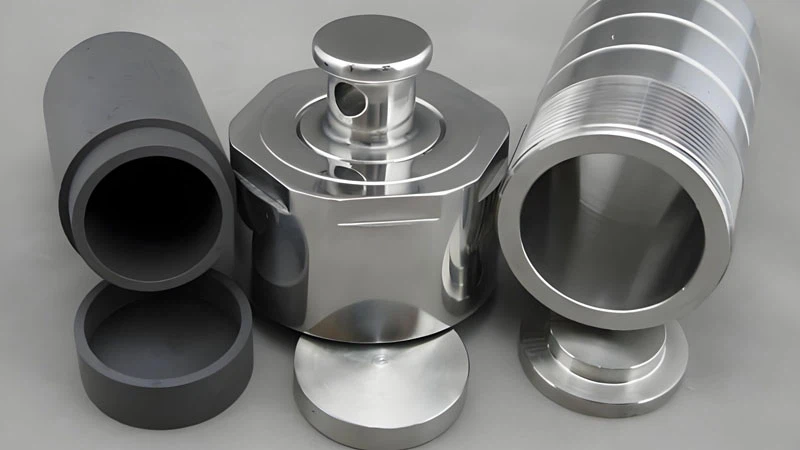
Hydrothermal synthesis reactions
Hydrothermal synthesis reactions are one of the most common types of reactions in hydrothermal synthesis autoclaves. It uses the special properties of water at high temperature and pressure, such as increased solubility and faster reaction speed, to promote the synthesis and conversion of reactants. For example, in the process of preparing nanomaterials, hydrothermal synthesis reactions can be used to obtain nanoparticles with specific morphologies and sizes.
Hydrogenation
Hydrogenation is a reaction in which hydrogen atoms are added to the unsaturated bonds of an organic compound in the presence of a catalyst. When hydrogenation reaction is carried out in hydrothermal synthesis autoclave, the solubility of hydrogen in the reaction system can be increased by increasing the pressure, thus increasing the reaction rate. This type of reaction is widely used in the field of oil hydrogenation to prepare hardened oil.

Polymerization
Polymerization is the synthesis of polymers from monomers. When polymerization is carried out in hydrothermal synthesis autoclave, the reaction rate can be adjusted by controlling the pressure and temperature, and a suitable reaction environment can be provided for some polymerization reactions. For example, in the reaction of ethylene polymerization to produce polyethylene, high molecular weight polyethylene products can be obtained by hydrothermal synthesis autoclave.
Carbonylation
A carbonylation reaction is a reaction in which a carbonyl group (C=O) is introduced into an organic compound molecule. In the carbonylation reaction in hydrothermal synthesis autoclave, high temperature and high pressure can be used to promote the activation and transformation of reactants. This type of reaction is widely used in the carbonylation of methanol to acetic acid and other fields.
Advantages and challenges of hydrothermal synthesis autoclave
Hydrothermal synthesis autoclave has significant advantages in chemical reactions, such as mild reaction conditions, high product purity, and fast reaction speed. However, it also has some challenges and limitations, such as high equipment cost, complex operation, and sensitivity to reaction conditions. Therefore, when using hydrothermal synthesis autoclave for chemical reaction, it is necessary to fully consider the experimental requirements and equipment performance to select the appropriate reaction conditions and operation mode.