



Hydrothermal Synthesis Autoclave Reactor
(1)25ml/50ml/100ml/150ml/200ml/250ml/300ml/400ml/500ml/1000ml---PTFE/≤ 220°C
(2)25ml/50ml/100ml/150ml/200ml/250ml/300ml/400ml/500ml/1000ml---PPL/≤ 280°C
***Price List for whole above, inquire us to get
2. Customization:
(1)Design support
(2)Directly supply the Senior R&D organic intermediate, shorten your R&D time and cost.
(3)Share the advanced purifying technology with you
(4)Supply the high quality chemicals and analysis reagent
(5)We want to assist you on Chemical Engineering (Auto CAD, Aspen plus etc.)
3. Assurance:
(1)CE and ISO certification Registered
(2)Trademark: ACHIEVE CHEM(since 2008)
(3)Replacement parts within 1-year for free
Description
Technical Parameters
Hydrothermal synthesis autoclave reactor is a closed container that can decompose insoluble substances. Can be used for sample pretreatment in atomic absorption spectroscopy and plasma emission analysis; It can also be used for small dose synthesis reactions; The purpose of quickly digesting insoluble substances can also be achieved by utilizing a sealed environment with strong acids or alkalis inside the tank and high temperature and pressure. Perform sample pre-treatment in chemical analysis methods such as gas phase, liquid phase, plasma spectral mass spectrometry, atomic absorption, and atomic fluorescence. It is a powerful assistant for digesting samples when determining trace elements and trace elements. It can be applied in the determination of heavy metals such as lead, copper, cadmium, zinc, calcium, manganese, iron, mercury, etc. It can also be used as a high-temperature, high-pressure, corrosion-resistant, high-purity reaction vessel, as well as in organic synthesis, hydrothermal synthesis, crystal growth, or sample digestion extraction. Digest heavy metals, agricultural residues, food, sludge, rare earths, aquatic products, organic matter, etc. before sample preparation. Therefore, it is widely used in research and production in departments such as petrochemical, biomedical, materials science, geochemistry, environmental science, food science, and commodity inspection.

Introduction
Constructions
Good corrosion resistance, no harmful substance overflow, reduced pollution, and safe use.
01
After heating and boosting, it can quickly and non-destructive dissolve samples that are difficult to dissolve under conventional conditions and samples containing volatile elements.
02
Beautiful appearance, reasonable structure, simple operation, shortened analysis time, and reliable data.
03
There is a polytetrafluoroethylene liner inside, which provides care and resistance to acids, alkalis, etc.
04
It can replace platinum crucibles to solve the problem of sample dissolution in the analysis of trace elements in high-purity alumina.
05
The high-pressure digestion tank used in the oven, also known as a sampler, pressure bomb, hydrothermal synthesis reactor, digestion tank, and polytetrafluoroethylene high-pressure tank, is a powerful assistant for digesting samples when determining trace elements and trace elements. Sample pre-treatment digestion of heavy metals, agricultural residues, food, sludge, rare earths, aquatic products, organic matter, etc.

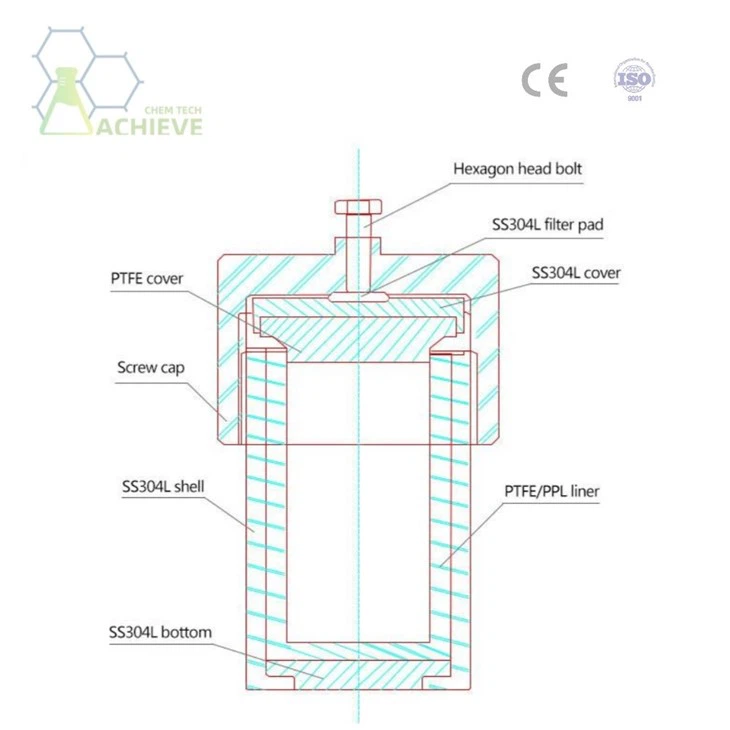
The kettle body is made of 304 high-quality stainless steel, sealed with circular tenons and grooves, and the manual screw is sturdy. It has good sealing performance, high safety factor, low consumption of acid and solvents, and is easy to use! The inner liner material is polytetrafluoroethylene (PTFE, abbreviated as F4).
High temperature resistance:
Operating temperature -200~+220 ℃
Low temperature resistance:
-196 ℃ can maintain 5%
Corrosion resistance:
Resistant to strong acids, alkalis, aqua regia, and various organic solvents
Insulation resistance:
The dielectric performance is independent of temperature and frequency
High lubrication:
Solid materials have the lowest friction coefficient
Non adhesion:
Do not adhere to any substance; Strong self wetting: friction coefficient of 0.04 in solid materials
Non toxic:
It has physiological inertia and can be implanted into the human body; Aging resistance can be used in the atmosphere for a long time
Pollution prevention:
Low blank value of metal elements, lead content less than 10-11 g/ml, uranium content less than 10-12 g/ml
Leakage prevention:
If dropped from a height of 1.2 meters above the ground, the bottle body will not break, the bottle cap will not fall off, and there will be no damage or leakage
Hydrothermal synthesis reactor for para polyphenylene:
- High temperature resistance of aligned polystyrene material: operating temperature -200~+250 ℃
- Made from high-temperature sintering and cooling to produce strong acid, alkali, and aqua regia organic solvents
- Better performance than PTFE products in terms of high-temperature resistance
- Extreme craftsmanship, dark brown color, no surface cracks, beautiful appearance
Parameters

cleaning steps

Hydrothermal synthesis autoclave reactor is a high-efficiency, high-pressure, and high-temperature reaction equipment widely used in various chemical reactions and industrial production. However, during use, various chemical substances and impurities may remain in the kettle. In order to ensure the normal use of the equipment and extend its service life, it is necessary to regularly clean the hydrothermal synthesis high-pressure kettle. The following are the cleaning steps for the high-pressure kettle of hydrothermal synthesis:
- Confirm that there is no residual pressure inside the kettle and open the kettle cover.
- Check the kettle body and lid for damage or leakage, and promptly repair or replace them.
- Empty the remaining chemical substances and impurities inside the kettle, including the sediment at the bottom of the kettle and the residue inside the kettle.
- Prepare cleaning tools and agents to ensure that the equipment and materials required during the cleaning process are complete.
- Rinse the inner wall of the kettle with water to remove dirt and residue from the surface.
- Use a soft brush and detergent to further clean the inner wall of the kettle, thoroughly removing difficult to remove dirt and residue.
- If necessary, some powerful detergents can be used, but it is necessary to ensure that they do not damage the kettle body and lid.
- During the cleaning process, the kettle should be kept moist to avoid water droplets or residue.
- Open the drain valve at the bottom of the bus to discharge the sewage.
- Rinse the bottom of the pot with water to remove sediment and debris.
- If there is dirt that is difficult to remove, it can be treated by soaking or rinsing.
- After confirming that the bottom of the kettle is clean, close the discharge valve.
- Check the sealing surfaces of the kettle cover and kettle body to confirm if there is any damage or residue.
- Use a soft brush and detergent to clean the sealing surface, thoroughly removing residue and dirt.
- If necessary, rinse the sealing surface with water, but keep the sealing surface moist.
- After cleaning, check whether the sealing surface is flat and smooth. If there are any problems, repair or replace them.
- Check the pipes and connections for residue and dirt, and if necessary, clean them with cleaning agent and water.
- For pipelines and connecting parts that are difficult to clean, appropriate mechanical methods or high-pressure water guns can be used for cleaning.
- Ensure that the pipes and connections are clean and free of foreign objects to avoid blockage or leakage during operation.
6. Drying and inspection
- Dry the inner wall and sealing surface of the kettle with a clean cloth to ensure that there are no water droplets or residue.
- Close the kettle cover and inspect the kettle body and lid for leaks or damage. If there are any problems, repair or replace them.
- During the drying process, the discharge valve at the bottom of the kettle can be opened to allow natural ventilation and drying inside the kettle.
- After drying, open the kettle cover and check if the inside of the kettle is completely dry. If necessary, wipe it again with a cloth.
7. Record and Maintenance
- Record the cleaning process, including cleaning time, materials used, and methods.
- Plan equipment maintenance, including regular inspections, maintenance, and repairs.
- Summarize and analyze the problems found during cleaning and use, and propose improvement measures and suggestions.
In summary, the cleaning steps of the hydrothermal synthesis high-pressure kettle include preparation work, cleaning the inner wall of the kettle, cleaning the bottom of the kettle, cleaning the sealing surface, cleaning the pipeline and connecting parts, drying and inspection, as well as recording and maintenance. During the cleaning process, attention should be paid to details, cleanliness should be maintained, and safety should be ensured to extend the service life of the equipment and improve its efficiency.
Related Operations
The hydrothermal synthesis autoclave reactor is a commonly used equipment in chemical laboratories. It uses a high-temperature and high-pressure aqueous solution environment to dissolve or react insoluble substances to produce corresponding dissolved products, and controls the temperature difference of the solution to form a supersaturated state, thereby precipitating growth crystals. This device is widely used in the preparation of nanomaterials, compound synthesis, crystal growth, and other fields.
Sealed reaction vessel
Place the PTFE liner or PPL liner inside the stainless steel jacket, ensuring that the lower gasket of the kettle body is in the correct position (with the protrusion facing downwards), and then insert the upper gasket.
First manually tighten the kettle cover, then use screws to twist and tighten the kettle cover until it can no longer rotate. Pay attention to applying even force when rotating to avoid damaging the threads.
Before each use, an appropriate amount of graphite powder can be applied to the threads to lubricate and prevent thread adhesion at high temperatures.
Equipment inspection
Check whether the hydrothermal synthesis high-pressure reactor is intact, especially whether there are cracks, deformations, or aging phenomena in key components such as the reactor body, lid, and sealing ring.
Check whether the controller, temperature sensor, pressure sensor and other instruments are connected correctly and in normal working condition.
Ensure that all wires (including power lines, electric furnace wires between the controller and the kettle, motor wires, temperature sensor and speedometer wires) are securely connected without exposure or damage.
Material preparation
According to the experimental requirements, accurately calculate and prepare the required reactants and solvents. Pay attention to the purity and dosage of the materials to ensure compliance with experimental standards.
Pour the reactants into a clean PTFE liner or PPL liner, and ensure that the total volume of the feed is less than 80% of the liner volume, leaving enough space for the gas generated during the reaction process to expand.
The hydrothermal synthesis autoclave reactor is a versatile piece of equipment widely utilized in materials science, chemistry, and nanotechnology for synthesizing various materials under high-pressure and high-temperature conditions. This reactor mimics the natural processes occurring within the Earth's crust, where minerals form under hydrothermal conditions.
The core component of this reactor is a sealed vessel, typically constructed from corrosion-resistant materials such as stainless steel or Hastelloy, capable of withstanding pressures up to several hundred atmospheres and temperatures exceeding the boiling point of water. Inside this vessel, reactants are suspended in an aqueous solution, which is then heated and pressurized to facilitate chemical reactions that would be otherwise unattainable under ambient conditions.
The autoclave reactor allows for precise control over the reaction environment, including temperature, pressure, and reaction time, enabling researchers to tailor the synthesis conditions to produce materials with specific properties. It is particularly suited for the preparation of complex oxides, zeolites, ceramics, nanomaterials, and other advanced materials, where subtle changes in synthesis parameters can significantly impact the final product's structure, morphology, and functionality.
Hot Tags: hydrothermal synthesis autoclave reactor, China hydrothermal synthesis autoclave reactor manufacturers, suppliers, factory, Laboratory Rotary Evaporator, Teflon Lined Stainless Steel Autoclave, Glass Reactor Laboratory, Rotovap Machine, 20l Rotary Evaporator, Crystallization Reactor
Previous
Rotary DistillationNext
Rotating EvaporatorSend Inquiry


