





Chemglass Jacketed Reactor
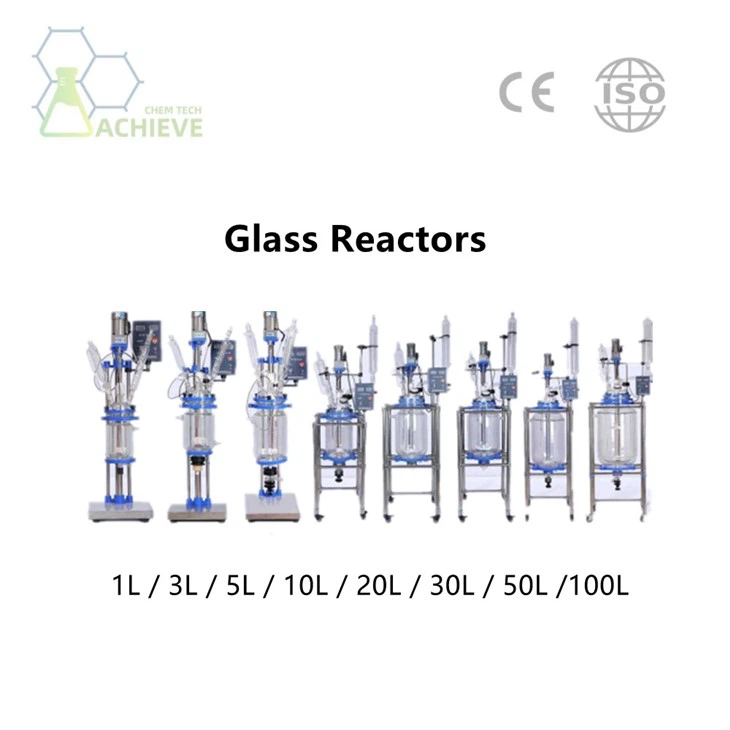
(1)1L/2L/3L/5L---Standard
(2)10L/20L/30L/50L/100L---Standard/EX-proof/Lifting Kettle
(3)150L/200L---Standard/EX-proof
***Price List for whole above, inquire us to get
2. Customization:
(1)Design support
(2)Directly supply the Senior R&D organic intermediate, shorten your R&D time and cost
(3)Share the advanced purifying technology with you
(4)Supply the high quality chemicals and analysis reagent
(5)We want to assist you on Chemical Engineering (Auto CAD, Aspen plus etc.)
3. Assurance:
(1)CE and ISO certification Registered
(2)Trademark: ACHIEVE CHEM(since 2008)
(3)Replacement parts within 1-year for free
Description
Technical Parameters
A chemglass jacketed reactor, also known as a double-layer glass reactor or a jacketed glass reactor, is an experimental device designed for various operations such as chemical reactions, mixing, heating, and cooling.
It consists of a double-layer glass structure, with the inner layer housing the reaction medium for stirring and reacting, while the outer jacket allows for the circulation of different thermal media (such as chilled water, hot water, or heating oil) to enable high- or low-temperature reactions.
The reactor's jacket serves as a heat exchanger, facilitating the transfer of heat to or from the reaction medium. This allows precise control over the reaction temperature, which is crucial for optimizing reaction rates and product quality. Additionally, the transparent glass material allows for direct observation of the reaction process, enhancing safety and facilitating real-time monitoring.

What Sizes We Have?


What's the Construction?

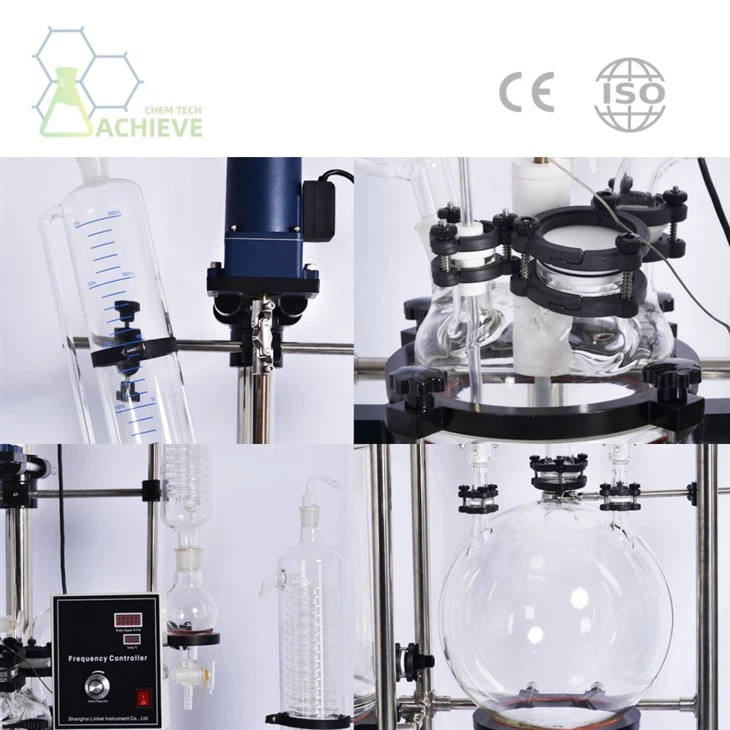
♦ Motor: Low-speed booster motor and reducer are used to ensure that the equipment can perform stirring work for a long time. In addition, according to user needs, you can choose to use explosion-proof motors or DC brushless motors.
♦ Constant pressure dropping funnel: Equipped with high-vacuum PTFE hand valve, which can ensure that the internal pressure remains constant, and has the function of preventing suction.
♦ Universal joint: The universal joint has the function of changing the angle for power transmission, connecting the motor and the stirring rod, so that the stirring function of the equipment is more stable.
♦ Stirring rod: made of polytetrafluoroethylene, high temperature resistance, corrosion resistance, acid and alkali corrosion resistance.
♦ Stirring seal: PTFE component plus mechanical component double seal, ceramic bearing.
♦ Vacuum gauge: monitor the pressure inside the kettle in real time.
♦ Kettle cover: adopt the design of seven openings, which are 60# of the agitator port, DN25 of the temperature sensor port, 50# of the condenser connection ball mill port, 40# of the constant pressure funnel port, 80# of the solid feeding port, and the emptying valve 34#, liquid glue port DN25.
♦ The upper and lower clamps of the kettle lid: play the role of fixing the kettle lid and the kettle body.
♦ Vacuum interlayer: it plays a good role in heat preservation, so that the temperature is not easy to lose.
♦ Circulating fluid interlayer: By connecting low-temperature cooling liquid circulating pump, high and low temperature integrated machine and other equipment that can provide low-temperature or high-temperature circulating liquid, it can heat or cool the experimental materials inside the kettle body.
♦ Aluminum clamps and PTFE gaskets: function to fix the discharge valve and have good sealing performance.
♦ No dead angle discharge valve: make the discharge work clean and thorough, and the detachable design facilitates the discharge of solids, particles and experimental materials with high viscosity.
♦ Empty valve: the protection can prevent the accidental injury of the reactor during the rotation process, and improve the safety of the reactor.
♦ Condenser vacuum port: connect the vacuum pump to reduce the pressure of the condenser, so as to speed up the condensation efficiency of the condenser.
♦ Through cooling water: By connecting the low-temperature cooling liquid circulation pump and other refrigeration cycle equipment to provide low temperature for the condenser and speed up the condensation efficiency of the condenser.
♦ Coil condenser: The double-layer coil design increases the contact area between the condenser and the gaseous material and improves the condensation efficiency.
♦ Silica gel fixing ring: It plays the role of fixing the condenser.
♦ Liquid separator: used to separate liquid from liquid.
♦ Liquid discharge valve: control the discharge of materials in the liquid separator.
♦ Dual display panels for temperature and speed: on the control panel of the whole machine, the temperature and speed will be displayed on the screen in digital form, and the operation is simple and fast.
♦ Vacuum interlayer outlet: used for vacuuming the vacuum interlayer.
♦ Kettle body support pipe fittings: used to fix and support the reactor body.
♦ Circulating fluid interlayer thermal insulation buffer tube: the material is stainless steel bellows and outsourced with high temperature resistant silicone thermal insulation cotton, with good thermal insulation performance.
♦ Stainless steel support frame: all SUS304 stainless steel frame, with better corrosion resistance and heat resistance.
♦ Casters with brakes: easy to move and more flexible to use.
How to Install it?

The installation of a chemglass jacketed reactor requires careful attention to ensure its safe and efficient operation. Here are the general steps for installing a glass jacketed reactor:
Prepare the Workspace: Ensure the workspace is clean and free from any debris or obstacles that could interfere with the installation. It is also important to have all the necessary tools and equipment ready for the installation process.
Position the Reactor: Place the reactor on a stable and level surface. Ensure that the reactor is securely positioned to prevent any movement or tipping during installation or operation.
Connect the Stirrer: Attach the stirrer to the reactor, ensuring that it is properly aligned and securely fixed. This is crucial for efficient stirring and mixing of the reaction medium.
Install the Heating/Cooling System: Connect the tubing for the heating or cooling media to the inlet and outlet ports on the reactor's jacket. Ensure that the connections are tight and leak-free to prevent any loss of thermal efficiency.
Check the Seals: Inspect all the seals and connections for tightness and integrity. Leaks can lead to safety hazards and inefficiencies in the reactor's operation.
Power Connection: Connect the reactor to a power source, following the manufacturer's instructions. Make sure to use the correct voltage and ensure that all electrical connections are safe and secure.
Test the System: Once the reactor is installed, perform a test run to ensure that all components are working properly. This includes checking the stirrer's function, the heating/cooling system's efficiency, and any other associated equipment.
Safety Precautions: Before commencing any operation, ensure that all safety measures are taken, such as wearing protective clothing and eyewear. Also, be aware of any potential hazards associated with the specific reaction or materials being used.
The Origin

♦ Early Glass Instruments
Glass instruments can be traced back to ancient Rome. At that time, glass technology was mainly used to make daily necessities and decorations, such as glass bottles and glass windows. With the continuous development and improvement of technology, glass is gradually used to make experimental instruments.
In the Middle Ages, European scholars began to use glass test tubes for chemical experiments. However, early glass instruments were mainly handmade and varied in shape and size.
♦ The invention of the glass jacketed reactor
In the early 19th century, European chemists began to study how to increase the temperature and pressure of chemical reactions. In this context, German chemist Rudolf Bunsen and French chemist Pierre Dulong independently invented the chemglass jacketed reactor. The core feature of this reactor is that the inner layer is high temperature resistant glass, and the outer layer controls the reaction temperature by heating or cooling medium.
The glass jacketed reactor invented by Bunsen in 1816 has epoch-making significance. He used this reactor to successfully synthesize many previously unsynthesized or difficult-to-obtain chemicals such as ammonia and sodium nitrate. At the same time, he also used the reactor to improve Kastner's alkali production method and increase production efficiency. Dulong's invention is similar to Bunsen's, but the exact time of invention is unknown.
♦ Naming and popularization
Since Bunsen and Dulong's invention made a major contribution to chemical experimental methods and industrial production, their names became the name of the reactor. In English, this reactor is called "Bunsen Burner" or "Bunsen Burner" (Bunsen Burner or Bunsen Furnace).
In Chinese, it is called "Bangsen Furnace" or "Bangsen Burner", and in some places it is simply called "Jacket Furnace".
Daily cleaning and inspection
Daily cleaning
Preparation before cleaning
Before performing routine cleaning, first make sure that the chemglass jacketed reactor has been cooled to room temperature and that there are no chemical reactions left inside. At the same time, prepare the necessary cleaning tools, such as soft brush, sponge, special cleaning agent and pure water.
Disassembly and preliminary cleaning
Remove the reactor from the jacket and remove all removable components such as stirrer, thermometer casing, etc. Use a soft brush or sponge to gently remove dust and stains from the surface. For stains that are difficult to remove, an appropriate amount of special cleaning agent can be used to soak or wipe.
Deep clean
Place the removed parts in a dedicated cleaning tank and use a cleaning agent for deep cleaning. Note that the choice of cleaning agent should be determined according to the material of the reactor and the nature of the stain, and avoid the use of cleaning agents that are corrosive to glass. At the same time, rinse with pure water repeatedly to ensure that the cleaning agent is completely rinsed.
Clean the jacket
The cleaning of the jacket is also important. Use a soft brush or sponge to remove the stain from the inner wall of the jacket and rinse with pure water. If there are difficult to remove stains inside the jacket, you can use the appropriate cleaning agent to soak, but be careful not to let the cleaning agent penetrate into the reactor.
Dry and store
After cleaning, dry the reactor and its components thoroughly to avoid corrosion or rust caused by residual water stains. Store the reactor and its components in a dry, ventilated, dark place, away from direct sunlight or high temperature baking.
 |
 |
 |
 |
Daily inspection
Tightness is one of the key indexes of reactor performance. In daily inspection, all sealing parts of the reactor, such as flanges, seals, bolts, etc. should be carefully checked to ensure that they are intact and securely fastened. If the seal is found to be aged, deformed or worn, it should be replaced immediately.
The normal operation of the agitator is very important for the mixing effect of the reactor. Check whether the blade of the mixer is complete and without deformation, and whether the mixing shaft is flexible and without holding. At the same time, check whether the motor and transmission device of the mixer are running normally, without abnormal noise or vibration.
The accuracy of thermometer and temperature sensor directly affects the precise control of reaction temperature. Check whether the thermometer is intact and undamaged, and whether the reading is accurate. At the same time, check whether the temperature sensor is loose or damaged to ensure that it correctly reflects the temperature inside the reactor.
Jacket and heating device are the key components of reactor temperature control. Check that the jacket is intact and free of cracks or deformation. Check whether the heating device is running normally and there is no abnormal heating or leakage. At the same time, check whether the heater connection line is firm and reliable to avoid safety hazards caused by electrical failures.
In addition to the above key components, other accessories of the reactor should be checked, such as valves, pipes, safety valves, etc. Ensure that it is intact, in good working order and meets safety requirements.
In summary, the daily cleaning and inspection of the chemglass jacketed reactor is an important guarantee to ensure its efficient operation, extend its service life and ensure the safety of the experiment. Through scientific and reasonable cleaning and inspection measures, potential safety hazards can be found and eliminated in time, and the reliability and stability of the reactor can be improved. Therefore, laboratory staff should attach great importance to the daily cleaning and inspection of the reactor to ensure the safety and smooth conduct of the experiment.
Hot Tags: chemglass jacketed reactor, China chemglass jacketed reactor manufacturers, suppliers, factory, 10l Rotovap, Double Layer Glass Reactor, High Pressure Reactor, Rotovap Distillation, Double Jacketed Reactor, 20l Rotovap
Previous
High Pressure Laboratory ReactorSend Inquiry


