




Rotary Distillation
(1)1L/2L---Manual lifting with irony base/Manual lifting with SS base/Electric lifting
(2)3L/5L/10L/20L/30L/50L---Manual Lifting/Electric Lifting
***Price List for whole above, inquire us to get
2. Customization:
(1)Design support
(2)Directly supply the Senior R&D organic intermediate, shorten your R&D time and cost
(3)Share the advanced purifying technology with you
(4)Supply the high quality chemicals and analysis reagent
(5)We want to assist you on Chemical Engineering (Auto CAD, Aspen plus etc.)
3. Assurance:
(1)CE and ISO certification Registered
(2)Trademark: ACHIEVE CHEM(since 2008)
(3)Replacement parts within 1-year for free
Description
Technical Parameters
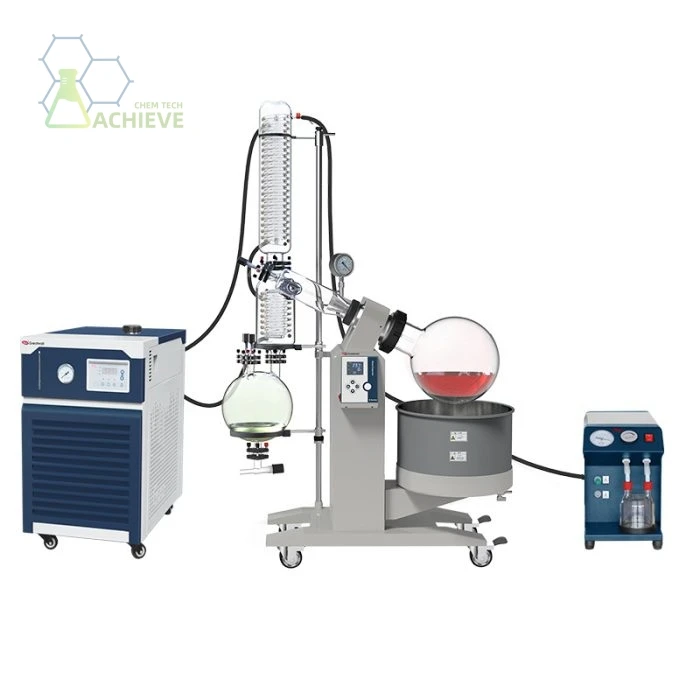
A rotary distillation, commonly referred to as a rotovap, is an essential laboratory instrument used for efficient solvent evaporation and recovery. By harnessing the principles of gentle heating, reduced pressure, and rotation, the rotary evaporator facilitates the separation and collection of desired compounds from liquid samples.
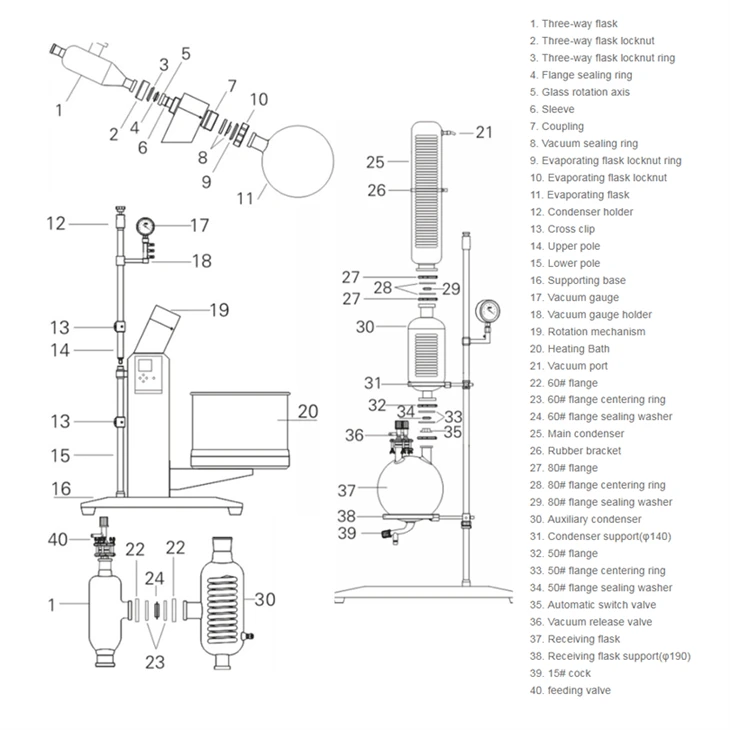
The device consists of a rotating flask, a heated water bath, a condenser, and a vacuum system. During operation, the sample is placed in the flask, which is then rotated in the heated bath. The reduced pressure created by the vacuum system lowers the boiling point of the solvent, allowing it to evaporate at a lower temperature without degrading or damaging the sample. The vapor is subsequently condensed in the condenser and can be collected separately, leaving behind a concentrated solution or purified substance.
The rotary evaporator is widely used in various scientific disciplines, including chemistry, biochemistry, pharmaceuticals, and food science, for tasks such as solvent removal, sample concentration, and solvent recycling. Its versatility, efficiency, and ability to handle heat-sensitive materials have made the rotary evaporator a vital tool in laboratories and research facilities worldwide.

Product Introduction
The rotovap distillation process utilizes the same principles as regular distillation but incorporates the rotational motion of the sample flask. By rotating the flask in a heated bath under reduced pressure, the volatile components with lower boiling points evaporate more efficiently. The vapor is then condensed and collected, while the non-volatile components remain in the flask.
This method is particularly useful for separating heat-sensitive compounds or those with high boiling points. Rotovap distillation finds applications in various industries, including chemistry, pharmaceuticals, and essential oil extraction, where it enables efficient separation, concentration, and purification of desired substances from complex mixtures. This technique has revolutionized the distillation process by providing enhanced control, higher purity, and faster evaporation, making it an indispensable tool for researchers and professionals in the field.

Product Parameter

A rotary distillation, also known as a rotovap or , is a sophisticated laboratory instrument used for efficient solvent evaporation and recovery. It consists of several key components, each with its own parameters and indicators that play a crucial role in the operation and performance of the device.
One of the primary components is the rotating flask, which holds the sample to be evaporated. The flask's capacity, typically measured in liters, determines the volume of liquid that can be processed at a time. The flask rotation speed, measured in revolutions per minute (RPM), controls the level of agitation and affects the efficiency of evaporation. A higher rotation speed can enhance the heat transfer and increase the evaporation rate.
The heated water bath is another essential component of the rotary evaporator. Its temperature range, usually displayed in degrees Celsius (°C), indicates the maximum and minimum temperatures that can be achieved. This parameter is crucial for controlling the solvent's boiling point, ensuring efficient evaporation without overheating or damaging the sample.
The condenser, often cooled by circulating water or a refrigeration unit, facilitates the conversion of the evaporated vapors back into liquid form. The cooling temperature, expressed in degrees Celsius (°C), determines the efficiency of condensation. Lower temperatures provide more effective condensation, allowing for better separation and recovery of the desired compounds.
The vacuum system in a rotary evaporator enables the reduction of the pressure inside the system, lowering the boiling point of the solvent and facilitating faster evaporation. The vacuum strength, measured in millibars (mbar) or Torr, indicates the degree of vacuum achieved. A stronger vacuum leads to lower boiling points and quicker solvent evaporation.
Various safety features and indicators are also present in modern rotary evaporators. These may include temperature sensors, overheat protection, pressure gauges, and automated shutdown mechanisms. These parameters and indicators ensure safe and reliable operation, preventing damage to the system and potential accidents.
All kinds of "Rotary Evaporator", Price List, you can choose online HERE
Product Applications
The rotary distillation, with its versatile functionality and efficient solvent evaporation capabilities, finds extensive applications across various scientific fields and industries.
In chemistry laboratories, it is commonly used for solvent removal, concentration, and purification of compounds. Researchers can separate mixtures, isolate desired components, and obtain concentrated samples for further analysis or experimentation.
Pharmaceutical laboratories utilize rotary evaporators for drug discovery, product development, and quality control, enabling the concentration and purification of active pharmaceutical ingredients (APIs) and intermediates.
In the food and beverage industry, rotovaps are employed for flavor extraction, concentration of essential oils, and removal of unwanted solvents or impurities.
Additionally, the technique has proven valuable in environmental analysis, as it helps concentrate and extract trace contaminants from water samples. The versatility of rotary evaporators is further seen in industries like petrochemicals, where they aid in distilling complex mixtures and recovering valuable solvents.
Moreover, the invention of explosion-proof rotovaps has allowed their safe usage in hazardous environments, expanding their application range. With its wide-ranging utility, the rotary evaporator continues to be a highly valued tool for scientists, researchers, and professionals seeking efficient solvent evaporation and purification processes.
Product Turkeny
There are several auxiliary equipment pieces that are useful in conjunction with a rotary distillation for carrying out efficient and precise distillation. These include:
Vacuum pump: A critical component of the rotary evaporator system, the vacuum pump creates and maintains a low-pressure atmosphere within the system, which aids in effective solvent evaporation at lower temperatures.
Chiller: The chiller circulates coolant through the condenser to maintain the temperature of the condenser at a low level, promoting efficient vapor condensation and recovery.
Heating bath: The heating bath is responsible for providing heat to the evaporation flask, causing the solvent to evaporate and separate from the sample. Maintaining precise temperature control is essential in ensuring optimal solvent removal while avoiding sample degradation.
Cold trap: A cold trap can be used to collect any volatile chemicals or solvents that may escape from the system and prevent them from entering the vacuum pump oil, which could cause contamination or damage.
Solvent recovery system: A solvent recovery system can be used to collect and recycle any solvents that are recovered during the distillation process. This can help cut down on waste and reduce costs.
Control software: Advanced rotary evaporators come with dedicated software that enables users to monitor and control parameters such as temperature, pressure, and rotation speed, facilitating precise process control and optimization.
 |
|

Choice of solvent for rotary distillation
Basic requirements for solvents
Solubility
The solvent should be able to dissolve the target essential oil components sufficiently to ensure that they can be effectively extracted during the distillation process.
Volatility
The solvent should be suitably volatile so that it can evaporate quickly during the distillation process, thus facilitating the separation and purification of essential oils.


Safety
The solvent should be non-toxic, harmless and non-corrosive to ensure the safety and health of the operator.
Stability
The solvent should be stable in the distillation process, not decomposed, not polymerized, in order to avoid adverse effects on the quality of essential oils.
Common solvent types
Water
Water is one of the most commonly used solvents for extracting water-soluble essential oil components. However, it is important to note that the water distillation method usually results in an aqueous solution of the essential oil, which requires further processing to obtain pure essential oil.
Ethanol
Ethanol is a commonly used organic solvent with good solubility and volatility. It is suitable for the extraction of a variety of plant essential oil components, and can be efficiently separated and purified by this equipment.
Other organic solvents
Such as methanol, acetone, ethyl acetate, etc., these solvents also have good solubility and volatility, but they should be selected according to specific needs when used, and pay attention to their safety and stability.
Specific considerations for solvent selection
Properties of the target ingredient
Different plant essential oil components have different solubility and volatility, so the appropriate solvent should be selected according to the properties of the target ingredient.
Extraction efficiency
Under the premise of ensuring safety, choosing a solvent that can improve extraction efficiency can save time and cost.
Follow-up treatment
Consider whether the follow-up treatment of the solvent is convenient, such as whether it is easy to recover and whether it is environmentally friendly.
Solvent use precautions
Solvent purity
The use of high-purity solvents can reduce the impact of impurities on the quality of essential oils.
Amount of solvent
oo much solvent will increase the distillation time and energy consumption, while too little solvent may lead to incomplete extraction. Therefore, the amount of solvent should be reasonably controlled according to the actual situation.
Solvent recovery
In the distillation process, solvents should be recovered and reused as much as possible to reduce resource waste and environmental pollution.
Hot Tags: rotary distillation, China rotary distillation manufacturers, suppliers, factory, Rotovap Machine, Hydrothermal Reactor Autoclave, Short Path Distillation, Rotary Evaporators, 5l Glass Reactor, 20 Liter Rotary Evaporator
Send Inquiry


