



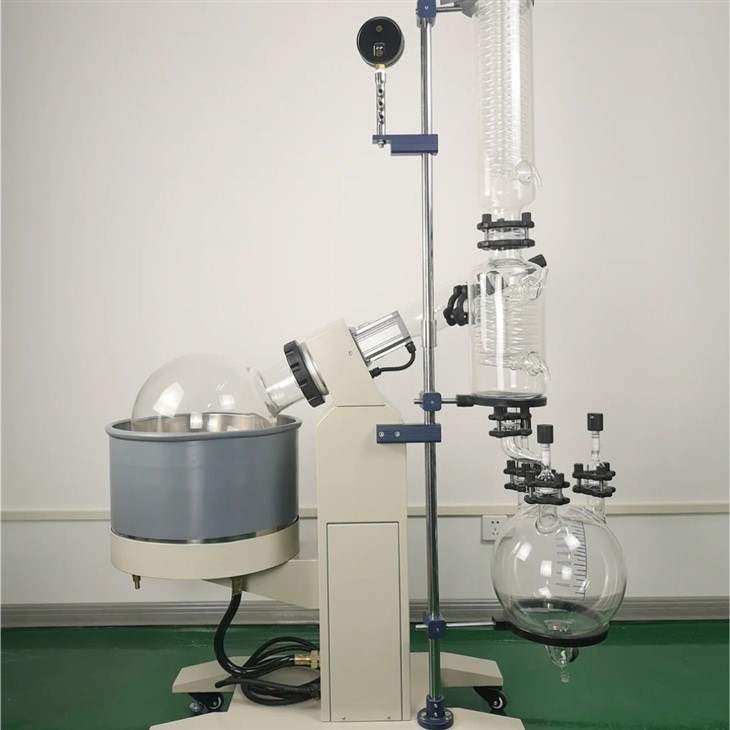



Laboratory Evaporators
(1)1L/2L---Manual lifting with irony base/Manual lifting with SS base/Electric lifting
(2)3L/5L/10L/20L/30L/50L---Manual Lifting/Electric Lifting
***Price List for whole above, inquire us to get
2. Customization:
(1)Design support
(2)Directly supply the Senior R&D organic intermediate, shorten your R&D time and cost
(3)Share the advanced purifying technology with you
(4)Supply the high quality chemicals and analysis reagent
(5)We want to assist you on Chemical Engineering (Auto CAD, Aspen plus etc.)
3. Assurance:
(1)CE and ISO certification Registered
(2)Trademark: ACHIEVE CHEM(since 2008)
(3)Replacement parts within 1-year for free
Description
Technical Parameters
Laboratory evaporators is the physical process of transforming liquid into gas. Generally speaking, an evaporator is an object that converts liquid substances into gas. There are a large number of evaporators in industry, among which the evaporator used in refrigeration systems is one of them. The evaporator is an important component among the four major refrigeration parts. Low temperature condensed liquid passes through the evaporator, exchanges heat with the outside air, vaporizes and absorbs heat, achieving the cooling effect. The evaporator is mainly composed of two parts: the heating chamber and the evaporation chamber. The heating chamber provides the heat required for evaporation to the liquid, promoting boiling and vaporization of the liquid; The evaporation chamber completely separates the gas-liquid phase. The vapor generated in the heating chamber contains a large amount of liquid foam, which can be separated from the vapor through self aggregation or the action of a demister in a larger evaporation chamber. Usually, the demister is located at the top of the evaporation chamber.
The Rotary evaporator is mainly used in the scientific research and production of pharmaceutical, chemical, biological products and other industries. Its functions include evaporation, concentration, crystallization, drying, separation, and solvent recovery.


Product Introduction
Laboratory evaporators are classified into three types based on operating pressure: atmospheric pressure, pressurization, and depressurization.
The atmospheric evaporator operates at a pressure close to atmospheric pressure, meaning its internal pressure is slightly higher or close to the external atmospheric pressure.
Due to the high operating pressure, the thermal efficiency of this evaporator is relatively low because the boiling point of water is high, requiring more energy to reach the temperature required for evaporation.
Atmospheric evaporators are usually used in situations where the evaporation rate is not high and equipment and maintenance costs need to be minimized as much as possible.
The pressurized evaporator operates at pressures higher than atmospheric pressure.
Increasing the operating pressure can correspondingly increase the boiling point of water, which means that the evaporator can be operated at higher temperatures, potentially improving the evaporation rate and thermal efficiency.
Pressure evaporators are commonly used in situations where volatile, heat sensitive, or corrosive materials need to be processed, as these materials may be more stable or easier to handle at higher temperatures.
However, pressurized evaporators also need to withstand higher pressure and temperature, so their design and manufacturing costs are usually higher.
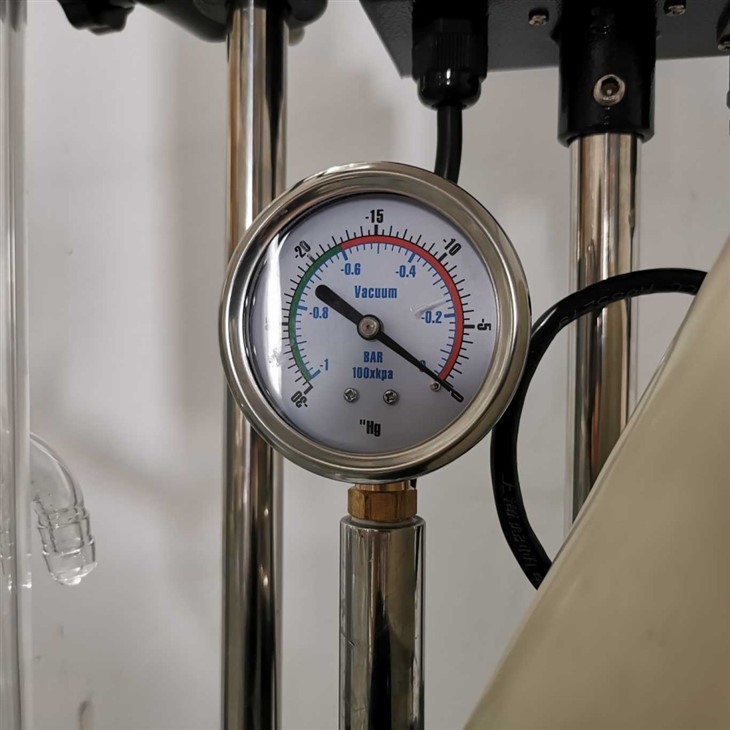
A pressure reducing (or vacuum) evaporator operates at a pressure below atmospheric pressure, reducing the boiling point of water by lowering the internal pressure, thereby achieving evaporation at lower temperatures.
This evaporator has significant thermal efficiency advantages because a lower boiling point means less energy consumption.
Vacuum evaporators are widely used in situations where energy conservation, prevention of material thermal decomposition, or handling of high viscosity, easily scaling materials are required.
However, due to the need to maintain a vacuum environment, the sealing and equipment complexity of the pressure reducing evaporator are relatively high.
According to the motion of the solution in the evaporator, there are:
1.
Circular type. Boiling solution passes through the heating surface multiple times in the heating chamber, such as central circulation tube type, suspended basket type, external heating type, Levin type, and forced circulation type.
2.
One way type. Boiling solution passes through the heating surface in the heating chamber without circulating, and the concentrated solution is discharged immediately, such as rising film, falling film, stirring film, and centrifugal film.
3.
Direct contact type. Heating medium and solution directly contact for heat transfer, such as immersion combustion evaporator.
During the operation of the evaporation device, a large amount of heating steam is consumed. To save heating steam, multi effect evaporation devices and steam recompression evaporators can be used. Evaporators are widely used in chemical, light industry and other sectors.
Product Features
1. Classified by evaporation method:
Natural evaporation: refers to the laboratory evaporators of a solution at a temperature below its boiling point, such as seawater drying salt. In this case, the solvent only vaporizes on the surface of the solution, resulting in a low rate of solvent vaporization.
Boiling evaporation: Heat the solution to boiling point and evaporate it in a boiling state. The evaporation operation in industry is basically of this type.
2. Divided by heating method:
Direct heat source heating is the evaporation process of mixing fuel with air, causing the high-temperature flame and smoke generated by its combustion to be directly sprayed into the evaporated solution through a nozzle to heat the solution and vaporize the solvent.
The indirect heat source heats the walls between the containers and transfers it to the evaporated solution. The heat transfer process that occurs in a wall mounted heat exchanger.
3. Divided by operating pressure:
It can be divided into atmospheric pressure, pressurized, and depressurized (vacuum) evaporation operations. Obviously, for thermosensitive materials such as antibiotic solutions, fruit juices, etc., they should be processed under reduced pressure. And high viscosity materials should be heated by a pressurized high-temperature heat source (such as thermal oil, molten salt, etc.) for evaporation
4. Score based on effectiveness:
It can be divided into single effect and multi effect evaporation. If the secondary steam generated by evaporation is directly condensed and no longer utilized, it is called single effect evaporation. If secondary steam is used as the next heating steam and multiple evaporators are connected in series, this evaporation process is called multi effect evaporation.


Product Features
1.
A metal circular basin with an inner diameter of 200mm and a height of approximately 100mm for the evaporator.
2.
The evaporator is a metal circular structure with smooth inner walls, and there should be no burrs or scratches on the edges of the evaporator.
3.
All parts in contact with water should be smooth, and the welds at their mating or connecting parts should be tight, firm, and free of water leakage.
4.
The assembly of all components and parts of the evaporator should be correct, without any looseness, deformation, or other defects that may affect its use.
5.
The protective layer applied to each component of the evaporator should be firm, uniform, and smooth, without defects such as delamination or rust.
6.
The evaporator and installation frame should be easy to install and able to prevent the evaporator from detaching due to wind force during normal use.
7.
Attachments: one graduated measuring cup, one water reservoir, one installation frame, and one metal mesh cover.
Inter wall heat transfer type
The commonly used partition heat transfer laboratory evaporators can be roughly divided into two categories based on the residence of the solution in the evaporator: circulation type and one-way type.
Circulating evaporator
This type of evaporator allows the solution to circulate in the evaporator. Due to different causes of circulation, it can be divided into two categories: natural circulation and forced circulation.
1. Central circulation tube evaporator, also known as standard evaporator. Its heating chamber is composed of vertical tube bundles, with a large diameter central circulation tube in the middle, and the other smaller diameter heating tubes are called boiling tubes. Due to the larger size of the central circulation tube, the heat transfer surface occupied by a unit volume of solution is smaller than that occupied by a unit volume of solution in the boiling tube. This means that the heating degree of the solution in the central circulation tube and other heating tubes is different, resulting in a lower density of the vapor-liquid mixture in the boiling tube than in the central circulation tube. In addition, the upward suction effect of rising steam will cause the solution in the evaporator to form a circulating flow from the central circulation tube descending to the boiling tube ascending. This kind of cycle is mainly caused by the density difference of the solution, so it is called natural cycle. This effect is beneficial for improving the heat transfer efficiency inside the evaporator.
In order to ensure good circulation of the solution, the cross-sectional area of the central circulation tube is generally 40-100% of the total cross-sectional area of other heating tubes; The height of the heating tube is generally 1-2m; The diameter of the heating tube is between 25-75mm. This type of evaporator is widely used due to its compact structure, easy manufacturing, good heat transfer, and reliable operation. However, due to structural limitations, the cycling speed is not high. By continuously circulating the solution in the heating chamber, its concentration always approaches that of the complete solution, resulting in a high boiling point of the solution and a decrease in the effective temperature difference. This is a common drawback of circulating evaporators. In addition, the cleaning and maintenance of the equipment are not convenient enough, so this evaporator is difficult to fully meet the production requirements.
2. In order to overcome the disadvantages of easy crystallization, scaling, and difficult cleaning of the evaporating liquid in the circulating evaporator, a more reasonable improvement has been made to the structure of the standard evaporator, which is the suspended basket evaporator. The heating chamber 4 is like a basket, suspended at the lower part of the evaporator shell, and replaced by a central circulation tube with an annular channel between the outer wall of the heating chamber and the inner wall of the evaporator. The solution rises along the center of the heating tube and then flows downwards along the annular gap between the outer wall of the suspended basket heating chamber and the inner wall of the evaporator to form a cycle. Due to the annular gap area being approximately 100 to 150% of the total cross-sectional area of the heating tube, the solution circulation speed is higher than that of a standard evaporator, reaching up to 1.5m/s. In addition, the heating chamber of this evaporator can be removed from the top for maintenance or replacement, and the heat loss is also relatively small. Its main disadvantage is its complex structure and high metal consumption per unit heat transfer area.
3. The natural circulation evaporator mentioned above has a circulation speed that is not high enough, generally below 1.5m/s. To make the evaporator more suitable for evaporating solutions with high viscosity, easy crystallization or severe scaling, and to increase the solution circulation speed to extend the operating cycle and reduce the number of cleaning times.
Its structural feature is the addition of a boiling chamber on top of the heating chamber. The solution in the heating chamber does not boil in the heating tube due to the static pressure added by the liquid column in the boiling chamber. It can only start boiling when it rises to the boiling chamber and the pressure decreases. Therefore, the boiling and vaporization of the solution move from the heating chamber to the boiling chamber without a heat transfer surface, thus avoiding the formation of crystals or dirt in the heating tube. In addition, the cross-sectional area of the circulation tube of this evaporator is about 2-3 times the total cross-sectional area of the heating tube, and the solution circulation speed can reach 2.5 to 3 m/s or more, so the overall heat transfer coefficient is also relatively high. The main disadvantage of this evaporator is the large temperature difference loss caused by the static pressure head effect of the liquid column (see 6.3.1 for details). In order to maintain a certain effective temperature difference, a high pressure is required for heating the steam. In addition, the equipment is large, consumes a lot of materials, and requires tall factories. In addition to the natural circulation evaporator mentioned above, a forced circulation evaporator is also used when evaporating materials with high viscosity, easy crystallization, and scaling. In this evaporator, the circulation of the solution mainly relies on external power, which is forced to flow in a certain direction by a pump to generate circulation. The size of the circulation speed can be controlled by adjusting the flow rate of the pump, usually above 2.5m/s. The heat transfer coefficient of forced circulation evaporator is also higher than that of general natural circulation. But its obvious disadvantage is high energy consumption, requiring about 0.4-0.8 kW per square meter of heating area.
One-way evaporator
The main feature of this type of Laboratory evaporators is that the solution only passes through the heating chamber once in the evaporator and is discharged as a concentrated liquid without circulating flow. When the solution passes through the heating chamber, it flows in a film shape on the tube wall, so it is commonly known as a liquid film evaporator. According to the different flow directions of materials in the evaporator, single pass evaporators are divided into the following types.
1. The heating chamber of a rising film evaporator is composed of many vertical long tubes. The commonly used heating tube diameter is 25-50mm, and the ratio of tube length to tube diameter is approximately 100-150. After preheating, the liquid is introduced from the bottom of the evaporator and heated in the heating tube, boiling and rapidly vaporizing. The generated steam rises at high speed in the heating tube. The suitable outlet steam velocity for normal pressure operation is 20-50m/s, and for reduced pressure operation, the steam velocity can reach 100-160m/s or even higher. The solution is driven by the rising steam, rising in a film along the pipe wall and continuing to evaporate. The mixture of vapor and liquid is separated in separator 2, and the complete liquid is discharged from the bottom of the separator, while the secondary steam is discharged from the top. It should be noted that if the amount of water evaporated from the liquid is not large, it will be difficult to achieve the required vapor velocity, that is, the rising film evaporator is not suitable for evaporating concentrated solutions; It is also not suitable for materials with high viscosity, easy crystallization or scaling.
2. The difference between falling film evaporator and rising film evaporator is that the feed liquid is added from the top of the evaporator, and under the action of gravity, it forms a film like descent along the pipe wall, and evaporates and thickens during this process, obtaining a concentrated liquid at its bottom. Due to the different film-forming mechanism from the rising film evaporator, the falling film evaporator can evaporate materials with higher concentration, viscosity (such as in the range of 0.05-0.45Ns/m2), and thermal sensitivity. However, due to the uneven distribution of liquid film inside the tube and the smaller heat transfer coefficient compared to the rising film evaporator, it is still not suitable for materials that are prone to crystallization or scaling.
Due to the film like flow of the solution in the one-way evaporator, the convective heat transfer coefficient is greatly improved, allowing the solution to reach the required concentration in one pass through the heating chamber without further circulation. Therefore, it has greater advantages than the circulation evaporator. The benefits of not circulating the solution include: (1) the residence time of the solution in the evaporator is very short, making it particularly suitable for the evaporation of thermosensitive materials; (2) The concentration of the entire solution is not always close to the concentration of the finished liquid like in the circulation type, so the effective temperature difference of this evaporator is relatively large. Its main disadvantage is that it is quite sensitive to fluctuations in feed load, and when the design or operation is not suitable, it is not easy to form a film. At this time, the convective heat transfer coefficient will significantly decrease.
3. The scraper evaporator has a heating steam jacket inside the evaporator shell, which is equipped with rotatable blades or scrapers. There are two types of scrapers: fixed type and rotor type. The gap between the former and the inner wall of the shell is 0.5-1.5mm, while the gap between the latter and the wall varies with the number of revolutions of the rotor. The liquid is added along the tangent direction from the upper part of the evaporator (also added to the material tray coaxial with the scraper). Due to gravity, centrifugal force, and the action of the rotating scraper, the solution forms a film of downward rotation on the inner wall of the device, and is evaporated and concentrated during this process, completing the discharge of the liquid at the bottom. This type of evaporator is a one-way evaporator that uses external power to form a film. Its outstanding advantage is its strong adaptability to materials and short residence time, usually a few seconds or tens of seconds, making it suitable for high viscosity (such as tannin extract, honey, etc.) and materials that are prone to crystallization, scaling, and heat sensitivity. But its structure is complex and consumes a lot of power, requiring about 1.5-3kW per square meter of heat transfer surface. In addition, its processing capacity is very small and the manufacturing and installation requirements are high.
Evaporator with direct contact heat transfer
In actual production, Laboratory evaporators with direct contact heat transfer are sometimes used. It mixes fuel (usually gas and oil) with air and burns it in a combustion chamber immersed in a solution, producing high-temperature flames and smoke that are directly sprayed into the evaporated solution through nozzles at the bottom of the combustion chamber. High temperature gas and solution come into direct contact, while heat transfer occurs to evaporate and vaporize water. The resulting water vapor and exhaust gas are discharged together from the top of the evaporator. The immersion depth of its combustion chamber in the solution is generally 0.2-0.6m, and the temperature of the gas exiting the combustion chamber can reach over 1000 ℃. Due to direct contact heat transfer, its heat transfer effect is very good and the heat utilization rate is high. Due to the lack of a fixed heat transfer wall, the structure is simple and particularly suitable for evaporation of materials that are prone to crystallization, scaling, and corrosion. It has been widely used in waste acid treatment and evaporation of ammonium sulfate solution. But if the evaporated liquid is not allowed to be contaminated by smoke, then this type of evaporator is generally not suitable. And due to the presence of a large amount of smoke, the utilization of secondary steam is limited. In addition, the nozzle is more prone to damage due to immersion in high-temperature liquid. From the above introduction, it can be seen that there are many structural types of evaporators, each with its own advantages, disadvantages, and applicable situations. When selecting, the first thing to consider is whether it can adapt to the process characteristics of the evaporated material, including its viscosity, thermal sensitivity, corrosiveness, and whether it is prone to crystallization or scaling. Then, it is required to have a simple structure, easy manufacturing, low metal consumption, convenient maintenance, good heat transfer effect, and so on.
Hot Tags: laboratory evaporators, China laboratory evaporators manufacturers, suppliers, factory, Double Glass Reactor, Hydrothermal Autoclave Reactor With Teflon Chamber 100ml, Teflon Lined Hydrothermal Autoclave, High Pressure Reactor Vessel, Rotating Evaporator, Chemglass Jacketed Reactor
Previous
Tablet Press Punches And DiesSend Inquiry


