


Advantages And Disa Of Lab & Pilot-Scale Spray Dryers
May 16, 2026
Leave a message
Introduction of Lab & Pilot-Scale Spray Dryers
Spray drying is one of the most widely used technologies for converting liquid materials into dry, uniform powder. In large industrial production, spray dryers support mass manufacturing for food, chemicals, pharmaceuticals and ceramics. However, for research laboratories, university institutes, startup teams and small-batch pilot production, industrial-scale spray dryers are often too large, too expensive and impractical. This is why lab-scale and small pilot-scale spray dryers have become essential equipment for early-stage development, formula screening, material testing and process verification.
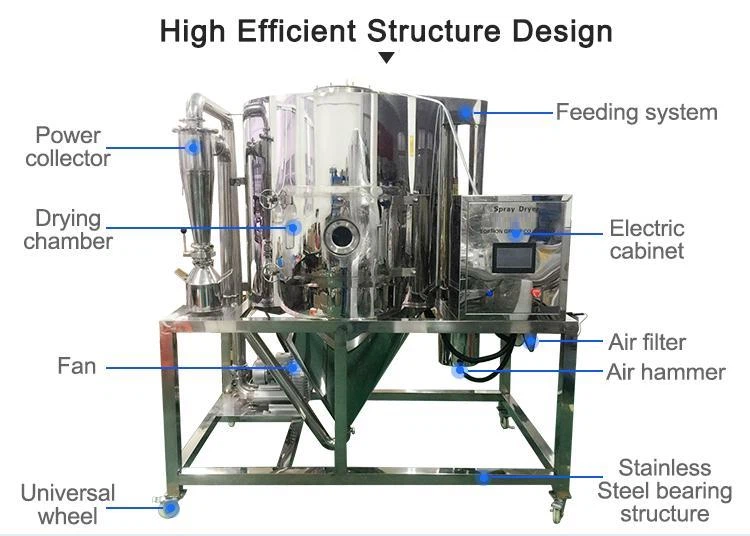
In this article, we explain the working principle of lab and small pilot-scale spray dryers, analyze their key advantages and disadvantages, and help you decide whether this equipment fits your research or startup production needs. By the end, you will understand how these compact dryers support innovation, reduce costs and accelerate product development.
What Is a Lab & Small Pilot-Scale Spray Dryer?
A laboratory or small pilot-scale spray dryer is a compact, closed or open drying system designed for small-volume liquid feeds, including solutions, suspensions, emulsions and slurries. It uses the core principle of atomization: the liquid feed is pumped into an atomizer to form tiny droplets, which are then instantly dried by hot air in a small drying chamber. Moisture evaporates rapidly, and dry powder is collected through a cyclone or collection vessel.
The typical workflow includes five simple steps:
1.Liquid feed is pumped into the system at a stable, controllable rate.
2.The feed is atomized into fine, uniform droplets via centrifugal or pressure nozzles.
3.Droplets contact hot air and dry within seconds.
4.Dry particles are separated from the exhaust air and collected.
5.Clean gas is discharged or filtered for environmental safety.
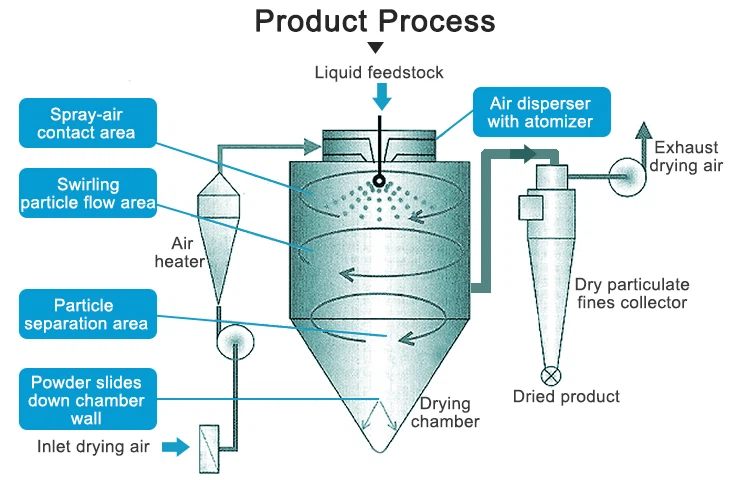
Unlike large industrial spray dryers that focus on high throughput and continuous mass production, lab and small pilot models are built for flexibility, precision, small footprint and ease of operation. They are perfect for users who need reliable drying results without heavy investment or large factory space.
Interested in one spray dryer for your lab/factory?[check our spray dryer list]
Key Advantages of Lab & Small Pilot-Scale Spray Dryers
1.Ultra-Fast Drying Process
Lab-scale spray dryers complete the entire drying cycle in just a few seconds. The small droplets created by atomization have an extremely large surface area, allowing moisture to evaporate almost instantly. This high-speed drying is especially valuable for R&D samples where time is limited and material waste must be minimized.
2.Excellent Compatibility with Heat-Sensitive Materials
Even though hot air is used, the short residence time in the chamber protects heat-sensitive ingredients such as enzymes, probiotics, vitamins, natural extracts, APIs and biopharmaceuticals. Activity and potency are well preserved, making these dryers widely used in pharma, food and biotech research. Many models can also work under mild conditions to support oxidation-sensitive materials.
3.Compact Structure and Small Footprint
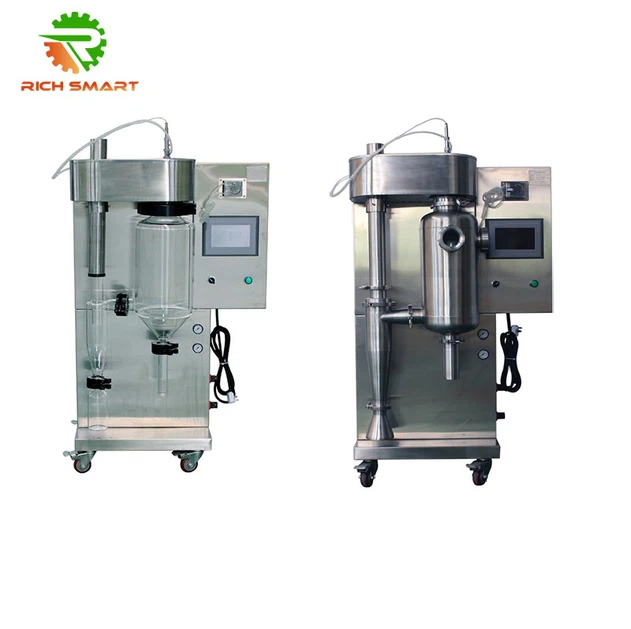
One of the biggest benefits for lab and startup users is the small size. Lab-scale dryers are often bench-top or floor-standing with a narrow frame. They fit easily in fume hoods, standard laboratories or small pilot rooms without requiring high ceilings or large production areas. This is a huge advantage compared with bulky industrial dryers.
4.Low Initial Capital Investment
For startups, university labs and small R&D teams, budget is always a key concern. Lab and small pilot spray dryers have a much lower purchase cost than industrial models. They also require simpler installation, less auxiliary equipment and no complex infrastructure. This makes them highly accessible for early-stage innovation.
5.Easy Operation and Low Maintenance
Modern small spray dryers feature intuitive touch panels, clear parameter displays and stable automatic control. Users can quickly set inlet temperature, feed rate, atomization speed and air flow. Professional training is not required; most researchers can master operation within a short time. Daily maintenance mainly involves cleaning the chamber, replacing filters and checking the atomizer - simple and time-saving.
6.Precise and Reproducible Product Control
The drying parameters can be finely adjusted to control particle size, apparent density, moisture content and powder flowability. This consistency supports reliable experimental data, repeatable tests and stable small-batch production. Researchers can screen formulas, optimize processes and verify scale-up feasibility with high confidence.
7.Produces Free-Flowing, Uniform Powder
Spray-dried powder usually has a spherical shape and narrow particle size distribution. These characteristics result in excellent flowability, making the powder easy to weigh, package, test and use in downstream processes such as tableting, capsule filling or re-dissolution.
8.Wide Application Versatility
Lab and small pilot spray dryers support many industries and materials, including:
- ·Pharmaceutical formulations and APIs
- ·Food ingredients, milk powder, coffee powder and natural extracts
- ·Cosmetic microcapsules and active ingredients
- ·Chemical materials, catalysts and ceramic powders
- ·Battery materials and new functional materials
- ·Environmental sample treatment and waste valorization
One machine can serve multiple research projects, greatly improving resource utilization.
Disadvantages of Lab & Small Pilot-Scale Spray Dryers
1.Limited Production Capacity
By design, these dryers are intended for R&D and small-batch trials, not mass industrial production. Daily output is much lower than large-scale units, so they are not suitable for large-scale commercial manufacturing.
2.Small Feed Volume Range
Most lab models work best with volumes from 50 mL to 5 L per batch. They are not designed to handle large, continuous feed streams. Users who need to scale up later must transition to larger pilot or industrial equipment.
3.Lower Recovery Rate for Ultra-Fine Particles
Extremely fine powder may be carried away by exhaust air, leading to a slightly lower collection rate. However, this can be improved with high-efficiency cyclones, filter collectors or secondary recovery devices available as optional upgrades.
4.Basic Automation Compared to Industrial Systems
While easy to operate, small dryers usually do not include advanced functions such as fully closed-loop control, automatic CIP cleaning or multi-stage continuous feeding. These features are reserved for large industrial systems.
5.Regular Cleaning Required for Multi-Material Use
To avoid cross-contamination between different samples, the chamber, nozzle, pipeline and collector must be cleaned properly. This is a standard lab practice but adds small daily workloads.
6.Environmental Emission Requirements
Although exhaust gas is clean compared with industrial dryers, some chemical or organic materials require additional filtration to meet environmental standards. Most small dryers can be equipped with exhaust filters to solve this issue.
Interested in buying one spray dryer for your lab/factory?[send inquiry now]
Who Needs a Lab or Small Pilot-Scale Spray Dryer?
This equipment is ideal for:
- ·University and research institute laboratories
- ·R&D centers in pharmaceutical, food, cosmetic and chemical companies
- ·Startup teams developing new materials, formulas or processes
- ·Users conducting small-batch pilot production and process verification
- ·Enterprises preparing to scale up from lab to industrial production
If you value compact size, low cost, easy operation and stable drying performance, a lab or small pilot spray dryer is the right choice.
How to Choose the Right Lab & Pilot-Scale Spray Dryer
When selecting equipment, consider these factors:
- ·Atomization type: Centrifugal for heat-sensitive materials; pressure for suspensions and ceramics.
- ·Feed volume: Match your typical sample or batch size.
- ·Footprint: Ensure it fits your lab space.
- ·Material compatibility: Stainless steel and food-grade/medical-grade surfaces.
- ·Control system: Stable temperature and feed rate control for repeatability.
- ·Upgradeability: Retrofit options for recovery, controls and atomizers.
Final Thoughts
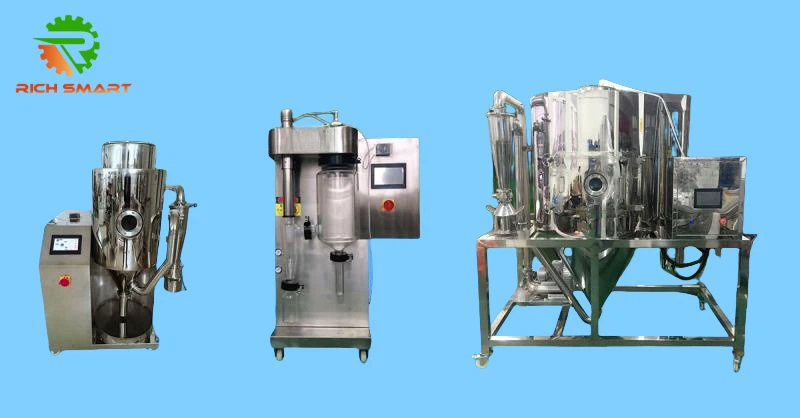
Lab and small pilot-scale spray dryers are indispensable tools for modern R&D and startup innovation. They combine fast drying, gentle processing, compact design and affordable cost to support formula development, material screening and pilot verification. While they have limitations in output and scale, these are intentional design choices for small-scale use, not defects.
For researchers and entrepreneurs who want to turn liquid ideas into dry powder quickly and reliably, small spray dryers deliver exceptional value. They reduce development time, lower costs and help you make better decisions before scaling up to industrial production.
At Achieve Chem, we specialize in laboratory and small pilot-scale spray dryers tailored for R&D, startups and small-batch production. Our equipment is compact, easy to operate, cost-effective and customizable to meet your specific needs. Whether you need standard models or custom solutions, we provide stable performance and short delivery times to support your innovation journey.
Interested in buying one pilot spray dryer for your lab/factory?[send inquiry now]
FAQs
Q1: How to choose between centrifugal and pressure Air atomization for lab use?
Centrifugal atomization is better for heat-sensitive bio-products, food and pharmaceuticals. Pressure atomization is more suitable for abrasive slurries such as ceramics and suspensions.
Q2: What industries use lab-scale spray dryers?
They are widely used in pharma, food, chemicals, cosmetics, battery materials and environmental R&D.
Q3: How long does it take to customize a lab/pilot spray dryer?
Custom design, fabrication and testing normally take 1–2 weeks.
Q4: Can existing small dryers be upgraded?
Yes. We provide retrofit kits for control systems, atomizers and energy recovery to improve performance.