


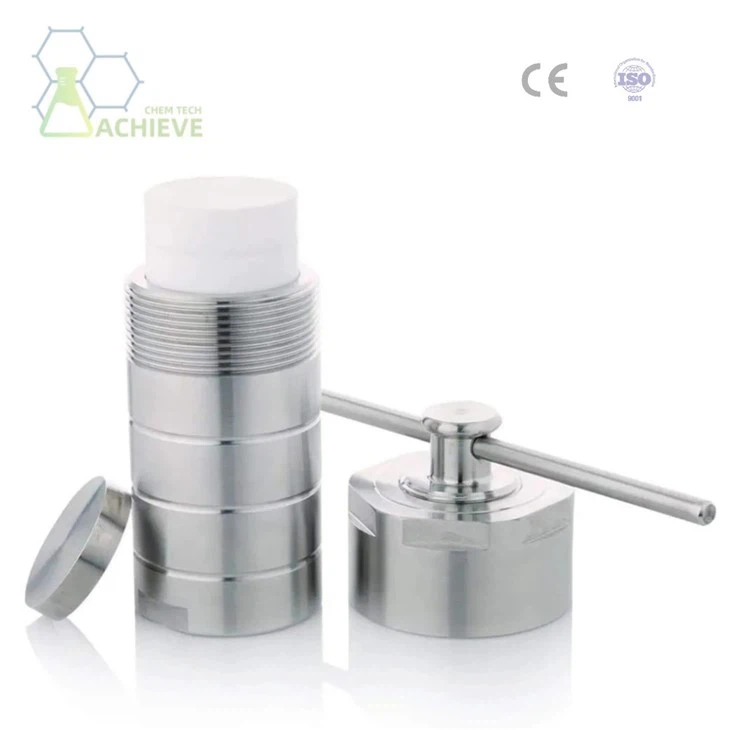

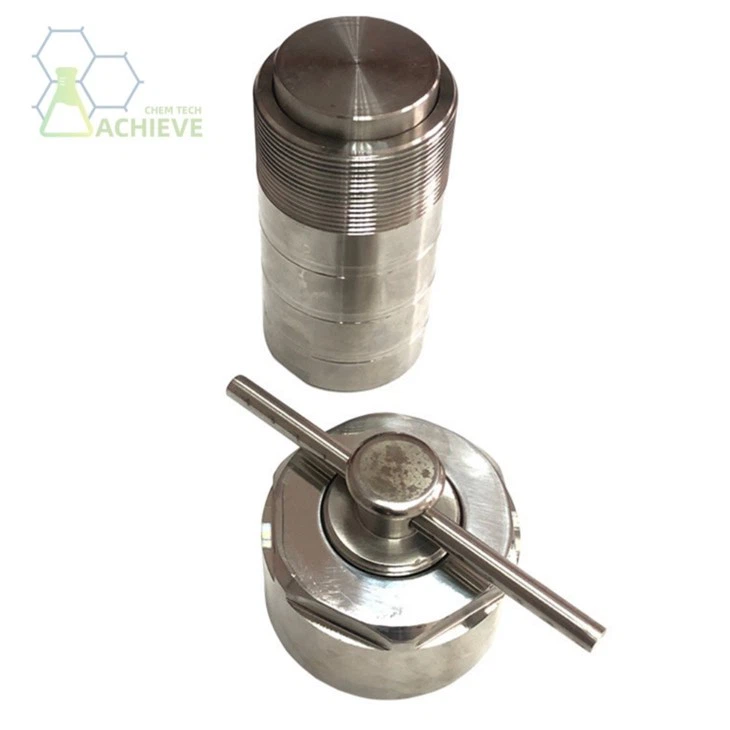
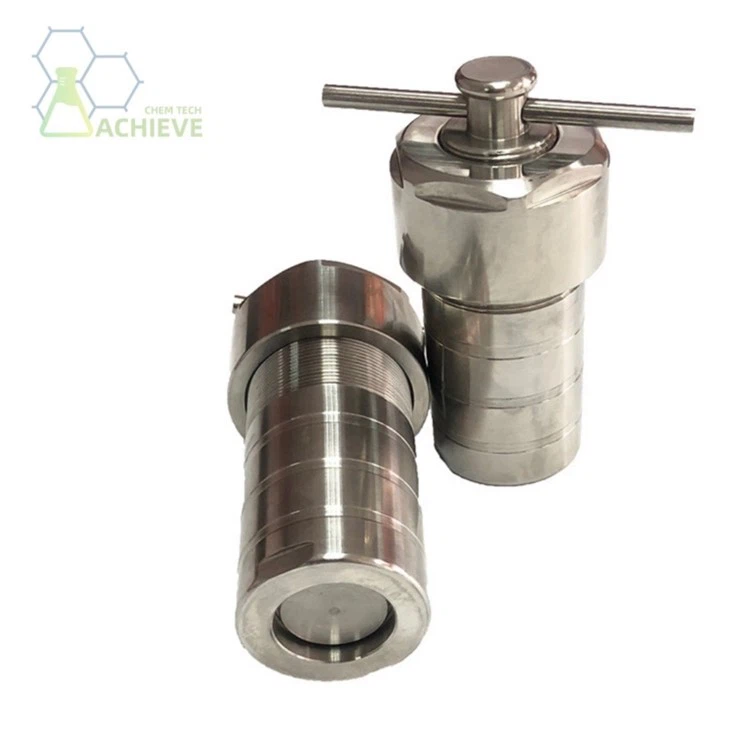
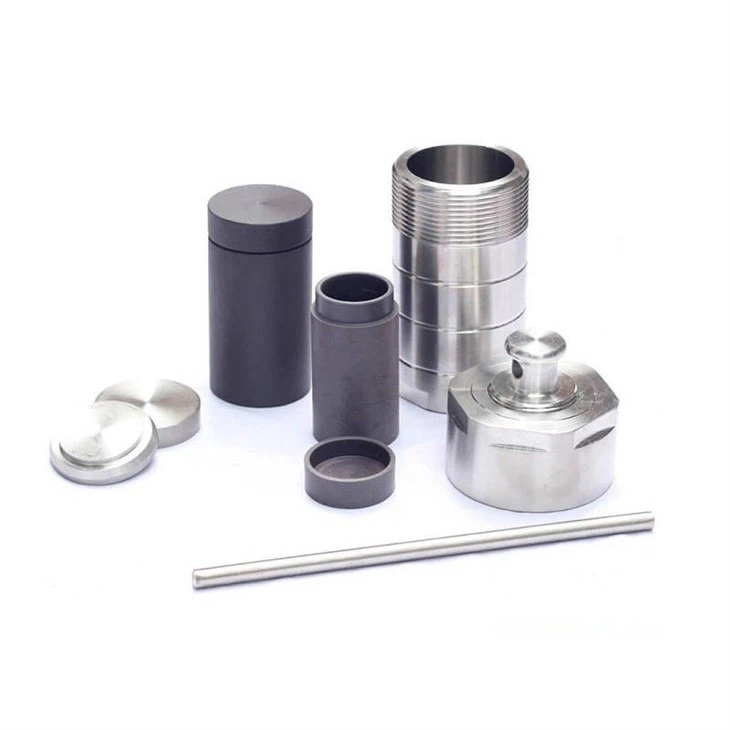
Teflon Stainless Steel Autoclave
(1)25ml/50ml/100ml/150ml/200ml/250ml/300ml/400ml/500ml/1000ml---PTFE/≤ 220°C
(2)25ml/50ml/100ml/150ml/200ml/250ml/300ml/400ml/500ml/1000ml---PPL/≤ 280°C
***Price List for whole above, inquire us to get
2. Customization:
(1)Design support
(2)Directly supply the Senior R&D organic intermediate, shorten your R&D time and cost.
(3)Share the advanced purifying technology with you
(4)Supply the high quality chemicals and analysis reagent
(5)We want to assist you on Chemical Engineering (Auto CAD, Aspen plus etc.)
3. Assurance:
(1)CE and ISO certification Registered
(2)Trademark: ACHIEVE CHEM(since 2008)
(3)Replacement parts within 1-year for free
Description
Technical Parameters
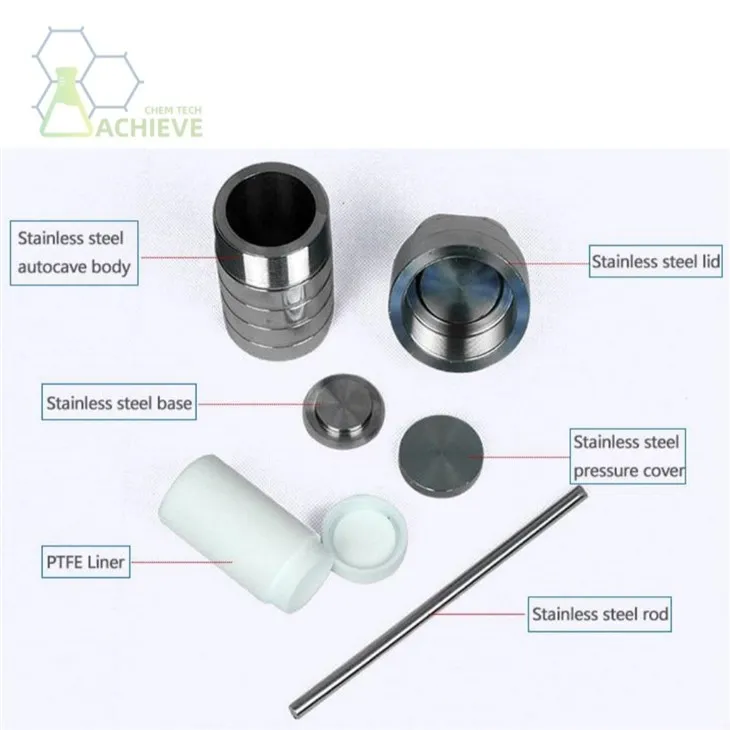
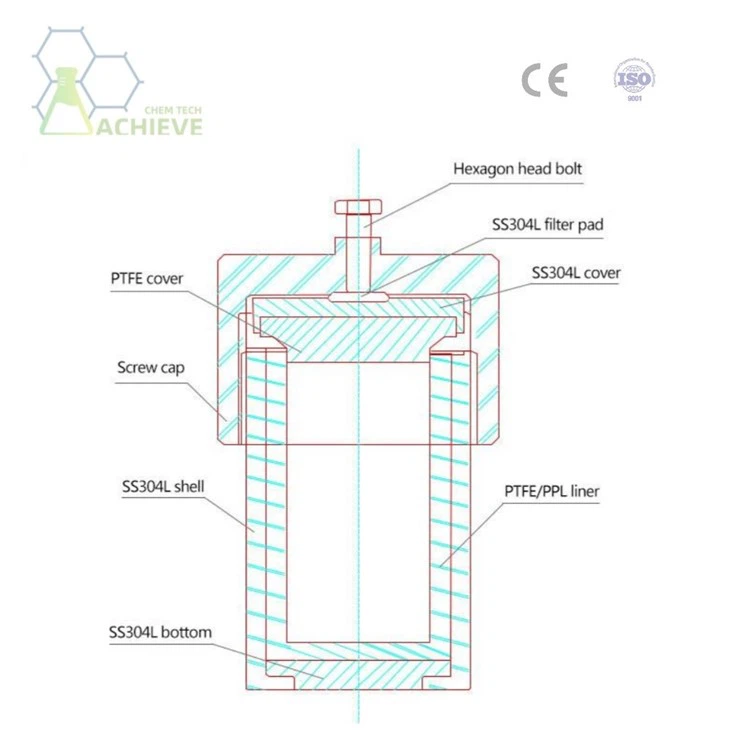
Teflon Stainless Steel Autoclave is a fine experimental equipment widely used in various chemical reactions and high pressure application scenarios in chemical laboratories. The polytetrafluoroethylene stainless steel high-pressure kettle is mainly composed of two parts: the boiler body and the boiler cover. The interior of the kettle body is equipped with a polytetrafluoroethylene lining, which can resist the erosion of various chemicals and ensure that the chemicals inside the kettle are not contaminated. At the same time, the inner part of the boiler cover is also equipped with a PTFE sealing ring to ensure that the kettle body will not leak under high pressure. The shell of this equipment is made of high-quality stainless steel, which has the characteristics of high strength, corrosion resistance, and elegant appearance. The boiler cover is equipped with a safety valve and pressure gauge, which can monitor the pressure inside the kettle in real time to ensure the safety of the experiment. In addition, the boiler body is also equipped with a heating sleeve and stirrer, which can facilitate heating and stirring operations.
It is widely used in medical, food processing, laboratory and other fields. In the medical field, it is used to sterilize medical instruments and surgical instruments; In the field of food processing, it is used to sterilize food packaging materials and containers; In the laboratory field, it is used to sterilize laboratory equipment and media.
Product Introduction
When using Teflon Stainless Steel Autoclave, it is necessary to pay attention to multiple aspects to ensure their safe and efficient operation. The following are some key precautions aimed at helping users operate and maintain such high-pressure vessels correctly.

1. Selection of solvents and media
Solvent selection:
When using PTFE high-pressure vessels for digestion and other experiments, the amount of solvent added should be determined according to specific experimental requirements, generally recommended to be 1/3 to 1/5 of the inner cup capacity. It is particularly important to note that if strong oxidants such as perchloric acid and hydrogen peroxide are used in the experiment, their dosage should be strictly controlled and not too much. It is recommended to carry out overnight cold nitrification treatment to avoid dangerous situations such as high pressure inside the container or explosion caused by intense reactions.
Medium compatibility:
PTFE material is known for its excellent chemical corrosion resistance, which can withstand the corrosion of various acids, alkalis, solvents and other chemical substances. However, before use, it is still necessary to confirm whether the processed medium is fully compatible with PTFE and stainless steel materials to avoid container damage or performance degradation caused by incompatible media.
2. Pressure and temperature control
Pressure control:
PTFE high-pressure vessels work in high-pressure environments, so the pressure inside the vessel must be strictly controlled. During the operation, it should be ensured that the container can withstand the maximum pressure required for the experiment and avoid overpressure operation. At the same time, after the digestion is completed, due to the possibility of residual high pressure in the container, it should be allowed to cool naturally to room temperature before opening to prevent danger caused by sudden pressure release.
Temperature control:
Although PTFE material has good high temperature resistance, it is still necessary to pay attention to temperature control during use to avoid exceeding its long-term use temperature range (usually -200 ° C to 260 ° C). Especially when conducting high-temperature experiments, it is necessary to ensure that there are sufficient insulation measures on the outside of the container to reduce heat loss and protect operators from high-temperature injuries.
3. Operation and maintenance
Correct operation:
When using PTFE steel high-pressure vessels, the operating procedures should be strictly followed to avoid container damage or safety accidents caused by rough operation or improper use. For example, when loading samples and solvents, specialized tools should be used and the inner walls of the container should be avoided from being scratched; When tightening the sealing cover, ensure that the seal is good but not too tight to avoid damaging the seal.
Regular maintenance:
Regular inspection and maintenance of PTFE high-pressure vessels are key to ensuring their long-term stable operation. The inspection should include whether the appearance of the container is damaged, whether the seals are aged or leaking, and whether the valves are flexible and reliable. If any problems are found, they should be dealt with promptly and damaged components should be replaced.
4. Safety protection
Personal protection:
When using PTFE high-pressure vessels, operators should wear personal protective equipment such as goggles, protective clothing, gloves, etc. to prevent chemicals from splashing into the eyes or skin and causing injury.
Emergency handling:
In case of emergency situations such as leakage or overpressure during operation, the experiment should be immediately stopped and corresponding emergency measures should be taken. For example, turning off gas or power sources, evacuating personnel, using firefighting equipment, etc. At the same time, professional personnel should be promptly contacted for handling to avoid the situation from escalating.
Product Parameter
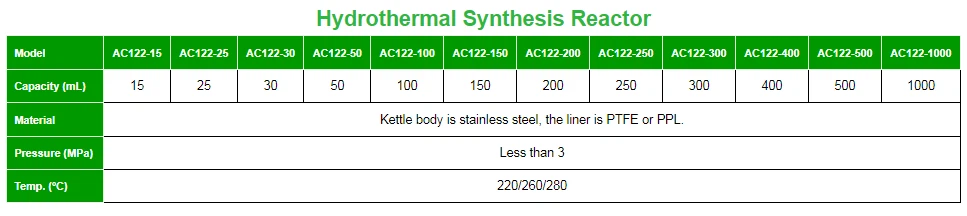
All kinds of "Hydrothermal Synthesis Reactor", price list, you can choose online HERE
When choosing Teflon Stainless Steel Autoclave based on the data provided in the table above and general principles for using high-pressure vessels, we can provide suggestions from the following aspects:
Firstly, it is necessary to clarify your experimental requirements, including the required reaction capacity, temperature range, corrosion resistance requirements, and whether high-temperature and high-pressure reactions are required. This will directly affect which model and specification of PTFE high-pressure vessel you choose.
From the above table, it can be seen that the capacity of PTFE high-pressure vessels ranges from 15 milliliters to 1000 milliliters. Therefore, when selecting, the appropriate model should be chosen based on the specific capacity required for the experiment. If the experiment requires processing a large number of samples, a container with a larger capacity should be selected; On the contrary, if the experimental scale is small, choosing a small capacity container is more economical and practical.
PTFE material is known for its excellent high temperature resistance, but different models and specifications of PTFE high-pressure vessels may have different temperature ranges. When selecting, it should be ensured that the temperature range of the selected container can meet the experimental requirements. If the experiment needs to be conducted at high temperatures, a container with a higher temperature range should be selected to ensure the smooth progress of the experiment.
PTFE is a material with extremely strong corrosion resistance, which can withstand the corrosion of various chemicals such as acids, alkalis, solvents, etc. However, when choosing PTFE high-pressure vessels, it is still necessary to pay attention to whether the lining material meets the experimental requirements. Especially when the experiment involves highly corrosive media, it should be ensured that the lining material has sufficient corrosion resistance to avoid damage to the container or affecting the experimental results due to corrosion.
On the premise of meeting the above needs, the selection should also be based on cost-effectiveness. The prices of PTFE high-pressure vessels of different brands, models, and specifications may vary greatly, so it is necessary to comprehensively consider the experimental budget and actual needs. Choose products with relatively reasonable prices while ensuring quality and performance.
Specific suggestions
(1)
If the experiment requires processing a large number of samples and has high temperature range requirements, it is recommended to choose PTFE high-pressure vessels with larger capacity and wider temperature range.
(2)
If the experiment involves highly corrosive media, special attention should be paid to the corrosion resistance of the lining material, and products with excellent corrosion resistance should be selected.
(3)
Considering safety and stability, it is recommended to choose products from well-known brands and legitimate manufacturers, and pay attention to the structural design, sealing performance, and material quality of the products.
(4)
When making a choice, you can also refer to the usage evaluations and feedback of other users to understand the actual effectiveness of the product.
Technical Guidance

The following is the operation method of polytetrafluoroethylene stainless steel high-pressure kettle:
The company conducted a competitive advantage analysis to identify its strengths and weaknesses compared to its rivals.
1. Inspection:
Before use, the high-pressure boiler needs to be inspected to ensure that there is no obvious damage or crack on the boiler body, lid, agitator, etc., and the sealing performance is good.
01
2. Preparation:
Prepare various chemical reagents and materials required for the experiment, and clean and dry the glass instruments, pipelines, valves, etc. used.
02
3. Feeding:
According to the experimental requirements, add reagents and materials to the high-pressure vessel, taking care not to exceed the maximum capacity of the vessel.
03
4. Connection:
Connect the high-pressure vessel to external pipelines, valves, etc., and ensure that the connection is well sealed.
04
5. Heating:
Heat the high-pressure boiler through equipment such as a heating sleeve or electric heating plate, and pay attention to controlling the heating temperature and speed to avoid overheating or boiling.
05
6. Stirring:
Turn on the stirrer as needed to fully mix and react with the substances in the boiler.
01
7. Pressure control:
Control the pressure inside the high-pressure boiler through regulating valves or other pressure control devices, and perform pressurization or decompression operations according to experimental requirements.
02
8. Sampling:
During the experimental process, samples can be taken and analyzed as needed, and a dedicated sampling valve can be used for sampling operations.
03
9. Cooling:
After the experiment is completed, the high-pressure boiler should be cooled to avoid damage to the boiler body or affecting the experimental results due to excessive temperature difference.
04
10. Cleaning:
After use, the high-pressure boiler should be cleaned in a timely manner to remove residual chemicals and dirt inside the boiler.
05
It should be noted that when operating the Teflon Stainless Steel Autoclave, relevant safety regulations should be strictly followed to ensure the safety and accuracy of the experimental operation. Meanwhile, for high-pressure kettles of different models and specifications, their operating methods and steps may vary slightly. Therefore, in actual operation, it is necessary to refer to the boiler manual for correct operation.
High Temperature Resistance
Polytetrafluoroethylene (PTFE), as a high-performance polymer material, stands out among its many outstanding properties due to its excellent high temperature resistance. This high temperature resistance enables polytetrafluoroethylene to maintain stable physical and chemical properties even under extreme temperature conditions, making it widely used in many industrial fields.
The high temperature resistance of polytetrafluoroethylene is mainly reflected in its ability to maintain stable performance in a high temperature range for a long time. Specifically, the long-term use temperature range of polytetrafluoroethylene is usually between -200 ° C and 260 ° C, which means it can work continuously within this temperature range without significant performance degradation. In addition, in some special cases, polytetrafluoroethylene can even withstand high temperatures of up to 300 ° C in a short period of time without undergoing thermal decomposition or degradation.
The excellent high temperature resistance of polytetrafluoroethylene is mainly attributed to its unique molecular structure and chemical properties. Firstly, the molecular structure of polytetrafluoroethylene is highly symmetrical. The polymer compound formed by the polymerization reaction of tetrafluoroethylene monomer has a very strong C-F bond in its molecular structure. The C-F bond is a very stable bond with a high energy binding ratio, which makes the molecular structure of polytetrafluoroethylene very stable and not easily destroyed by factors such as heat and chemical substances. Secondly, the molecular chain structure size of polytetrafluoroethylene is relatively small, and the intermolecular interaction forces are weak, which makes it less affected by thermal motion in high temperature environments, and the forces between molecules are also relatively small, thus possessing certain high temperature resistance performance.
The excellent high temperature resistance of polytetrafluoroethylene provides possibilities for its application in multiple fields. In the manufacturing process of wires and cables, the use of PTFE high-temperature heat shrink tubing can effectively improve the high-temperature resistance of wires and cables, avoiding current leakage and arc occurrence caused by insulation performance degradation in high-temperature environments. In the chemical industry, polytetrafluoroethylene is often used as a material for corrosion-resistant and high-temperature resistant pipelines, valves, pumps, and other equipment to withstand the erosion of high temperatures and corrosive media. In addition, polytetrafluoroethylene is widely used in aerospace, automotive industry, medical equipment and other fields due to its high temperature resistance, such as manufacturing high-temperature seals, bearings, piston rings and other components.
Although polytetrafluoroethylene has excellent high temperature resistance, its temperature resistance is also affected by some factors. For example, under high temperature conditions, if polytetrafluoroethylene is subjected to excessive mechanical stress or chemical erosion, it may lead to a decrease in its performance or even failure. In addition, factors such as material purity, manufacturing process, and usage environment may also affect the high temperature resistance of Teflon Stainless Steel Autoclave.
Hot Tags: teflon stainless steel autoclave, China teflon stainless steel autoclave manufacturers, suppliers, factory, Glass Reactor Laboratory, Laboratory Rotary Evaporator, Lab Rotary Evaporator, 10l Glass Reactor, Glass Lab Reactor, Short Path Distillation
Send Inquiry


