



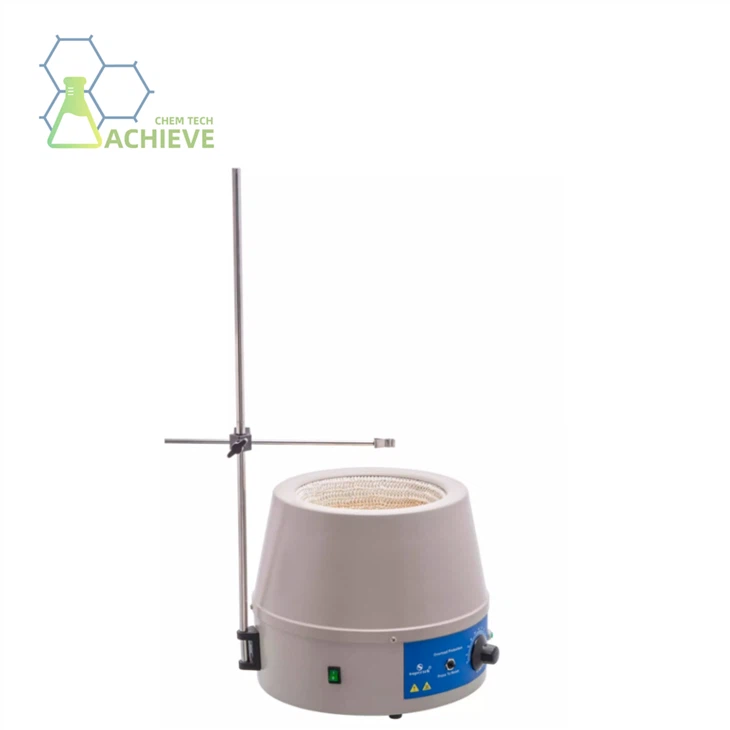
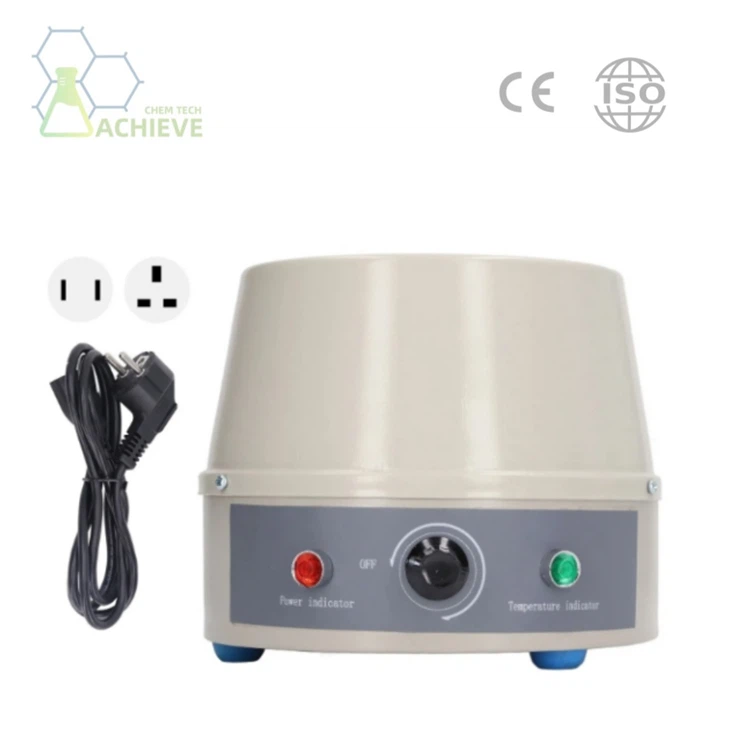


Heating Mantle Manual
Feature: Heating Function
Capacity: 100ML/250ML/500ML/1,000ML/2,000ML/3,000ML/5,000ML/10,000ML/20,000ML
2.Digital Temperature Control Type
Feature: Heating Function, Temperature Display, Temperature Sensor
Capacity:100ML/250ML/500ML/1,000ML/2,000ML/3,000ML/5,000ML/10,000ML/20,000ML/50,000ML
3.Digital Magnetic Type
Feature: Heating Function, Temperature Display, Temperature Sensor, Magnetic Stirring
Capacity:100ML/250ML/500ML/1,000ML/2,000ML/3,000ML/5,000ML/10,000ML/20,000ML/50,000ML
4.Digital Display Constant Temperature Magnetic Force
Feature: Heating Function, Temperature Display, Time Display, Temperature Sensor, Magnetic Stirring, Timer
Capacity:100ML/250ML/500ML/1,000ML
Description
Technical Parameters
A heating mantle is a fabric or flexible material that is wrapped around a container, such as a flask or reactor. The mantle is then connected to a power source, which heats the material and, consequently, the contents of the container. The design of the heating mantle allows for even heat distribution, preventing hot spots and ensuring that the contents are heated uniformly. It is a critical piece of equipment in various scientific and industrial settings, particularly in laboratories where precise temperature control is essential.
It operates on the principle of convective heat transfer. When the mantle is connected to a power source, it begins to generate heat. This heat is then transferred to the container and its contents through convection currents. The fabric or material of the mantle plays a crucial role in this process, as it must be able to withstand high temperatures while also providing effective heat transfer.
The heating mantle manual should contain a wealth of information to guide users to use the heating sleeve correctly and safely, and provide comprehensive user service and support. This information will help users better understand the performance and characteristics of the heating sleeve, improve the efficiency and safety of use.
The heating mantle is mainly used in chemical laboratories for constant heating of reactants that need to be heated. It provides uniform heat distribution and avoids localised overheating, thus ensuring the smooth running of chemical reactions.
Product Feature

◆ Adjustable temperature: Heating temperature can be adjusted according to experimental requirements.
◆ Constant temperature control: Through electronic or digital temperature control system, maintain the stability of heating temperature.
◆ Safety protection: Some products have functions such as broken pair protection and overheating protection to ensure safe use.
◆ Strong applicability: suitable for different capacity and shape of the flask, beaker and other containers.
Product Parameter


Technical Specifications
Refer to the technical specifications provided by the manufacturer for detailed information on the heating mantle's capabilities and limitations. Key specifications include:
|
|
◆ Power Rating: The maximum power consumption of the heating mantle. ◆ Temperature Range: The minimum and maximum temperatures the heating mantle can achieve. ◆ Dimensions: The size of the heating mantle, including its inner and outer diameters and height. ◆ Material: The materials used in the construction of the heating mantle, such as fiberglass, silicone, or ceramic. ◆ Compatibility: The types of vessels and containers the heating mantle is compatible with. |

What should I do the manchine in case of danger?
When the heating sleeve is in danger, such as overheating, short circuit, fire, etc., the following measures should be taken immediately to ensure the safety of personnel and minimize losses:
◆ Cut off the power supply
The first step: immediately cut off the power supply of the heating sleeve to prevent the current from continuing to pass, to avoid the expansion of the fire or the occurrence of electric shock accidents. This can be done by unplugging the power or turning off the circuit switch.
◆ Alarm and evacuation
Alarm: Quickly call the local fire department (such as 119), report the fire situation to the fire department, and provide details of the address and fire scene.
Evacuation: In accordance with the established evacuation routes and assembly points, quickly and orderly evacuation of personnel to a safe area. Avoid elevators and choose stairs for evacuation.
◆ Initial fire suppression
Use a fire extinguisher: If the fire is small and can be controlled, use a fire extinguisher to extinguish the fire initially while ensuring your own safety. Commonly used fire extinguishers are dry powder fire extinguishers, carbon dioxide fire extinguishers, etc., should pay attention to the spray direction when using, as close as possible to the flame root to fight.
Note: Do not use water to extinguish the fire, because the heating jacket is an electrical device, and the water will conduct electricity and increase the risk of electric shock. At the same time, avoid using other fire extinguishing agents with electrical conductivity.
◆ Cooperate with the fire department
Provide information: After the fire department arrives at the scene, it should provide the fire commander with relevant information about the fire scene in time, such as the cause of the fire, the fire situation, and whether there are people trapped.
Assist in fire fighting: under the command of firefighters, cooperate with them in fire fighting to ensure the smooth operation of fire fighting.
◆ Follow-up Procedure
Check equipment: After extinguishing the fire, you should thoroughly inspect the electric heating jacket and other related equipment to confirm whether it is damaged and assess the need for repair or replacement.
◆ Summary and improvement
Summarize and analyze the fire accident, find out the cause of the accident and existing problems, formulate improvement measures and strengthen safety training to prevent similar accidents from happening again.
Safety Considerations
Safety is paramount when using a mantle. Here are some important safety considerations to keep in mind:
◆ Electrical Safety: Always ensure that the mantle is connected to a grounded electrical outlet. Avoid using damaged or frayed power cords.
◆ Fire Safety: Keep flammable materials away from the mantle and never leave it unattended while in use. Have a fire extinguisher nearby in case of an emergency.
◆ Heat Safety: Wear heat-resistant gloves and protective clothing when handling hot containers or working near the mantle.
◆ Chemical Safety: Be aware of the chemicals you are using and their potential hazards. Follow all safety procedures and guidelines for handling hazardous materials.
Troubleshooting Common Issues
Despite careful use and maintenance, mantles may occasionally encounter problems. Here are some common issues and troubleshooting tips:
|
|
◆ Heating Slowly or Not at All: Check that the power cord is securely plugged into the outlet and that the outlet is functioning correctly. Verify that the temperature control is set to the desired temperature and that the heating element is not damaged.
◆ Overheating: Ensure that the temperature control is set correctly and that the over-temperature protection feature is functioning. If the mantle continues to overheat, discontinue use and contact the manufacturer for assistance.
◆ Uneven Heating: Check that the container being heated is centered within the mantle and that there are no obstructions between the heating element and the container. Uneven heating may also be caused by damaged insulation or a malfunctioning heating element.
◆ Unusual Noises: If the machine emits unusual noises during operation, discontinue use immediately and inspect it for any signs of damage or malfunction. |

Error range of temperature stability test
Source of error
Heating sleeve itself
The design, manufacturing accuracy and material selection of the heating jacket will directly affect its temperature stability.
The distribution of the heating element, the power, and the location and accuracy of the temperature sensor also affect the accuracy of the test results.
Test environment
External factors such as temperature fluctuations, airflow and humidity in the test environment may affect the temperature stability of the heating jacket.
Interference from external heat sources or cold sources may also lead to errors in test results.
Test equipment
The accuracy and response time of the thermometer or thermocouple will directly affect the accuracy of the test results.
The accuracy and stability of the data recording equipment will also affect the reliability of the test data.
Test method
The choice of test method, the arrangement of test points and the determination of test time will affect the error range of test results.
If the test method is not reasonable or the test point is not properly arranged, the test result may not accurately reflect the temperature stability of the heating jacket.
Error range analysis
General margin of error:
Under normal circumstances, the error range of the temperature stability test of the heating jacket should be controlled within a certain range to ensure the accuracy and reliability of the test results.
The specific error range should be determined according to the use scenario, performance requirements and test standards of the heating sleeve.
Specific error value:
Due to the different types of heating sleeves, specifications and test conditions, the specific error value will also be different.
In general, high-quality heating sleeves under good test conditions, the temperature stability test error range can be controlled in a small range, such as ±0.5 ° C or smaller.
For some special purpose heating sleeves, such as high-precision temperature control heating sleeves, the error range of the temperature stability test may need to be controlled within a smaller range, such as ±0.1 ° C or less.
Methods to reduce errors
Improve the quality of heating sleeve
Optimize the design of heating jacket, improve the manufacturing precision and material quality.
Reasonable arrangement of heating elements and temperature sensors can improve the accuracy and stability of temperature control.
Improve the test environment
Strictly control the external factors such as temperature and air flow of the test environment to avoid the impact on the test results.
Keep the test environment clean and dry to avoid interference from external heat or cold sources.
Improve test equipment accuracy
Choose a thermometer or thermocouple with high accuracy and stability for testing.
Use highly accurate and stable data recording equipment for data recording and analysis.
Optimized test method
Select reasonable test methods to ensure the accuracy and reliability of test results.
Reasonable arrangement of test points to ensure that the temperature distribution of the heating jacket can be fully reflected.
Hot Tags: heating mantle manual, China heating mantle manual manufacturers, suppliers, factory, Chemglass Jacketed Reactor, Rotary Evaporator Distillation, Short Path Distillation Equipment, 5l Glass Reactor, Molecular Distillation Unit, Autoclave For Hydrothermal Synthesis
Previous
1000ml Heating MantleNext
5l Heating MantleSend Inquiry


