



Laboratory Magnetic Stirrer
(1)LCD/Double Knob/Timmer/Heating Plate
(2)Stirring Volume:5L
2. Large Capacity Magnetic Stirrer
(1)Double Knob/DC Brushless Motor/100~240V/5~40°C 80%RH
(2)Stirring Volume:10L/20L/50L
3. Multi Link Magnetic Stirrer:
(1)Double Knob/LCD/100~240V/100~1500RPM
(2)Stirring Volume:3*1/6*1/9*1
4. Mini Magnetic Stirrer:
(1)Miniature Brushless Motor/Stepless Speed Regulation/0~2000RPM/AC 220V 50Hz
(2)Stirring Volume:2L
5. Single Control Multi Connection Magnetic Stirrer:
(1)LED Digital/0~1600RPM/RT±5~99.9°C/220V 50/60Hz
(2)Stirring Volume:4*1/6*1
***Price List for whole above, inquire us to get
Description
Technical Parameters
Laboratory magnetic stirrer is a type of laboratory equipment primarily used for mixing liquids or liquid solutions. By driving the agitator to rotate through a magnetic field, the goal of uniformly mixing liquids is achieved. There are usually composed of a magnetic drive and a stirrer, which is usually made of stainless steel or polytetrafluoroethylene material and has high corrosion resistance and wear resistance. There are widely used in fields such as chemistry, biology, and medicine, and are one of the essential equipment in experimental research.
Parameters
Magnetic stirrer
It is a laboratory instrument capable of agitating or mixing up to 5 liters of liquid using a rotating magnetic field.


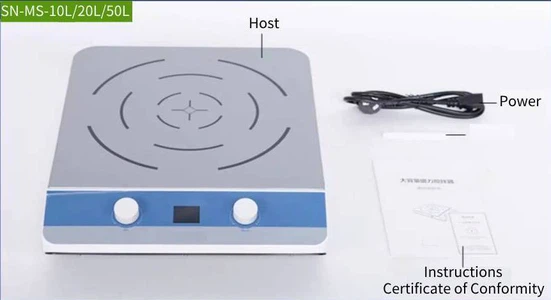
Large capacity magnetic stirrer
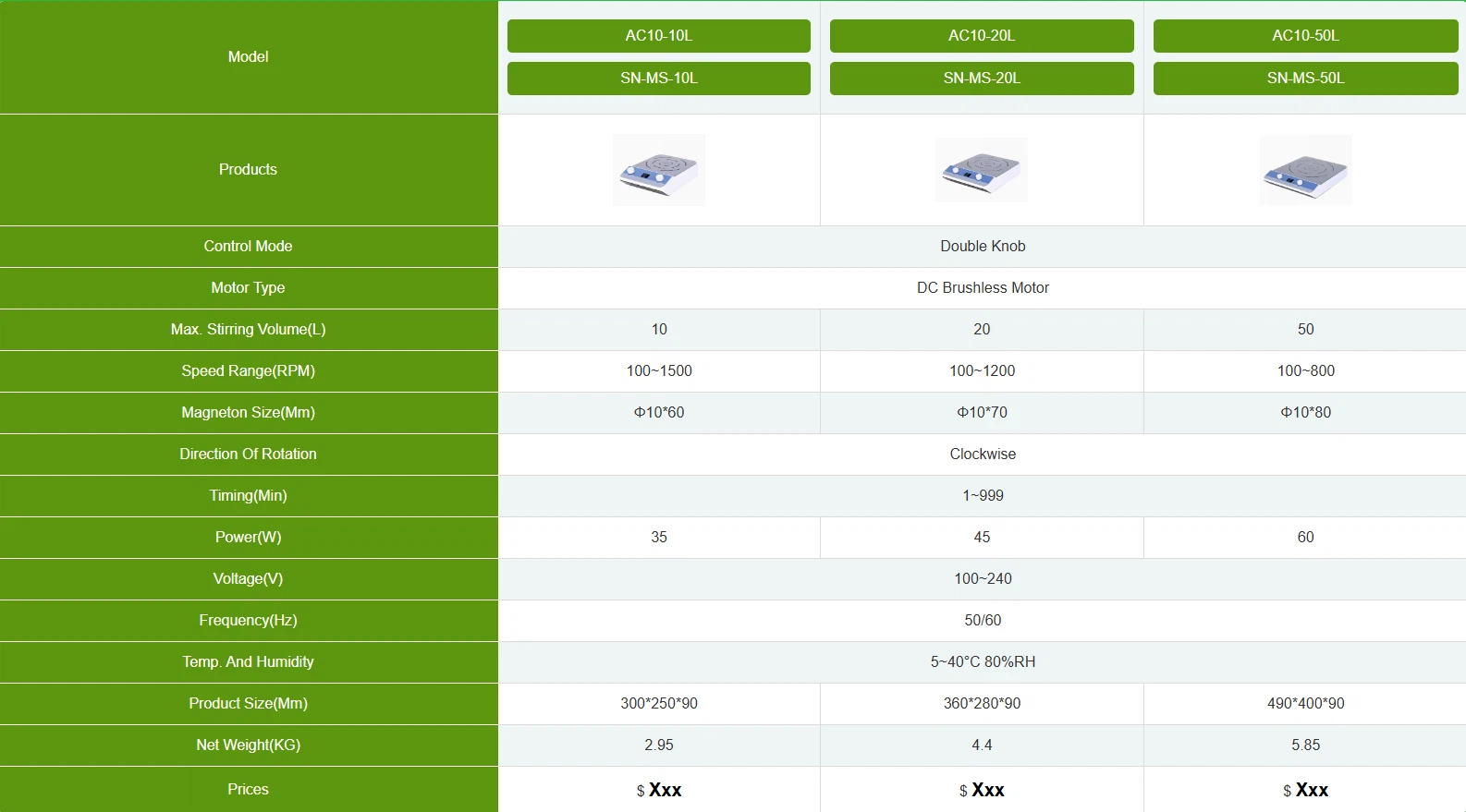
It ia a laboratory instrument designed to stir or mix large amounts of liquid using a rotating magnetic field, typically exceeding the standard capacity. Our high-capacity magnetic mixers include 10 liters, 20 liters, and 50 liters.
Multi link magnetic stirrer
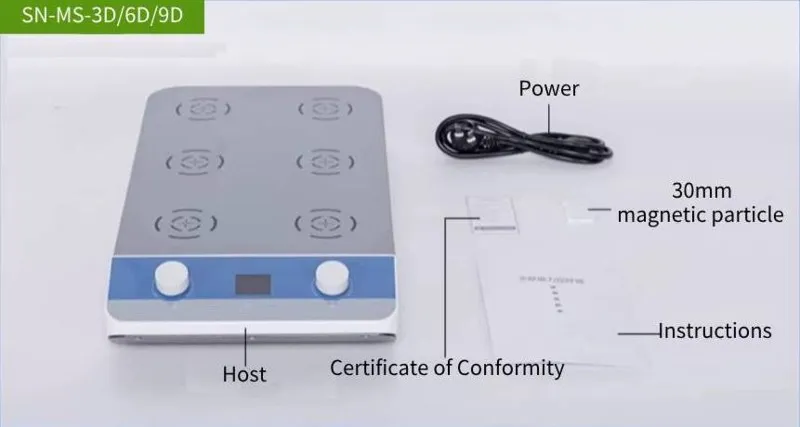
A product is a laboratory equipment that allows the use of a single control unit to simultaneously control it. We have three types of product: three, six, and nine.

Mini magnetic stirrer
The product is a compact laboratory instrument used for small-scale stirring or mixing of liquids using a rotating magnetic field.


Single Control multi connection magnetic stirrer
The product provides the function of individually controlling each stirrer, allowing users to independently adjust and control the speed and other parameters of each stirrer.


Structure
The structure of a laboratory apparatus typically consists of the following components:
Base: The base provides stability and houses the motor and control electronics. It is usually made of durable materials such as metal or high-quality plastic.
Motor: The motor is responsible for generating the rotational motion of the magnetic stir bar. It is usually an electric motor, either brushless or brushed, located inside the base.
Control Panel: The control panel is mounted on the base and includes various controls and indicators. It allows users to adjust the stirring speed, start/stop the motor, and sometimes control additional features like temperature or timer functions.
Stir Plate: The stir plate is where the magnetic stir bar is placed for stirring. It is typically a flat, circular surface made of chemically-resistant material such as glass or ceramic. The stir plate may have a non-slip surface or magnetic coating to ensure secure placement of the vessel.
Magnetic Stir Bar: Also known as a flea or stir bar, it is a small magnetic rod or disc-shaped object made of a magnetically susceptible material (e.g., PTFE coated magnetic material). The magnetic stir bar is placed inside the vessel containing the liquid to be stirred. When the magnetic field generated by the rotating magnetic field of the stirrer interacts with the magnetic stir bar, it causes the stir bar to rotate, creating the stirring action.
Power Supply: The laboratory apparatus requires an electrical power supply to operate. It is typically connected to a standard AC power outlet.

Applications
Apparatus are widely used in experimental operations, scientific research, industrial production, and safety, mainly reflected in the following aspects:

Applied in those fields
1. Chemical experimental field: It play an important role in chemical experiments. In many chemical reactions, it is necessary to continuously stir the solution to promote the progress of the reaction. A apparatus can drive the agitator to rotate through a magnetic field, providing a stable and continuous stirring effect, ensuring the smooth progress of chemical reactions. This can not only improve the efficiency of the experiment, but also ensure the accuracy and reliability of the experimental results.
2. Biological experimental field: In biological experiments, especially those involving cell culture, microbial growth, etc., apparatus are also an indispensable tool. When cultivating cells or microorganisms, it is necessary to provide a constant temperature and a uniform nutritional environment. It promotes the uniform distribution of nutrients by stirring the solution, and with the heating function, it can precisely control the temperature of the culture environment, providing the best conditions for the growth of cells or microorganisms.
3. Medical research field: In medical research, such as drug development, cell culture, tissue engineering, etc., it also play a key role. Through precise temperature control and stable stirring effect, it can provide high-quality experimental conditions for medical research, promote drug development and progress in medical research.
4. Industrial production field: In industrial production, a large number of mixing and stirring operations are essential. There are widely used in various industrial production processes for liquid mixing and stirring due to their high efficiency, stable stirring performance, and easy operation. It can improve production efficiency, reduce energy consumption, and enhance product quality and stability.
5. Research field: In the field of scientific research, there are also important experimental tools. When conducting various basic and applied research, researchers need to use apparatus for a large amount of liquid mixing and heating operations. It can provide stable and efficient experimental conditions, helping researchers quickly obtain accurate experimental results.
Classification
Classification by mixing method:
Continuous stirring type: suitable for experiments with long-term continuous stirring, providing stable and continuous stirring effects.
Intermittent mixing type: suitable for short-term and intermittent mixing needs, able to quickly achieve mixing effects, suitable for experiments that require frequent start and stop.
Classification by heating method:
Electric heating: heated by electric heating elements, it has the advantages of precise temperature control and uniform heating.
Hydrothermal: heated by hot water or other liquid medium, suitable for experiments that require higher temperatures.
Classification by container type:
Test tube type: suitable for stirring small containers, such as test tubes, centrifuge tubes, etc.
Beaker type: suitable for medium capacity stirring, such as beakers, culture dishes, etc.
Large capacity type: suitable for stirring large containers, such as reaction vessels, fermentation tanks, etc.
Classification by functional extension:
Integrated magnetic stirrer: In addition to basic stirring functions, it also integrates other experimental functions such as heating, cooling, pH control, etc.
Modular magnetic stirrer: With a modular design that can be disassembled and replaced, different modules can be added or replaced according to experimental needs, such as heating modules, cooling modules, etc.
Classification by degree of automation:
Manual control type: requires manual adjustment of mixing speed and temperature, suitable for simple and small-scale experiments.
Automatic control type: With automatic control function, it can automatically adjust the mixing speed and temperature according to the preset program, suitable for large-scale and complex experiments.
Classification by size:
Small household size: Small in size, lightweight and easy to carry, suitable for use in households or small laboratories.
Professional large-scale: larger in size and more powerful in functionality, suitable for use in large laboratories or industrial production.
Classification by material:
Stainless steel type: Stainless steel mixers and containers are suitable for most chemical experiments and industrial production.
PTFE type: Mixers and containers made of PTFE material are suitable for highly corrosive chemical experiments.
Classification by purpose:
Research oriented: suitable for research institutions and university laboratories, with high accuracy and stability.
Industrial production type: suitable for industrial production lines, with strong durability and reliability.
Introduction to the usage steps of laboratory magnetic stirrer

This step demonstrates the two main components of the device - an unassembled mixing rod (or magnetic drive rod) and a bracket. The user first needs to check whether all accessories are complete and intact, and then assemble the bracket according to the instructions or diagram. The bracket is a key part that fixes the equipment and supports the mixing rod.
In this step, the user needs to install the stirring rod (usually equipped with magnetic components to drive the rotation of the magnet inside the container) on the bracket and ensure its stability. Subsequently, the user needs to place the Y instrument next to the container containing the solution and align the magnet on the stirring rod (if the stirring rod itself does not have a magnet, a magnet needs to be pre placed in the container) with the magnet inside the container. At this point, the user should slowly adjust the mixing knob on the mixer to control the mixing speed, while observing whether the magnet starts to rotate.
This step may be somewhat misleading, as the device usually does not directly use a "stirring rod", but instead uses magnetic force to drive the rotation of magnetic particles inside the container to stir the solution. However, if the "stirring rod" here refers to a magnet or stirring rod, then this step emphasizes correctly inserting the magnet (or magnetic part on the stirring rod) into the solution, ensuring that it can be driven by magnetic force and effectively stir the solution. At this point, the mixer should be ready for the next step of operation.
After confirming that all settings are correct, the user can officially turn on the mixer to rotate the magnet in the solution, thereby achieving uniform stirring of the solution. At this point, the indicator light on the mixer (if any) may light up, indicating that the mixer is working. Users can adjust the stirring speed and time according to experimental needs.
Bottom tip: The words "Ready to stir" indicate that the instrument is ready for mixing operations and users can begin their experiments.
Hot Tags: laboratory magnetic stirrer, China laboratory magnetic stirrer manufacturers, suppliers, factory, SS Reactor, SS316 Reactor, Rotovap Machine, Glass Reactor Laboratory, Stainless Steel Reactor, Molecular Distillation Unit
Previous
Rotavapor DistillationSend Inquiry
You Might Also Like


