



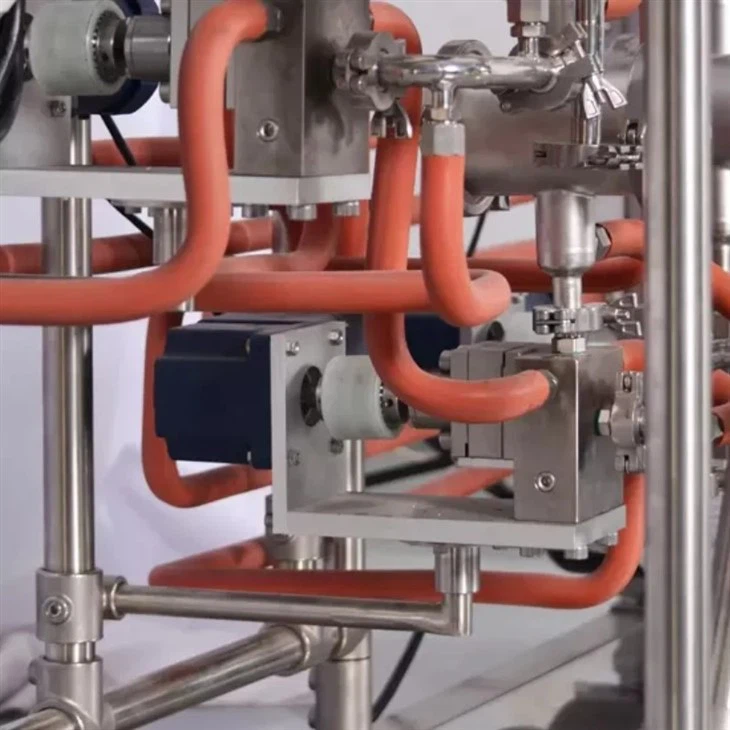


SPDU
Example: The specification list of distillation for CBD
(1) Laboratory Test (<20L)
NCF-10A, NCF-20A, NCF-30A, NCF-50A
(2) Pilot Production (20L<100L)
NCF-100, NCF-200
(3) Industrial Production (100L<300L)
NCF-500
2. Customization
The details pls download The Request List of Short Path Distillation
(1)Design support
(2) Directly supply the Senior R&D organic intermediate, shorten your R&D time and cost
(3) Share the advanced purifying technology with you
(4) Supply the high quality chemicals and analysis reagent
(5) We want to assist you on Chemical Engineering (Auto CAD, Aspen plus etc.)
3. Assurance
(1) CE and ISO certification Registered
(2) Trademark: ACHIEVE CHEM(since 2008)
(3) Replacement parts within 1-year for free
Description
Technical Parameters
The core of the SPDU typically consists of a vacuum chamber, a heating source, a condenser, and a collection vessel. By operating under reduced pressure, the boiling point of the material is lowered, further enhancing the gentleness of the process. The heating element, often a bath filled with silicone oil or water, uniformly heats the distillation flask containing the sample.
Short-range distillation unit is a kind of separation equipment with high efficiency and environmental protection, which has a wide application prospect and significant technical advantages. With the continuous progress and innovation of technology, it will play an important role in more fields. At present, there are many brands of short-range distillation units on the market, these devices have differences in material, specifications, performance, etc., and the price range is also wide, ranging from several thousand yuan to several hundred thousand yuan. Users can choose the right equipment according to their needs and budget.

Types

Applications
|
SPDU plays an important role in the application of cowboy refining high-carbon alcohol (also known as stearyl alcohol). Stearyl alcohol, also known as octadecyl alcohol, is a fatty alcohol with a distinct chemical structure characterized by an eighteen-carbon chain attached to a hydroxyl group (-OH). This long-chain alcohol finds its place in various industrial and consumer applications due to its unique properties. Derived primarily from natural fats and oils through a process involving hydrolysis and hydrogenation, stearyl alcohol is a waxy, white, solid substance with a mild, characteristic odor. Its molecular weight and saturated nature contribute to its stability and resistance to oxidation, making it an ideal component in formulations requiring durability and stability. In the cosmetics industry, stearyl alcohol serves as an emulsifier, stabilizer, and thickening agent. It helps create smooth, creamy textures in lotions, creams, and hair care products, enhancing their spreadability and moisturizing effects. Additionally, its emollient properties make it beneficial for soothing and protecting the skin. Furthermore, stearyl alcohol finds use in the manufacturing of surfactants, lubricants, and polymers. In surfactants, it aids in reducing surface tension, enhancing cleaning capabilities. As a lubricant, it minimizes friction and wear in mechanical parts. In polymer production, it acts as a modifier, influencing the final product's hardness, flexibility, and durability. |
|

Separation and purification
Separate and purify high-carbon alcohol refined by denim. In this process, by heating and distilling the mixture, different components are separated at different temperatures, thus obtaining high-carbon alcohol products with high purity.
Impurities removal
Such as residual fatty acids, esters and other unnecessary components, in the refined high-carbon alcohol of denim. By adjusting the temperature and pressure, impurities can be selectively removed and the purity and quality of products can be improved.
Controlling product properties
Control specific properties of products, such as boiling point range, viscosity and color of target products. By adjusting the operating conditions, the product performance can be customized.
Visual Window
Visual window of SPDU refers to the window designed on short-range distillation unit for observing and monitoring distillation process.
Material selection
The visual window of distillation unit is usually made of materials with high transparency, high temperature resistance and corrosion resistance, such as high-quality glass or special alloy. This can ensure that the operator can clearly see the changes and products in the distillation process.
01
Design location
The visualization window is usually located between the evaporator and condenser of the device, so as to observe the flow and phase change of liquid in the device. Sometimes, visual windows are also set at other key locations such as collection bottles or fractionators.
02
Safety protection
In order to ensure the safety of operators, the visual window of unit usually has explosion-proof and leak-proof functions. For example, an explosion-proof device may be added to the edge of the window to prevent the window from breaking, and a sealing device may be provided to prevent gas or liquid from leaking.
03
Observation mode
The visualization window is usually designed as a transparent plate or a cylinder, which is convenient for operators to observe the distillation process through the window. Some visualization windows will also be equipped with magnifying glasses or cameras and other auxiliary devices to provide a clearer observation effect.
04
Cleaning and maintenance
The design of visual window should be considered for easy cleaning and maintenance. Some windows may be easily removed or opened for cleaning or replacement.
05
The working principle of the cooling system
In SPDU distillation units, the cooling system works in a relatively simple but efficient way. When the steam enters the condenser, it exchanges heat with the cooling medium, transferring heat to the cooling medium and condensing itself into a liquid. The cooling medium is constantly flowing under the action of the circulating pump, taking the heat away from the condenser and dissipating to the environment. The precise control of the temperature control system ensures that the temperature of the condenser outlet liquid is always maintained within the set range.
The cooling system characteristics and requirements


High efficiency condensation:
The cooling system should have an efficient condensing capacity that can quickly condense steam into a liquid to reduce heat loss and material degradation.
Precise temperature control:
The temperature control system should be able to achieve accurate temperature control of the cooling medium to ensure that the temperature of the condenser outlet liquid meets the product requirements.
Strong corrosion resistance:
The material and structure of the cooling system should have good corrosion resistance and be able to resist the erosion of the equipment by the chemicals in the distilled material.
Easy to maintain and operate:
The cooling system should be designed for easy disassembly and cleaning to reduce maintenance costs and time. At the same time, the operation interface should be intuitive and easy to use, convenient for operators to monitor and adjust.
Energy saving and environmental protection:
The cooling system should adopt energy-saving and environmental protection design and technology to reduce energy consumption and environmental pollution. For example, you can choose to use efficient cooling media and circulating pumps, as well as technologies such as waste heat recovery to reduce energy consumption.
Configuration of safety facilities and equipment
As an indispensable separation equipment in chemical, pharmaceutical and other fields, the operation process of short-range distillation unit involves high temperature, high pressure, flammable and explosive risk factors, therefore, well-configured safety facilities and equipment are of vital significance to ensure production safety and prevent accidents. The following is a detailed discussion of the safety facilities and equipment configuration of the short-range distillation unit.
The configuration of safety facilities
Function: The safety valve is one of the most commonly used safety facilities in the distillation unit, and its function is to automatically open when the internal pressure of the distillation unit exceeds the set value, release the internal pressure, and prevent the equipment from being damaged or exploded due to overpressure.
Configuration points: The selection of safety valve should be selected according to the actual working conditions and pressure requirements of the distillation unit to ensure that it can be opened quickly and accurately when needed. At the same time, the safety valve should be regularly checked and maintained to ensure its stable and reliable performance.
Function: The temperature sensor is used to detect the temperature change inside the equipment, and sends an alarm signal when the temperature exceeds the set value, reminding the operator to take measures in time to prevent safety accidents caused by excessive temperature.
Configuration points: The temperature sensor should be installed in the key parts of the distillation unit, such as the heating area, the condensing area, etc., to ensure that the temperature inside the equipment can be accurately reflected. At the same time, the accuracy and response time of the temperature sensor should also meet the requirements of the relevant standards.
Function: The liquid level sensor is used to detect the change of the liquid level inside the distillation unit, and sends an alarm signal when the liquid level is too high or too low to prevent safety accidents caused by abnormal liquid level.
Configuration points: The liquid level sensor should be installed in the key parts of the distillation unit, such as the liquid storage tank or still, and set a reasonable liquid level alarm value according to actual needs. At the same time, the accuracy and reliability of the liquid level sensor should also be guaranteed.
Function: The gas detector is used to detect the concentration of harmful gases in the environment around the distillation unit, such as combustible gases, toxic gases, etc., when the concentration of harmful gases exceeds the set value, it sends an alarm signal to remind the operator to take measures in time.
Configuration points: The gas detector should be installed in the operating area of the distillation unit or the area that may leak harmful gases, and select the appropriate detection gas type and alarm value according to the actual needs. At the same time, the gas detector should be regularly verified and maintained to ensure its stable and reliable performance.
Function: explosion-proof electrical appliances are designed for use in flammable and explosive environments and electrical equipment, with explosion-proof, dustproof, waterproof and other functions, to prevent the failure of electrical equipment caused by explosion accidents.
Configuration points: In the operation area of the short-range distillation unit or the area that may produce flammable and explosive gases, explosion-proof electrical equipment that meets the relevant standards should be configured, such as explosion-proof switches and explosion-proof lights. At the same time, the installation, use and maintenance of explosion-proof electrical equipment should also meet the requirements of relevant standards.
The configuration of security equipment

Fire protection equipment
Configuration content: including fire extinguisher, fire hydrant, fire hose, etc., used to quickly fight the initial fire in the event of a fire, to prevent the spread of fire.
Key points of configuration: Fire protection equipment should be configured in the operating area of the distillation unit or in the area where fire may occur, and ensure that its number, type and performance meet the actual needs. At the same time, fire protection equipment should be inspected and maintained regularly to ensure that it is in a good standby state.
Emergency shutdown system
Function: Emergency shutdown system is a kind of safety equipment that can quickly cut off the power source or control signal of the distillation unit in an emergency, so that the equipment stops running.
Configuration points: The emergency shutdown system should be set in the key parts of the distillation unit, such as the control room, the operation table, etc., and ensure that it can quickly and accurately cut off the power source or control signal in an emergency. At the same time, the emergency shutdown system should be inspected and tested regularly to ensure its stable and reliable performance.


Personal protective equipment
Contents: Including protective clothing, protective gloves, protective glasses, and respiratory protective equipment, used to protect the operator from harmful substances or dangerous factors such as high temperature and high pressure during operation.
Personal protective equipment should be selected according to the operational characteristics and potential hazards of the short-range distillation unit, and ensure that it meets the requirements of the relevant standards. At the same time, enterprises should regularly check and maintain personal protective equipment to ensure that it is in good condition.
Management of safety facilities and equipment
Regular inspection and maintenance
Content: Regular inspection and maintenance of safety facilities and equipment to ensure stable and reliable performance.
Measures: Make a detailed inspection and maintenance plan, clarify the inspection content and maintenance cycle, and assign special personnel to be responsible for implementation. At the same time, establish inspection and maintenance record files for traceability and inquiry.
Training and exercise
Content: Conduct training and emergency drills on the use of safety facilities and equipment for operators to improve their safety awareness and emergency handling capabilities.
Measures: Regularly organize operators to conduct safety training, explaining the use methods and precautions of safety facilities and equipment. At the same time, emergency drill activities were carried out to simulate real accident scenarios and test the emergency handling ability and cooperative combat ability of operators.
Update and upgrade
Content: According to technological development and actual needs, timely update and upgrade safety facilities and equipment to improve their performance and reliability.
Measures: Pay attention to industry trends and technology development trends, and keep abreast of new safety facilities and equipment information. According to the actual needs and economic conditions, gradually update and upgrade the existing safety facilities and equipment to improve the level of production safety.
To sum up, the configuration of safety facilities and equipment of spdu is an important link to ensure production safety and prevent accidents. The enterprise should reasonably allocate safety facilities and equipment according to the actual needs and requirements of relevant standards, and strengthen its management and maintenance to ensure the smooth progress of the production process and the personal safety of the operator.
Hot Tags: spdu, China spdu manufacturers, suppliers, factory, 50l Rotary Evaporator, 50l Rotovap, High Pressure Lab Reactor, Stainless Steel Chemical Reactor, Rotating Evaporator, Rotary Evaporators
Send Inquiry


