



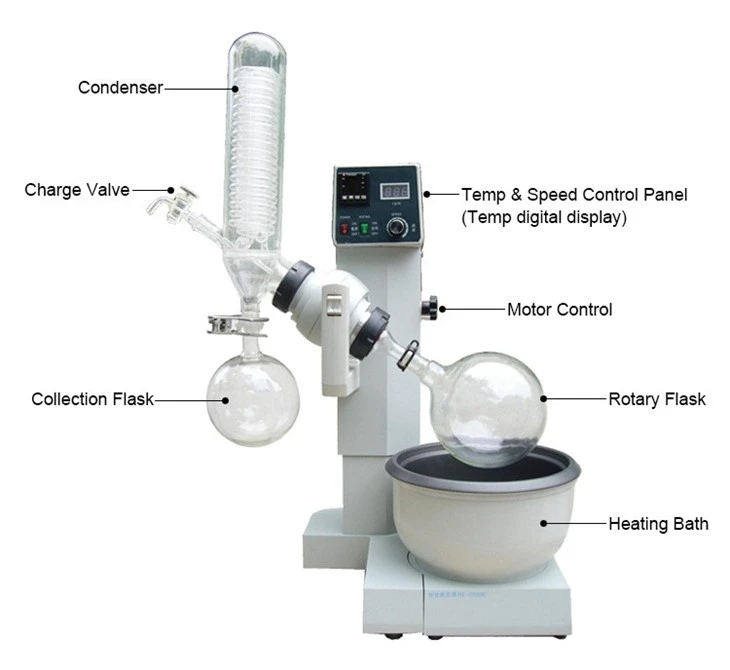


10l Rotovap
(1)1L/2L---Manual lifting with irony base/Manual lifting with SS base/Electric lifting
(2)3L/5L/10L/20L/30L/50L---Manual Lifting/Electric Lifting
***Price List for whole above, inquire us to get
2. Customization:
(1)Design support
(2)Directly supply the Senior R&D organic intermediate, shorten your R&D time and cost
(3)Share the advanced purifying technology with you
(4)Supply the high quality chemicals and analysis reagent
(5)We want to assist you on Chemical Engineering (Auto CAD, Aspen plus etc.)
3. Assurance:
(1)CE and ISO certification Registered
(2)Trademark: ACHIEVE CHEM(since 2008)
(3)Replacement parts within 1-year for free
Description
Technical Parameters
The 10L rotovap, as an indispensable high-performance equipment in the laboratory, cleverly integrates efficient evaporation technology with flexible capacity adjustment in its design. This instrument not only inherits the excellent performance of the rotary evaporator family in solvent recovery, concentration and purification, but also meets the unique needs of researchers in processing medium-sized samples through its specific 10 liter capacity setting. Structurally, the core component of the 10L rotary evaporator is a carefully designed evaporation bottle, whose spacious capacity allows for the simultaneous loading of a relatively large amount of liquid to be evaporated, thereby improving work efficiency and reducing the frequency of sample or solvent replacement. Meanwhile, the rotating design of the evaporator bottle is the essence of the entire equipment. The centrifugal force generated by rotation effectively increases the contact area between the liquid and the heating source, accelerates the evaporation rate of the solvent, and avoids sample loss or deterioration caused by local overheating. Compared with small rotary evaporators, the 10L model undoubtedly has an advantage in processing capacity and can easily meet larger scale experimental needs; Compared with large equipment, it has higher flexibility and economy, does not require too much laboratory space, and reduces operating costs. Therefore, for laboratories that require frequent medium-sized sample processing, 10L is undoubtedly an ideal choice.

We provide 10L rotovap, please refer to the following website for detailed specifications and product information.
Product: https://www.achievechem.com/chemical-equipment/rotary-evaporators.html
Product Applications
The 10L rotovap, or 10-liter rotary evaporator, has various common applications and requires attention to specific operational details for optimal use. Additionally, there are ways to improve the efficiency of a 10L rotovep's operation.
Rotary evaporator is a commonly used laboratory equipment in the fields of chemistry, pharmaceuticals, materials science, etc., mainly used for concentration, distillation, separation and purification of solutions. One of its core components is the evaporator bottle, which comes in various types to meet different experimental needs. Below, we will provide a detailed introduction to several common types of rotary evaporator evaporation bottles.

Round bottom flask
The round bottom flask is the most commonly used type of evaporator in rotary evaporators, with a conical flask body with a circular bottom. This design not only has good sealing performance, but also effectively reduces volatilization loss, making the experimental process more stable and efficient. The material of round bottom flasks is mostly glass, which has excellent corrosion resistance and heat resistance, and can withstand various chemical reagents and high temperature environments commonly used in experimental processes. In addition, glass material also has high transparency, making it easy to observe the solution state and changes during the experimental process.
Negative pressure bottle
Negative pressure bottles are similar in shape to round bottom flasks, but may differ in the design of the bottle mouth and threads. This design is usually intended to better adapt to operations in negative pressure environments, ensuring the sealing and stability of the system during the experimental process. Negative pressure bottles are also suitable for experimental scenarios that require high vacuum or low boiling point solvent evaporation. When choosing a negative pressure bottle, special attention should be paid to its sealing performance and pressure resistance to ensure experimental safety.


Flat bottomed bottle
Flat bottomed bottles are mainly used in experimental scenarios where heating or mixing of samples is required during rotary evaporation. Due to its flat bottom, it can be placed more stably on the heating source, which is conducive to uniform heat transfer and uniform heating of the sample. Flat bottomed bottles are commonly used for dissolving solid samples or conducting experiments using acidic and alkaline solutions. However, it should be noted that flat bottomed bottles may generate significant vibrations and noise during rotation, so special attention should be paid to their stability and safety when used.
Imported pacifier bottles
Imported pacifier bottle is a specially designed evaporator bottle, characterized by a pacifier device installed at the bottle mouth. This pacifier can effectively control the dripping speed of the solution, making the sampling process more precise and controllable. Therefore, imported pacifier bottles are particularly suitable for experimental scenarios where samples are manually added or added in small quantities. In addition, the pacifier device can also play a certain buffering role, reducing the impact and vibration generated during the sample addition process, and protecting the stability of the experimental device and sample.


Special shaped evaporation bottle
In addition to the common types of evaporation bottles mentioned above, there are also some special shaped evaporation bottles, such as eggplant shaped flasks, pear shaped flasks, etc. These specially shaped evaporation bottles typically have larger capacities and more complex structures to meet the needs of specific experimental scenarios. For example, the eggplant shaped flask, due to its unique shape design, can more effectively collect evaporated solvents and residues; Pear shaped bottles, on the other hand, are more suitable for experimental scenarios that require precise control of solution volume and evaporation rate due to their narrow bottom and long neck.
Selection and considerations
Medium property
Medium type
Select the right rotary valve according to the type of medium transported (such as gas, liquid, slurry, etc.). Different media have different requirements for valve material, sealing performance and wear resistance.
Medium temperature
Consider the temperature range of the medium, select the valve material and seal structure that can adapt to the corresponding temperature. Extreme temperature conditions may exacerbate the corrosive effect of fluids on certain materials, so special attention is needed.
Medium pressure
Select the right valve according to the pressure requirements of the system to ensure that the valve can withstand the corresponding working pressure to avoid leakage or damage.
Medium characteristics
Such as the corrosive, abrasive, viscosity and other characteristics of the medium will also affect the selection of valves. For example, for abrasive materials, valve materials with good wear resistance should be selected.
Flow and pressure requirements

Flow characteristics
Different types of rotary valves have different advantages in terms of flow characteristics. According to the actual need to choose the appropriate type, such as straight through, adjustment, shear and so on.

Pipe diameter
The diameter range of the rotary valve is very large, and the appropriate pipe diameter needs to be selected according to the actual working conditions to ensure the on-off flow of the valve.

Pressure level
The rotary valve is designed according to different pressure levels, and the appropriate pressure level needs to be selected according to the actual working conditions.
► Installation and maintenance
1)Installation mode: The installation mode and connection mode of the rotary valve must match the pipeline system. Common installation methods include flange connection, threaded connection, etc.
2)Ease of maintenance: Consider the ease of maintenance of the valve, such as easy removal, cleaning and replacement of parts.
► Working environment and special requirements
1)Use environment: The use environment of the rotary valve also needs to be considered, such as whether there is a special industry standard, whether it needs to be treated with anti-corrosion, explosion-proof or anti-static.
2)Special requirements: If remote control, automatic adjustment and other special functions are required, the corresponding electric or pneumatic actuator should be selected.
► Cost and budget
1)Valve costs: Different types of valves have different associated manufacturing costs. The type of valve material and the intended control medium will affect the valve construction material to meet any particular requirements and budget.
2)Maintenance cost: Consider the maintenance cost of the valve, including regular maintenance, replacement parts and other costs.
► Brand and reputation
1) Brand selection: Select well-known brands and reputable suppliers to ensure product quality and after-sales service.
2) Product certification: Check whether the product has passed relevant certifications, such as ISO certification, API certification, etc., to ensure that the product quality meets international standards.
Development trend


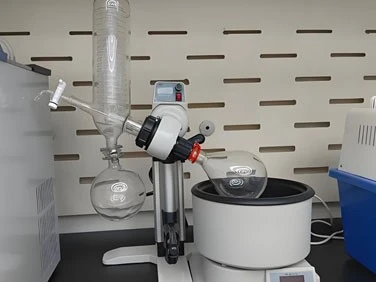

Automatic control: The future 10l rotovap will pay more attention to automatic control, integrate advanced sensors and control systems, achieve accurate control and automatic adjustment of temperature, speed, vacuum and other parameters, reduce manual intervention, improve experimental efficiency and repeatability.
Remote monitoring and operation: Through the Internet of Things technology, to achieve remote monitoring and operation of equipment, users can check the operating status of equipment anytime and anywhere through mobile phones or computers, parameter adjustment, improve the flexibility and convenience of the experiment.
Optimize the heating system: Use more efficient heating methods, such as electromagnetic heating, infrared heating, etc., to reduce energy loss and improve heating efficiency.
Vacuum system improvement: Optimize the vacuum pump and seal structure, improve the vacuum degree, reduce energy consumption, and reduce solvent volatilization and loss.
Energy-saving design: Incorporate energy-saving concepts into equipment design, such as standby mode, automatic shutdown and other functions to reduce energy consumption during long-term operation.
Modular design: The 10L rotary evaporator will adopt a modular design, and users can flexibly configure different functional modules according to the experimental requirements, such as condenser, receiving bottle, vacuum controller, etc., to improve the adaptability and scalability of the equipment.
Multi-function integration: Integrate a variety of functions in one, such as distillation, concentration, solvent recovery, etc., reduce the space occupied by experimental equipment, improve the efficiency of the laboratory.
Safety protection function: Add safety protection function, such as overheat protection, overvoltage protection, leakage protection, etc., to ensure the safety of the equipment during operation.
Explosion-proof design: For the experiment of handling flammable and explosive solvents, 10L rotary evaporator will adopt explosion-proof design to ensure the safety of the experiment.
Operation interface optimization: touch screen or liquid crystal display screen is used to provide intuitive operation interface, simplify operation process and reduce the threshold of use.
Ergonomic design: Integrate ergonomic concepts into the structural design of the equipment, such as reasonable operating height, comfortable holding sense, etc., to improve the user experience.
Green materials: The use of environmentally friendly materials manufacturing equipment to reduce pollution to the environment.
Solvent recovery and reuse: Optimize the solvent recovery system, improve the recovery rate of solvents, reduce the production of experimental waste liquid, in line with the development trend of green chemistry.
Compact design: Under the premise of ensuring performance, the 10L rotary evaporator will pay more attention to compact design, reduce the volume and weight of the equipment, and facilitate the layout and movement of the laboratory.
Portable design: For the needs of field experiments or field testing, the development of portable 10L rotary evaporator to meet the needs of different scenarios.
Data recording and analysis: The built-in data recording function of the device can record all parameters in the experiment process in real time, and process and analyze the experimental data through the data analysis software to help users optimize the experiment plan.
Intelligent management: Combined with laboratory information management system (LIMS), to achieve intelligent management of equipment, such as equipment reservation, use records, maintenance reminders, etc., to improve the management efficiency of the laboratory.
Personalized customization: According to the special needs of users, provide personalized customized services, such as special materials of evaporation bottles, non-standard size equipment, etc., to meet the experimental needs of different users.
Compliance with international standards: The design and manufacturing of 10L rotary evaporator will pay more attention to compliance with international standards, such as CE certification, UL certification, etc., to improve the international competitiveness of the equipment.
Sum up
In the future, the development of 10l rotovap will focus on the direction of intelligence, high efficiency and energy saving, modularity, safety, humanization, environmental protection, miniaturization, data analysis, customized services and international standards. These trends not only reflect the progress of laboratory equipment technology, but also reflect the higher requirements of users for experimental efficiency, safety and environmental protection. With the continuous innovation of technology, 10L rotary evaporator will play a more important role in scientific research, pharmaceutical, chemical and other fields.
Hot Tags: 10l rotovap, China 10l rotovap manufacturers, suppliers, factory, Short Path Molecular Distillation, Short Path Distillation Kit Turn Key, Complete Short Path Distillation Kit, Rotary Distillation, Rotary Evaporator Distillation, Molecular Distillation Equipment
Previous
Short Path Distillation SystemNext
20l RotovapSend Inquiry


