



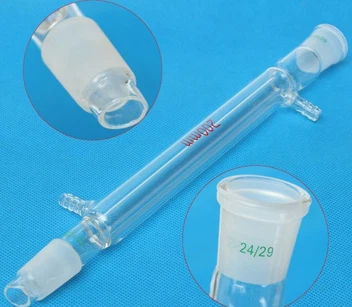
Glass Coil Condenser
(1)150mm/200mm/300mm/400mm/500mm/600mm---19*2
(2)200mm/300mm/400mm/500mm/600mm---24*2
(3)400mm/500mm/600mm---29*2
2. Allihn Condenser
(1)150mm/200mm/300mm/400mm/500mm/600mm---19*2
(2)200mm/300mm/400mm/500mm/600mm---24*2
(3)500mm/600mm---29*2
3. Graham Condenser:
(1)150mm/200mm/300mm/400mm/500mm/600mm---19*2
(2)200mm/300mm/400mm/500mm/600mm---24*2
(3)500mm/600mm---29*2
***Price List for whole above, inquire us to get
Description
Technical Parameters


Model and price

"The table shows the reference prices for sales in 2023"

"The table shows the reference prices for sales in 2023"

Main features
1. Strong corrosion resistance: Glass material has excellent corrosion resistance to various chemical media and can adapt to corrosive environments such as acid, alkali, and salt. Therefore, It are particularly suitable for use in industries such as chemical and petroleum.
2. Good high-temperature resistance: Glass material has good high-temperature resistance and can operate stably for a long time at higher temperatures. This enables the glass graham one to adapt to the condensing needs of high-temperature steam.
3. High heat transfer efficiency: The special structure of glass coils creates turbulence in the cooling water inside the tube, increasing the contact area and heat transfer time between water and steam. This makes the glass graham one have high heat transfer efficiency, which can reduce energy consumption and equipment volume.
|
|
|

5. Compact structure: The product has a compact structure, occupies small space, and is conducive to reducing equipment costs and installation costs.
6. Easy maintenance: The structure and material of glass graham one are relatively simple, making maintenance more convenient. If the coil is damaged or blocked, it can be easily replaced or cleaned.
7. Strong adaptability: It can adapt to different process conditions and condensation needs. According to actual needs, different specifications and structures of glass coils can be selected to meet specific heat and mass transfer requirements.
8. Environmental safety: Glass material itself is non-toxic and harmless, and will not cause pollution to the environment. In addition, the sealing performance of the product is good, which can effectively prevent the occurrence of safety accidents such as leaks.

Material selection
In terms of materials, the corrosion resistance, high temperature resistance, and transparency of glass material make it the main material for glass coil one. However, the fragility and weight of glass materials have also prompted people to constantly explore alternative materials, such as metal materials such as stainless steel, copper, and aluminum. These materials have better strength and durability, and can adapt to a wider range of industrial application scenarios.
In terms of design and manufacturing, the structure and process of glass coil one have also undergone many improvements and innovations. Its adopt advanced design concepts and technologies, such as optimizing coil structure, improving heat transfer efficiency, and improving cooling efficiency. In addition, with the development of automation and intelligent technology, the control system of glass coil condensers is becoming increasingly intelligent and automated, capable of remote monitoring, automatic adjustment, and fault diagnosis functions.
Design points
1. Choose the appropriate material: Select the appropriate material to make one based on the corrosiveness, temperature, and pressure of the material. The glass material should be selected as high-temperature and corrosion-resistant to ensure the long-term stable operation of the equipment.
2. Controlling temperature difference: Temperature difference is one of the important factors affecting heat transfer efficiency. When designing, consideration should be given to controlling temperature differences to improve heat transfer efficiency and reduce the possibility of scaling and corrosion.
3. Consider installation and maintenance: When designing, the convenience of equipment installation and maintenance should also be considered. Reasonable structural design can reduce installation difficulty and improve equipment reliability. Meanwhile, convenient maintenance and repair are also important factors to consider during design.
4. Safety and reliability: Due to the fragility of glass materials, the design should fully consider the safety and reliability of the equipment. Measures should be taken to prevent damage to personnel and equipment when glass is damaged. For example, safety measures such as setting up protective covers and adding explosion-proof devices can be taken.
5. Environmental Protection and Energy Conservation: With the increasing awareness of environmental protection, the design should consider the environmental performance and energy-saving effect of the equipment. Efficient cooling technology and optimized structural design can be used to reduce energy consumption, while environmentally friendly materials and accessories should be selected to reduce negative impacts on the environment.
6. User needs and customization: Different application scenarios may have different requirements for it Design should fully consider user needs and provide customized solutions. According to the specific requirements of users, it with different specifications, structures, and performance can be designed to meet specific process requirements and usage conditions.
7. Technological innovation and continuous improvement: With the continuous progress and innovation of technology, the design of glass coil condensers should also keep up with the times. By introducing new materials, processes, and technologies, the performance and reliability of equipment can be improved, and manufacturing costs can be reduced. At the same time, attention should be paid to industry dynamics and technological development trends, and continuous improvement and optimization of equipment design should be carried out to meet the constantly changing market demands.
It is indeed a highly efficient and versatile heat transfer equipment that has found widespread use in numerous industrial sectors. Its unique combination of glass material for the heat transfer tube, along with its excellent corrosion resistance and high temperature tolerance, makes it an ideal choice for a variety of complex and demanding process conditions.
Precautions for use
As a common condensing equipment in the laboratory, the correct use and maintenance of the equipment is very important to ensure the accuracy of the experimental results and the safe operation of the equipment. The following details its use precautions:
Preparation and inspection before installation

Integrity check
Before installation, all parts of the glass coil condenser should be carefully checked to see if they are complete, especially if the glass tube is cracked or damaged.
Check whether the connecting parts are tight and ensure that there is no loosening or air leakage.
Cleaning and pretreatment
Before installation, the condenser should be cleaned to remove surface dirt and impurities to ensure condensation.
If the condenser has not been used for a long time, pre-treatment should be carried out, such as cleaning the interior with acid to prevent blockage from affecting the cooling effect.

Correct installation and debugging
Installation location selection
The device should be installed in a stable and well-ventilated place to avoid vibration and high temperature environment.
Ensure that the inlet and outlet of the condenser are properly connected to the pipeline and are tightly connected to avoid leakage.
Water filling and pressure test
Before installation, the condenser coil should be filled with water, block one opening, inflate and pressurize the other opening to 0.1MPa, and check whether the coil is cracked and leaking.
If leakage is found, discontinue use immediately and replace damaged parts.
Gas phase and cooling water flow
It should be noted that the gas phase cannot flow in the same phase as the cooling water to ensure the condensation effect.
Adjust the flow rate and temperature of cooling water to meet different experimental requirements.
Precautions in the operation process
Slow warming and cooling
In the process of use, the water should be slowly released first, and then the water valve should be opened, and then slowly heated up after the water outlet is met.
Avoid sudden water shortage or sharp temperature rise to prevent equipment damage or affect the condensation effect.
Regular maintenance and maintenance
Clean and maintain the condenser regularly to remove internal dirt and sediment.
Check the flow and temperature of the cooling water to ensure that it is within the normal range.
If it is found that the condensation effect is reduced or the cooling water flow is abnormal, it should be checked and eliminated in time.
Personal Protection
During operation, wear appropriate personal protective equipment, such as protective gloves, goggles, etc., to prevent damage from glass fragments or chemicals.
Shutdown and storage
Shutdown operation
Before stopping, the heat source should be turned off first, and then the cooling water should be turned off to avoid negative pressure or damage inside the equipment.
If it is necessary to shut down for a long time, the cooling water in the condenser should be drained to prevent corrosion and blockage.
Storage environment
Store it in a dry, well-ventilated place, away from humidity and heat.
If the condenser needs to be stored for a long time, it should be cleaned and maintained to ensure that it is in good condition for next use.
Safety warning and emergency handling
Safety warning
When using the glass coil condenser, the operating procedures and safety regulations should be strictly observed.
Avoid running the condenser unattended to prevent accidents.
Emergency treatment
In case of emergency such as leakage or fire, stop using the condenser immediately and take appropriate emergency measures.
Be familiar with the location and use of fire fighting equipment in the laboratory, so as to respond quickly in case of emergency.
In summary, the precautions for the use of the equipment cover many aspects, such as preparation and inspection before installation, correct installation and commissioning, precautions during operation, shutdown storage, safety warning and emergency treatment.The implementation of these precautions will help ensure the safety of experimental personnel and the normal operation of equipment, and improve the efficiency and accuracy of the experiment.
Hot Tags: glass coil condenser, China glass coil condenser manufacturers, suppliers, factory, High Pressure Reactor, High Pressure Stirred Lab Autoclaves, 500ml Short Path Distillation Kit, Short Path Distillation Kit, Short Path Molecular Distillation, Jacketed Lab Reactor
Previous
Condenser in LaboratoryNext
Spiral CondenserSend Inquiry


