


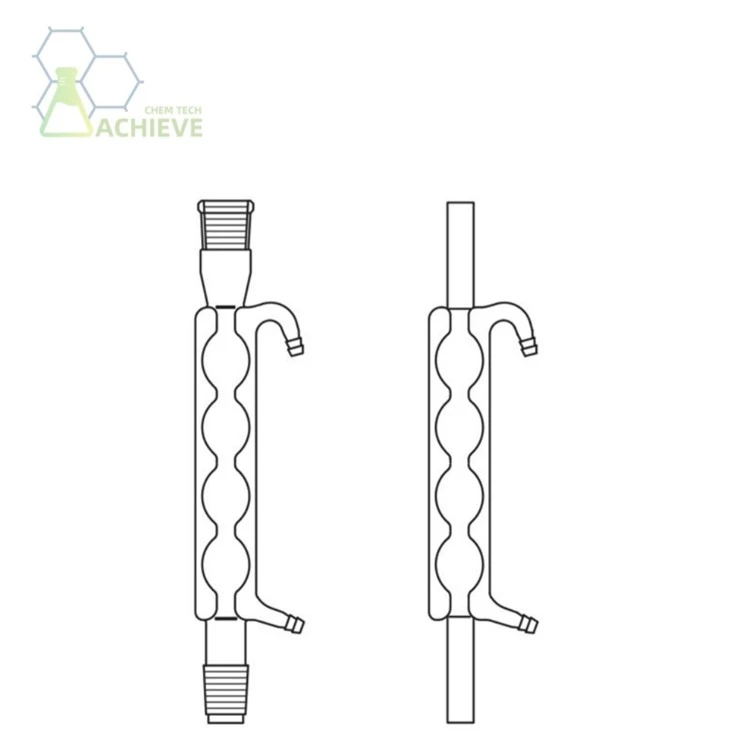


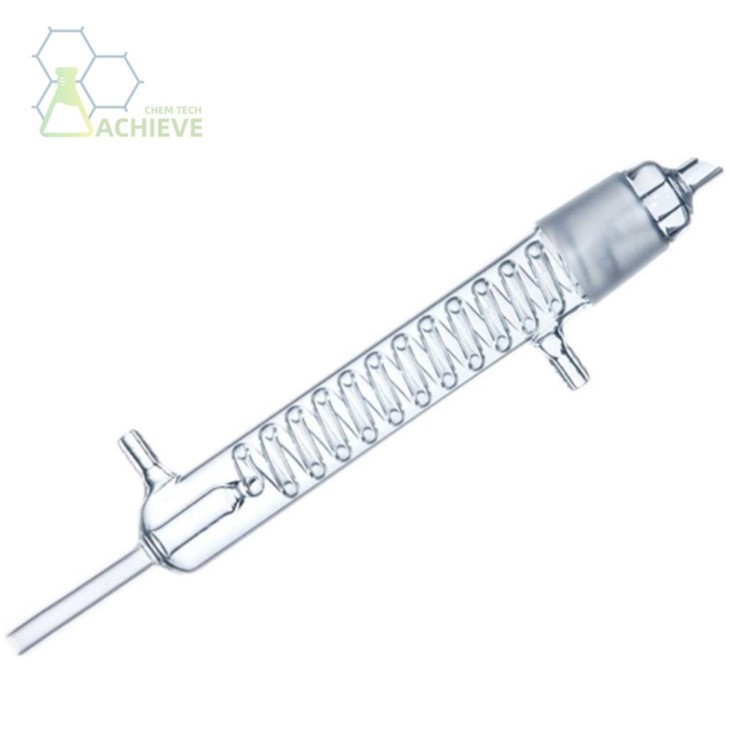


Spiral Condenser
(1)150mm/200mm/300mm/400mm/500mm/600mm---19*2
(2)200mm/300mm/400mm/500mm/600mm---24*2
(3)400mm/500mm/600mm---29*2
2. Allihn Condenser
(1)150mm/200mm/300mm/400mm/500mm/600mm---19*2
(2)200mm/300mm/400mm/500mm/600mm---24*2
(3)500mm/600mm---29*2
3. Graham Condenser:
(1)150mm/200mm/300mm/400mm/500mm/600mm---19*2
(2)200mm/300mm/400mm/500mm/600mm---24*2
(3)500mm/600mm---29*2
***Price List for whole above, inquire us to get
Description
Technical Parameters

Condenser working principle

Specifically, the spiral tube condenser consists of a series of parallel spiral plates. The condensing medium flows through the gaps between the spiral plates, while the heating medium flows through the channels on the spiral plates. Heat and mass transfer occur between the condensing medium and the heating medium through the walls of the spiral plate. The working process is an exothermic process, so the temperature of the condenser is always high. It passes through the exothermic surface of the condenser, transferring the heat of the refrigerant's superheated vapor to the surrounding air or water. It is cooled into saturated vapor and further cooled into a high-pressure liquid, which is circulated in the system.
parameter

Choose the appropriate material: Based on the corrosiveness and other characteristics of the material, choose the appropriate material to make the spiral tube condenser. Common materials include stainless steel, copper, titanium, etc.
"The table shows the reference prices for sales in 2023"

Determine heat transfer area: Determine the required heat transfer area based on process requirements and the characteristics of the processed materials. The size of the heat transfer area will directly affect the processing capacity and heat transfer efficiency of the equipment.
"The table shows the reference prices for sales in 2023"

Function
Against the backdrop of the increasing global emphasis on energy conservation, emission reduction and sustainable development, this product, as an efficient and compact heat exchange device, plays a crucial role in industrial production.Especially in terms of energy conservation, emission reduction, and waste recycling, the spiral tube condenser has demonstrated extensive application potential and significant economic benefits due to its unique structural design and excellent performance characteristics.
Pioneer in energy conservation and emission reduction
In the industrial production process, a large amount of heat energy is often lost in the form of steam, high-temperature gases, etc., which not only causes energy waste but also exacerbates environmental thermal pollution. The spiral tube condenser, through its efficient heat exchange mechanism, can quickly condense these high-temperature fluids into liquids, thereby recovering and reusing the heat energy therein. This recycling process not only reduces energy consumption, but also lowers carbon emissions during the production process, providing strong support for the energy-saving and emission reduction goals of enterprises.
Specifically, the instrument adopts a spiral rising coil structure, which enables the fluid to form strong turbulence effects during the flow process, thereby enhancing the heat exchange effect. Meanwhile, its countercurrent heat transfer method ensures that the fluid maintains a large temperature difference throughout the heat transfer process, further improving the heat exchange efficiency. This efficient heat exchange performance enables the spiral tube condenser to save more energy and reduce corresponding carbon emissions compared to traditional condensers under the same conditions.
A powerful tool for waste recycling
In industrial production, many waste materials often exist in the form of steam, gas, or liquid, which often contain useful components or energy. If directly discharged into the environment, it will not only cause resource waste, but may also pollute the environment. This instrument can condense high-temperature steam or gas in these waste materials into liquid through its condensation effect, which facilitates subsequent separation, purification, and reuse.
For example, in the chemical industry, many chemical reactions generate large amounts of high-temperature steam and exhaust gas. These vapors and exhaust gases often contain useful components such as unreacted raw materials, by-products, or catalysts. Through the condensation effect of the instrument, useful components in these vapors and exhaust gases can be condensed and subsequently separated and purified. This not only recovers valuable raw materials and catalysts, reduces production costs, but also reduces waste emissions and environmental pollution.
Significant comprehensive benefits
The application of energy conservation, emission reduction, and waste recycling not only brings significant economic benefits, but also has important social and environmental benefits. From an economic perspective, by recycling and reusing the useful components and thermal energy in waste, enterprises can reduce production costs, improve resource utilization efficiency, and achieve economic benefits. At the same time, the implementation of energy conservation and emission reduction also helps enterprises reduce carbon emissions and environmental costs, enhance their social image and competitiveness. From the perspective of social and environmental benefits, applications can help reduce energy consumption and carbon emissions in industrial production processes, as well as lower thermal pollution and exhaust emissions to the environment. This is of great significance for mitigating global climate change, improving air quality, and protecting the ecological environment. In addition, the promotion of waste recycling and reuse also helps to promote the development of circular economy and the sustainable use of resources.
Structural characteristics analysis
The spiral condenser, as the core equipment of the industrial heat exchange system, its structural characteristics directly affect the performance and application effect of the equipment. The following systematically analyzes its technical characteristics from four dimensions: core structure, material innovation, thermodynamic design, and intelligent integration:
 |
 |
 |
Spiral Channels and Three-dimensional Heat Transfer Structure
The core innovation of this product lies in its unique spiral flow channel design. Take the wound helical tube condenser as an example. Hundreds of heat exchange tubes are wound in reverse at a helical Angle of 3°-20° around the central cylinder, forming a multi-layer three-dimensional heat transfer surface. This design increases the heat transfer area of a single device by 3 to 5 times compared to the traditional tubular type, enhances the turbulence intensity by 80%, and the heat transfer coefficient can reach 8000- 13,600 W/(m²·℃). The helical baffles set inside the shell force the fluid to flow in a spiral manner, reducing thermal resistance and further enhancing the heat exchange efficiency.
Under the steam condensation condition, the pressure drop control is excellent. For example, in the natural gas liquefaction project, the processing capacity of a single device reaches 500 tons per hour, and the system pressure drop is controlled within 0.05MPa. Under the same heat exchange capacity, its volume is reduced by 40% to 60% compared with traditional equipment, saving floor space. For instance, after its application in a certain LNG receiving terminal, the height of the equipment was reduced by 40%, saving over ten million yuan in land costs.
Corrosion-resistant Materials and Composite Structures
For highly corrosive media (such as seawater and acid mist), this product is made of 254SMO super austenitic stainless steel or titanium alloy, which increases the corrosion resistance by 3 to 5 times.The temperature resistance of the silicon carbide composite tube bundle has been raised to 1200℃, making it suitable for media such as molten salt and high-temperature flue gas. The shell is made of carbon steel or composite materials, and the inner wall is sprayed with anti-corrosion coating to withstand internal pressure and external corrosion. The connection between the tube sheet and the tube bundle adopts a double seal of expansion joint + welding, with a leakage rate of less than 0.005%, meeting the requirements of high-pressure (≤15 MPa) working conditions.
The modular design supports the replacement of single tube bundles, reducing maintenance time by 70% and annual maintenance costs by 40%. For instance, a case of a certain chlorine-alkali factory shows that the weight of the equipment has been reduced by 50% and its corrosion resistance has been improved by two times.
Thermal Stress Compensation and Fluid Mechanics Optimization
The spiral structure naturally has the ability to compensate for thermal expansion. Under the working condition of a temperature difference of 150℃, the stress level of the equipment is reduced by 60% compared with the fixed tube sheet design. The free sections reserved at both ends of the tube bundle can freely expand and contract with temperature changes, completely solving the problem of thermal stress cracking. The synergistic effect of heat conduction, convection and radiation is achieved through the stainless steel/silicon carbide composite tube wall. Under high-temperature working conditions, the contribution rate of radiation heat transfer exceeds 10%. Experiments show that in the high-temperature hydrogen condensation at 1200℃, the system energy efficiency is improved by 25%.
The flow channel design adopts a variable cross-section helical structure. The flow velocity in the inlet section is high (≥3 m/s), and that in the outlet section is low (≤1 m/s), balancing pressure drop and heat transfer. The inner wall of the pipe is mechanically polished to Ra≤0.2μm to reduce the tendency of scaling. The outer wall of the tube is sprayed with a nano-ceramic layer, and the emissivity is increased to 0.92.
Intelligent Monitoring and Adaptive Control
Integrated fiber Bragg grating sensors are used to monitor the temperature and strain of the pipe wall in real time. Combined with digital twin technology, predictive maintenance is achieved, and the accuracy rate of fault early warning is over 98%. The adaptive regulation system automatically optimizes fluid distribution by monitoring the temperature differences at 16 key points in real time, improving the overall energy efficiency by 12%. For instance, in the ethylene cracking project, it can withstand a high-temperature shock of 1000℃, with a temperature change tolerance of 400℃/min. The heat recovery efficiency is increased by 30%, and the annual fuel gas consumption is saved by 500,000 tons of standard coal.
The equipment leasing + energy efficiency sharing model reduces the initial investment of enterprises. For example, after the adoption of a certain chemical industrial park, the payback period of investment was shortened to 1.5 years. The nano-silicon carbide coating is deposited on the inner wall of the tube through plasma spraying technology, and the wear resistance is improved by 50%. The 3D printed flow channel design increases the specific surface area to 500㎡/m³ and the heat transfer coefficient exceeds 12,000 W/(m²·℃).
The spiral condenser demonstrates significant advantages under high-temperature, high-pressure and highly corrosive working conditions through the collaborative innovation of spiral flow channels, corrosion-resistant materials, thermal stress compensation and intelligent control. Its structural features not only solve the efficiency bottleneck of traditional equipment, but also achieve energy efficiency improvement and operation and maintenance cost reduction through cutting-edge technologies such as digital twins and 3D printing, becoming a key equipment for the green transformation of industries such as chemical engineering, energy, and environmental protection.
Hot Tags: spiral condenser, China spiral condenser manufacturers, suppliers, factory, 20l Rotovap, Hydrothermal Reactor, SS316 Reactor, Stainless Steel Jacketed Reactor, Hydrothermal Synthesis Autoclave Reactor, High Pressure Hydrothermal Autoclave Reactor
Previous
Glass Coil CondenserNext
Allihn CondenserSend Inquiry


