



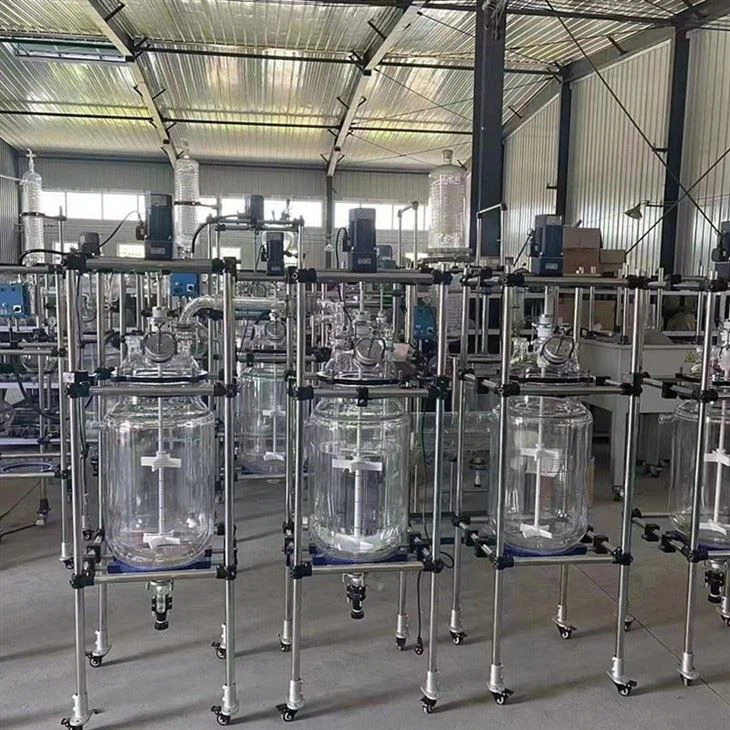
Chemglass 50l Reactor
(1)1L/2L/3L/5L---Standard
(2)10L/20L/30L/50L/100L---Standard/EX-proof/Lifting Kettle
(3)150L/200L---Standard/EX-proof
***Price List for whole above, inquire us to get
2. Customization:
(1)Design support
(2)Directly supply the Senior R&D organic intermediate, shorten your R&D time and cost
(3)Share the advanced purifying technology with you
(4)Supply the high quality chemicals and analysis reagent
(5)We want to assist you on Chemical Engineering (Auto CAD, Aspen plus etc.)
3. Assurance:
(1)CE and ISO certification Registered
(2)Trademark: ACHIEVE CHEM(since 2008)
(3)Replacement parts within 1-year for free
Description
Technical Parameters
Chemglass 50L reactor is mainly used for chemical synthesis reactions, such as organic synthesis, inorganic synthesis and polymer synthesis. It is a high-precision experimental equipment, usually made of glass or corrosion-resistant high-quality engineering materials, with good chemical stability and corrosion resistance.
The principle of design and use pays attention to the precise control of chemical reactions and the reliability of experimental conditions. It usually has accessories such as stirring device, heating and cooling system and pressure and temperature control system, so as to realize various chemical reactions.


Differences with Bioreactor
|
|
|


Similarities
◆ Type of reactors: They are all devices used for experiments and reactions, for containing reactants and providing reaction conditions.
◆ Reaction process: Both chemical reactions and biological processes involve the transformation of substances and the formation of products. Whether chemical reaction or biological reaction, it is necessary to control parameters such as temperature, pressure and stirring speed to promote the reaction or biological process.
◆ Design principle: chemical glass reactor and bioreactor, both of which need the design principle of safety, sustainability and controllability.
Differences
Uses
Chemical glass reactor is mainly used for chemical reactions, such as organic synthesis and inorganic chemistry. Bioreactors are used in biological processes such as bioengineering, biopharmaceuticals and microbial culture.
Material selection
Glass reactors usually use acid and alkali resistant high borosilicate glass materials, while bioreactors use more materials such as stainless steel to avoid toxicity and pollution to organisms.
Design structure
Lab glass reactors usually have large volume and high pressure bearing capacity. The bioreactor pays more attention to the design of gas ventilation, stirring and temperature control to optimize the effect and output of biological process.
Operating conditions
The glass reactors generally involve organic solvents, strong acids, strong bases and other chemicals, and the operating conditions are relatively strict. Bioreactors involve organisms, cell culture media, etc., and need to pay more attention to aseptic operation and biological safety.
Expanding Knowledge
Chemglass 50L reactor is a pilot jacketed reactor suitable for R&D laboratories in the chemical, pharmaceutical and petrochemical industries.
The reactor has a professional material ratio, reasonable diameter to height ratio and good sealing, which makes it play an important role in these fields, simplifying and efficiently simplifying the work of researchers.
A chemical reduction reaction is a reaction in which a substance gets electrons or electron pairs close together. In chemical reactions, reduction reaction and oxidation reaction generally coexist, and the essence of reduction reaction is electron transfer, not limited to different elements. Most inorganic metathesis reactions are not redox reactions, because the ions in these metathesis reactions exchange with each other, there is no electron transfer, and the oxidation number of each element remains unchanged. Displacement reaction, combination reaction with simple substance and decomposition reaction with simple substance are generally redox reactions. In organic chemistry, the reaction that reduces the total oxidation state of carbon atoms in organic molecules is called reduction reaction.
Chemglass 50L reactor can be connected with a variety of inert gases to complete the reduction reaction, such as hydrogen, nitrogen and argon. These gases are usually used as protective gases or reducing agents in chemical reactions, which can effectively inhibit the contact between reactants and oxygen, thus improving the efficiency of reduction reaction and the purity of products.
using inert gas or reduction reactionf, the following points should also be noted
1
Ensure the purity and dryness of the gas meet the requirements, so as not to interfere with the reaction.
2
The flow and pressure of gas are controlled to ensure the stability and safety of reaction conditions.
3
Pay attention to the amount and residue of gas to avoid polluting the product or affecting the accuracy of subsequent experiments.
Working principle of gas purification and pressure system
Filtering principle: By using filters or filter membranes, impurities such as solid particles, dust and oil mist are removed from the gas.
The filter is filled with various filtering materials, such as glass fiber, activated carbon, molecular sieve, etc. These materials have good adsorption effect on impurities in gas and can effectively remove impurities.
Adsorption principle: The adsorbent has a large surface area and can adsorb harmful components, odor, moisture and other impurities in the gas.
Commonly used adsorbents include activated carbon, silica gel and molecular sieve. Through the adsorption of adsorbent, the impurity content in gas can be significantly reduced.
Condensation principle: By lowering the temperature of the gas, impurities such as water vapor and organic vapor in the gas are condensed into liquid or solid, so as to achieve the purpose of purification.
The commonly used condensation methods include direct cooling method and indirect cooling method. According to different gases and impurities, the appropriate condensation temperature and coolant are selected.
Compression principle: By compressing the volume of gas, the pressure of gas is increased. The compression process is usually completed by compressors, such as piston compressors, screw compressors and centrifugal compressors.
By compressing the gas, the transportation, storage and pressure control of the gas can be realized.
Application
The Chemglass 50L reactor can be used for redox reactions of metal ions to refine or prepare metals. Example:
Metal refining by electrolysis: metal ions are reduced to metal monomers by electrolyzing solutions containing metal ions, using redox reactions. This method is commonly used to refine active non-ferrous metals, such as copper, zinc, etc.
High-temperature reduction method for the preparation of metals: under high-temperature conditions, the use of reducing agents (such as carbon, carbon monoxide, hydrogen, etc.) to reduce metal oxides to metal monomers. This method is commonly used in the preparation of ferrous metals (such as iron) and other non-ferrous metals.
The manufacturing process of many important chemical products involves redox reactions, and the Chemglass 50L reactor can be used for these reactions. Example:
Synthesis of ammonia: In the presence of a catalyst, nitrogen and hydrogen under high temperature and pressure undergo a redox reaction to produce ammonia.
Synthesis of hydrochloric acid: Hydrogen is burned in chlorine gas, a redox reaction occurs, generating hydrogen chloride gas, which is then dissolved in water to form hydrochloric acid.
Contact system sulfuric acid: sulfurite or sulfur combustion in the air to generate sulfur dioxide, sulfur dioxide and then oxidized to sulfur trioxide, and finally sulfur trioxide and water reaction to generate sulfuric acid.
There are many redox reactions in petrochemical industry, Chemglass 50L reactor can be used for the catalytic or treatment of these reactions. For example:
Catalytic dehydrogenation and catalytic hydrogenation: Under the action of catalyst, hydrogen atoms are removed or added through redox reactions, thus changing the structure and properties of hydrocarbons.
Oxidation of chain hydrocarbons to produce carboxylic acids: chain hydrocarbons undergo oxidation in the presence of oxygen to produce the corresponding carboxylic acids.
Application in agricultural production
Although the direct application of Chemglass 50L reactor in agricultural production is relatively small, but the redox reaction is of great significance in agricultural production. For example:
Photosynthesis and respiration in plants: both processes are complex redox reactions that are critical to plant growth and development. Although these reactions take place mainly in plants, understanding them helps in understanding the role of redox reactions in nature.
Redox reactions have a wide range of applications in the field of batteries and energy, and the Chemglass 50L reactor can be used for research and development of battery materials or the study of battery reactions. For example:
Dry cell batteries, storage batteries and high-energy batteries: the working principle of these batteries is based on redox reaction, through the transfer of electrons to realize the mutual conversion of chemical energy and electrical energy.
Redox reactions can also be used for environmental monitoring and pollution control. For example, certain redox reactions can be utilized to detect the concentration of pollutants in a body of water or to remove pollutants. Although the application of the Chemglass 50L reactor in this field may not be as direct as in the field of chemical or metal preparation, the related research results may provide new ideas for solving environmental problems.
In summary, the Chemglass 50L reactor has a wide range of applications in redox reactions, and can be used in a variety of fields such as metal refining and preparation, manufacture of chemical products, redox reactions in petrochemicals, agricultural production (indirectly), batteries and energy fields, as well as environmental monitoring and pollution control. These applications not only demonstrate the importance of redox reactions in the chemical industry, but also provide a wealth of examples of how the Chemglass 50L reactor can be used.
Hot Tags: chemglass 50l reactor, China chemglass 50l reactor manufacturers, suppliers, factory, 50l Rotary Evaporator, 5l Glass Reactor, Autoclave For Hydrothermal Synthesis, Stainless Steel Pressure Reactor, Jacketed Glass Reactor, High Pressure Chemical Reactor
Previous
Rotavap LabNext
Rotary Evaporator 5lSend Inquiry


