


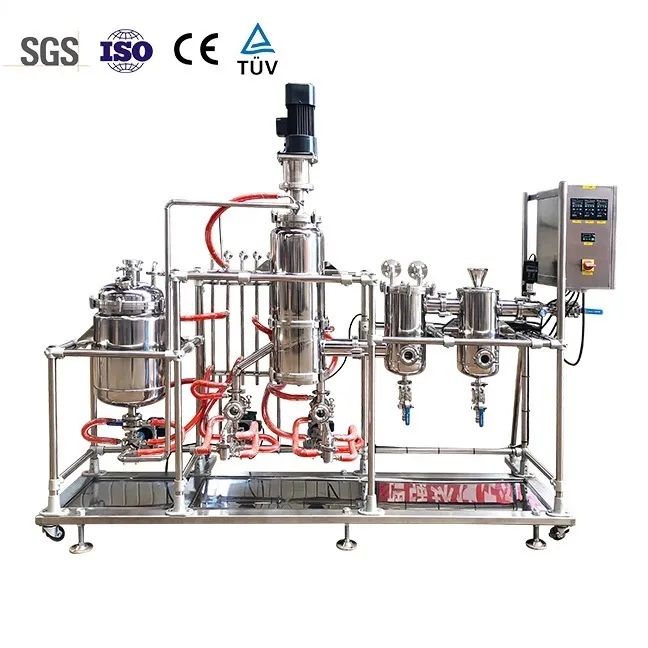


Short Path Distillation System
Example: The specification list of distillation for CBD
(1) Laboratory Test (<20L)
NCF-10A, NCF-20A, NCF-30A, NCF-50A
(2) Pilot Production (20L<100L)
NCF-100, NCF-200
(3) Industrial Production (100L<300L)
NCF-500
2. Customization
The details pls download The Request List of Short Path Distillation
(1)Design support
(2) Directly supply the Senior R&D organic intermediate, shorten your R&D time and cost
(3) Share the advanced purifying technology with you
(4) Supply the high quality chemicals and analysis reagent
(5) We want to assist you on Chemical Engineering (Auto CAD, Aspen plus etc.)
3. Assurance
(1) CE and ISO certification Registered
(2) Trademark: ACHIEVE CHEM(since 2008)
(3) Replacement parts within 1-year for free
Description
Technical Parameters
Short Path Distillation System is an efficient distillation technology, especially suitable for the separation and purification of high boiling point, thermosensitive, easily oxidized, and easily polymerized substances. It utilizes the difference in the average free path of molecular motion of different substances to separate them at temperatures far below the boiling point of the material. It is a device for separating liquid mixtures, which can separate different components from the mixture by controlling temperature and pressure.
Simply put, it means dividing the mixed liquid into different parts. Applied in industries such as chemical, pharmaceutical, food, spices, cosmetics, etc. In the field of chemical engineering, it can be used to separate high boiling and thermosensitive substances; In the pharmaceutical field, it can be used to extract and purify active pharmaceutical ingredients; In the food and spice industry, it can be used to extract and concentrate natural flavor components.
Working Principle
Under high vacuum conditions (0.1–100Pa), the evaporator and condenser are placed at an extremely short distance (usually a few centimeters). When the liquid mixture forms a thin film on the heating surface and is heated, light molecules evaporate and directly reach the condenser surface to be condensed into liquid, while heavy molecules return to the feeding tank. This short-distance design reduces molecular collision loss, shortens heating time, and effectively avoids thermal degradation and oxidation of materials.

Product Introduction
From the physical point of view, we can analyze the short path distillation system from the aspects of gas-liquid equilibrium, vapor pressure and boiling point.

Gas-liquid balance:
Short-distance distillation machine uses the principle of gas-liquid balance for separation.
At a given temperature and pressure, the liquid and gas will reach a dynamic equilibrium state, that is, the molecules in the liquid will evaporate at a certain rate to form gas, and the gas will condense into liquid at the same rate.
This balance can ensure the separation of different components in the mixture.
Vapor pressure:
The vapor pressure of a liquid refers to the pressure at which molecules on the liquid surface evaporate to form gas at a certain temperature.
Different components have different vapor pressures, and the vapor pressure is positively correlated with temperature.
The more volatile components have higher vapor pressure, while the less volatile components have lower vapor pressure.
Boiling point:
Boiling point refers to the temperature at which a liquid becomes a gas at a given pressure.
For pure substances, the boiling point is fixed, but for mixtures, the boiling point will change due to the existence of different components.
By adjusting the temperature and pressure, the short-path distillation column makes some components in the liquid mixture reach their corresponding boiling points, thus realizing separation.
Model Specifications
Glass Short Path Distillation
|
Model (with diffusion pump) |
Effective evaporation area |
Internal condensing area |
Outer condensing area |
Barrel Inside diameter |
Constant pressure feeding funnel volume |
Processing flow |
|
GMD-60(B) |
0.05 |
0.1 |
0.2 |
60 |
1.5 |
0.1∽2.0 |
|
GMD-80(B) |
0.1 |
0.15 |
0.25 |
80 |
1.5 |
0.3∽4.0 |
|
GMD-100(B) |
0.15 |
0.2 |
0.3 |
100 |
1.5 |
0.5∽5.0 |
|
GMD-150(B) |
0.25 |
0.4 |
0.6 |
150 |
1.5 |
1.0∽8.0 |
|
GMD-200(B) |
0.35 |
0.5 |
0.6 |
190 |
1.5 |
1.5∽10.0 |
|
GMD-230(B) |
0.5 |
0.65 |
0.6 |
220 |
1.5 |
2.0∽15.0 |
Stainless steel Short Path Distillation
| Models | NCF-6A | NCF-10A | NCF-20A | NCF-30A | NCF-50A | NCF-100A | NCF-200A |
| Feeding Rates(L/h) | 0.5L-3L/H | 3-15 L/h | 5-25 L/h | 5-30 L/h | 10-50 L/h | 30-200 L/h | 30-260L/h |
| Evaporation Area (㎡) | 0.06㎡ | 0.1 m² | 0.2 m² | 0.3 m² | 0.5m² | 1 m² | 2 m² |
|
Wiper Style |
Scraper-type film scraping rotor | ||||||
| Vacuum Seal | Mechanical seal (Magnetic seal is optional) | ||||||
| Scraper Motor Power (w) | 200W | 370W | 370W | 550W | 750W | 750W | 1500W |
| Speed Regulation Mode | Electronic speed regulation | ||||||
Interested in a Short path distillation for your Lab? [Send an Inquiry now]
Main Components
|
|
|


Click here to get whole price list
Short range distillation systems typically consist of the following main components:
Evaporator:
This is the core part of a short-range distillation system, where the material is heated and produces steam. Evaporators typically use special designs to optimize the contact between materials and heating surfaces and promote the formation of steam.
01
Condenser:
Steam is cooled and condensed into liquid in the condenser. The condenser is usually located above or next to the evaporator and is cooled by cooling water or other cooling media.
02
Vacuum system:
In order to reduce operating pressure, the short-range distillation system needs to be equipped with a vacuum system. The vacuum system reduces the pressure in the evaporator by suction steam, thereby lowering the boiling point of the material.
03
Rotors:
In certain types of short-range distillation systems, such as scrape film short-range stills, the rotor is used to form a thin film of material on the heating surface to increase the evaporation area and efficiency.
04
Control system:
The control system is used to monitor and adjust various parameters of the system, such as temperature, pressure, flow rate, etc., to ensure the stable operation of the system and product quality.
05
Product Knowledge
In the short path distillation system, the boiling point plays a key role in separating the mixture.
Water (H2O):
The standard boiling point of water is 100 degrees Celsius (atmospheric pressure is 1 atmosphere), but the boiling point of water can be reduced by reducing the pressure in the short-distance distillation system.
For example, in vacuum distillation, water can be evaporated at a lower temperature by reducing the operating pressure, thus realizing the separation of solvent and solute.
Alcohols:
Different types of alcohols (alcohol-based compounds) have different boiling points. For example, the boiling point of ethanol (alcohol) is 78 degrees Celsius and the boiling point of butanol is 117 degrees Celsius.
Alcohols are often used as solvents in short-path distillation, especially in pharmaceutical and chemical industries.
Hydrocarbons:
Hydrocarbons with different carbon chain lengths have different boiling points.
For example, the boiling point of methane (one-carbon saturated hydrocarbon) is -161 degrees Celsius, and the boiling point of n-butane (four-carbon saturated hydrocarbon) is 77 degrees Celsius.
Hydrocarbons are often used as fuels, solvents and raw materials in short-path distillation.
Ketones:
Ketones are compounds containing carbonyl (C=O) functional groups. The boiling point of ketones depends on their molecular structure and bonding.
For example, the boiling point of acetone (dimethyl ketone) is 56 degrees Celsius and that of hexanone (hexanone) is 152 degrees Celsius.
Ketones are commonly used in organic synthesis and solvent extraction in short-path distillation.
Applications
Pharmaceutical Industry: Purification of APIs, intermediates, vitamins, antibiotics
CBD & Hemp Extracts: High-purity CBD distillate & isolate production
Essential Oils & Spices: De-waxing, decolorizing, concentration of aromatic compounds
Fine Chemicals: Separation of high-boiling solvents, polymers, additives
Food & Nutraceuticals: DHA/EPA fish oil purification, natural extract concentration
|
|
|


Customization Service
- We provide full customization based on your material properties, output requirements and working conditions:
- Custom evaporation area and processing capacity
- Glass or stainless steel material options
- Explosion-proof configuration for hazardous materials
- Multi-stage distillation system for continuous production
- CAD & Aspen Plus process design support
- UL CE ISO certification
FAQ
Q: What materials is the short path distillation system suitable for?
A: It is ideal for high-boiling, heat-sensitive, easily oxidized and viscous materials such as CBD oil, essential oils, APIs, polymers and fine chemicals.
Q: What is the difference between short path and molecular distillation?
A: Short path distillation is a structural form of molecular distillation, featuring ultra-short evaporation-condensation distance, high vacuum and low-temperature operation.
Q: Can the system be customized for industrial production?
A: Yes, we provide lab, pilot and full industrial models with customizable capacity, material and control system.
Q: What certifications do you have?
A: Our systems comply with CE and ISO 9001 standards, with explosion-proof options available.
Request a Free Quote
Contact us today for detailed specifications, process solutions and customized short path distillation systems for your production line!
Hot Tags: short path distillation system, China short path distillation system manufacturers, suppliers, factory, Molecular Distillation Equipment, Crystallization Reactor, Single Press Tablet Machine, SS316 Reactor, PPL Lined Hydrothermal Autoclave, 50l Rotary Evaporator
Previous
Short Path Molecular DistillationSend Inquiry


