



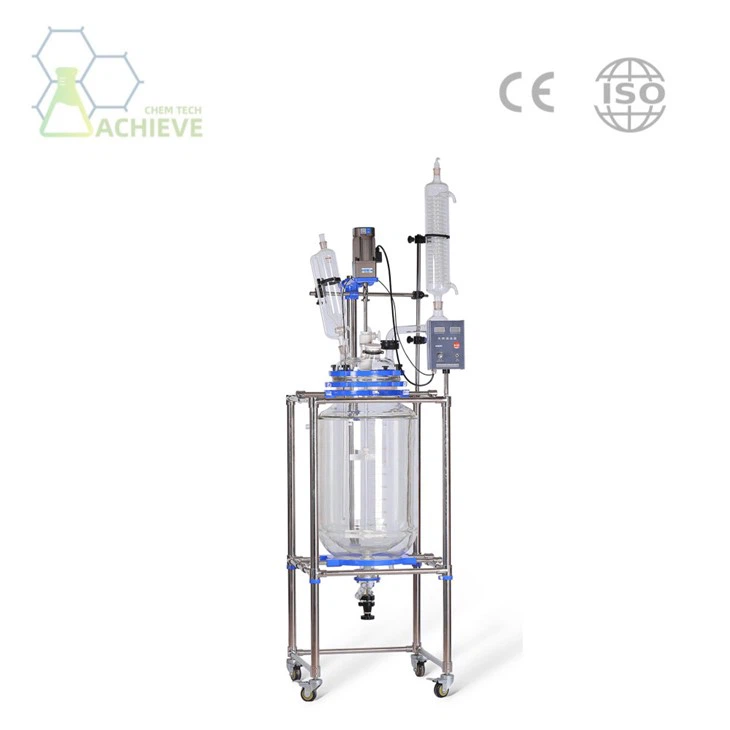


Glass Lab Reactor
(1)1L/2L/3L/5L---Standard
(2)10L/20L/30L/50L/100L---Standard/EX-proof/Lifting Kettle
(3)150L/200L---Standard/EX-proof
***Price List for whole above, inquire us to get
2. Customization:
(1)Design support
(2)Directly supply the Senior R&D organic intermediate, shorten your R&D time and cost
(3)Share the advanced purifying technology with you
(4)Supply the high quality chemicals and analysis reagent
(5)We want to assist you on Chemical Engineering (Auto CAD, Aspen plus etc.)
3. Assurance:
(1)CE and ISO certification Registered
(2)Trademark: ACHIEVE CHEM(since 2008)
(3)Replacement parts within 1-year for free
Description
Technical Parameters
A glass lab reactor is a chemical instrument commonly used to process chemical reactions, both in the laboratory and in industrial applications, including the treatment of toxic industrial chemical waste. There are two common classifications of glass laboratory reactors: single-layer glass reactors and double-layer glass reactors,also known as jacketed lab reactor.
Lab reactors have come a long way since their inception. Traditional reactor systems, such as batch reactors and stirred tank reactors, have been the mainstay of chemical synthesis for decades. However, these systems often suffer from inefficiencies, including poor heat and mass transfer, limited control over reaction conditions, and the challenge of scaling up processes for larger-scale production.
The emergence of this experimental facility marks a significant shift towards more efficient, universal and scalable reactor systems. Glass is known for its transparency, chemical inertness and ability to withstand extreme conditions, making it an ideal material for building these advanced reactor systems. By incorporating glass into the design, the researchers gained an unprecedented reaction environment, enabling real-time monitoring and precise control of reaction parameters.
|
|
|


Product Introduction

A glass lab reactor, also known as a glass-lined reactor or glass vessel, is a versatile equipment extensively used in laboratories and research facilities for chemical reactions, mixing, and various process optimizations. It is constructed with a glass jacket or lining that provides transparency and visibility, allowing researchers to monitor the reaction progress visually. They are valued for their corrosion resistance, thermal stability, and inert nature, making them suitable for a wide range of applications. They are widely utilized in fields such as pharmaceuticals, fine chemicals, biotechnology, and academic research due to their reliability and versatility.
Product Features
Lab glass reactors offer several key features that make them indispensable tools in the laboratory setting. Firstly, the glass construction ensures excellent chemical resistance, enabling the safe handling of corrosive materials and reactive substances. Secondly, the transparent nature of the glass vessel allows researchers to observe color changes, phase transitions, and other visual indicators during the reaction. This visual monitoring aids in process control and optimizing reaction conditions. Additionally, laboratory reactors can withstand a broad temperature range, enabling both high-temperature reactions and cryogenic applications. Their superior thermal conductivity facilitates efficient heat transfer and precise temperature control.
Furthermore, lab glass reactors often feature customizable designs, allowing for the integration of additional components such as stirrers, probes, and condensers, enhancing the versatility and functionality of the system. Overall, the combination of corrosion resistance, transparency, temperature versatility and customization options makes this experimental device an indispensable tool for researchers and scientists in various industries.

Feel free to click on the device to get the necessary information. You can then follow the guide to buy the products you need.
Extensive Application
In the wake of nuclear disasters such as Fukushima and Chernobyl, there has been a global effort to find effective ways to improve and reduce nuclear contamination. The potential application of glass laboratory reactors in nuclear waste disposal has become a topic of considerable interest in recent years. The following is a discussion of the theoretical feasibility, implementation and alternative methods of nuclear leakage treatment using laboratory glass reactors.
|
|
|


Theoretical feasibility of laboratory glass reactors for nuclear waste treatment
Advantages of vitrification technology
Vitrification technology is considered one of the best solutions for the safe storage, transportation and final safe disposal of nuclear waste. Glass's high durability and ability to incorporate a range of elements into its structure make it an ideal material for stationary storage of nuclear waste. Glass is highly resistant to compositional changes, and its physical and chemical durability ensures safe storage over the long term. In addition, vitrification technology can significantly reduce the volume of waste materials and reduce storage space costs.
Specific practices
Countries such as France, India, Japan, Russia, Slovakia, South Korea, the United Kingdom and the United States have used glass technology facilities for stationary disposal of high-level radioactive waste. These countries generally choose borosilicate glass as the glass material for stationary disposal of high-level radioactive waste. For example, this technology is used at the Defense Waste Treatment Facility near the Savannah River in the United States.
Implementation status
Domestic progress
On September 11, 2021, China's first high-level radioactive waste liquid vitrification facility was officially put into operation in Guangyuan, Sichuan. This facility marks that my country has achieved a breakthrough in its high-level radioactive waste treatment capabilities and has become one of the few countries in the world that has high-level radioactive waste vitrification technology. The facility is expected to safely process hundreds of cubic meters of high-level radioactive waste every year, and the vitreous produced by the treatment will be buried hundreds of meters underground in a repository to isolate radioactive materials from the biosphere.
International cooperation
Our country's progress in this field also benefits from international cooperation. The facility was jointly designed by China and Germany, and multiple units participated in collaborative research, accumulating rich experience in key special materials and key equipment for glass curing.
Alternative methods
Seawater infusion
In some cases, such as the Fukushima nuclear accident in Japan, seawater infusion was used to cool and dilute the nuclear fuel to prevent the core from continuing to sink and reduce radiation. However, this method produces large amounts of nuclear-contaminated water that requires further treatment and disposal.
Physical blockade
During the Chernobyl nuclear accident, the Soviet Union used a method of dropping sandbags from helicopters to block the radiation ports of the reactor to prevent further spread of radiation. Although this method has demonstrated effectiveness in extreme conditions, it poses a significant threat to pilot safety.
Chemical method
Chemicals such as boric acid and lead are used to absorb neutrons, thereby slowing down the reaction and sinking speed of the molten core and achieving a "cold shutdown." This method has a certain effect in slowing down nuclear reactions, but it also requires strict operation and safety measures.
As a mature nuclear waste treatment method, vitrification technology has demonstrated its superiority in both theory and practice. Through international cooperation and technological innovation, our country has made significant progress in this field, providing a strong guarantee for the safe disposal of nuclear waste. However, in the face of extreme situations such as nuclear leakage, the comprehensive application of multiple methods is still needed to ensure the safe handling of nuclear waste and the long-term protection of the environment. At the same time, we should continue to strengthen scientific research investment and technological innovation in the future, and explore more efficient and safer nuclear waste treatment methods.
While glass lab reactors possess notable qualities for chemical processes, their practicality for nuclear waste treatment remains uncertain due to the extreme conditions involved. Stainless steel reactors are currently considered a more viable option for handling radioactive materials, providing the necessary durability and resistance. However, the evolving field of advanced nuclear waste treatment technologies offers hope for more effective and environmentally sound solutions. Ongoing research and international collaboration will continue to drive innovation in this critical area, ultimately minimizing the impact of nuclear leaks and ensuring the safe management of nuclear waste.
Impact
The introduction of the device has had a profound impact on the scientific community. By providing a safe, controlled environment for chemical reactions, they facilitate the discovery of new compounds, optimization of synthetic routes, and development of innovative technologies.
In academia, glass laboratory reactors have become an important tool for teaching and research. They provide students with hands-on experience with advanced laboratory techniques and develop a deeper understanding of chemical principles and reaction mechanisms.
In industry, its adoption has greatly improved process efficiency, product quality and safety. By enabling researchers to quickly screen and optimize reaction conditions, these reactors shorten product development cycles, reduce waste, and lower production costs.
In addition, the device plays a key role in addressing global challenges. In the field of renewable energy, they promote the development of more efficient solar cell, fuel cell and battery technologies. In healthcare, they contribute to the synthesis of novel drugs and medical devices that improve patient outcomes and quality of life.
Future Directions
As scientific research continues to evolve, so too will the design and functionality of glass lab reactors. One area of ongoing research is the integration of automation and artificial intelligence (AI) to enhance the control and analysis of chemical reactions. By leveraging machine learning algorithms, researchers can predict reaction outcomes, optimize process parameters, and identify potential safety hazards in real-time.
Another promising direction is the development of more sustainable reactor designs. This includes the use of renewable energy sources for heating and cooling, the implementation of circular economy principles for waste reduction, and the exploration of alternative materials for reactor construction.
Conclusion
Glass lab reactors have become indispensable tools in the field of chemical research and development. Their transparent nature, chemical inertness, precise temperature control, scalability and versatility make them ideal for conducting a wide range of chemical reactions and processes. As the technology continues to advance, we can expect to see more innovation in its design and function, driving further advances in chemical synthesis and sustainable production.
The future of chemical research and industry is bright and this device will play a key role in shaping that future. By harnessing the unique properties of glass and incorporating the latest technological advances, researchers will be able to conduct more efficient, accurate and sustainable chemical reactions, leading to the discovery of new materials, drugs and processes that benefit society as a whole.
As we look to the future, it is clear that the device will continue to be at the forefront of chemical research and development. Their ability to provide precise control over reaction conditions, combined with their scalability and versatility, makes them an indispensable tool for researchers and scientists pushing the boundaries of chemical knowledge and innovation. With the continuous advancement of technology and commitment to sustainability, we can expect even greater achievements in the field of chemical synthesis and production, driven by the innovative power of glass laboratory reactors.
Hot Tags: glass lab reactor, China glass lab reactor manufacturers, suppliers, factory, PPL Lined Hydrothermal Autoclave, Rotary Evaporator Distillation, Rotovap Machine, High Pressure Stirred Reactor, Rotovap Distillation, High Pressure Hydrothermal Autoclave Reactor
Previous
SS ReactorSend Inquiry


