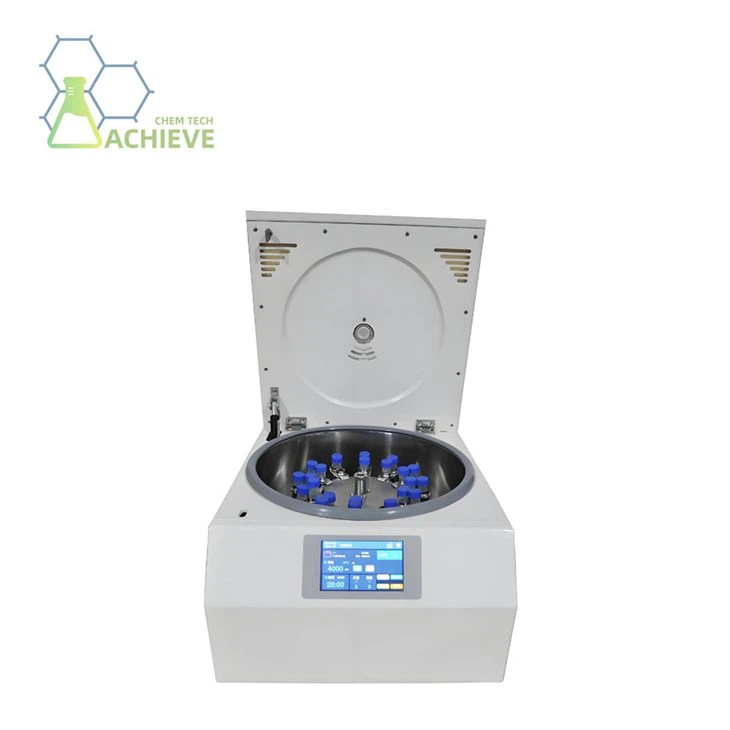


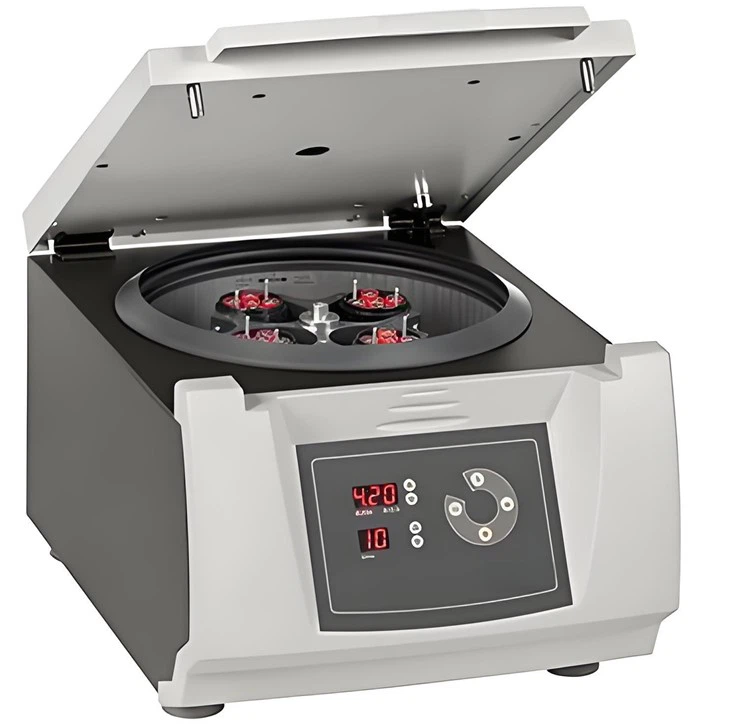
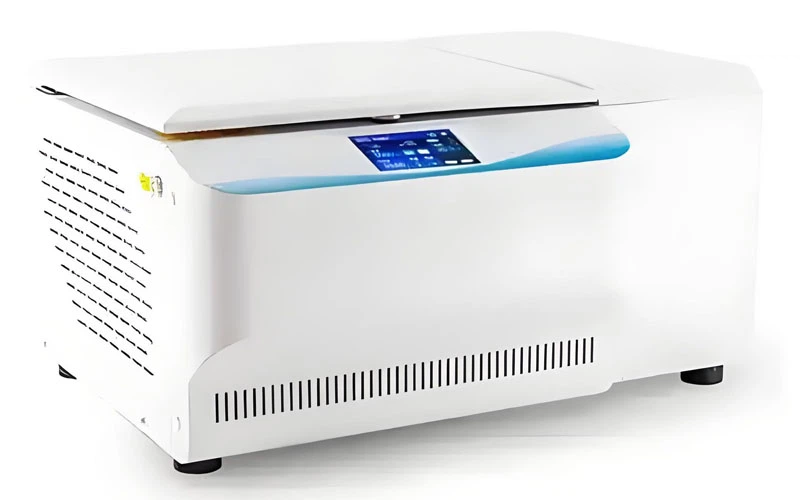
Bench Top Centrifuge Machine
Description
Technical Parameters
A bench top centrifuge machine is a device commonly found in laboratories that is primarily used to separate, precipitate, and concentrate particles in a suspension or emulsion. It uses the centrifugal force generated by the high-speed rotation of the rotor to separate the different components in the sample due to differences in density, size and shape. Table centrifuge has the characteristics of small size, light weight, easy operation, adjustable speed, etc., and is widely used in biomedicine, chemistry, environmental monitoring, food processing and other fields.
Table centrifuges play an important role in many fields as a useful assistant in the laboratory. With the continuous progress and innovation of science and technology, desktop centrifuges will continue to develop and improve, providing more efficient, accurate and convenient centrifuge separation solutions for laboratories.
When using a table centrifuge, it is necessary to strictly follow the safe operation code, pay attention to the preparation and balance of samples, select the appropriate rotor and centrifugal tube, set the appropriate parameters, monitor the operation process, and carry out regular maintenance and maintenance. These considerations ensure the safe and efficient operation of the centrifuge and protect the safety of the operator.
Speed monitoring
The importance of speed monitoring
Ensure experimental accuracy: the results of centrifugal experiments are often closely related to the speed. If the speed is not accurate, it may lead to incomplete or excessive sample separation, affecting the reliability of the experimental results.
Protect equipment safety: When centrifuges rotate at high speed, if the speed exceeds the design range, it may cause damage to the equipment and even cause safety accidents.
The speed monitoring method

Direct display and monitoring
Liquid crystal Display: Modern desktop centrifuges are usually equipped with a liquid crystal display that can display the current speed value in real time. The operator can directly monitor the centrifuge speed through the display screen.
Microcomputer processor control: Many centrifuges use microcomputer processor to precisely control the speed to ensure the stability and accuracy of the speed. The operator can set the desired speed through the control panel, and the microcomputer processor automatically adjusts the motor speed to reach the set value.
Alarm and protection mechanism
Overspeed alarm: When the centrifuge speed exceeds the set range, the centrifuge will automatically send an alarm signal to remind the operator to pay attention.
Automatic stop protection: Some centrifuges are also equipped with automatic stop protection mechanism, when the speed exceeds the safe range, the centrifuge will automatically stop running to prevent equipment damage or safety accidents.

Speed monitoring precautions
Regular calibration
In order to ensure the accuracy of speed monitoring, it is recommended to regularly calibrate the speed of the centrifuge. Calibration can be done using a professional tachometer or other calibration equipment.
Check the sensor
Speed monitoring usually relies on sensors to detect the speed of the motor. If the sensor is faulty or damaged, it may result in inaccurate speed monitoring. Therefore, regularly checking the working status of the sensor is an important measure to ensure the accuracy of speed monitoring.
Comply with the operating procedures
During operation, the operating procedures of the centrifuge should be strictly followed to avoid the failure of speed monitoring or equipment damage caused by misoperation.
The practical application of speed monitoring
In practical applications, speed monitoring may vary for different types of centrifuges. For example, for high-speed centrifuges, the accuracy of speed monitoring is particularly important, because high-speed centrifuges will generate huge centrifugal forces during operation, and the stability of the speed is higher. For low-speed centrifuges, although the speed is relatively low, the speed monitoring is still an important part of ensuring the accuracy of the experiment and the safety of the equipment.
Case analysis of speed monitoring
For example, a type of benchtop high speed centrifuge is equipped with a liquid crystal display screen and a microprocessor control system that displays the current speed value in real time and allows the operator to set the required speed. At the same time, the centrifuge is also equipped with overspeed alarm and automatic stop protection mechanism, when the speed exceeds the set range, the centrifuge will automatically send an alarm signal and stop operation. This design effectively guarantees the safety and accuracy of the experiment.
In summary, the speed monitoring of bench top centrifuge machine during operation is an important link to ensure the accuracy of the experiment and the safety of the equipment. The real-time monitoring and precise control of centrifuge speed can be realized by means of modern technology such as liquid crystal display screen and microprocessor control system. At the same time, regular calibration of sensors, inspection of equipment status and compliance with operating procedures are also important guarantees to ensure the accuracy of speed monitoring.
Vibration monitoring
The importance of vibration monitoring
Ensure the safety of the equipment: when the centrifuge is rotating at high speed, if the vibration is too large, it may lead to the loosening of the equipment components, wear and even damage, and may cause safety accidents in serious cases. Vibration monitoring enables you to detect and handle vibration anomalies in a timely manner, ensuring the safe running of devices.
Improve experimental accuracy: The results of centrifugal experiments are often closely related to the stability of the equipment. Excessive vibration may lead to uneven distribution of samples in the centrifugal tube, affect the separation effect, and thus reduce the accuracy of the experimental results. Through vibration monitoring, the centrifuge can be ensured to run in a stable state and improve the reliability of the experimental results.
Vibration monitoring methods

Install vibration sensors
Install vibration sensors in the key parts of the centrifuge (such as rotor, bearing, etc.) to monitor the vibration of the equipment in real time. Vibration sensors can convert mechanical vibrations into electrical signals, which can be recorded and analyzed by data acquisition systems.

Set a vibration threshold
Set a reasonable vibration threshold according to the model, specification and experimental requirements of the centrifuge. When the vibration signal exceeds the set threshold, the system will issue an alarm to remind the operator to take timely measures.

Periodically analyze vibration data
Periodically analyze the collected vibration data to evaluate the operating status of the equipment. By analyzing the vibration frequency, amplitude and other parameters, you can determine whether the equipment has hidden trouble, and timely maintenance or replacement of parts.
Precautions for vibration monitoring
Select the right vibration sensor: According to the characteristics of the centrifuge and experimental requirements, select the right vibration sensor. The sensor should have high precision, high sensitivity and good stability to ensure the accuracy of vibration monitoring.
Reasonable setting of vibration threshold: The setting of vibration threshold should consider the performance of the equipment, experimental requirements and environmental factors. If the threshold is too high, vibration anomalies cannot be detected in time. If the threshold is set too low, false alarms may be generated
Regular maintenance of equipment: regular maintenance and maintenance of the centrifuge, check whether the parts of the equipment are loose, worn or damaged, and timely replacement or repair. This helps to reduce the generation of vibration sources and improve the stability of the equipment.

The practical application of vibration monitoring
In laboratory and industrial production, benchtop centrifuges are widely used for sample separation and purification. In order to ensure the normal operation of the equipment and the accuracy of the experimental results, many centrifuges are equipped with vibration monitoring systems. For example, some high-end centrifuges can monitor the vibration of the equipment in real time through the built-in vibration sensor, and display the vibration data through a digital display or computer interface. When vibration exceeds a set threshold, the system alerts and automatically shuts down to protect equipment and samples.
Summary
Vibration monitoring of bench top centrifuge machine is an important means to ensure the safe and stable operation of equipment and the accuracy of experimental results. By installing vibration sensor, setting vibration threshold and analyzing vibration data regularly, the real-time monitoring and early warning of centrifuge vibration can be realized. At the same time, regular maintenance of equipment and reasonable setting of vibration thresholds are also the key to improve the effect of vibration monitoring. In practical application, the suitable vibration monitoring scheme should be selected according to the characteristics of centrifuge and experimental requirements to ensure the normal operation of equipment and the accuracy of experimental results.
Running status monitoring
The importance of health monitoring
Bench top centrifuge machine is widely used in scientific research, medical treatment, chemical industry and other fields. In order to ensure the accuracy of the experimental results and the long-term stable operation of the equipment, it is particularly important to monitor the running state of the centrifuge in real time. Through the operation status monitoring, you can find the potential trouble of the equipment in time, prevent the occurrence of sudden faults, reduce the downtime, and improve the reliability and service life of the equipment.
The content of operation status monitoring
Temperature monitoring
Temperature is an important factor affecting centrifuge performance and sample quality. Too high or too low a temperature can cause sample damage or experiment failure. Therefore, real-time monitoring of the operating temperature of the centrifuge to ensure its operation in a suitable range is crucial to ensure the accuracy of the experimental results.
Vibration monitoring
When the centrifuge is rotating at high speed, if the vibration is too large, it may cause damage to the equipment and even cause safety accidents. By installing vibration sensor, the vibration of centrifuge can be monitored in real time, and the abnormal vibration can be found and dealt with in time, which can effectively ensure the safe operation of equipment.
Speed monitoring
The centrifuge speed directly affects the separation effect. It is of great significance to monitor the centrifuge speed in real time to ensure that it runs within the set range.
Other parameter monitoring
Depending on the specific model and application scenario of the centrifuge, other parameters may also need to be monitored, such as pressure, flow, etc. The real-time monitoring of these parameters helps to fully understand the operating status of the centrifuge, and to discover and deal with potential problems in time.
The implementation of operational status monitoring
Built-in monitoring system
Modern desktop centrifuges are usually equipped with built-in monitoring systems that can monitor the operating status of the equipment in real time, including temperature, vibration, speed and other parameters. When the parameter exceeds the normal range, the system will issue an alarm to remind the operator to take measures in time.
External monitoring equipment
For some older centrifuges or scenarios that require higher precision monitoring, external monitoring equipment can be considered. These devices can be connected to the centrifuge through sensors to monitor the operating status of the equipment in real time and transmit the data to a computer or display screen for display and analysis.
Remote Monitoring
With the development of Internet of Things technology, more and more centrifuges are beginning to support remote monitoring. Through the network connection, the operator can remotely view the operating status of the centrifuge, discover and deal with potential problems in time, and improve the operation efficiency and safety of the equipment.
Precautions for operation status monitoring
Periodically calibrate the sensor
In order to ensure the accuracy of monitoring data, the sensor needs to be calibrated regularly. The calibration period should be determined according to the performance of the sensor and the environment in which it is used.
Set a proper monitoring threshold
Set a proper monitoring threshold based on the centrifuge model and application scenario. Setting the threshold too low may result in false alarms and increase the burden on the operator. If the threshold is too high, potential problems may not be detected in a timely manner.
Timely processing of alert information
When the monitoring system issues an alarm, the operator should view and process the alarm information in time. For problems that cannot be solved immediately, record and track the progress of the problem to ensure that the problem is properly resolved.
Strengthen equipment maintenance
Perform regular maintenance and maintenance on the centrifuge, check whether the parts of the equipment are loose, worn or damaged, and replace or repair them in time. This helps to reduce the occurrence of failures and improve the reliability and service life of the equipment.
Summary
The operation condition monitoring of bench top centrifuge machine is the key measure to ensure the safe and efficient operation of the equipment. By monitoring the temperature, vibration, speed and other parameters of the equipment in real time, potential problems can be found and dealt with in time, which can effectively ensure the safe operation of the equipment and the accuracy of the experimental results. At the same time, strengthening equipment maintenance and regularly calibrating sensors are also important means to improve the monitoring effect.
Hot Tags: bench top centrifuge machine, China bench top centrifuge machine manufacturers, suppliers, factory, High Pressure Stainless Steel Reactor, PPL Lined Hydrothermal Autoclave, Stainless Steel Reactor, Short Path Distillation, 10l Glass Reactor, Laboratory Rotary Evaporator
Previous
Big Centrifuge MachineSend Inquiry