


What Is The Difference Between Rotary Evaporator And Short Path Distillation?
May 25, 2024
Leave a message
In the realm of laboratory equipment for chemical preparing, both the rotational evaporator and short path distillation play significant parts. These two strategies are utilized for isolating and decontaminating substances, but they separate altogether in their instruments, applications, and proficiency. Understanding the difference between these methods is significant for selecting the most reasonable strategy for particular applications.
Rotary Evaporator: Principles and Applications
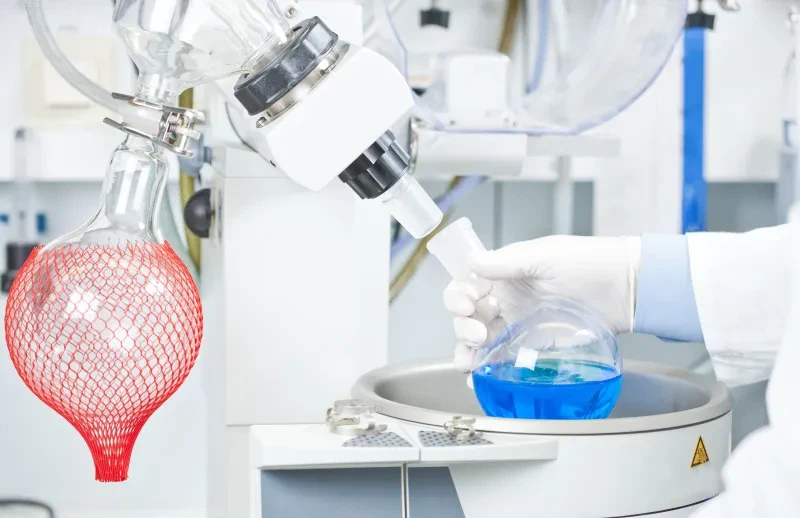
A rotary evaporator, also known as a rotovap, is a research facility gadget utilized for proficient and delicate vanishing of solvents from a test beneath decreased weight. It comprises of a rotational jar (or round-bottom jar) that is warmed by a water or oil shower whereas being turned, encouraging the vanishing prepare. Here are the standards and applications of rotational evaporators:
Principles:
Evaporation Beneath Diminished Weight:
The essential guideline of a rotary evaporator is to dissipate solvents from a test beneath diminished weight. By bringing down the weight interior the framework, the bubbling focuses of the solvents diminish, permitting for dissipation to happen at lower temperatures than beneath air pressure.
Heat Exchange:
The rotary flask containing the test is warmed by a water or oil shower, or by a warming mantle. The warm exchanged to the jar increments the temperature of the test, advancing vanishing of the solvent.
Rotary Movement:
The rotary flask is turned at a controlled speed utilizing a motorized drive unit. The turn increments the surface range accessible for vanishing, improves blending and warm exchange, and avoids bumping or sprinkling of the sample.
Condensation:
The vaporized dissolvable is at that point condensed back into fluid frame in a partitioned condenser unit. Cooling water or a refrigerant is regularly circulated through the condenser to expel warm and encourage condensation.
Collection: The condensed dissolvable is collected in a getting carafe or vessel. Alternatively, a vacuum pump is utilized to keep up decreased weight in the framework, helping in dissolvable dissipation and condensation.
Applications:
Solvent Removal:
Rotary evaporators are widely used for the efficient removal of solvents from chemical reactions, extractions, or synthesis processes. They are particularly useful when working with volatile solvents or when solvent recovery is desired
Concentration:
Rotary evaporators can be used to concentrate dilute solutions by evaporating the solvent under reduced pressure, leaving behind a more concentrated sample.
Purification:
Rotary evaporation is employed for the purification of natural product extracts, essential oils, and other complex mixtures. By selectively evaporating the solvent, impurities can be removed, resulting in a purer product.
Sample Preparation:
Rotary evaporators are used in sample preparation techniques such as drying, desalting, or solvent exchange. They are commonly employed in research laboratories, pharmaceuticals, food and beverage, and chemical industries.
Environmental Testing: Rotary evaporators are also used in environmental testing laboratories for the concentration and analysis of environmental samples such as water, soil, or air samples.
Overall, rotary evaporators offer a versatile and efficient method for solvent evaporation and concentration in various laboratory and industrial applications, contributing to increased productivity and sample purity.

Operating Mechanism of Rotary Evaporator
The operation of a rotary evaporator begins with the sample placed in a flask, which is then rotated to increase the surface area exposed to heat and vacuum. As the solvent evaporates due to reduced pressure and elevated temperature, it forms vapor that travels through a condenser, where it is cooled and liquefied. The condensed solvent is collected in a separate flask, leaving behind the desired compound in the original flask.
Applications of Rotary Evaporator
The rotating evaporator finds broad application in different areas such as pharmaceuticals, chemistry, and nourishment science. It is especially valuable for concentrating arrangements, decontaminating compounds, and expelling solvents from tests without subjecting them to over the top heat.


Short Path Distillation: Principles and Applications
Short path distillation, moreover known as molecular distillation, is a specialized method utilized for the refinement of high-boiling point substances with negligible corruption. Not at all like customary refining strategies, brief way refining works beneath tall vacuum conditions and utilizes short path lengths to minimize the introduction of the test to warm.
Operating Mechanism of Short Path Distillation
Short path distillation involves the vaporization of the sample at low temperatures and pressures, followed by rapid condensation to obtain a purified product. This process occurs within a short distance, hence the name "short path." By reducing the distance between the evaporation surface and the condenser, short path distillation minimizes the loss of volatile compounds and maximizes the efficiency of separation.

Comparison between Rotary Evaporator and Short Path Distillation
1. Operating Conditions
While both rotary evaporators and short path distillation systems operate under vacuum, their operating conditions differ significantly. Rotary evaporators typically operate at higher temperatures and longer residence times compared to short path distillation, which employs lower temperatures and shorter residence times to minimize thermal degradation.
2. Efficiency and Throughput
Short path distillation offers higher efficiency and throughput compared to rotary evaporation due to its ability to achieve greater separation in a shorter time frame. The short path length reduces the time taken for molecules to travel from the evaporator to the condenser, resulting in faster distillation and higher purity of the product.
3. Heat Sensitivity
For heat-sensitive compounds, short path distillation is preferred over rotary evaporation as it allows for distillation at lower temperatures, minimizing the risk of thermal degradation. Rotary evaporators, while efficient, may subject delicate compounds to higher temperatures during prolonged evaporation, potentially compromising their integrity.
4. Complexity and Cost
Rotary evaporators are generally simpler in design and more cost-effective than short path distillation systems, making them accessible to a wider range of users. Short path distillation setups, on the other hand, require specialized equipment and expertise, which may incur higher initial costs and maintenance expenses.
Conclusion
In summary, while both rotary evaporators and short path distillation serve the purpose of separating and purifying substances, they differ in their operating mechanisms, efficiency, and suitability for specific applications. Rotary evaporators excel in handling larger volumes and routine evaporation tasks, whereas short path distillation offers superior performance in terms of purity and efficiency, especially for heat-sensitive compounds. Understanding the distinctions between these techniques is essential for selecting the most appropriate method to achieve desired results in laboratory and industrial settings.
References:
https://www.sigmaaldrich.com/technical-documents/articles/analytical/chromatography/evaporation-technologies-rotary-evaporator-short-path-distillation.html
https://www.edwards.co.jp/sites/default/files/2018-09/AN0027EN.pdf
https://www.buchi.com/en/purity-during-thermal-separation