


Improve Pilot Spray Dryer Efficiency And Reduce Maintenance Frequency
Jun 25, 2026
Leave a message
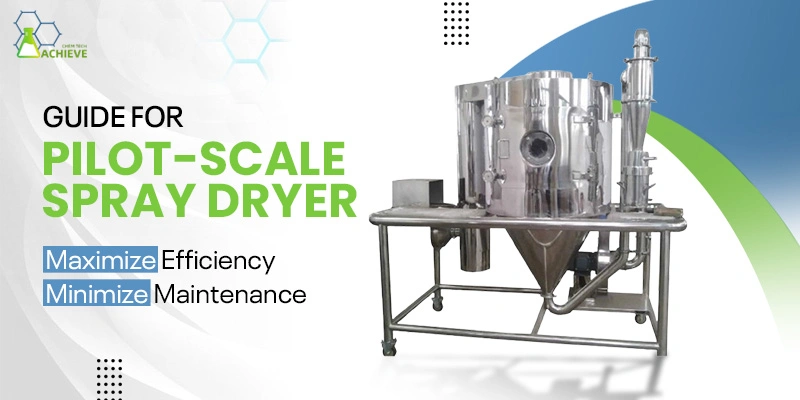
Pilot Spray Dryer Specifications and Features
How to Improve the Efficiency of Pilot Spray Dryers
- Optimize Feed Preparation
- Increased Atomization Effectiveness
- Control Temperature and Airflow
- Improve Powder Recovery
- Automate and Monitor Processes
Reducing Maintenance Requirements
- Prevent Build-up and Blockages
- Maintain Atomization Components
- Maintain Ventilation and Filtration System
- Apply Quality Material and Design
- Adopt Maintenance Strategy
Applications of Pilot Spray Dryers
Introduction
A pilot spray dryer converts liquids, suspensions, or emulsions into dry powder by rapidly removing moisture with hot gas. Achieving optimal efficiency requires advanced, well-engineered systems from reliable manufacturers, ensuring durability, low maintenance, and consistent product quality through precise design and high-grade materials.
This guide will help you understand how to tune in your production with the right equipment that improves efficiency and requires less maintenance.
What is a spray dryer?
The pilot spray dryer is a piece of equipment that converts liquid solutions, emulsions, or suspensions into dry powders by rapidly evaporating solvents with hot air in a chamber specifically designed for it.
Working Principle:
- Liquid feed is dispersed into fine droplets.
- Hot air is fed to the drying chamber.
- Quick heat exchange results in rapid evaporation.
- Particles obtained after the process are dry.
It is commonly utilized due to its numerous advantages that include:
- Short drying time
- Regulated particle size
- Product uniformity
- Ability for continuous operation

When combined with preceding operations, such as purify by evaporation via a rotary evaporator, spray drying becomes more efficient.
Pilot Spray Dryer Specifications and Features
Achieve Chem modern pilot dryers are designed for flexibility, precision, and ease of scale-up. They are designed by experts using modern advanced technology to ensure precise drying and protection for heat-sensitive feed. These features make our pilot and lab scale spray dryers an ideal choice for research institutions, chemical processing, pharmaceuticals, and the food industry. The table below states features and details about our product.
|
Category |
Specification |
Details |
|
General |
Capacity & Scale |
1–50 kg/h, suitable for lab scale and pilot production |
|
Operation Mode |
Continuous / semi-continuous drying |
|
|
Temperature Control |
Inlet & Outlet Range |
40°C–350°C (inlet), adjustable outlet with ±1°C PID accuracy |
|
Heating Method |
Electric heating with optional steam configuration |
|
|
Atomization System |
Type & Performance |
Two-fluid nozzle or centrifugal atomizer (up to 25,000 RPM, 1–100 µm size) |
|
Feed Control |
Adjustable feed rate via precision pump |
|
|
Construction |
Material & Design |
SS304/SS316 stainless steel, GMP-compliant, sanitary finish |
|
Control System |
Automation & Monitoring |
PLC with touchscreen, real-time data monitoring, and logging |
|
Airflow System |
Air Handling |
Co-current airflow with adjustable blower and filtration system |
|
Powder Collection |
Recovery System |
Cyclone separator/bag filter with up to 95–99% efficiency |
|
Safety Features |
Protection Systems |
Over-temperature shutdown, pressure control, safety interlocks |
|
Maintenance |
Cleaning & Serviceability |
Modular design, easy cleaning, and an optional CIP system |
|
Integration |
Process Compatibility |
Works with rotary evaporation, crystallization equipment, and jacketed reactor |
|
Utilities |
Requirements |
Standard power supply, compressed air support, lab/pilot installation ready |
Speak with our engineers for in-depth details about the spray dryers as per your application-specific requirements.

How to Improve the Efficiency of Pilot Spray Dryers
Efficiency improvements in processes and output results from optimizing both process parameters and system integration. Here is a list of adjustments you can make to improve your products' efficiency.
1. Optimize Feed Preparation
Feed preparation is critical to efficient drying, as it directly affects the drying process.
- Implement rotary evaporation for solvent removal and concentration.
- Employ crystallization devices to regulate particle morphology.
- Utilize jacketed reactors for accurate heating and blending.
Consequence : Decreased drying burden and enhanced output consistency.
2. Increased Atomization Effectiveness
Effective and proper atomization guarantees the formation of equal droplets.
- Choose appropriate nozzles or atoms.
- Regulate feed viscosity and fluidity.
- Stabilize pressure and rotational speed.
Advantage : Accelerated drying and decreased internal chamber deposits.
3. Control Temperature and Airflow
Balanced thermal conditions are essential for effectively managing and upgrading the efficiency during the process.
- Manage ideal inlet and outlet temperatures.
- Calibrate airflow to facilitate even drying.
- Prevent excessive heat on sensitive substances.
Effect : Higher yield, improved product quality, and lower energy expenditure.
4. Improve Powder Recovery
Material loss lowers operational efficiency.
- Deploy highly effective cyclone separators.
- Strategize airflow direction.
- Prevent fine particles from escaping.
Consequence : Enhanced retrieval efficiency and minimized waste.
5. Automate and Monitor Processes
Automation improves consistency.
- Incorporate PLC systems for control parameters.
- Track temperature, airflow, and pressure in real-time.
- Record process data for reproducibility.
Effect : Consistent operation and seamless scaling.
Get personalized assistance on improving energy efficiency for significantly better results.
Reducing Maintenance Requirements
Maintenance plays a crucial role in influencing the cost and downtime in operation.
1. Prevent Build-up and Blockages
- Maintain cleanliness inside the drying chamber
- Avoid sticky build-ups by ensuring optimal feed composition
- Apply non-stick coatings where necessary
2. Maintain Atomization Components
- Regularly check the condition of nozzles and atoms
- Replace damaged components before breakdown
- Perform appropriate alignment and calibration
3. Maintain Ventilation and Filtration System
- Clean and/or change filters at regular intervals
- Ensure clear air ducts
- Maintain fans and blowers
4. Apply Quality Material and Design
- Stainless steel ensures durability and a low chance of corrosion
- Modular construction makes equipment replacements simpler
- Safety mechanisms built into the equipment prevent breakdown
5. Adopt Maintenance Strategy
- Plan for periodic inspection
- Monitor the efficiency of the system
- Educate operators on equipment use
Result : Minimized downtime and efficient equipment performance.
Applications of Pilot Spray Dryers
Pilot spray dryers are widely used across multiple industries due to their flexibility and scalability.
Key Applications:
Here are some industries that use our superior-quality spray dryer for fast, efficient, and enhanced production.
► Pharmaceuticals
With extensive use in drug formulation, the technology enables controlled drying of temperature-sensitive materials, thereby increasing their stability and bioavailability. It is essential for manufacturing inhalation products, antibiotics, and other drug delivery mechanisms.
► Food Industry
An indispensable process when it comes to making products such as milk powder, coffee, flavorings, and other nutritional components. Spray drying guarantees high-quality output with long shelf-life and retention of natural flavor.
► Chemical Processing
Used in the manufacture of chemical intermediates, catalysts, and other specialty products. The process is particularly significant because it offers the possibility of achieving desirable particle morphology.
► Biotechnology
Applied in the dehydration of enzymes, probiotics, and biological products without losing their biological functions. Spray drying helps to upscale biopharmaceuticals and nutraceuticals from laboratory discoveries to industrial manufacturing.
► Material Science
Allows the development of novel powders, ceramics, and nanomaterials. Spray drying contributes to the even dispersal of particles, which is important for electronic, coating, and high-performance material applications.
Conclusion here!
Optimizing a pilot spray dryer enhances yield, efficiency, and reliability through proper process control and maintenance. Partnering with Achieve Chem ensures advanced, high-quality systems backed by global expertise, delivering consistent performance and reduced operational challenges.
Explore our product catalog or speak with our engineers For custom equipment.

FAQs
Ques 1. What do I need a pilot spray dryer for?
Ans: The function of a pilot spray dryer is to act as a link between the laboratory and full-scale commercial production operations. With the use of this machine, manufacturers will be able to carry out tests on their formulations, fine-tune drying conditions, and assess important features of their products, such as particle size and moisture content.
Question 2. Why does rotary evaporation support spray drying?
Ans: Rotary evaporation is used to purify by evaporation because it helps in removing excess solvents and concentrating the feed solution. It all happened before spray drying, as this step overall improves process efficiency and product consistency.
- Less energy consumption with reduced drying load.
- Improves feed concentration and uniformity
- It can also be used for heat-sensitive materials.
Ques 3. What factors affect spray drying efficiency?
Ans: Achieve Chem products are optimized for faster production. However, these are some factors you can look up:
- Feed consumption, viscosity, and concentration, as well as atomization quality and droplet size.
- Temperature control, airflow rate, and humidity levels.
- Effectiveness of powder recovery systems and proper integration in robust equipment.
Ques 4. What services do you provide for spray drying equipment?
Ans: We offer comprehensive support across the entire project lifecycle, ensuring that clients receive reliable and efficient solutions. In addition, you can ask us for equipment design based on the application, installation guidance, commissioning, and operator training. Finally, the ongoing technical support and process optimization assistance.
Ques 5. What certification does Achieve Chem provide, and what are the international delivery facilities?
Ans: Yes, our equipment is manufactured in compliance with international standards such as ISO, CE, and GMP. Our international delivery is also smooth, as we handle everything carefully and ensure on-time delivery to your doorstep.