


Spray Dryer Working Principle: Process, Components & Applications
Nov 04, 2026
Leave a message
How Does a Spray Dryer Work? Working Principle, Process and Key Components
Spray drying is widely used to convert liquid materials into dry powders with controlled moisture content, particle size, and physical properties. Products such as milk powder, instant coffee, plant extracts, ceramic powders, pharmaceutical ingredients, and specialty chemicals can all be processed using spray drying technology.
But how does a spray dryer turn a liquid feed into a dry powder within seconds?
The answer lies in the combination of atomization, heat transfer, mass transfer, and powder separation. By breaking a liquid feed into thousands of small droplets and exposing them to a controlled stream of hot air, a spray dryer removes moisture rapidly while forming individual powder particles.
Understanding the spray dryer working principle is important not only for operating the equipment but also for selecting the right drying system for a specific material. Feed characteristics, atomizer design, air temperature, airflow distribution, and powder collection efficiency all influence the final result.
In this guide, we explain how a spray dryer works, examine its main components, compare different atomization methods, and discuss the operating factors that determine powder quality.
1. What Is a Spray Dryer?
A spray dryer is an industrial drying machine that converts a liquid solution, suspension, emulsion, or pumpable slurry into dry powder through rapid evaporation.
Unlike conventional drying methods, which may require a material to remain on a heated surface or inside a drying chamber for an extended period, spray drying disperses the feed into fine droplets. This creates a large surface area for moisture evaporation and significantly shortens the drying time.
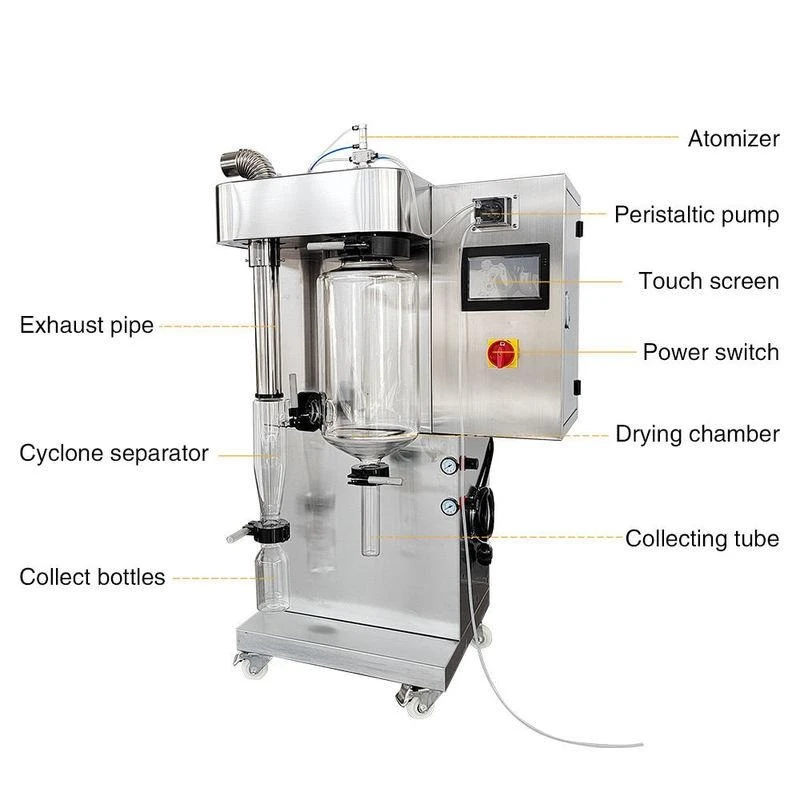
A typical spray drying system consists of a feed preparation unit, feed pump, atomizer, hot air supply, drying chamber, powder recovery equipment, and exhaust system.
The process generally operates continuously:
Liquid feed is prepared and delivered to the atomizer.
The atomizer produces fine droplets.
Heated air contacts the droplets inside the drying chamber.
Moisture evaporates, leaving solid particles.
The resulting powder is separated from the exhaust air and collected.
The final product can be a fine, free-flowing powder or a powder with specific particle characteristics, depending on the feed formulation and operating conditions.
2. What Is the Fundamental Principle of a Spray Dryer?
The spray dryer working principle is based on heat and mass transfer between hot drying air and atomized liquid droplets.
When liquid feed is converted into small droplets, its exposed surface area increases considerably. Hot air transfers thermal energy to the droplets, allowing moisture to evaporate. At the same time, water vapor moves from the droplet surface into the surrounding drying air.
As evaporation continues, the concentration of solid material inside each droplet increases. A solid structure gradually develops, eventually forming a dry or partially dried particle.
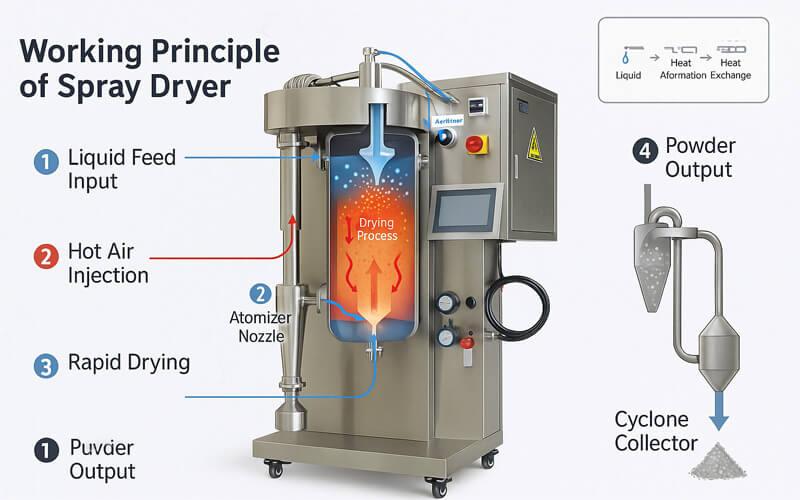
The basic physical process involves three important mechanisms:
2.1 Atomization and Surface Area Expansion
Atomization breaks the liquid feed into small droplets. Smaller droplets provide a greater surface-area-to-volume ratio, which generally promotes faster moisture removal.
For example, a large liquid stream cannot dry as quickly as the same amount of liquid dispersed into thousands of fine droplets under comparable conditions.
The atomizer therefore plays a major role in determining droplet size, particle formation, and the overall drying performance.
2.2 Heat Transfer
Heat is transferred from the hot drying air to the liquid droplets through convection.
Part of this thermal energy is used to evaporate moisture. During the initial wet stage, evaporation absorbs much of the transferred heat, helping keep the droplet temperature below the surrounding air temperature.
This is one reason spray drying can be suitable for many heat-sensitive materials, although excessive thermal exposure after drying can still damage certain products.
2.3 Mass Transfer and Moisture Evaporation
As moisture evaporates, water vapor moves away from the droplet surface and mixes with the drying air.
The rate of evaporation depends on several factors, including:
Droplet diameter
Air temperature
Air humidity
Air velocity
Feed composition
Solids concentration
Residence time
As the droplet loses moisture, its solid content becomes more concentrated. Depending on the material, a surface crust or shell may develop, followed by further moisture removal from the interior.
The resulting particle may be dense, porous, hollow, or irregular in shape. Its structure depends on the feed properties and drying conditions.
3. How Does a Spray Dryer Work? The Complete Process
A practical spray drying operation involves five main stages: feed preparation, atomization, contact with heated air, particle drying, and powder separation.
Step 1: Feed Preparation
Before entering the drying chamber, the liquid material must be prepared for stable pumping and atomization.
Depending on the application, feed preparation may involve mixing, filtration, homogenization, concentration adjustment, temperature control, or pH adjustment.
Important feed properties include:
Solid content and concentration
Viscosity and density
pH value
Feed temperature
Suspended particle content
Solvent or water-based composition
Heat sensitivity
Tendency to foam, stick, or crystallize
For example, milk concentrate, protein solutions, ceramic slurry, and botanical extracts have different flow and drying characteristics.
A feed that is too viscous may cause unstable atomization, while large suspended particles may block certain nozzle designs. Proper feed preparation helps maintain consistent droplet formation and powder quality.
Step 2: Atomization of Liquid Feed
The prepared liquid is pumped to an atomizer, which disperses it into fine droplets inside the drying chamber.
This is one of the most important stages in the spray drying process because droplet size directly influences drying speed and the characteristics of the final powder.
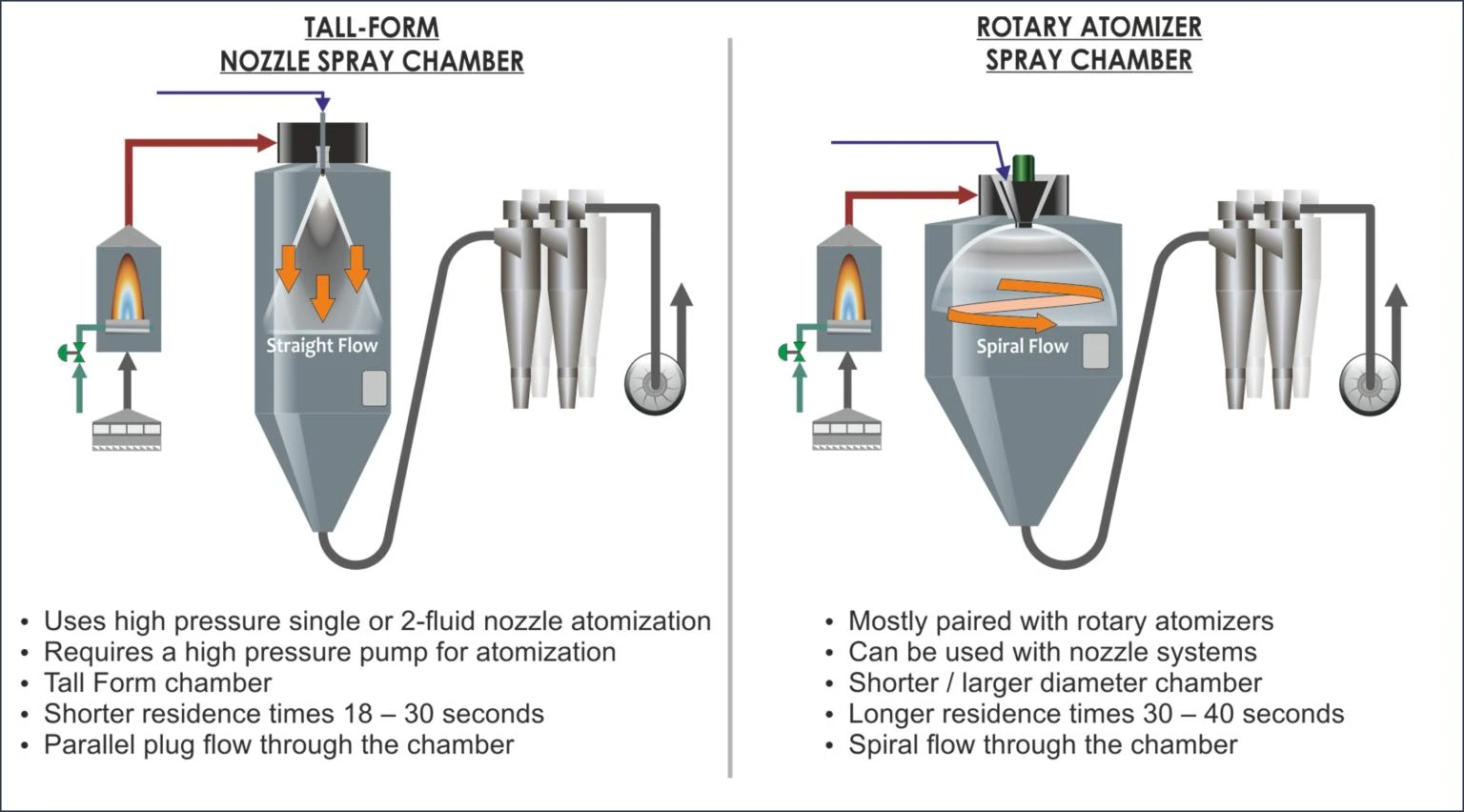
Common atomization methods include:
Rotary Atomization
A high-speed rotating disc or wheel distributes the liquid through centrifugal force. The feed moves outward from the rotating surface and breaks into droplets.
Rotary atomizers are commonly used in industrial spray drying applications where continuous operation and adjustable atomization conditions are required.
Pressure Nozzle Atomization
A high-pressure pump forces liquid through a specially designed nozzle orifice. The liquid exits at high velocity and breaks into droplets.
Pressure nozzle systems are useful when specific particle characteristics, production capacity, and chamber configurations are required.
Two-Fluid Nozzle Atomization
In this method, compressed air or another suitable gas interacts with the liquid feed at the nozzle, breaking it into fine droplets.
Two-fluid nozzles are commonly used in laboratory and pilot-scale spray dryers, particularly when smaller feed rates and flexible experimental conditions are needed.
The most appropriate atomization method depends on feed viscosity, solids content, target particle size, production capacity, and maintenance requirements.
Step 3: Contact Between Hot Air and Droplets
After atomization, the droplets enter the drying chamber and come into contact with heated air.
The air is generated by a heating system and delivered through an air distribution assembly to establish the required temperature and flow pattern.
Heat transfers from the hot air to the droplets, while moisture moves from the droplets into the surrounding air.
The interaction between air and droplets is influenced by:
Inlet air temperature
Outlet air temperature
Airflow rate
Air distribution
Droplet size
Chamber dimensions
Feed rate
A well-designed drying chamber helps maintain suitable contact between the droplets and hot air, allowing moisture to evaporate efficiently without excessive product degradation or wall deposition.
Step 4: Moisture Evaporation and Particle Formation
As the droplets travel through the drying chamber, moisture evaporates rapidly.
The solid components become concentrated, and individual particles begin to form. Depending on the material, the particles may develop a solid surface layer, a porous structure, or a hollow interior.
The drying time is generally very short, often measured in seconds, although the actual residence time depends on dryer design, airflow, particle properties, and operating conditions.
The powder must reach the required moisture level before leaving the drying system.
If drying is insufficient, the powder may remain wet or sticky. If thermal exposure is excessive, certain materials may experience discoloration, loss of activity, or changes in physical properties.
Step 5: Powder Separation and Collection
After particle formation, the dried powder must be separated from the exhaust air.
Larger particles may fall toward the bottom of the drying chamber, while finer particles are carried away with the exhaust gas.
A cyclone separator uses centrifugal force to separate much of the powder from the air stream. A bag filter or other secondary dust collection device may be installed to recover finer particles.
The collected powder is then discharged through an appropriate collection arrangement for packaging, storage, or further processing.
Powder recovery efficiency is important because it directly affects product yield, dust emissions, and material losses.
Important: Standard spray drying does not normally involve automatically returning the collected powder to the beginning of the process. If the powder does not meet the target specification, operators may adjust the feed and drying conditions or use a separate secondary drying or post-processing step.
4. Main Components of a Spray Dryer and Their Functions
Although spray dryer configurations vary according to capacity and application, most systems contain several essential components.
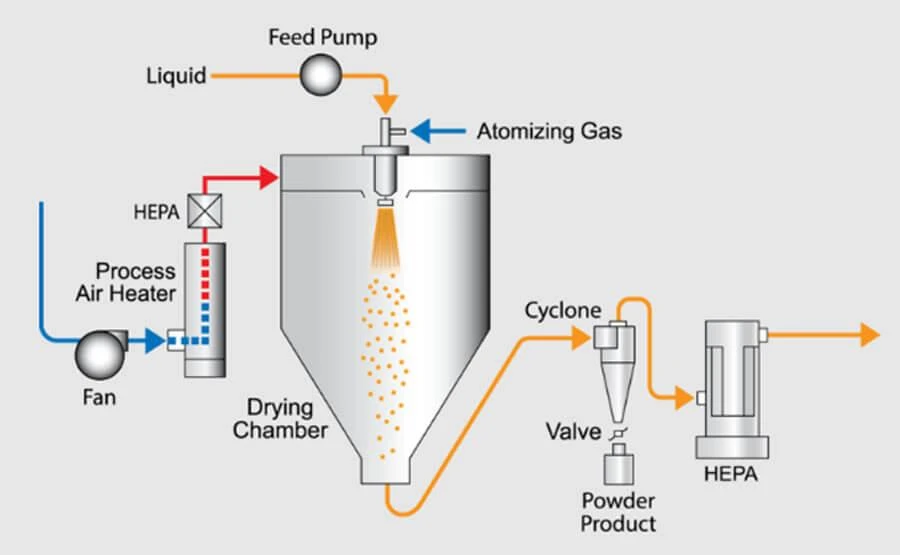
| Component | Main Function |
|---|---|
| Feed Tank | Stores and prepares the liquid material before drying |
| Feed Pump | Delivers the feed at a controlled flow rate |
| Atomizer | Converts liquid feed into fine droplets |
| Air Filter | Removes unwanted particles from incoming air |
| Air Heater | Heats the drying air to the required temperature |
| Air Distributor | Distributes heated air inside the drying chamber |
| Drying Chamber | Provides the space for droplet drying and particle formation |
| Cyclone Separator | Separates powder from the exhaust air |
| Bag Filter | Captures additional fine particles |
| Exhaust Fan | Maintains the required airflow through the system |
| Control System | Monitors and adjusts important operating parameters |
| Powder Collection Unit | Collects and discharges the finished powder |
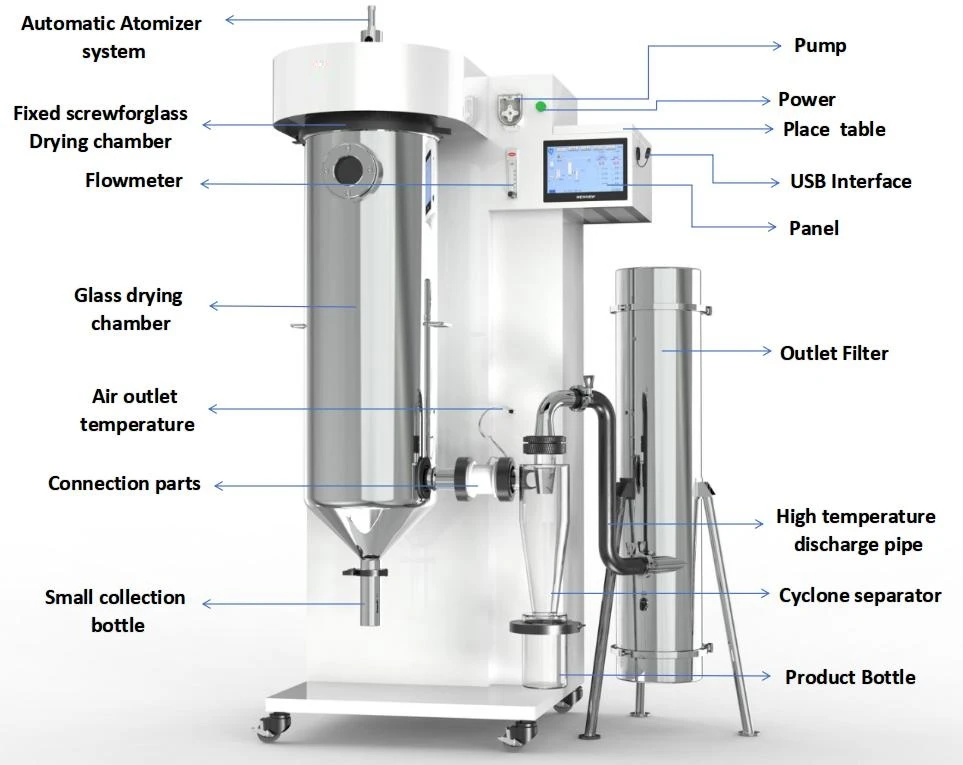
4.1 Drying Chamber
The drying chamber is the central part of the equipment. It provides the environment in which atomized droplets interact with hot air and undergo moisture evaporation.
Its diameter, height, internal geometry, and air distribution arrangement influence the residence time and drying performance.
4.2 Atomization System
The atomization system determines how the liquid feed is dispersed. Its design should match the viscosity, solids content, and target particle characteristics of the material.
4.3 Heating and Air Supply System
This system supplies the thermal energy required for evaporation. Depending on the equipment configuration, heating may be provided by electric heaters, steam, or other suitable heat sources.
Air filtration and temperature control are also important for maintaining stable operating conditions.
4.4 Powder Collection System
The collection system separates dried particles from the exhaust air. Cyclones and bag filters are commonly combined when improved powder recovery is required.
4.5 Control and Monitoring System
A control panel allows operators to monitor and adjust important parameters such as inlet temperature, outlet temperature, feed rate, and airflow.
More advanced systems may include automatic temperature regulation, alarms, data recording, and additional process monitoring functions.
5. Different Types of Spray Dryers
Spray dryers can be classified according to their atomization methods, operating configurations, and production scale. These classifications describe different aspects of the equipment and should not be treated as one single category.
5.1 Classification by Atomization Method
Rotary Atomizer Spray Dryer
Uses a rotating disc or wheel to disperse liquid feed. It is suitable for applications requiring flexible atomization and continuous powder production.
Pressure Nozzle Spray Dryer
Uses a high-pressure pump and nozzle to generate droplets. It is often selected for processes requiring specific particle size and powder characteristics.
Uses compressed gas to assist liquid atomization. It is frequently used for laboratory research, pilot testing, and small-scale production.
5.2 Classification by Drying System Configuration
Open-Cycle Spray Dryer
Uses fresh filtered air as the drying medium. The humid exhaust air is discharged after powder separation. This is a common configuration for water-based feed materials.
Closed-Loop Spray Dryer
Circulates a controlled drying gas within a closed system. It may use nitrogen or another suitable inert gas and can incorporate solvent condensation and recovery.
This configuration is considered for suitable solvent-based or oxygen-sensitive processes. Its design requires careful assessment of solvent properties, safety requirements, and applicable regulations.
5.3 Classification by Production Scale
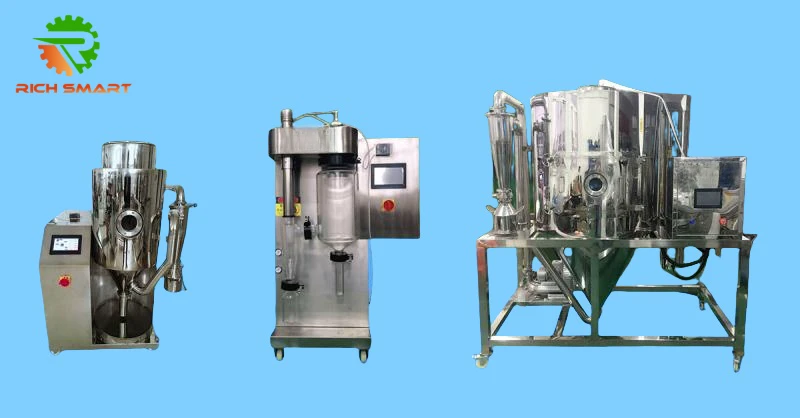
Designed for research, formulation development, and small sample processing. It allows users to investigate drying conditions before moving toward larger production equipment.
Used to evaluate process feasibility and obtain operating data for scale-up. It helps determine whether a particular formulation can achieve the required powder characteristics.
Designed for continuous production at larger capacities. Its configuration depends on the required evaporation load, feed properties, powder specifications, and plant utilities.
6. What Operating Parameters Affect Spray Drying Performance?
A spray dryer does not produce consistent powder quality by controlling only one temperature setting. The final result depends on the combined effect of several operating parameters.
| Operating Parameter | Influence on Drying Performance |
|---|---|
| Inlet Air Temperature | Affects the thermal energy available for moisture evaporation |
| Outlet Air Temperature | Provides an important indication of drying conditions and product thermal exposure |
| Feed Rate | Influences moisture load and the balance between evaporation capacity and drying demand |
| Atomizer Speed or Nozzle Pressure | Affects droplet formation and particle characteristics |
| Feed Solids Content | Influences evaporation requirements and the amount of powder produced |
| Feed Viscosity | Affects pumping stability and atomization behavior |
| Airflow Rate | Influences heat transfer, moisture removal, and particle movement |
| Residence Time | Determines how long droplets and particles remain in the drying environment |
6.1 Inlet and Outlet Temperature
Inlet temperature refers to the temperature of the heated air entering the drying chamber. Outlet temperature refers to the temperature of the air leaving the dryer.
Increasing inlet temperature can improve the available drying capacity, but it does not automatically produce better powder.
Outlet temperature is particularly useful for evaluating the drying process and balancing moisture removal against product thermal exposure.
The appropriate temperature range depends on the feed formulation, moisture target, equipment design, and product sensitivity.
6.2 Feed Rate
Feed rate determines how much liquid enters the drying chamber over a given period.
If the feed rate is too high for the available evaporation capacity, the powder may not dry sufficiently. If the feed rate is too low, the equipment may operate inefficiently or produce powder with different characteristics.
6.3 Droplet Size
Droplet size influences drying speed and the size distribution of the resulting particles.
Smaller droplets generally dry faster, while larger droplets require more time for moisture removal. However, final powder size is not necessarily identical to the original droplet diameter because particle shrinkage, shell formation, porosity, and agglomeration can occur during drying.
6.4 Feed Concentration and Viscosity
Higher solids concentration can reduce the amount of moisture that needs to be evaporated for a given quantity of dry solids.
However, increasing concentration may also raise viscosity and make atomization more difficult.
For this reason, feed concentration should be optimized together with pump capacity and atomizer selection.
7. What Determines the Final Powder Quality?
The purpose of spray drying is not simply to remove moisture. In many applications, the powder must also meet specific physical and functional requirements.
| Powder Quality Indicator | Main Influencing Factors |
|---|---|
| Moisture Content | Outlet temperature, feed rate, solids content, airflow |
| Particle Size Distribution | Atomizer type, speed, nozzle pressure, feed viscosity |
| Bulk Density | Droplet characteristics, solids concentration, particle structure |
| Flowability | Moisture, particle shape, surface properties, particle size |
| Solubility | Feed formulation, particle structure, drying conditions |
| Color and Product Activity | Thermal exposure, residence time, material characteristics |
| Powder Recovery Rate | Chamber deposition, cyclone efficiency, filter performance |
For example, instant food ingredients may require good dispersibility, while ceramic powders may need controlled particle characteristics for subsequent forming and sintering processes.
Pharmaceutical and biochemical materials may require additional attention to thermal stability, product purity, and contamination control.
The correct operating conditions should therefore be established according to the intended use of the final powder rather than based on temperature alone.
8. Applications of Spray Drying Technology
Spray drying is used across a wide range of industries because it can process many pumpable liquid materials into dry powders.
Food and Dairy Industry
Common applications include milk powder, whey powder, coffee extract, fruit juice powder, flavor ingredients, and protein powders.
The process helps convert liquid food ingredients into powders that are easier to store, transport, and incorporate into other formulations.
Pharmaceutical and Biotechnology Industry
Spray drying can be used for pharmaceutical intermediates, excipients, botanical extracts, enzymes, and selected biological formulations.
The process conditions and equipment configuration must be evaluated according to the material's stability, hygiene requirements, and intended application.
Chemical Industry
Applications include pigments, dyes, specialty chemicals, polymers, and various inorganic materials.
Spray drying can help produce powders with controlled moisture and physical characteristics for downstream manufacturing.
Ceramic and Advanced Materials
Ceramic slurries and selected advanced material suspensions can be processed into powders for further forming, pressing, or other manufacturing operations.
The feed formulation and atomization conditions are particularly important when particle characteristics affect subsequent processing.
Agricultural and Environmental Applications
Certain fertilizers, mineral suspensions, and other suitable liquid formulations can also be processed using spray drying technology.
The appropriate system depends on feed composition, production capacity, material handling, and environmental requirements.
9. How to Select the Right Spray Dryer for Your Application
Choosing a spray dryer based only on its advertised capacity can lead to unsuitable equipment selection.
Two materials processed at the same feed rate may require different atomizers, temperature profiles, chamber designs, and collection systems.
Before purchasing spray drying equipment, consider the following factors.
1. Material Characteristics
Identify whether the feed is a solution, suspension, emulsion, or slurry. Determine its viscosity, solids content, particle characteristics, and heat sensitivity.
2. Required Production Capacity
Clarify the feed processing rate and the expected water evaporation load. These are different measurements and should not be confused when comparing equipment specifications.
3. Target Powder Specifications
Define the required moisture content, particle size distribution, bulk density, flowability, solubility, and other relevant product properties.
4. Atomization Method
Choose between rotary atomization, pressure nozzles, and two-fluid nozzles based on feed properties and the intended powder characteristics.
5. Heating and Drying Configuration
Consider the heat source, temperature control range, air distribution, and whether an open-cycle or closed-loop system is necessary.
6. Powder Recovery and Cleaning
Evaluate cyclone and filter arrangements, powder discharge, cleaning access, and the requirements for product changeover.
7. Future Production Requirements
Consider whether the equipment will be used for laboratory research, pilot testing, or continuous production. The possibility of future capacity expansion should also be considered.
When the material or drying behavior is uncertain, laboratory or pilot-scale testing can provide useful information before selecting a larger system.
10. Common Spray Drying Problems and Possible Causes
Understanding common operating problems helps improve production stability and reduce material losses.
| Common Problem | Possible Causes | Recommended Checks |
|---|---|---|
| Wet or Sticky Powder | Excessive feed rate, insufficient drying, unsuitable outlet temperature | Review feed rate, airflow, and drying conditions |
| Powder Sticking to Chamber Walls | Material stickiness, unsuitable temperature profile, poor airflow distribution | Review feed formulation and chamber operating conditions |
| Uneven Particle Size | Unstable atomization, fluctuating feed properties, nozzle wear | Check atomizer condition and feed stability |
| Low Powder Recovery | Fine particles escaping, cyclone inefficiency, leakage | Inspect collection equipment and filter system |
| Nozzle Blockage | High viscosity, suspended solids, unsuitable nozzle opening | Check feed preparation and nozzle specifications |
| Product Discoloration | Excessive thermal exposure or material instability | Review temperature profile and residence time |
These symptoms can have multiple causes. Operators should evaluate feed properties, atomization, air conditions, and collection performance together rather than changing one parameter without identifying the underlying issue.
11. Why Are Laboratory and Pilot Spray Dryer Tests Important?
For a new material, knowing that it can be atomized does not necessarily mean that it can be dried successfully at the required production scale.
A laboratory or pilot spray dryer test helps establish the relationship between feed characteristics, drying conditions, and final powder properties.
A practical test may record:
Feed composition and solids content
Feed rate
Inlet and outlet temperatures
Atomization method and operating conditions
Powder appearance
Final moisture content
Particle size distribution
Powder recovery rate
These results provide a useful reference for selecting an atomizer, evaluating drying performance, and planning future scale-up.
However, laboratory results should not be treated as a direct guarantee of industrial production performance. Differences in chamber geometry, airflow distribution, heat transfer, and powder collection must also be considered during scale-up.
12. Frequently Asked Questions About Spray Dryers
Q1. What is the basic working principle of a spray dryer?
A spray dryer works through atomization, heat transfer, moisture evaporation, and powder separation. Liquid feed is dispersed into small droplets, which come into contact with hot air. Moisture evaporates rapidly, leaving solid particles that are collected from the exhaust air.
Q2. How long does the spray drying process take?
Droplet drying generally takes place within seconds. The actual residence time depends on droplet size, air temperature, airflow, chamber design, and material properties.
Q3. What temperature is used in a spray dryer?
There is no single temperature suitable for every material. Inlet and outlet temperatures depend on the feed composition, heat sensitivity, required final moisture, and equipment design. Both temperatures should be considered when developing a drying process.
Q4. How does a spray dryer control particle size?
Particle size is influenced by atomizer type, atomizer speed, nozzle pressure, feed viscosity, solids concentration, and drying conditions. Selecting the appropriate atomization system is an important part of particle size control.
Q5. Can a spray dryer process heat-sensitive materials?
Yes. Spray drying is suitable for many heat-sensitive materials because moisture evaporates quickly and the wet droplets are cooled by evaporation. However, temperature profiles, residence time, and post-drying exposure must be carefully controlled.
Q6. What is the difference between a spray dryer and a conventional oven dryer?
A conventional oven dryer typically removes moisture from materials placed on trays or surfaces, while a spray dryer atomizes liquid feed into droplets and dries them while suspended in hot air. Spray drying is particularly useful when a pumpable liquid needs to be converted directly into powder.
Q7. What materials can be processed by spray drying?
Common materials include milk, coffee extract, proteins, plant extracts, ceramic slurries, pigments, chemicals, and selected pharmaceutical ingredients. Suitability depends on the feed's pumpability, viscosity, thermal stability, and required powder characteristics.
Q8. How do I choose between a laboratory and industrial spray dryer?
A laboratory spray dryer is generally used for formulation research and small sample processing. A pilot spray dryer helps evaluate process conditions and scale-up requirements. An industrial spray dryer is designed for continuous production at a specified capacity.
13. Explore Spray Drying Equipment for Your Application
Understanding the spray dryer working principle is the first step toward developing a reliable drying process. However, the right equipment configuration depends on the material being processed, the required production capacity, and the final powder specifications.
At Achieve Chem, we provide spray drying equipment for laboratory research, process development, and small-scale production applications. Equipment configuration can be evaluated according to feed characteristics, drying requirements, and specific application needs.
Whether you are processing food ingredients, plant extracts, proteins, ceramic suspensions, or specialty chemicals, selecting the right atomization and drying conditions is essential for achieving consistent results.
Looking for a suitable spray dryer for your material?
Share the following information with our team:
Material name and feed composition
Feed concentration or solids content
Expected processing capacity
Required final moisture content
Target particle size, if available
Any special temperature or material handling requirements
Our team can help review your application and recommend a suitable spray drying configuration.
Contact Achieve Chem to discuss your spray drying project and equipment requirements.