


How Is Temperature Controlled in A Stainless Steel Reactor?
Oct 18, 2024
Leave a message
In chemical activities, temperature control is vital, in particular when using stainless steel furnaces. These flexible containers' exceptional heat transfer characteristics, resilience to corrosion, and durability make them popular throughout a wide range of industries, notably food processing and medicines. Ensuring the quality of goods, maximizing reaction rates, and upholding security standards all depend on preserving exact temperature regulation within a stainless steel reactor.
This blog post will explore the various methods and technologies employed to regulate temperature in stainless steel reactors, providing insights into the intricate world of chemical engineering and process control. Whether you're a seasoned professional or a curious newcomer to the field, understanding these temperature control mechanisms can help you appreciate the complexity and precision involved in modern chemical manufacturing processes.

We provide stainless steel reactors, please refer to the following website for detailed specifications and product information.
Product: https://www.achievechem.com/chemical-equipment/stainless-steel-reactor.html
The Importance of Temperature Control in Stainless Steel Reactors
A vital component in the efficiency and performance of stainless steel reactors is controlling the temperature. The outside temperature at which chemical processes occur can have a big influence on the outcome, which is why these vessels are designed to help with them. Why controlling temperatures is essential is as outlined below:
● Reaction Rate Optimization: Chemical reactions are often temperature-dependent. The rate at which reactants convert to products can be accelerated or slowed by adjusting the temperature. In a stainless steel reactor, precise temperature control allows chemists and engineers to optimize reaction rates, ensuring that processes are as efficient as possible.
● Product Quality: Many chemical products are sensitive to temperature fluctuations. Maintaining a consistent temperature throughout the reaction process is essential for ensuring product quality and consistency. In industries such as pharmaceuticals or fine chemicals, even small temperature deviations can lead to significant variations in product properties.
● Safety Considerations: Some chemical reactions can become dangerous if the temperature is not properly controlled. Exothermic reactions, for instance, release heat and can potentially lead to runaway reactions if not managed correctly. Stainless steel reactors with robust temperature control systems help mitigate these risks.
● Energy Efficiency: Proper temperature control can also contribute to energy efficiency. By maintaining optimal temperatures, less energy is wasted on unnecessary heating or cooling, reducing operational costs and environmental impact.
● Process Reproducibility: In research and development, as well as in production settings, the ability to reproduce specific reaction conditions is crucial. Accurate temperature control in stainless steel reactors ensures that processes can be replicated consistently, whether for small-scale experiments or large-scale manufacturing.
Methods of Temperature Control in Stainless Steel Reactors
Several methods are employed to control temperature in stainless steel reactors, each with its own advantages and applications:
|
● Jacketed Reactors: One of the most common methods of temperature control in stainless steel reactors is the use of jacketed designs. These reactors feature a hollow outer layer, or jacket, through which a heating or cooling medium can circulate. This allows for efficient heat transfer between the jacket and the reactor contents. 1) Heating Jackets: Hot water, steam, or thermal oil can be circulated through the jacket to heat the reactor contents. 2) Cooling Jackets: Cold water, refrigerants, or other cooling fluids can be used to remove heat from the reactor. ● Internal Coils: Some stainless steel reactors are equipped with internal coils. These coils can be used for both heating and cooling, depending on the fluid circulated through them. Internal coils offer excellent heat transfer capabilities and are particularly useful in applications where precise temperature control is required. ● External Heat Exchangers: In some cases, the reactor contents are circulated through an external heat exchanger. This method allows for more flexible temperature control and can be advantageous when dealing with highly viscous materials or when additional heating or cooling capacity is needed. |
|
|
|
● Electrical Heating: For smaller stainless steel reactors or applications requiring rapid heating, electrical heating elements can be used. These can be embedded in the reactor walls or used in combination with a heating jacket. ● Thermal Fluid Systems: Some advanced temperature control systems use specialized thermal fluids that can operate over a wide temperature range. These systems offer precise control and can be particularly useful in processes that require both heating and cooling cycles. ● Cryogenic Cooling: For reactions that need to be conducted at very low temperatures, cryogenic cooling systems can be employed. These systems use liquefied gases such as nitrogen or carbon dioxide to achieve extremely low temperatures in stainless steel reactors. |
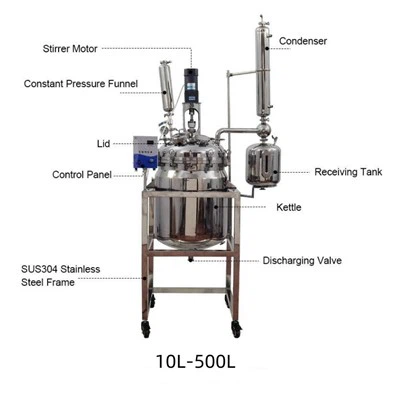

Advanced Temperature Control Technologies for Stainless Steel Reactors
As the demand for more precise and efficient temperature control in chemical processes grows, advanced technologies are being developed and implemented in stainless steel reactor systems:
● Programmable Logic Controllers (PLCs): Modern stainless steel reactors often incorporate PLCs to automate temperature control. These systems can monitor multiple temperature sensors, control heating and cooling systems, and adjust parameters in real-time to maintain optimal conditions.
● Model Predictive Control (MPC): This advanced control strategy uses mathematical models of the process to predict future behavior and optimize temperature control actions. MPC can be particularly useful in complex reactions where multiple variables need to be considered simultaneously.
● Artificial Intelligence and Machine Learning: Some cutting-edge temperature control systems for stainless steel reactors are beginning to incorporate AI and machine learning algorithms. These systems can analyze historical data, learn from past performance, and continuously optimize temperature control strategies.
● Distributed Control Systems (DCS): In large-scale chemical plants, DCS are used to integrate temperature control of multiple stainless steel reactors into a centralized system. This allows for coordinated control and monitoring of entire process lines.
● Wireless Temperature Sensors: Advanced wireless temperature sensing technologies are being developed to provide more flexible and comprehensive temperature monitoring within stainless steel reactors. These sensors can be placed at multiple points within the reactor, offering a more detailed temperature profile.
● Rapid Temperature Cycling: Some specialized stainless steel reactors are designed for rapid temperature cycling, allowing for quick transitions between heating and cooling phases. This can be particularly useful in applications such as polymer production or in research settings where multiple reaction conditions need to be tested quickly.
● Microwave Heating: While less common, some specialized stainless steel reactors incorporate microwave heating technology. This can offer rapid, uniform heating for certain types of reactions, particularly in laboratory or small-scale production settings.
● Computational Fluid Dynamics (CFD): Advanced CFD modeling is increasingly being used in the design and optimization of temperature control systems for stainless steel reactors. These simulations can help predict heat transfer patterns and identify potential hot spots or dead zones within the reactor.
Conclusion
An important and vital part of chemical process technology is controlling temperatures in stainless steel reactors. From traditional jacketed designs to cutting-edge AI-driven systems, the methods and technologies used to regulate temperature continue to evolve. The scope of functioning, the required accuracy, and the specific needs of the chemical process all play an impact in the choice of temperature regulation approach. As industries strive for greater efficiency, product quality, and sustainability, the importance of accurate temperature control in the products cannot be overstated.
By leveraging advanced technologies and innovative design approaches, chemical manufacturers can optimize their processes, ensure product consistency, and maintain the highest standards of safety and quality. Whether you're working with a small laboratory-scale reactor or managing a large-scale industrial facility, understanding and implementing effective temperature control methods is key to success in the world of chemical engineering.