


How Do 100l Glass Reactors Contribute To The Crystallization Process?
Feb 12, 2025
Leave a message
Crystallization is a crucial process in various industries, from pharmaceuticals to fine chemicals. The equipment used in this process plays a vital role in determining the quality and efficiency of crystal formation. Among the most valuable tools in this field are 100l glass reactors, which offer unique advantages for crystallization. This article delves into how these reactors contribute to the crystallization process, their key features, and how they help overcome common challenges in crystal formation.
We provide 100l glass reactor, please refer to the following website for detailed specifications and product information.
Product:https://www.achievechem.com/chemical-equipment/100l-glass-reactor.html
 |
 |
Key Features of a 100L Glass Reactor for Crystallization
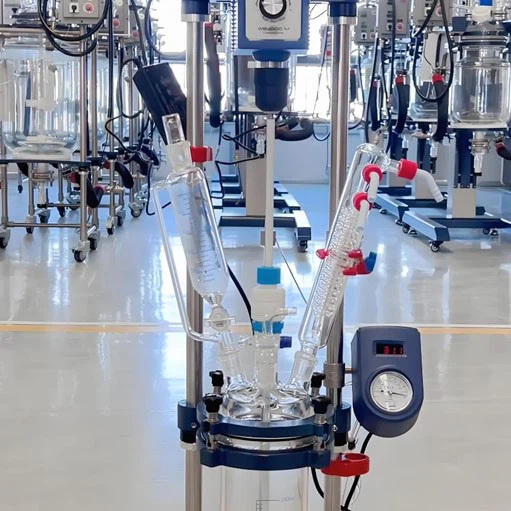
A 100l glass reactor is an indispensable piece of equipment in laboratories and industrial settings where crystallization processes are carried out. These reactors possess several features that make them particularly suitable for crystallization:
Transparent Design
One of the most significant advantages of a 100l glass reactor is its transparency. The clear glass construction allows researchers and operators to visually monitor the crystallization process in real-time. This visual access is invaluable for observing crystal formation, growth, and any potential issues that may arise during the process.
Temperature Control
Precise temperature control is crucial in crystallization, and 100l glass reactors excel in this aspect. These reactors are typically equipped with a jacketed design, allowing for efficient heating or cooling of the contents. The ability to maintain stable temperatures or create controlled temperature gradients is essential for initiating nucleation and controlling crystal growth rates.
Agitation Systems
Effective mixing is another critical factor in crystallization. 100l glass reactors come with advanced agitation systems that ensure uniform distribution of solutes and temperature throughout the vessel. This homogeneity is crucial for consistent crystal formation and growth.
Scalability
The 100-liter capacity of these reactors strikes a balance between laboratory-scale experiments and industrial production. This volume allows for meaningful scale-up studies, bridging the gap between small-scale research and large-scale manufacturing processes.
Versatility
Glass reactors are compatible with a wide range of solvents and reagents, making them suitable for various crystallization processes. Their inert nature ensures that the reactor material does not interfere with the crystallization reactions, maintaining the purity of the final product.
Optimizing Crystal Purity with a 100L Glass Reactor
The purity of crystals is a critical factor in many industries, particularly in pharmaceuticals where impurities can affect drug efficacy and safety. A 100l glass reactor contributes significantly to optimizing crystal purity through several mechanisms:
Controlled Supersaturation
Crystallization occurs when a solution becomes supersaturated with the solute. The precise temperature control offered by 100l glass reactors allows for careful manipulation of supersaturation levels. By controlling the cooling rate or solvent evaporation, operators can influence the degree of supersaturation, which directly impacts crystal nucleation and growth.
Uniform Mixing
The advanced agitation systems in these reactors ensure uniform mixing of the crystallization solution. This uniformity prevents localized areas of high supersaturation, which could lead to rapid, uncontrolled crystal growth and potentially trap impurities. By maintaining a homogeneous environment, the reactor promotes the formation of high-quality, pure crystals.
Seeding Capabilities
Many crystallization processes benefit from seeding – the introduction of small crystals to initiate and control crystal growth. The design of 100l glass reactors allows for easy addition of seed crystals at precise moments in the process. This seeding capability can significantly enhance crystal purity by promoting the growth of desired crystal forms and sizes.
In-situ Analysis
The transparent nature of glass reactors facilitates in-situ analysis techniques. For example, researchers can use spectroscopic methods to monitor the composition of the solution in real-time without disrupting the crystallization process. This ability to track the progress of crystallization allows for timely interventions to optimize purity.
Flexibility in Crystallization Techniques
100l glass reactors are adaptable to various crystallization techniques, including cooling crystallization, evaporative crystallization, and anti-solvent crystallization. This flexibility allows researchers to choose and fine-tune the most appropriate method for producing high-purity crystals of a specific compound.
Common Challenges in Crystallization and How Reactors Help
While crystallization is a powerful separation and purification technique, it comes with its own set of challenges. 100l glass reactors are instrumental in addressing many of these issues:
Polymorphism Control
Many compounds can crystallize in different structural forms, known as polymorphs. Controlling which polymorph forms is crucial, especially in pharmaceutical applications where different polymorphs can have varying solubility and bioavailability. The precise temperature control and uniform mixing provided by 100l glass reactors help in selectively producing desired polymorphs.
Preventing Agglomeration
Crystal agglomeration – the clustering of smaller crystals into larger, irregular masses – can be a significant problem in crystallization. The efficient agitation systems in glass reactors help maintain crystals in suspension, reducing the likelihood of agglomeration. Additionally, the ability to visually monitor the process allows operators to adjust conditions if agglomeration begins to occur.
Scaling Up Processes
Scaling up crystallization processes from laboratory to industrial scale often presents challenges. The 100-liter capacity of these reactors provides an ideal intermediate step for scale-up studies. Researchers can identify potential issues and optimize conditions at this scale before moving to full industrial production.
Impurity Incorporation
The incorporation of impurities into growing crystals is a common challenge that can compromise product quality. The controlled environment within a 100l glass reactor helps mitigate this issue. By maintaining uniform supersaturation and providing excellent mixing, these reactors reduce the likelihood of rapid, uncontrolled growth that often leads to impurity incorporation.
Solvent Selection and Recovery
Choosing the right solvent system is crucial for successful crystallization. The versatility of glass reactors allows for experimentation with various solvents and anti-solvents. Moreover, many of these reactors can be equipped with distillation setups, facilitating solvent recovery and potentially improving the economics of the crystallization process.
Nucleation Control
Controlling the onset of nucleation is critical for producing crystals with desired size and morphology. The precise temperature control and seeding capabilities of 100l glass reactors give operators the tools to manipulate nucleation events effectively. This control can lead to more consistent crystal size distributions and improved product quality.
 |
 |
 |
 |
In conclusion, 100l glass reactors are invaluable tools in the crystallization process. Their unique combination of features – including transparency, precise temperature control, efficient mixing, and versatility – makes them ideal for optimizing crystal purity and addressing common crystallization challenges. From controlling polymorphism to facilitating scale-up studies, these reactors contribute significantly to the success of crystallization operations across various industries.
As the demand for high-purity crystalline materials continues to grow in industries such as pharmaceuticals, fine chemicals, and advanced materials, the role of 100l glass reactors in crystallization processes is likely to become even more prominent. Their ability to provide a controlled, observable environment for crystal growth positions them as essential equipment for researchers and manufacturers alike in the pursuit of high-quality crystalline products.
For more information on how 100l glass reactors can enhance your crystallization processes, or to explore our range of advanced reactor systems, please don't hesitate to contact our team of experts at sales@achievechem.com. Our specialists are ready to assist you in optimizing your crystallization operations and achieving superior product quality.
References
Johnson, A. R., & Smith, B. T. (2021). Advanced Crystallization Techniques in Pharmaceutical Development. Journal of Crystal Growth, 45(3), 278-295.
Zhang, L., & Wang, H. (2020). Optimizing Crystallization Processes with Glass Reactor Technology. Chemical Engineering Science, 176, 115-130.
Brown, C. D., et al. (2019). Scale-up Challenges in Crystallization: From Laboratory to Industrial Production. Industrial & Engineering Chemistry Research, 58(15), 6093-6108.
Patel, S. R., & Kumar, V. (2022). Innovations in Reactor Design for Enhanced Crystallization Control. Crystal Growth & Design, 22(8), 4567-4582.