


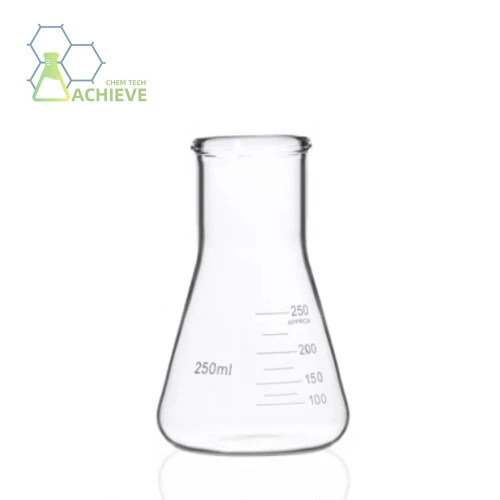


Simax Erlenmeyer Flask
1) Narrow-mouth Bottle: 50ml~10000ml;
2) Big B Bottle: 50ml~3000ml;
3) Horn Mouth: 50ml~5000ml;
4) Wide-mouth Bottle: 50ml/100ml/250ml/500ml/1000ml;
5) Conical Flask With Cover: 50ml~1000ml;
6) Screw Conical Flask:
a. Black Lid (General Sets): 50ml~1000ml
b. Orange Lid (Thickening Type): 250ml~5000ml;
2. Single and Multi-mouth Round Bottom Flask:
1) Single Mouth Round Bottom Flask: 50ml~10000ml;
2) Inclined Three-mouth Flask: 100ml~10000ml;
3) Inclined Four-mouth Flask: 250ml~20000ml;
4) Straight Three-mouth Flask: 100ml~10000ml;
5) Straight Four-mouth Flask: 250ml~10000ml.
***Price List for whole above, inquire us to get
Description
Technical Parameters
The Simax Erlenmeyer Flask, a staple in chemistry and biology laboratories worldwide, represents a timeless design that combines functionality with durability. Crafted from high-quality borosilicate glass, known for its exceptional resistance to thermal shock and chemical corrosion, this flask is an essential tool for a wide range of scientific experiments.
Its distinctive conical shape, named after the German chemist Emil Erlenmeyer, allows for efficient mixing and prevents splashing during agitation, making it ideal for performing reactions, cultivating microorganisms, and preparing solutions. The wide mouth facilitates easy pouring, pipetting, and insertion of stirring bars or temperature probes, while the narrow base ensures stability during operation.
Markings along the neck, often in milliliters or fractions thereof, offer precise measurement capabilities, eliminating the need for additional measuring tools in many routine procedures. The smooth, transparent surface ensures clear visibility of reactions and growth processes within, aiding in observations and documentation.
Moreover, the Simax brand, renowned for its commitment to quality and precision, guarantees that each flask is meticulously crafted to meet the highest standards of scientific rigor. This attention to detail, combined with the flask's versatility and durability, makes the simax erlenmeyer flask a valued and trusted companion in any laboratory setting.
Specifications


About Mr.Emil
Emil Erlenmeyer, born Richard August Carl Emil Erlenmeyer on June 28, 1825, in Taunusstein, Hesse, Germany, was a prominent chemist of the 19th century. His life and contributions are marked by significant achievements in the field of chemistry, particularly in the study of chemical structures and organic compounds.
Early Life and Education
Erlenmeyer initially pursued medicine at the University of Giessen but was drawn to chemistry through the lectures of Justus von Liebig, eventually switching his focus to chemistry. He later studied pharmacy at the University of Heidelberg, furthering his expertise in the field.
Career Milestones
Pharmacist and Early Teaching
After obtaining his pharmacist's license in Nassau, Erlenmeyer worked as a pharmacist in Katzenelnbogen for five years. In 1850, he returned to Giessen where he earned his Ph.D. under Liebig's supervision with a thesis on "Über basisches Cyanblei" (Alkaline Cyanide Lead).
Academic Pursuits
Seeking further academic endeavors, Erlenmeyer purchased a pharmacy in Wiesbaden and taught chemistry at the local trade and industry school. However, due to financial challenges, he pursued additional studies under Robert Wilhelm Bunsen at Heidelberg, focusing on the chemistry of fertilizers, which led to a professorial qualification in 1855.
University Positions
In 1857, he became an unpaid lecturer at the University of Heidelberg, concurrently establishing a private consulting laboratory for the fertilizer industry. By 1863, he was appointed an extraordinary professor at the university. Subsequently, he was invited to serve as a professor of chemistry at the Munich Polytechnic (later Munich University of Technology) where he also consulted for various chemical companies.
Scientific Contributions
Structural Chemistry
Erlenmeyer made pioneering contributions to the understanding of chemical structures. In 1862, he was the first to recognize the existence of multiple bonds, a crucial insight that elucidated numerous chemical structures.
Publication and Editing
From 1859, he served as an editor of the journal "Chemistry, Pharmacy, and Mathematics," allowing him to disseminate his theories and engage with fellow scientists.
Organic Chemistry
In Munich, he concentrated on the structures of organic compounds, accurately elucidating the structures of naphthalene, guanidine, and tyrosine. He also developed methods for the synthesis of guanidine and tyrosine.
Nomenclature and Terminology
Erlenmeyer introduced the modern notation for chemical structures, using straight lines for single bonds, double lines for double bonds, and triple lines for triple bonds. This notation system remains widely used today.
Legacy
Erlenmeyer's contributions to chemistry are enduring. His name is associated with the Erlenmeyer flask, a conical flask commonly used in laboratories. He served as Vice President of the German Chemical Society in 1874 and as its President from 1884 until his retirement in 1883 due to health reasons. He passed away on January 22, 1909, in Aschaffenburg, Bavaria, leaving behind a rich legacy in the annals of chemistry.
In summary, Emil Erlenmeyer's life and work epitomize the pursuit of knowledge and scientific inquiry, making him a revered figure in the history of chemistry.
Differences with Beaker
A beaker is a cylindrical or conical-shaped container with a wide mouth and a flat or slightly rounded bottom. It is commonly used in chemistry and biology laboratories for mixing, heating, and measuring liquids.
Shape
The wide mouth facilitates easy pouring and stirring, but the lack of a narrow neck makes it less suitable for preventing spillage during vigorous shaking or swirling.
Stability
Depending on the shape and size, beakers may not be as stable as Erlenmeyer flasks, especially when filled with liquid.
Usage
Primarily used for mixing, measuring, and heating small to moderate volumes of liquid.
There are various types of beakers, including the Griffin Beaker (also known as the standard or low-form beaker), which is widely used in laboratories due to its design that minimizes the risk of breakage.
Borosilicate glass beakers are preferred for laboratory use due to their durability and resistance to thermal shock.
|
|
|


| Simax Erlenmeyer Flask | Beaker | |
|---|---|---|
| Shape | Flat bottom, conical body, cylindrical neck | Wide mouth, cylindrical or conical-shaped body, flat or slightly rounded bottom |
| Stability | High due to flat bottom | Varies, may be less stable than Erlenmeyer flasks |
| Swirling/Stirring | Easy due to conical shape | Easy pouring, but less suitable for vigorous swirling without a spill risk |
| Applications | Widely used in chemistry (e.g., titration), microbiology, heating liquids | Mixing, measuring, and heating liquids |
| Graduation | Usually graduated for volume measurements | May or may not be graduated |
| Materials | Often made of high-quality borosilicate glass (e.g., Simax) | Can be made of various glass types, borosilicate preferred for laboratories |
In summary, the simax erlenmeyer flask and the beaker differ primarily in their shape, stability, and intended uses. The Erlenmeyer flask's conical design and narrow neck make it ideal for stirring and preventing spillage, while the beaker's wide mouth facilitates easy pouring and mixing but may not be as stable or suitable for vigorous shaking. Both are essential laboratory tools, but the choice between them depends on the specific requirements of the experiment.
Maintenance and Care of Simax Erlenmeyer Flasks
► Cleaning
Proper cleaning is essential to maintain the performance and longevity of Simax Erlenmeyer flasks. After each use, the flasks should be rinsed thoroughly with water to remove any residual chemicals. For more stubborn residues, a suitable detergent or solvent can be used. It is important to avoid using abrasive materials or harsh chemicals that may scratch or damage the glass surface. After cleaning, the flasks should be dried thoroughly, either by air - drying or using a lint - free cloth.
► Sterilization
In applications where sterile conditions are required, such as in biological cultures, Simax Erlenmeyer flasks can be sterilized. The most common method of sterilization is autoclaving, which involves subjecting the flasks to high - pressure saturated steam at a temperature of around 121°C for a specified period. It is important to ensure that the flasks are compatible with autoclaving and that they are not over - filled, as this could cause them to break during the sterilization process.
► Storage
When not in use, Simax Erlenmeyer flasks should be stored in a clean and dry place. They can be stacked carefully to save space, but it is important to avoid stacking them too high to prevent them from toppling over. If the flasks have stoppers, the stoppers should be removed during storage to prevent the formation of a vacuum that could make it difficult to remove the stopper later.
Future Prospects
► Innovation in Design
As laboratory techniques and requirements continue to evolve, there may be opportunities for innovation in the design of Simax Erlenmeyer flasks. For example, the development of flasks with improved heat transfer properties, such as those with internal coatings or modified shapes, could enhance their performance in heating and cooling processes. Additionally, the integration of smart sensors or indicators into the flasks could provide real - time information about temperature, volume, or chemical composition.
► Sustainability
In an era of increasing environmental awareness, there is a growing demand for sustainable laboratory practices. Simax could explore ways to make the production of Erlenmeyer flasks more environmentally friendly, such as by using recycled materials or reducing energy consumption in the manufacturing process. Furthermore, the development of more durable and long - lasting flasks could contribute to reducing waste generation in laboratories.
► Customization
With the increasing specialization of laboratory research, there may be a need for customized Simax Erlenmeyer flasks. This could include flasks with specific shapes, sizes, or features tailored to the requirements of particular experiments or industries. Simax could leverage its manufacturing capabilities to offer customized solutions to its customers, further expanding the applications of its Erlenmeyer flasks.
Conclusion

The Simax Erlenmeyer flask is a time - tested and indispensable piece of laboratory glassware. Its rich history, combined with its excellent design features, versatility, and durability, has made it a staple in laboratories worldwide. From chemical synthesis to biological cultures and educational demonstrations, Simax Erlenmeyer flasks play a vital role in advancing scientific knowledge and innovation. As the field of science continues to progress, the Simax Erlenmeyer flask is likely to adapt and evolve, meeting the changing needs of researchers and educators while remaining a symbol of scientific excellence. Whether in a high - tech research facility or a humble classroom laboratory, the Simax Erlenmeyer flask will continue to be a trusted companion for scientists and students alike.
Hot Tags: simax erlenmeyer flask, China simax erlenmeyer flask manufacturers, suppliers, factory, Stainless Steel Reactor, High Pressure Chemical Reactor, Tablet Punching Machine, PPL Lined Hydrothermal Autoclave, 10 Liter Short Path Distillation, Short Path Distillation System
Previous
Triforest Erlenmeyer FlasksSend Inquiry


