



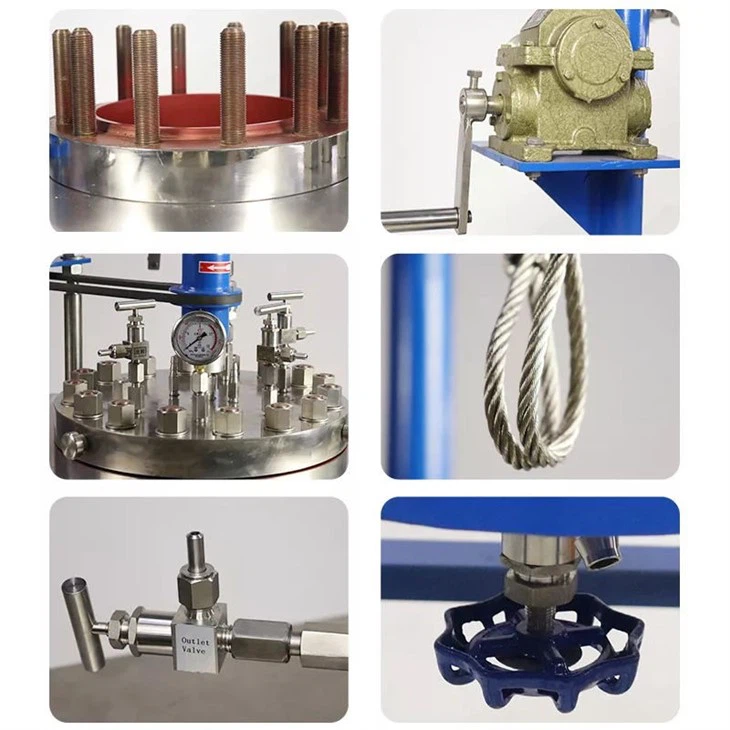
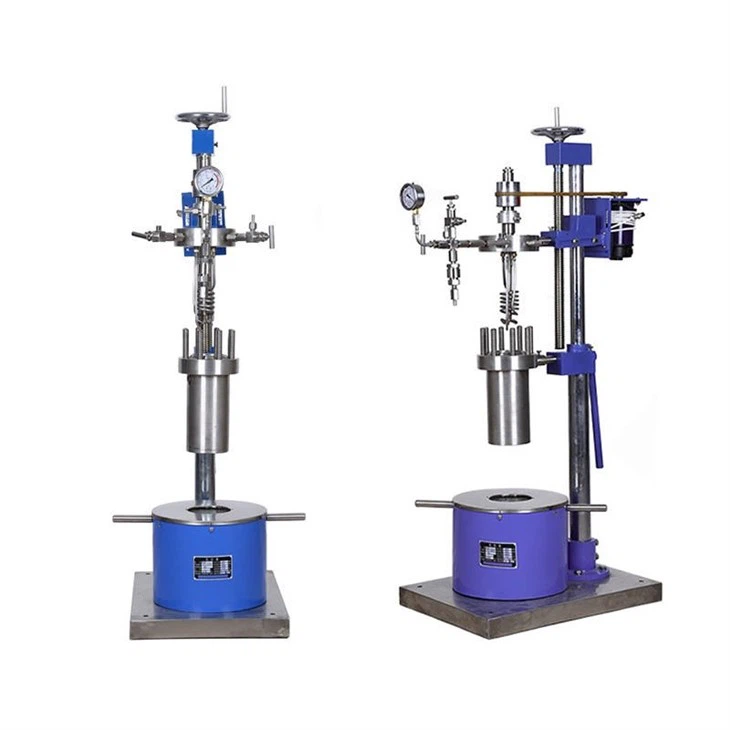


High Pressure Hydrogenation Reactor
2. Volume: 0.1L-50L
3. Applications: Suitable for alkylation, amination, bromination, carboxylation, chlorination, and catalytic reduction
4. Stainless steel framework
5. Working Temperature: up to 350°C
6. Voltage: 220V 50/60Hz
7. Manufacturer: ACHIEVE CHEM Xi’an Factory
8. 16 years experiences on Chemical Equipment
9. CE and ISO certification
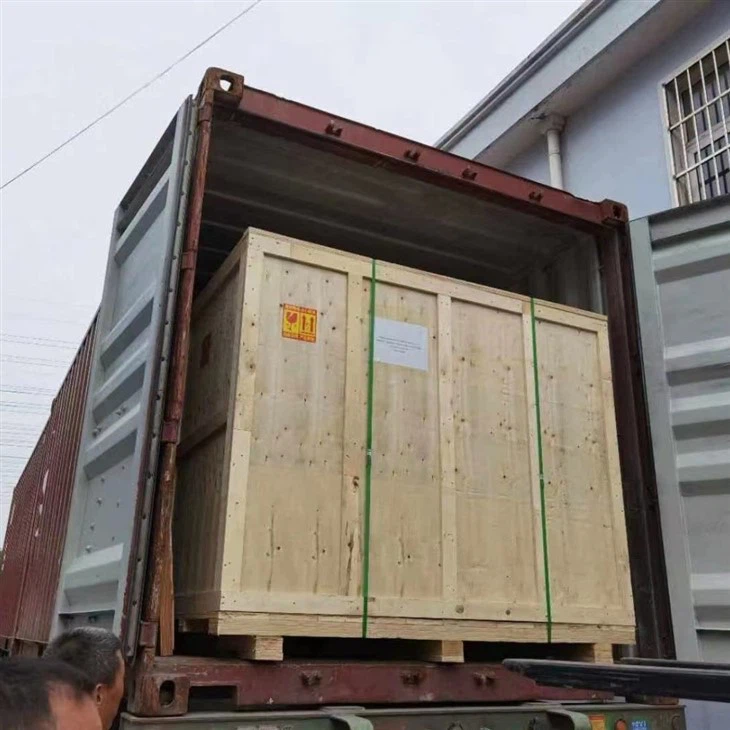
10. Professional shipping
Description
Technical Parameters
High pressure hydrogenation reactor is a special high-pressure vessel,which is used in various chemical processes such as catalytic reaction,chemical reaction,extraction and fractionation.It is the diffusion,convection and reaction of hydrogen in the liquid phase through the stirred liquid layer in the form of bubbling under the action of mechanical stirring.In chemical industry,hydrogenation reactor is an important equipment for hydrogenation,chemical reaction,extraction and fractionation.
The structure of hydrogenation reaction kettle includes kettle body,kettle cover,jacket,agitator,transmission device,shaft seal device,support and other parts.The material can be carbon manganese steel,stainless steel,zirconium,nickel-based(Hastelloy,Monel)alloy and other composite materials.According to the manufacturing structure of the reactor,it can be divided into three categories:open flat cover reactor,open butt welding flange reactor and closed reactor.

We provide High pressure hydrogenation reactor, please refer to the following website for detailed specifications and product information.
Product: https://www.achievechem.com/chemical-equipment/high-pressure-reactor.html
Products Introduction
In the high pressure hydrogenation reactor, hydrogen plays the following important roles.

◆ Catalyst reduction:Many catalysts need to be reduced in order to play a good catalytic performance.Hydrogen provided in the high-pressure reactor can reduce the metal ions on the catalyst surface to more active metal atoms,thus enhancing the activity and selectivity of the catalyst.
◆ Reactant reduction:Hydrogen can be used as reducing agent and participate in various chemical reactions.In the high-pressure hydrogenation autoclave,hydrogen can undergo hydrogenolysis reaction with reactants,reducing them to higher valence or more organic substances.This reaction is widely used in the field of organic synthesis,such as reducing ketones to alcohols or reducing aromatic compounds.
◆ Hydrogenation: Hydrogen can directly react with some organic compounds in reactor.This reaction is often used for hydrogenation of saturated unsaturated bonds and saturation of aromatic rings of aromatic compounds.Hydrogenation usually requires higher pressure and the presence of appropriate catalyst.
◆ Environmental control: Hydrogen plays a role in controlling the reaction environment in the chemical hydrogenation reactor.By adjusting the pressure and concentration of hydrogen,the atmosphere in the reaction system can be changed,and the reaction rate and product distribution can be affected.The presence of hydrogen can also inhibit some side reactions and improve the selectivity of the reaction.
Products Parameter
FCF Series Liftable Reactor
|
Model |
AC1233-0.1 |
AC1233-0.25 |
AC1233-0.5 |
AC1233-1 |
AC1233-2 |
AC1233-3 |
AC1233-5 |
AC1233-10 |
AC1233-20 |
AC1233-30 |
AC1233-50 |
|
Capacity(L) |
0.1 |
0.25 |
0.5 |
1 |
2 |
3 |
5 |
10 |
20 |
30 |
50 |
|
Setting Pressure(MPa) |
22 |
||||||||||
|
Setting Temperature(°C) |
350 |
||||||||||
|
Accuracy of Temperature Control(°C) |
±1 |
||||||||||
|
Heating Method |
General electric heating,others are far-infrared,thermal oil,steam,circulating water,etc. |
||||||||||
|
Stirring Torque(N/CM) |
120 |
||||||||||
|
Heating Power(KW) |
0.6 |
0.8 |
1.5 |
2 |
2.5 |
4 |
7 |
10 |
12 |
||
|
Temperature Controller |
Real-time display and adjust the speed,temperature,time,with standard PID automatic temperature adjustment meter. |
||||||||||
|
Working Environment |
Ambient Temperature 0-50°C,Relative Humidity 30~80%. |
||||||||||
|
Voltage(V/Hz) |
220 50/60 |
||||||||||
Product Features
The stirring device of autoclave is usually composed of impeller,shaft,bearing,etc.
|
◆ Impeller: Impeller is the core part of the stirring device,and its shape and size depend on the specifications of the reaction kettle and the characteristics of the medium to be stirred.In the lab hydrogenation reactor,the impeller is usually made of stainless steel or aluminum alloy with excellent corrosion resistance.The impeller is connected with a motor through a rotating shaft,and the impeller is driven to rotate through the motor. ◆ Shaft: The shaft is a transmission part connecting the motor and the impeller,and it is fixed on the kettle cover of the reaction kettle through bearings.The length and diameter of the shaft depend on the size of the reactor to ensure sufficient rigidity and strength.The shaft is usually made of high strength steel or stainless steel. ◆ Bearings: Bearings are used to support the impeller and shaft so that the impeller can rotate smoothly.Sliding bearings with excellent corrosion resistance and bearing capacity are usually used in high-pressure ss reactors.The bearing is in contact with the inner wall of the reaction kettle through the inner liner and the outer cylinder.The inner liner is usually made of PTFE and other materials to enhance its corrosion resistance. |
|

Knowledge
There are three main sealing devices for high pressure hydrogenation reactors:
◆ Packing seal: Packing seal is a common sealing method,which is suitable for high pressure,high temperature and corrosive media.In packing sealing,the packing is pressed between the shaft and the packing seat to form a sealing surface.Fillers are usually made of materials with excellent corrosion resistance and self-lubricating performance,such as PTFE and graphite.
◆ Mechanical seal: Mechanical seal is a kind of sealing method that relies on mechanical force to achieve sealing purpose.In mechanical seal,the moving ring and the static ring are closely combined by mechanical force to form a sealing surface.Mechanical seal has the advantages of good sealing performance and long service life,but its structure is complex and its maintenance requirements are high.
◆ Magnetic seal: Magnetic seal is a kind of sealing method which uses magnetic principle to realize sealing.In the magnetic seal,the stirring shaft in the kettle body is connected with the magnetic stirrer on the kettle cover through magnetic coupling,so as to realize non-contact seal.Magnetic seal has the advantages of good sealing performance,simple structure and convenient maintenance,but it is not suitable for high-speed operation and high-temperature environment.
Applications
The high pressure hydrogenation reactor can be used for some key reactions in the coal gasification process,including the following steps:
|
|
◆ Preparation of coal gas: In the process of coal gasification,coal is usually heated to a high temperature and pyrolyzed under the condition of lack of oxygen or partial oxygen to produce a gas mixture called syngas.Syngas is mainly composed of carbon monoxide(CO),carbon dioxide(CO2),hydrogen(H2)and methane(CH4). ◆ Hydrogenation reaction: In the reactor,the synthesis gas produced by coal gasification can be further hydrogenated.The purpose of hydrogenation reaction is to convert carbon monoxide and carbon dioxide in synthesis gas into more useful hydrocarbon compounds,such as methane,ethane and propane.This process usually requires the presence of catalysts,such as nickel or iron-based catalysts. |

Safety measure
Equipment selection and installation
Equipment selection
Select equipment with explosion-proof certification and ensure that it complies with relevant standards and requirements.
The material of the hydrogenation reactor and its pipeline should meet the relevant standards(such as SH3059)to adapt to the use of high temperature and high pressure environment.
Equipment installation
Hydrogen equipment should be strictly leak-proof,the instrument and valves used should be well sealed,and regularly checked.
The installation of equipment and pipes shall be completed by the unit with GC1 or GC2 pressure pipe installation qualification license.
Hydrogen pipelines should use seamless metal pipelines,cast iron pipelines are prohibited,and the connection of pipelines should be welded or other effective connection methods to prevent hydrogen leakage.
Operation room requirements
The high-pressure hydrogenation reactor shall be placed in a high-pressure operating room that meets the explosion-proof requirements.
The operating room should be equipped with an effective ventilation system to ensure that hydrogen and other combustible gases can be discharged in time to reduce the risk of explosion.
Explosion-proof electrical equipment,such as switches,sockets,lighting,etc.should be used in the operation room,and installed and maintained in accordance with relevant standards.
Anti-static and grounding measures
Measures should be taken to prevent static buildup in the operating room,using floors and benches with anti-static coatings or conductive materials.
The indoor and outdoor hydrogen pipes,bus bars,and connected flanges are connected to each other and grounded.Ensure that the crossover resistance between the hydrogen device and the flanges on the pipes is less than 0.03Ω.
All electrical equipment related to hydrogen should have anti-static grounding devices,and regularly check the grounding resistance.
Gas detection and alarm system
Hydrogen stations need to implement gas detection and alarm systems for early detection of unexpected events such as gas leaks and fires and explosions.
The gas detection system can quickly and accurately detect the gas leakage of the hydrogenation unit,and the alarm system can send an alarm in time to remind the relevant personnel to take corresponding emergency measures.
Leakage and automatic shutdown system
Hydrogen refueling stations need to install leakage and automatic shutdown systems to reduce the occurrence of fire and explosion accidents.
The leak system is able to detect hydrogen leaks in the unit and take immediate emergency measures in the event of a leak.
The automatic shutdown system can shut down immediately in the event of a hydrogen leak or other safety risk to avoid the escalation of the accident.
Safety operation procedures and training
Develop detailed safe operation procedures for high-pressure hydrogenation reactors,and clarify the responsibilities and operational requirements of operators.
Provide professional training to all practitioners on the safety and preventive measures of hydrogenation units.
Safety drills and emergency plans should be conducted regularly to improve the emergency handling ability of operators.
Other security measures
A check valve should be installed between the hydrogen pipeline and the device or equipment connected to it to prevent the external flame from backfiring into the hydrogen system.
The hydrogen pipeline should avoid going through the gutter,sewer and railway,automobile and road,etc.,and should be equipped with casing when going through.
The hydrogen pipeline shall not pass through the living room,office and other rooms that do not use hydrogen,and should pass through the wall or floor should be laid in the casing.
The high pressure hydrogenation reactor and its auxiliary equipment are inspected and maintained regularly to ensure that they are in good working condition.
Challenges and Future Directions
|
Despite the significant advancements in high pressure hydrogenation reactor technology, several challenges remain. One of the primary challenges is the need for more efficient and selective catalyst systems. Current catalyst systems often require high temperatures and pressures to achieve the desired reaction rates and selectivities, leading to increased energy consumption and potential safety hazards. Another challenge is the need for better process control and monitoring systems. While advanced control systems have been developed, there is still room for improvement in real-time monitoring and adjustment of reaction conditions. Better sensors and data analytics tools are needed to provide operators with more accurate and timely information about the reaction progress and reactor performance. Looking ahead, the future of high pressure hydrogenation reactor technology lies in the continued development of more efficient and selective catalyst systems, as well as advanced process control and monitoring systems. Researchers are also exploring new reactor designs and operating conditions to expand the range of reactions that can be catalyzed and improve the overall efficiency and sustainability of these processes. |
|

Conclusion
In conclusion, high pressure hydrogenation reactors are indispensable tools in the field of chemical processing. Their ability to catalyze hydrogenation reactions under extreme conditions makes them crucial in the production of various chemicals, materials, and pharmaceuticals. As technology continues to advance, the capabilities and efficiency of these reactors will undoubtedly improve, leading to more sustainable and efficient chemical processes. While challenges remain, the ongoing research and development efforts in this field hold promise for even greater advancements in the future.
Hot Tags: high pressure hydrogenation reactor, China high pressure hydrogenation reactor manufacturers, suppliers, factory, Stainless Steel Reactor, 50L Jacketed Reactor, Single Layer Glass Reactor, Short Path Distillation Kit, Hydrothermal Reactor, Laboratory Evaporators
Previous
High Pressure Lab ReactorSend Inquiry


