



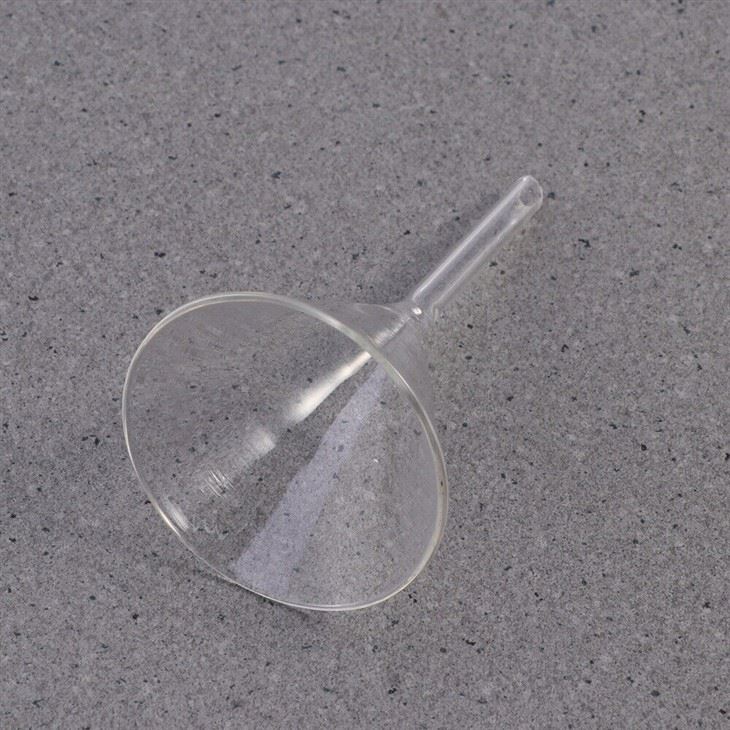
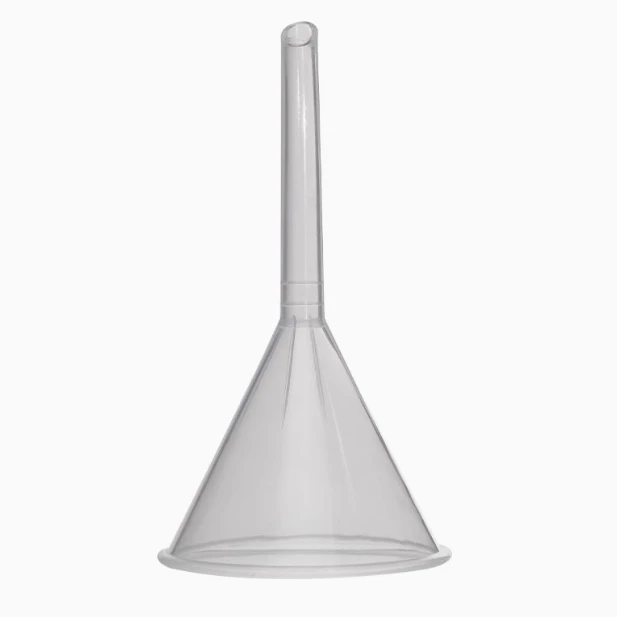


Glass Separatory Funnel
2.Big mouth Funnel:90mm/170mm/210mm/260mm
3.Wide-mouthed funnel: 150mm/200mm/250mm/300mm
***Price List for whole above, inquire us to get
Description
Technical Parameters
A glass separatory funnel is a piece of laboratory glassware used to separate two immiscible liquids based on their different densities. A separatory funnel, also known as a separation funnel, is a laboratory device used to separate mixtures of liquids that do not mix together, such as oil and water. It typically consists of a conical or pear-shaped glass body with a stopcock at the bottom, allowing the liquids to be drained off separately.
The separatory funnel works on the principle that immiscible liquids can be separated based on the difference in their densities. The denser liquid sinks to the bottom while the lighter liquid floats on top, enabling the two liquids to be drained out separately from the stopcock.
Principle
It works on the principle that immiscible liquids can be separated based on the difference in their densities. The denser liquid sinks to the bottom while the lighter liquid floats on top, enabling the two liquids to be drained out separately from the stopcock. The following is a detailed explanation of this process:
Pouring of mixed liquids: First, a mixture of the two immiscible liquids to be separated is poured into the separating funnel. Usually, the two liquids will stratify naturally because they do not dissolve in each other.
Layering: The separatory funnel with the mixed liquids is left to stand for a period of time so that the two liquids will naturally layer according to the difference in density. The heavier liquid will sink to the bottom of the funnel, while the lighter liquid will float to the top.
Close the piston: After the two liquids are completely stratified, close the piston at the bottom of the funnel to prevent any liquid from escaping.
Pouring out the top liquid: Gently remove the separatory funnel from the stand and turn the neck of the funnel to the side so that the outlet of the funnel is away from the container. Then slowly open the piston and allow the heavier liquid at the bottom to flow out until the interface between the two liquids is reached. At this point, close the piston to stop the discharge.
Collecting the upper liquid: Place the funnel back on the stand, making sure it is upright. Then carefully open the piston to allow the lighter liquid from the upper layer to flow out and collect it in another container. As the two liquids are immiscible, they will maintain a clear interface in the funnel, which ensures that the upper liquid is collected pure and not mixed with the lower liquid.
Rinse and Repeat: If necessary, the separatory funnel can be rinsed and the process repeated to ensure that both liquids are completely separated and collected.
Caution: During operation, care needs to be taken not to disturb the liquid interface so as not to mix the two liquids and affect the separation. In addition, rapid decanting or violent shaking should be avoided during operation to avoid liquid splashing or interface confusion.
In this way, the glass separating funnel can effectively separate immiscible liquids according to their density difference, which is a very useful technique in chemical experiments and industrial production.
Parameter
|
Triangular Funnel |

| Specification | Diameter of funnel orifice | Funnel pipe diameter | Height | Packaging |
| 60mm | 60mm | 5.20mm | 104.0mm | 400 Pcs/ Box |
| 75mm | 75mm | 8.10mm | 135.1mm | 300 Pcs/ Box |
| 90mm | 90mm | 7.10mm | 154.0mm | 250 Pcs/ Box |
| 120mm | 120mm | 14.3mm | 185.0mm | 150 Pcs/ Box |
| 150mm | 150mm | 21.4mm | 212.0mm | 80 Pcs/ Box |

Big mouth Funnel
| Specification | Diameter of funnel orifice | Funnel pipe diameter | Height | Packaging |
| 90mm | 90mm | 15.0mm | 93.0mm | 50 Pcs/ Box |
| 170mm | 170mm | 20.0mm | 148.0mm | 20 Pcs/ Box |
| 210mm | 210mm | 22.0mm | 182.0mm | 20 Pcs/ Box |
| 260mm | 260mm | 25.0mm | 211.0mm | 20Pcs/ Box |

Wide-mouthed funnel
| Specification | Diameter of funnel orifice | Funnel pipe diameter | Height | Packaging |
| 150mm | 150mm | 15.5mm | 235.0mm | 10 Pcs/ Box |
| 200mm | 200mm | 15.6mm | 275.0mm | 10 Pcs/ Box |
| 250mm | 250mm | 25.0mm | 331.0mm | 10 Pcs/ Box |
| 300mm | 300mm | 25.5mm | 375.0mm | 10 Pcs/ Box |
Applications in Chemistry
|
Glass Separatory Funnel (Glass Separating Funnel) has a wide range of specific applications in chemistry experiments, here are some common uses:
|
|

Removal of water from organic liquids: In organic synthesis, it is sometimes necessary to remove water from organic solvents, and the separatory funnel can accomplish this by using a desiccant such as anhydrous magnesium sulfate or anhydrous calcium chloride.
Environmental Analysis: In environmental analysis, separatory funnels can be used to separate suspended particles or contaminants from water or soil samples for further analysis.
Teaching and Demonstration: In teaching laboratories, separatory funnels are used to demonstrate liquid-liquid extraction techniques to students to help them understand the process of separating immiscible liquids.
Quality Control: In quality control laboratories, separatory funnels are used to ensure the purity and quality of raw materials and finished products by removing impurities and foreign particles through filtration.
Research and Development: In research and development laboratories, separatory funnels are used to separate and analyze different components of a mixture, facilitate chemical reactions, and purify compounds for further experimentation.
These applications demonstrate the versatility and importance of them in chemistry experiments, where they are one of the indispensable tools.
Material innovation direction
Performance optimization and cost control of high borosilicate glass

Improved heat resistance and chemical stability
High borosilicate glass (such as Pyrex) has become the mainstream material of glass separation funnel due to its low thermal expansion coefficient (3.3×10⁻⁶/℃) and excellent acid and alkali resistance. In the future, by adjusting the ratio of boric acid to silica, its heat resistance (such as tolerance to temperature differences between -20 ° C and 500 ° C) and chemical stability can be further optimized. For example, Japan's Asahi Glass subsidiary developed hydrofluoric acid-resistant high-borosilicate glass by introducing alumina components, which is suitable for the separation of ultra-pure reagents in the semiconductor industry.

Cost reduction and scale production
The high cost of high-borosilicate glass (about 3-5 times that of ordinary glass) limits its popularity. Technological breakthrough directions include:
Melting process improvement: the use of oxygen combustion technology instead of traditional air combustion, can reduce the melting temperature 100-150℃, reduce energy consumption;
Waste recycling: through chemical strengthening technology, waste glass products are converted into high borosilicate glass raw materials, and the recycling rate can reach more than 70%;
Automated production lines: Industrial robots are introduced to shape, cut and polish glass, increasing production efficiency and reducing labor costs.

Functional coating technology
To meet specific experimental requirements, functional coatings can be applied to the surface of high borosilicate glass:
Hydrophobic coating: The sol-gel method is used to deposit nano silica coating, so that the water contact Angle is above 110°, which is convenient for the rapid discharge of liquid after separation;
Antibacterial coating: loaded with silver ions or zinc oxide nanoparticles, inhibit microbial growth, suitable for biomedical fields.
The innovative application of composite materials
Glass-ceramic composites
By embedding ceramic particles such as alumina and silicon nitride in the glass matrix, the mechanical strength and wear resistance can be significantly improved. For example, the Zerodur® glass ceramic developed by Schott, Germany, has a bending strength of 1200 MPa, more than 10 times that of ordinary glass, and is suitable for high pressure or high impact scenarios.
Glass-polymer composites
Coating the glass surface with polytetrafluoroethylene (PTFE) or polyether ether ketone (PEEK) coating enhances corrosion resistance and self-lubrication. For example, the use of PTFE coating on the neck of the funnel can withstand strong acids and alkalis, and the friction coefficient is reduced to less than 0.05, reducing liquid residue.
Nanocomposite
The introduction of nanomaterials such as graphene and carbon nanotubes into the glass matrix can give the funnel self-cleaning, conductive or antibacterial functions. For example, by electrophoretic deposition, a graphene film is formed on the glass surface to achieve super-hydrophobic (contact Angle >150°) and super-lipophilic (contact Angle <10°) properties, suitable for oil-water separation.
The development of new glass materials
Extreme environment resistant glass
Ultra-low temperature glass: The development of glass with a thermal expansion coefficient close to zero (such as silicate glass containing zirconia), suitable for separation operations in liquid nitrogen (-196℃) or liquid helium (-269℃) environment;
Radiation resistant glass: Through the introduction of cerium oxide or lanthanum oxide, improve the absorption capacity of glass to gamma rays, suitable for the treatment of radioactive waste liquid in the nuclear industry.
Intelligent responsive glass
Photochromic glass: doped silver halide microcrystals in the glass to achieve dynamic regulation of light transmittance under light, which is convenient to observe the separation process in real time;
Electrochromic glass: Changing the color of glass by ion embedding/deembedding, suitable for liquid level monitoring in automated experimental systems.
Biocompatible glass
The development of bioactive glass containing calcium oxide and magnesium oxide can release calcium and phosphorus plasma in the body and promote cell proliferation. Such glass funnels can be used for cell culture-medium separation in tissue engineering to reduce cell damage.
Technological breakthrough path and future trend
Materials genomics and high throughput screening
Using machine learning algorithms to predict the relationship between glass composition and properties, combined with a high-throughput experimental platform, accelerate the development cycle of new glass materials. For example, 10 potential high-borosilicate glass formulations have been selected through simulation calculation, and after experimental verification, the development time can be reduced by more than 50%.
3D printing and additive manufacturing
Directly print glass separation funnels with complex structures using stereolithography (SLA) or selective laser melting (SLM) technology. For example, the Fraunhofer Institute in Germany has achieved 3D printing of glass with an inner wall roughness of Ra<1μm, which is suitable for the integration of microfluidic chips.
Green manufacturing and circular economy
To develop lead-free, arsenic-free and environmentally friendly glass formula, and establish the whole life cycle evaluation system. For example, through life cycle assessment (LCA) analysis, it has been proved that the carbon footprint of the new glass funnel is 40% lower than that of the traditional product, and the used funnel can be 100% recycled.
Conclusion
The material innovation of glass separatory funnel needs to focus on the three major goals of performance improvement, cost reduction and function expansion. In the future, the optimization of high borosilicate glass, the application of composite materials and the development of new glass will promote the evolution of products to the high-end, intelligent and green direction. Technological breakthroughs need to be combined with material science, smart manufacturing and environmental protection concepts to meet the complex needs of biomedicine, new energy, environmental monitoring and other fields. With the maturity of materials genomics and 3D printing technology, the performance and manufacturing efficiency of glass separation funnels will achieve a qualitative leap, providing stronger support for scientific research and industrial development.
Hot Tags: glass separatory funnel, China glass separatory funnel manufacturers, suppliers, factory, Laboratory Rotary Evaporator, 500ml Short Path Distillation Kit, SS Reactor, High Pressure Hydrogenation Reactor, 50l Rotovap, 5l Short Path Distillation
Previous
Separatory Funnel StopcockSend Inquiry


