



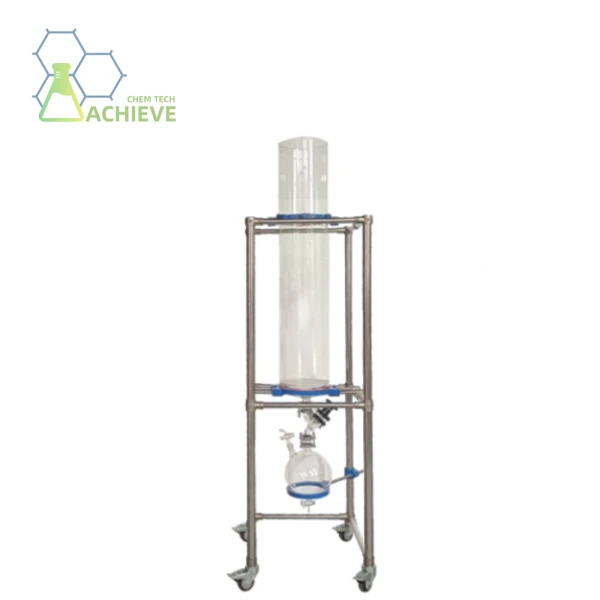


Cation Column Chromatography
2.Chromatographic Column (Rotation Type)
3.Chromatographic Column (Manual)
***Price List for whole above, inquire us to get
Description
Technical Parameters
Cation Column Chromatography is a specialized form of ion exchange chromatography used primarily for the separation and purification of positively charged ions, or cations, from a mixture. This technique leverages the principle of reversible ion exchange between ions in a sample and ions immobilized on a stationary phase within a column.
The stationary phase typically consists of a resin or polymer matrix that is functionalized with negatively charged groups, such as sulfonic acid (-SO₃⁻) or carboxylic acid (-COO⁻) groups. These functional groups attract and bind positively charged cations from the sample solution as it passes through the column. The separation of cations is achieved based on differences in their affinity for the stationary phase, which can be influenced by factors such as ionic strength, pH, and the nature of the cation itself.
The process begins with the loading of the sample onto the column, followed by the elution of bound cations using a mobile phase, often a buffer solution. Cations with weaker interactions with the stationary phase are eluted first, while those with stronger interactions are retained longer. This differential elution allows for the effective separation and collection of individual cations.
It finds applications in various fields, including biochemistry, environmental science, and pharmaceuticals, where the purification and analysis of cations are crucial. Its high selectivity and efficiency make it a valuable tool for both analytical and preparative purposes.
Parameters


The choice of eluent
The eluent plays an important role in cation column chromatography. It must not only be able to elute the cations on the column, but also have the appropriate conductivity to produce a clear signal on the conductivity detector. Common rinses include inorganic acids (such as hydrochloric or nitric acid) and ethylenediamine salts. The specific choice of eluent depends on the type and concentration of cations to be measured.
Elution of Cations
The primary function of the eluent is to displace the bound cations from the cation exchange resin. This is achieved by either increasing the ionic strength of the solution (to compete with the cations for binding sites) or altering the pH (to change the charge state of the cations, reducing their affinity for the resin).
Compatibility with Detection
The eluent must also be compatible with the detector used in the chromatography system. For conductivity detectors, which are commonly employed in ion chromatography, the eluent should have an appropriate conductivity to produce a clear and measurable signal. High conductivity can lead to baseline noise, while too low conductivity may result in poor sensitivity.
Common Eluents
Inorganic Acids: Hydrochloric acid (HCl) and nitric acid (HNO₃) are frequently used as eluents due to their strong acidic properties, which help in protonating and thus eluting cations from the resin. They also provide good conductivity for detection.
Ethylenediamine Salts: These can be used as eluents in specific cases, especially when a more complex elution profile is needed. They can offer different selectivity and may be advantageous for separating certain cations.
- For the determination of monovalent metal ions such as alkali metals and ammonium, dilute nitric acid is usually used as the eluent.
- For alkaline earth metal ions, ethylenediamine nitrate can be used as a eluent.
- For transition metals and rare earth elements, a mixture of ethylenediamine cation plus tartrate anion or 2-hydroxybutyric acid anion may be required as a eluent.
operating steps
The operation steps of cation column chromatography mainly include sample processing, instrument setting, sampling analysis and data processing.
► Sample handling
Proper pretreatment of the sample to be tested is a key step to ensure the accuracy of the analysis. Sample treatment includes dilution, filtration, centrifugation and other operations to remove impurities and interfering substances from the sample. For solid samples, dissolution and dilution operations are also required. The treated sample should be clear and transparent, free of suspended solids and sediments.
► Instrument setting
The analytical conditions of the instrument are set according to the properties and concentrations of the ions to be measured. This includes parameters such as the concentration and flow rate of the eluent, the amount of injection, the temperature of the separation column and the flow rate. When setting parameters, factors such as ion retention time, separation degree and sensitivity need to be considered to ensure the accuracy and reliability of the analysis results.
► Injection analysis
The treated sample is injected into the instrument for separation and detection. In the process of injection, it is necessary to pay attention to the accuracy of the injection quantity and the consistency of the injection speed. After sampling, the instrument will automatically complete the ion separation and detection process, and output the analysis result.
► Data processing
According to the output results of the instrument, the cations in the samples were analyzed qualitatively and quantitatively. This includes operations such as calculating ion concentrations, drawing ion chromatograms, and comparing ion concentration differences between different samples. In the process of data processing, it is necessary to pay attention to the accuracy and reliability of data to avoid the impact of errors and interference on the analysis results.
applications in chemical industry
Cation column chromatography is a cornerstone technique in biotechnology and bioanalysis, particularly for the purification of proteins, nucleic acids, and other biomolecules. This method leverages the principle of ion exchange, where a stationary phase (the cation exchange resin) is functionalized with negatively charged groups that attract and bind positively charged molecules (cations) under specific pH conditions.
At a defined pH, proteins or other biomolecules that carry a net positive charge will interact with the negatively charged resin. The strength of this interaction depends on factors such as the molecule's charge density, the pH of the buffer, and the ionic strength of the solution. By carefully controlling these parameters, researchers can achieve selective binding of target biomolecules while unwanted contaminants pass through the column.
|
◆ Determination of zinc ions in zinc gluconate ◆ Determination of ions in phenolic resin extract ◆ Determination of halogen ions in flame retardant materials |
|
|
|
◆ Determination of chloride ion and sulfate ion in calcium hydroxide ◆ Determination of brine composition in salt lakes To sum up, the application cases of single column cationic chromatography in the chemical industry are rich and diverse, not limited to the above examples. With the continuous progress of technology and the continuous expansion of application fields, the application prospect of single column cationic chromatography in chemical industry will be more broad. |


Conclusion and prospect
Cation column chromatography, a cornerstone of ion chromatography, has firmly established itself as an indispensable analytical tool across diverse sectors, including environmental monitoring, food analysis, and the pharmaceutical industry. Its appeal lies in its combination of simplicity, high separation efficiency, remarkable sensitivity, and broad applicability, enabling precise quantification and identification of cations in complex matrices.
However, the technique is not without challenges. Background conductance interference, arising from impurities or the mobile phase itself, can compromise analytical accuracy. Additionally, column selectivity may pose limitations when distinguishing between cations with similar properties, necessitating careful optimization of conditions to achieve desired resolutions.
The future of column cationic chromatography is poised for exciting advancements. Continuous innovation in ion chromatography technology is likely to drive the development of novel stationary phase materials with enhanced selectivities and stabilities. Optimization of separation conditions-such as mobile phase composition, pH, and flow rate-can further refine resolution and sensitivity. Additionally, advancements in detection methods, including the integration of high-sensitivity detectors or multidimensional approaches, promise to expand the technique's analytical capabilities.
By addressing current limitations and embracing technological progress, column cationic chromatography is set to play an even more pivotal role in scientific research and industrial applications. Researchers can look forward to more accurate, reliable, and versatile analytical solutions, facilitating breakthroughs in environmental protection, food safety, and drug development. The future holds great promise for this technique as it evolves to meet the ever-growing demands of modern analytical science.
Hot Tags: cation column chromatography, China cation column chromatography manufacturers, suppliers, factory, Hydrothermal Autoclave Reactor With Teflon Chamber 100ml, Short Path Molecular Distillation, Hydrothermal Reactor Autoclave, High Pressure Stainless Steel Reactor, Lab Rotary Evaporator, Hydrothermal Synthesis Autoclave Reactor
Send Inquiry


