





Industrial Chromatography Column
2.Chromatographic Column (Rotation Type)
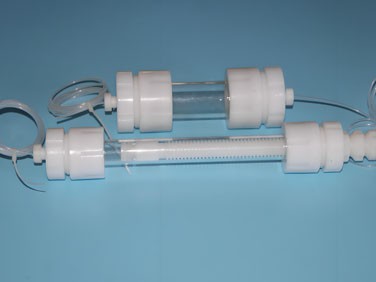
3.Chromatographic Column (Manual)
***Price List for whole above, inquire us to get
Description
Technical Parameters
An industrial chromatography column is a tool used for chemical analysis that separates compounds in a mixture and measures the amount of each compound. It is widely used in petrochemical, pharmaceutical, food industry, environmental protection and other fields for separation, purification and detection. It works on the basis of the distributive balance between the fixed and moving phases of different substances. A column usually consists of a stationary phase and a mobile phase. In chromatographic analysis, the sample is passed through a column, where the characteristics of the fixed phase and the mobile phase allow various compounds to pass through the column at different rates, thus achieving separation. These compounds can then be detected and quantitatively analyzed by a detector.
The separation effect of the column depends on the stationary phase selected, as well as the preparation and operating conditions of the column. Common packing materials for distribution columns include carbon octane column (ODS/C18), carbon octane column (MOS/C8), carbon Hexyl/C6, carbon quaternary column (Butyl/C4), carbon Methyl/C1, anion exchange column (SAX), cation exchange column (SCX), Phenyl column (Phenyl), amino column (A) mino/NH2), Cyano/CN/Nitrile, etc.
Parameter


Application field
Industrial chromatography columns have a wide range of applications in a number of fields, including:
Biopharmaceutical: The chromatographic column is the main means of separation and purification of biopharmaceutical, which is used for the manufacture of high purity and high activity biological products.
Food safety: Used to detect harmful substances such as additives and residues in food to ensure food safety.
Environmental monitoring: Separation and analysis of pollutants in the environment and assessment of environmental quality.
Petrochemical: Used for purity detection of petroleum products, impurity analysis, etc.
Packing and selection of Industrial Chromatography Column
In many fields such as industrial analysis, environmental monitoring, drug research and development, chromatographic column is a key separation tool, and its performance directly affects the accuracy and reliability of analytical results. The performance of the column depends largely on the type and characteristics of its fillers. This paper will deeply discuss the types of fillers, the selection principles and the points for attention in practical application of industrial chromatographic columns, in order to provide useful reference for researchers in related fields.
The type of column packing
The selection of column fillers is wide, and according to the different basic materials, it can be divided into inorganic fillers, organic fillers and biological fillers. Each filler has its own unique physical and chemical properties and scope of application.



Inorganic filler
Inorganic fillers are known for their high mechanical stability, high temperature stability and acid-base stability, and are suitable for more demanding separation conditions. Common inorganic fillers include silica gel, alumina, graphitized carbon and zirconia.
Silica gel is one of the most commonly used inorganic fillers, and its surface has polar functional groups such as silicon hydroxyl group (SiOH), which is suitable for normal phase chromatography and reverse phase chromatography. In normal phase chromatography, silica gel is used as stationary phase, and the polar components are washed out of the column first. In reverse phase chromatography, silica gel surface bonding has a relatively weak polarity of functional groups, such as C18, C8, etc., the larger polarity of the group is first flushed out. Silicone fillers have good chemical and thermal stability and are suitable for a wide range of pH and temperature conditions.
Alumina is also a kind of inorganic filler, and its particles are rigid and can be made into a stable chromatographic column bed. Alumina filler is suitable for mobile phase with pH up to 12, but its application range is limited due to its strong action with alkaline compounds.
Graphitized carbon is a new type of inorganic filler whose surface is the basis of retention without any other surface modification. Graphitized carbon fillers have a stronger retention capacity than alkyl bonded silica gel or porous polymer fillers and are suitable for separating certain geometric isomers. In addition, graphitized carbon is not dissolved in the HPLC mobile phase and can be used at any pH and temperature.
Zirconia filler is one of the new inorganic fillers studied in recent years. It is a commercial porous zirconia microsphere column with polymer coating only. Zirconia filler is suitable for pH range 1~14, temperature up to 100℃, has a broad application prospect.
Organic fillers
Organic fillers mainly include polymer fillers, such as polystyrene-divinylbenzene, polymethylpropionate and so on. Such fillers can be used in the pH range of 1 to 14 and have stronger hydrophobicity. Polymeric fillers with large pores are very effective for the separation of biological macromolecules such as proteins. In addition, organic fillers have good chemical and thermal stability and are suitable for a wide range of separation conditions.
Biological fillers
Biological fillers are mainly suitable for the analysis of biological macromolecules, such as proteins or nucleic acids. Common biological fillers include polysaccharide derivatives stationary phase column, cyclodextrin column and protein chiral column. These fillers enable efficient separation using the interaction forces between biomolecules.
The principle of column packing selection
The selection of suitable column packing is the key to ensure the separation effect of chromatography. When selecting fillers, the following factors need to be considered:
Separation mode
According to the properties of analytes, the suitable chromatographic separation mode is selected. Common chromatographic separation modes include reversed phase chromatography (RPC), normal phase chromatography (HILIC), ion exchange chromatography (IEC), Affinity chromatography (Affinity) and gel permeation chromatography (GPC). Different separation modes have different requirements for fillers, such as reverse phase chromatography usually selects non-polar fillers based on silica gel or polymer, while normal phase chromatography selects polar fillers.
Fixed phase and mobile phase
The choice of stationary phase depends on the polarity, molecular size and structure of the analyte. For polar substances, polar fillers can be selected, such as silica gel and hydrophilic column fillers; For non-polar substances, non-polar fillers can be selected, such as hydrophobic column fillers. At the same time, the polarity of the mobile phase also needs to match the fixed phase to ensure a good separation effect. For example, in normal phase chromatography, the polarity of the mobile phase should be lower than that of the stationary phase; In reversed phase chromatography, the polarity of the mobile phase is stronger.
Particle size and aperture
The particle size of the filler directly affects the column efficiency and sample loading capacity. Fine-grained fillers can provide higher column efficiency, but may lead to increased back pressure; Coarse-grained packing is beneficial to sample loading, but the column efficiency is low. Therefore, the selection of fillers needs to be balanced according to the actual separation needs. In addition, the pore size of the filler also affects the retention time and selectivity of the analyte. Large pore size fillers are beneficial to the separation of large molecular compounds, while small pore size fillers are helpful to improve the retention of small molecular compounds.
Chemical stability
The selected filler should be chemically stable under analytical conditions and not react with the sample or mobile phase. This is the basis to ensure the accuracy and reliability of the chromatographic separation effect. For separation under high temperature, high pressure or strong acid and alkali conditions, it is necessary to select a filler with higher chemical stability.
Brand and cost
Different brands of column fillers may vary in performance, but also need to consider cost factors. When selecting fillers, it is necessary to comprehensively consider the conditions and budget of the laboratory and choose cost-effective products.
 |
 |
 |
Case Study
► Purification of Monoclonal Antibodies (mAbs) in Biopharmaceuticals
Background
A global biotech company aimed to scale up the purification of a therapeutic monoclonal antibody (mAb) from a 50 L pilot batch to a 1,000 L commercial batch. The challenge was to maintain >99% purity while minimizing aggregate formation and host cell protein (HCP) contamination.
Methodology
Column Design:
A 300 mm internal diameter (ID) × 500 mm stainless steel column packed with Protein A affinity resin (MabSelect SuRe, Cytiva).
Maximum operating pressure: 3 bar.
Process Parameters:
Binding buffer: 20 mM sodium phosphate, pH 7.4.
Elution buffer: 0.1 M citric acid, pH 3.0.
Flow rate: 150 mL/min (linear velocity: 100 cm/h).
Automation:
Integrated single-use sensors for pH, conductivity, and UV detection (280 nm).
Automated cleaning-in-place (CIP) with 0.5 M NaOH.
Results
Yield: 85% (1,020 g of mAb from 1,200 g crude feed).
Purity: 99.5% (HPLC analysis).
Aggregate Content: <1% (size-exclusion chromatography, SEC).
HCP Reduction: From 50,000 ppm to <5 ppm (ELISA assay).
Key Takeaways
Scalability: The column's L/D ratio (length-to-diameter) of 1.67 ensured consistent performance across scales.
Resin Lifecycle: The Protein A resin survived 100 cycles with CIP, reducing per-batch costs by 30%.
Automation: Real-time monitoring reduced manual intervention by 70%, improving process reliability.
The precautions of column packing in practical application
In practical applications, after selecting the appropriate column packing, the following points need to be paid attention to to ensure the chromatographic separation effect:
Certified Read the column instruction manual
Before using a new column, you should carefully read its instructions to understand the nature of the filler, conditions of use and maintenance methods. This helps ensure proper use of the column and extends its service life.
Use a well-filled column
Ensure that the column is well filled, no bubbles, no cracks and other defects. This helps to ensure the consistency and accuracy of the chromatographic separation effect.
Minimize stress fluctuations
In the process of chromatographic separation, pressure fluctuations should be minimized to avoid mechanical and thermal shocks. This helps protect column fillers and extend their service life.
Use protective columns and in-line filters
To protect column fillers from contamination and damage, protective columns and in-line filters can be used. This helps filter out impurity particles and strongly retained components in the sample and mobile phase.
Wash column frequently with strong solvent
Regular flushing of the column with a strong solvent can remove impurities and contaminants remaining on the surface of the filler and maintain its good separation performance.
Fully filter the sample and mobile phase
Before injecting the sample and mobile phase into the column, it should be fully filtered to remove impurity particles. This helps to avoid stuffing clogging and reduced separation effect.
Control the column temperature
The use temperature of the column has an important effect on its separation effect. Under normal circumstances, the temperature of the column should be less than 40℃. For columns with silica gel matrix, the pH value of the mobile phase should be maintained between 3.0 and 8.0 to avoid filler damage and decreased separation effect.
Conclusion
The selection of column packing is the key to ensure the effect of chromatographic separation. When selecting fillers, factors such as separation mode, fixed and mobile phase, particle size and pore size, chemical stability, brand and cost need to be considered. At the same time, in practical applications, it is also necessary to read the column instruction manual, use a well-filled column, reduce pressure fluctuations, use protective columns and online filters, wash the column frequently, and adequately filter the sample and flow. By considering these factors and paying attention to the details in practical application, the good performance of column packing and the accuracy and reliability of chromatographic separation effect can be ensured.
Hot Tags: industrial chromatography column, China industrial chromatography column manufacturers, suppliers, factory, 10l Glass Reactor, SS316 Reactor, Laboratory Evaporators, Hydrothermal Reactor Autoclave, High Pressure Hydrogenation Reactor, Teflon Autoclave
Previous
Empty Chromatography ColumnsSend Inquiry


