



Small Scale Column Chromatography
2.Chromatographic Column (Rotation Type)
3.Chromatographic Column (Manual)
***Price List for whole above, inquire us to get
Description
Technical Parameters
Small-scale column chromatography is based on the distribution of compounds between two phases: a stationary phase (typically a solid adsorbent packed in a column) and a mobile phase (a solvent or mixture of solvents). The separation occurs due to differences in the physicochemical properties of the compounds, such as their adsorption capacity, solubility, molecular shape and size, polarity, and affinity towards the stationary and mobile phases.
As the mobile phase flows through the column, it interacts with the stationary phase and the compounds being separated. Each compound has a unique affinity for the stationary phase, resulting in different retention times. Compounds with stronger affinities for the stationary phase elute more slowly, while those with weaker affinities elute more rapidly. This differential elution allows for the separation of the compounds into distinct fractions.
Types of Small-Scale Column Chromatography
Small-scale column chromatography can be classified into several types based on the nature of the stationary phase and the separation mechanism involved. Some of the most common types include:
◆ Silica Gel Chromatography: Silica gel is a popular stationary phase due to its high adsorptive capacity and chemical stability. It is widely used for the separation of polar and non-polar compounds. The separation mechanism is primarily based on adsorption and desorption processes.
◆ Alumina Chromatography: Alumina is another commonly used stationary phase, particularly for the separation of acidic, basic, and neutral compounds. It has a high affinity for polar compounds and can be used in both normal-phase and reversed-phase modes.
◆ Reversed-Phase Chromatography: In this type of chromatography, the stationary phase is a hydrophobic material (such as C18-bonded silica) and the mobile phase is an aqueous solution containing an organic solvent. This technique is particularly useful for the separation of hydrophobic compounds.
◆ Ion-Exchange Chromatography: This technique uses ion-exchange resins as the stationary phase. The separation is based on the exchange of ions between the sample and the resin, which can be cationic or anionic depending on the type of resin used.
◆ Size-Exclusion Chromatography: Also known as gel filtration, this technique separates compounds based on their molecular size. The stationary phase consists of porous beads, and the separation occurs as compounds diffuse into and out of the pores of the beads.
Parameter


Factors Influencing Separation Efficiency
Several factors can affect the separation efficiency of small-scale column chromatography:
● Stationary Phase: The type, particle size, and porosity of the stationary phase influence the retention and separation of the components.
● Mobile Phase: The composition, polarity, and pH of the mobile phase affect the solubility and interaction of the components with the stationary phase.
● Temperature: Temperature changes can alter the solubility and interaction of components, affecting separation.
● Flow Rate: The flow rate of the mobile phase influences the residence time of the components in the column, affecting separation resolution.
● Sample Concentration and Volume: Higher sample concentrations and volumes can lead to overloading, reducing separation efficiency.
Applications of Small-Scale Column Chromatography
Small-scale column chromatography finds applications in various fields of analytical chemistry, including:
|
Purification of Compounds: It is commonly used for the purification of natural products, synthetic compounds, and pharmaceuticals. By separating impurities and unwanted by-products, small-scale column chromatography helps in obtaining pure compounds suitable for further analysis or use. Isolation of Components from Mixtures: This technique is essential for the isolation of individual components from complex mixtures, such as those found in natural extracts, plant materials, or reaction mixtures. Qualitative and Quantitative Analysis: Small-scale column chromatography can be used for the qualitative identification of compounds based on their elution patterns and retention times. It can also be coupled with detection methods such as UV-Vis spectroscopy, mass spectrometry, or fluorescence for quantitative analysis. Preparation of Samples for Further Analysis: Purified compounds obtained through small-scale column chromatography can be used for various analytical techniques, such as NMR, IR spectroscopy, and X-ray crystallography, which require highly pure samples. |
|

Experimental Procedures for Small-Scale Column Chromatography
Performing small-scale column chromatography involves several steps, from preparing the column and loading the sample to eluting and collecting the fractions. Here's a detailed outline of the experimental procedure:
|
|
Preparation of the Column: Select an appropriate column size based on the amount of sample and the desired separation resolution. Pack the column with the chosen stationary phase (e.g., silica gel, alumina) using a slurry method or dry packing. Ensure that the stationary phase is packed tightly and evenly to avoid channeling. Loading the Sample: Dissolve the sample in a suitable solvent (mobile phase) that will not interfere with the separation. Apply the sample to the top of the column using a pipette or syringe. Allow the solvent to drain through the column slowly to ensure even distribution of the sample. Elution of the Sample: Select an appropriate elution solvent or solvent mixture based on the polarity and adsorptive properties of the compounds to be separated. Gradually add the elution solvent to the column, allowing it to drip through at a controlled rate. Collect the eluted fractions in separate containers. Monitoring and Collection of Fractions: Monitor the elution process using a detection method such as UV-Vis spectroscopy or TLC. Collect fractions based on the elution pattern observed. Combine fractions that contain the same compound for further purification or analysis. Analysis of Fractions: Analyze the collected fractions using analytical techniques such as NMR, mass spectrometry, or IR spectroscopy for compound identification and purity assessment. |
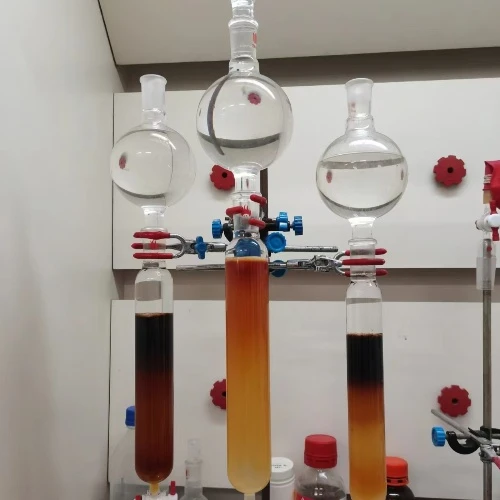
Case Study: Separation of Carbazole Compounds from Highly Mature Crude Oil
To illustrate the application of small-scale column chromatography, consider a case study involving the separation of carbazole compounds from highly mature crude oil. Carbazoles are nitrogen-containing heterocyclic compounds found in crude oil and are of interest for their geochemical implications. However, their low concentration in highly mature crude oil makes their separation challenging.
A study by Lu et al. (2024) presented a small-scale column chromatography method using silica gel as the stationary phase and a Pasteur pipette as the separation device. The oil sample was eluted with solvents mixed with different volume proportions of n-hexane and dichloromethane. The results showed that increasing the reagent polarity caused the aromatic hydrocarbons and carbazole compounds to be eluted sequentially. Most aromatic compounds could be selectively eluted using a reagent polarity ratio of 9:1 (n-hexane:dichloromethane), with no carbazole compounds present. However, a significant amount of carbazole compounds were eluted in the polar segments of 8:2–6:4, with the eluted carbazoles concentration accounting for more than 98% of the total concentration.
This study demonstrates the effectiveness of small-scale column chromatography in separating complex mixtures such as crude oil. The method provided high separation efficiency and could be applied to both highly mature crude oil and other types of oils, including biodegradable oil. It serves as a versatile tool for the separation of carbazole compounds and provides technical support in unveiling their geochemical implications in complex areas.
Advanced Variations and Recent Advancements
● High-Performance Liquid Chromatography (HPLC)
HPLC is a modern variant of column chromatography that uses high-pressure pumps to force the mobile phase through a packed column with small particle sizes (typically 3-5 μm). This results in faster separations, improved resolution, and better sensitivity.
● Reversed-Phase Chromatography
In reversed-phase chromatography, the stationary phase is hydrophobic, and the mobile phase is polar. This method is particularly useful for separating non-polar compounds and is widely used in analytical and preparative separations.
● Chiral Chromatography
Chiral chromatography employs stationary phases that can differentiate between enantiomers, allowing for the separation of chiral compounds. This technique is crucial in the pharmaceutical industry for the purification of enantiomerically pure drugs.
Conclusion
Small-scale column chromatography is a versatile and powerful technique for the separation and purification of compounds. Its wide applicability in various fields, coupled with recent advancements, continues to make it a cornerstone in analytical chemistry, biochemistry, and pharmaceutical sciences. By understanding the fundamentals, experimental procedures, and factors influencing separation efficiency, researchers can harness the full potential of this technique to achieve efficient and effective separations. As technology advances, we can expect further improvements in column chromatography, expanding its applications and enhancing our ability to analyze and purify complex mixtures.

Hot Tags: small scale column chromatography, China small scale column chromatography manufacturers, suppliers, factory, Short Path Distillation Kit Turn Key, Jacketed Glass Reactor, Lab Rotary Evaporator, Stainless Steel Chemical Reactor, Short Path Distillation Kit, Teflon Lined Hydrothermal Autoclave
Previous
Ion Chromatography ColumnsSend Inquiry


