


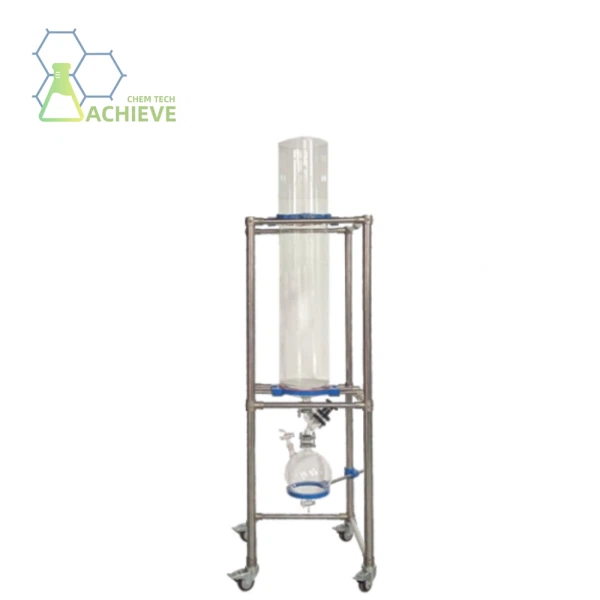

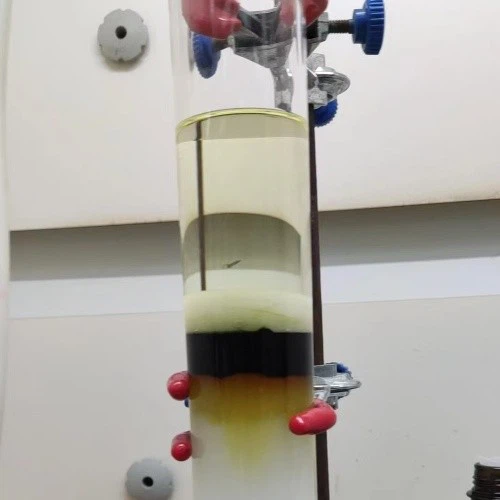
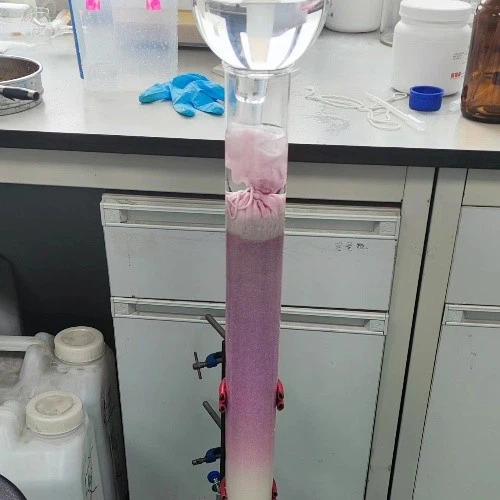
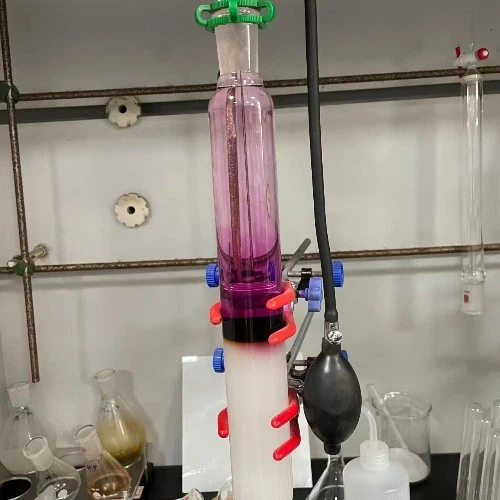
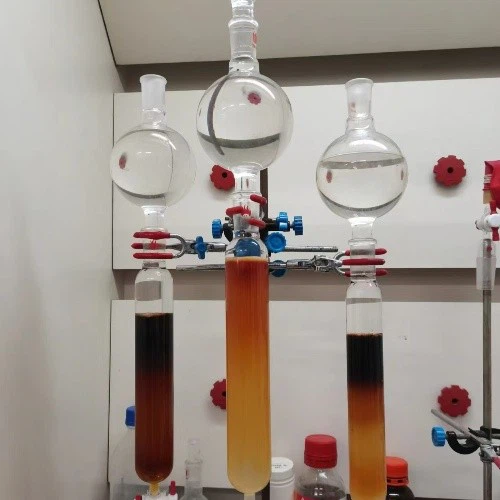
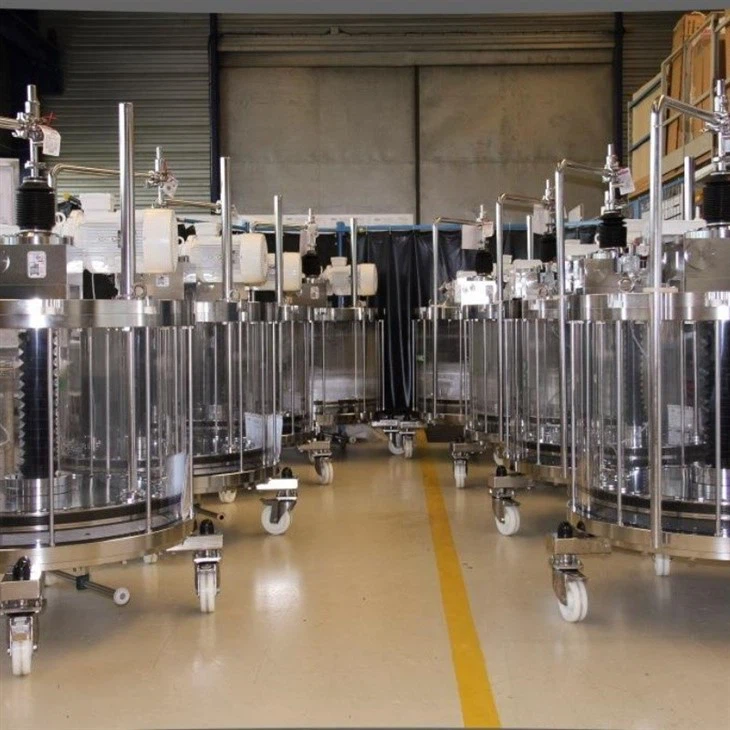
Aluminium Oxide Column Chromatography
2.Chromatographic Column (Rotation Type)
3.Chromatographic Column (Manual)
***Price List for whole above, inquire us to get
Description
Technical Parameters
Aluminium oxide (Al₂O₃) column chromatography is a widely used separation technique in analytical and preparative chemistry, leveraging the adsorptive properties of alumina to isolate compounds based on their polarity. Alumina exists in different activity grades (e.g., neutral, basic, or acidic), depending on its water content and pH, making it versatile for separating diverse organic and inorganic substances.
In this method, a column is packed with alumina, and the sample mixture is loaded onto the top. A mobile phase (eluent) is then passed through the column. Compounds interact with the alumina surface via van der Waals forces, hydrogen bonding, or ionic interactions. Nonpolar compounds elute faster due to weaker interactions, while polar compounds adhere more strongly and move slower. This differential adsorption enables separation.
Key advantages include its effectiveness for separating neutral compounds, such as steroids, terpenes, and alkaloids, and its compatibility with nonpolar to moderately polar solvents. However, alumina's reactivity with acidic or basic functional groups may cause irreversible adsorption or degradation. Proper selection of alumina activity and eluent polarity is critical for optimal resolution.
This technique remains valuable in laboratories for purification, qualitative analysis, and fractionation of complex mixtures, offering a balance of simplicity and efficiency in chemical separations.
Parameters


Operation process
|
|
|
|


Aluminium oxide column chromatography is an important chromatographic separation technology, its operation process involves a number of key steps, the following is a detailed introduction to the operation process:
Preparation
Instrument and reagent preparation:
Instruments: chromatographic column (or column), long dropper (or pipette), glass funnel, receiving bottle, cock, etc.
Reagents: neutral alumina (or other types of alumina, selected according to separation needs), development agent (such as ethanol, methanol, ethyl acetate, etc., selected according to the polarity of the substance to be separated), sample to be separated, quartz sand, etc.
Instruments and equipment:
Secure the chromatographic column to an appropriate support to ensure stability.
A cock is installed at the lower end of the chromatographic column to control the flow of the mobile phase.
Loading column operation
Filling adsorbent:
Select suitable alumina as the adsorbent to ensure uniform particle size and no impurities.
Fill with dry or wet packing method. When dry loading, alumina is directly added to the chromatographic column, and the column body is struck while adding, so that the adsorbent is evenly filled and there is no gap. When wet loading, the alumina is mixed with an appropriate amount of developing agent to form a paste and then added to the chromatographic column, again tapping the column body to ensure uniform filling.
Adjusting cylinder:
A little quartz sand is added to the upper part of the adsorbent to keep the cylinder flat and stable.
Ensure that the amount of adsorbent is sufficient, usually 30 to 40 times the amount of the mixture to be separated, and may even reach 100 times to ensure adequate adsorption and separation effects.
Washing column operation
Select developing agent:
According to the polarity and solubility of the substance to be separated, the appropriate development agent is selected.
Column washing:
Add the selected development agent from the top of the column, and appropriately release the cock at the lower end of the column so that the development agent slowly flows out.
During the addition process, it should be fast first and then slow, so that the adsorbent is always covered by the spreading agent.
At the same time, tap the column body to remove air bubbles and ensure a more dense filling.
Loading and elution operation
Dissolved sample:
Dissolve the mixture to be separated with the minimum amount of developing agent to ensure that the sample is completely dissolved and the concentration is moderate.
Add sample:
The dissolved sample is carefully added to the chromatographic column to avoid impinging the adsorbent on the separation effect.
Elution:
When the liquid level of the mixture solution is close to the quartz sand on the adsorbent, the eluting agent is added.
Drop acceleration should be controlled within an appropriate range (such as 1 to 2 drops per second) to ensure that the developing agent is always able to cover the adsorbent.
Observe the change of chromatographic column and the flow of developing agent, adjust the operating parameters in time.
Collection and analysis
Collect effluent:
The effluent of different time periods is collected respectively, and the preliminary judgment is usually made according to the characteristics of color and transparency.
Analysis and processing:
The collected effluent is further analyzed and treated, such as concentration, drying, purity testing, etc.
According to the analysis results, the separation effect and purity were determined.
Precautions
During the entire operation, the experimental environment should be kept clean and quiet to avoid external interference.
01
Adhere to laboratory safety regulations and wear appropriate personal protective equipment.
02
Pay attention to controlling conditions such as operating temperature and humidity to ensure the stability and accuracy of the separation effect.
03
In the loading and elution process, we should pay close attention to the changes of the chromatographic column and the flow of the development agent, find the problem in time and take measures to solve it.
04
In summary, the operation process of alumina column chromatography involves several key steps and precautions. Through proper selection and operation of these steps, efficient and accurate compound separation and purification can be achieved.
Applications in the field of bioanalysis
As a classic chromatographic separation technology, aluminium oxide column chromatography has shown extensive application potential and unique advantages in the field of bioanalysis since its birth. With the continuous progress of science and technology, the application of alumina column chromatography in biological analysis is increasingly in-depth and extensive.
The basic principle
Alumina column chromatography is a separation technology based on the principle of liquid-solid adsorption. It uses alumina as a stationary phase, through the flow of solvent (i.e. mobile phase), the different components of the sample according to their adsorption capacity on the alumina to separate. There will be interactions between the hydroxyl groups on the surface of alumina and the compounds to be separated, such as van der Waals force, dipole force, hydrogen bonding, etc., and the differences in these interaction forces lead to different adsorption capacities of different compounds on alumina, so as to achieve separation.
The separation effect of alumina column chromatography is affected by many factors, including the type of alumina (such as neutral alumina, basic alumina, acidic alumina, etc.), particle size, specific surface area, pore size distribution, mobile phase selection and elution conditions. By optimizing these factors, efficient separation and purification of different biomolecules can be achieved.


Amino acid analysis
Amino acids are the basic units of proteins and play a vital role in living organisms. Alumina column chromatography can efficiently separate and identify different kinds of amino acids. By selecting the appropriate alumina type and elution conditions, scientists can achieve high-resolution separation of amino acids, providing strong support for subsequent structural and functional studies.
Separation and purification of peptides and proteins
A peptide is a compound composed of multiple amino acids connected by peptide bonds, while a protein is a complex biological macromolecule formed by folding multiple peptide chains. Alumina column chromatography has a unique advantage in the separation and purification of peptides and proteins. By adjusting the size and pore size distribution of alumina, effective separation of peptides and proteins of different sizes and polarities can be achieved. In addition, alumina column chromatography can also be used in combination with other separation technologies (such as gel filtration, ion exchange, etc.) to further improve separation efficiency and purity.
Separation of alkaloids
Alkaloids are a class of nitrogen-containing organic compounds with biological activity and widely exist in plants. Alumina column chromatography has important application value in the separation of alkaloids. By optimizing the type and elution conditions of alumina, scientists can achieve efficient separation and purification of alkaloids, providing strong support for subsequent bioactivity research and drug development.
Isolation and purification of nucleic acids
Nucleic acids are important genetic material in living organisms, including DNA and RNA. Alumina column chromatography can also be used for the separation and purification of nucleic acids. By selecting the appropriate alumina type and elution conditions, the high efficiency of nucleic acid separation and removal of impurities can be achieved, and high quality nucleic acid samples can be provided for the subsequent molecular biology research.
Analysis of drug metabolites
During drug development, understanding the metabolites of a drug is critical to evaluating the efficacy and safety of a drug. Alumina column chromatography can be used for the analysis of drug metabolites. By isolating and identifying the metabolites of drugs in vivo, scientists can deeply understand the metabolic pathways and mechanisms of drugs, and provide an important basis for further optimization and improvement of drugs.
advantages
Efficient separation capability
Alumina column chromatography has high efficiency and can achieve high resolution separation of biomolecules. This allows scientists to delve into the structure and function of biomolecules, as well as their metabolic processes in living organisms.
Good chemical stability
Alumina has good chemical stability and can work stably in different reaction environments. This makes alumina column chromatography suitable for a variety of complex biological sample analysis, including acidic, alkaline, high temperature and other conditions.
Wide range of applications
Alumina column chromatography is not only suitable for the separation and purification of amino acids, peptides and proteins, but also for the analysis of various biomolecules such as alkaloids, nucleic acids and drug metabolites. This makes alumina column chromatography has a wide application prospect in the field of bioanalysis.
Easy to operate and regenerate
The operation of alumina column chromatography is relatively simple and does not require complex equipment and cumbersome operation steps. In addition, the alumina column can also be regenerated by appropriate treatment methods for next use. This reduces the experimental cost and improves the experimental efficiency.
Aluminium oxide column chromatography has emerged as a critical tool in bioanalysis, offering unique advantages for separating and purifying biomolecules. Its development prospects are particularly promising due to its adaptability to diverse biological systems. Unlike silica gel, which exhibits microacidity, aluminium oxide provides a more neutral or even basic environment, making it suitable for isolating acid-sensitive or basic compounds such as proteins, nucleotides, and alkaloids.
In biopharmaceuticals, aluminium oxide columns are increasingly utilized for refining recombinant proteins and antibodies. The material's pH stability and adjustable surface chemistry enable selective retention of target molecules while minimizing non-specific interactions. This is crucial for downstream processing, where high purity and yield are essential. Additionally, advancements in nanotechnology are expected to enhance column efficiency by reducing particle sizes and improving surface uniformity, thereby accelerating separation speeds and increasing resolution.
The demand for aluminium oxide chromatography in environmental and food safety testing is also rising. Its ability to detect trace contaminants, such as pesticides or heavy metals, aligns with global regulatory trends prioritizing stringent quality controls. As bioanalysis expands into personalized medicine and diagnostics, aluminium oxide columns may play a pivotal role in isolating biomarkers or therapeutic agents from complex biological matrices. Continued innovation in column design and materials will likely solidify its position as a cornerstone technique in modern bioanalytical workflows.
Hot Tags: aluminium oxide column chromatography, China aluminium oxide column chromatography manufacturers, suppliers, factory, High Pressure Batch Reactor, Rotary Evaporator Distillation, SS Reactor, Crystallization Reactor, Hydrothermal Autoclave 100 Ml, Hydrothermal Reactor
Previous
Classical Column ChromatographySend Inquiry


