



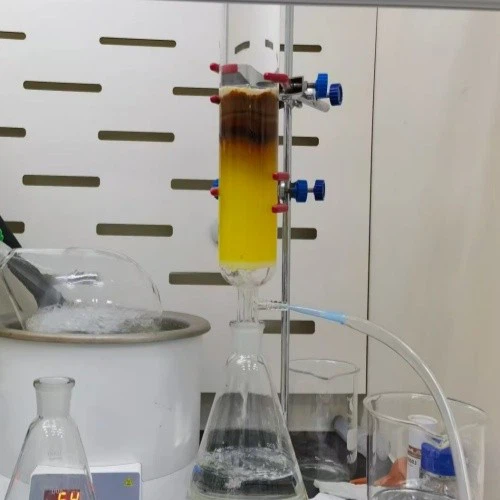

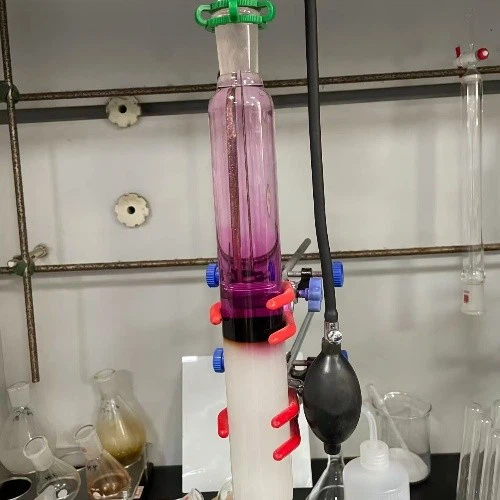
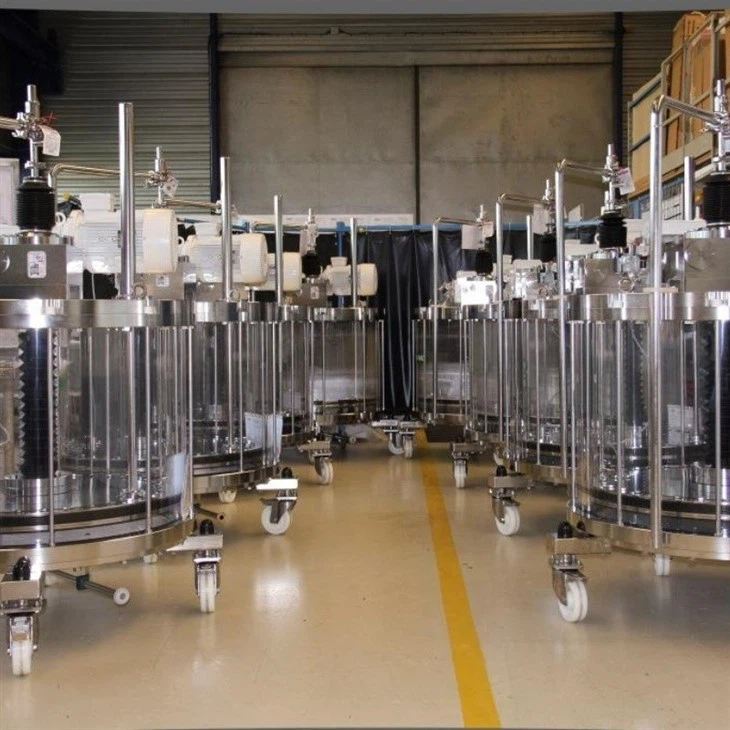
Pall Chromatography Column
2.Chromatographic Column (Rotation Type)
3.Chromatographic Column (Manual)
***Price List for whole above, inquire us to get
Description
Technical Parameters
A pall chromatography column is a high-performance separation tool widely used in various industries, including biopharmaceuticals, food and beverage, and environmental testing. Renowned for its superior quality and reliability, they are designed to deliver efficient and precise separations of complex mixtures. These columns utilize advanced stationary phase materials, which are carefully selected and optimized to provide excellent selectivity, resolution, and recovery for target analytes. The construction of Pall columns ensures robustness and durability, making them suitable for both analytical and preparative chromatography applications. They are available in a range of sizes and configurations to accommodate different sample volumes and throughput requirements. Additionally, they are compatible with a variety of mobile phases and operating conditions, offering flexibility to users. Their consistent performance and reproducibility make them a trusted choice for researchers and analysts seeking accurate and reliable results in their chromatographic separations. Whether for purification, analysis, or quality control, they provide a reliable solution for meeting demanding separation challenges.
Parameters


Advantages & disadvantages
Pall Chromatography Columns are widely recognized for their advanced design and performance in various separation applications. These columns are engineered to deliver high efficiency, precision, and reliability, making them suitable for a diverse range of industries, including biotechnology, pharmaceuticals, and environmental analysis.
One of the primary applications is in the purification of biomolecules, such as proteins, antibodies, and nucleic acids. Their high selectivity and resolution capabilities enable the effective separation of target molecules from complex mixtures, ensuring high purity and yield. This is crucial in the production of therapeutic proteins and vaccines, where even trace impurities can affect product safety and efficacy.
In the pharmaceutical industry, Pall columns are utilized for drug discovery, development, and quality control. They facilitate the separation and analysis of active pharmaceutical ingredients (APIs) and their impurities, supporting compliance with regulatory standards.
Additionally, they find applications in environmental monitoring, food and beverage analysis, and academic research. Their versatility, coupled with robust construction, ensures consistent performance across different operating conditions, making them a preferred choice for researchers and analysts worldwide. Overall, they play a pivotal role in advancing scientific research and industrial processes.
advantages
Efficient separation
Pall columns use advanced separation technology and high-quality materials to provide outstanding separation capabilities. It can quickly and accurately separate the various components of the sample, especially suitable for the analysis of complex samples.
01
High sensitivity
The column is extremely sensitive to the target components in the sample and can accurately detect low concentrations of components. This is of great significance for areas requiring high-precision analysis, such as biomedicine and environmental monitoring.
02
Good stability
Pall column has good chemical stability and thermal stability, and can maintain a stable separation effect under different experimental conditions. This helps to reduce experimental errors and improve the reliability of data.
03
Compatibility
The column is suitable for many types of samples and analytical needs, including organic compounds, inorganic ions and more. At the same time, it can also be used with a variety of detectors, such as ultraviolet detector, fluorescence detector, etc., to meet the needs of different experiments.
04
Long service life
Pall columns have a long service life due to high quality materials and advanced manufacturing processes. Under normal use and maintenance, it can continue to provide stable separation effect and reduce experimental costs.
05
Shortcomings
Higher price
Compared with some domestic or low-end brands of columns, the price of Pall columns is higher. This can increase the cost of experiments and may be a consideration for laboratories with limited budgets.
High requirements for operation
In order to give full play to the performance of Pall columns, operators need to have certain professional knowledge and skills. This includes proper sample handling, selection and preparation of mobile phase, setting of chromatographic conditions, etc. If the operation is improper, it may affect the separation effect and the service life of the column.
High maintenance costs
Although Pall columns have a long service life, they still require regular maintenance and maintenance during use. This includes operations such as cleaning, regeneration, replacement of fillers, etc., which may require specialized equipment and reagents, thus increasing maintenance costs.
Service life
|
|
|
|


The service life of a pall chromatography column is affected by many factors, including the type of column, the nature of the sample, the frequency of use, operating conditions, and maintenance. Therefore, it is difficult to give a specific and universally applicable service life. However, based on general experience and market feedback, the service life of Pall columns can be estimated and analyzed roughly. Under normal use and maintenance, the service life of Pall columns usually varies from a few months to a few years.
Column type
Different types of Pall columns, their service life will be different. For example, some columns for specific purposes, such as ion columns or HPLC columns, may have a longer service life because they incorporate more advanced separation techniques and materials.
01
Properties of the sample
The properties of the sample have a great impact on the service life of the column. If the sample contains highly adsorbent, corrosive, or high concentrations of contaminants, these substances may damage the column's packing or surface, thereby shortening its service life.
02
Frequency of use
Frequent use of the column accelerates its wear and aging process, thereby shortening its service life. Therefore, reasonable arrangement of experimental plan, avoid excessive use of chromatographic columns, can extend its service life.
03
Operating conditions
Operating conditions such as flow rate, pressure, temperature, etc., will also affect the service life of the column. Improper operating conditions, such as high flow rates or excessive pressure, may cause the column's packing to loosen or damage, thereby shortening the service life.
04
Maintenance
Regular cleaning, regeneration and maintenance of the column can extend its service life. If the maintenance work is neglected, it may lead to deterioration of column performance and even damage.
05
In order to extend the service life, the following measures are recommended:
Strictly follow the operation manual to avoid column damage caused by improper operation.
The column is cleaned and regenerated regularly to remove residual contaminants and impurities.
Pay attention to sample pretreatment and purification work to avoid strong adsorption, corrosive or high concentration of pollutants into the column.
Reasonable arrangement of experimental plan to avoid excessive use of chromatographic columns.
Regular inspection and maintenance of chromatographic columns, timely discovery and solution of problems.
In summary, the service life of Pall columns is affected by many factors, but through rational use and maintenance work can extend its service life and improve its performance stability.
Emergency response for sample ejection or solution leakage
In the process of chromatographic analysis, pall chromatography column is the key component, and its performance stability is very important. However, in actual operation, emergency situations such as sample ejection or solution leakage may be encountered, which not only affect the accuracy of the analysis results, but also may pose a threat to the experimental environment and personnel safety. Therefore, it is particularly important to master the emergency treatment measures for PALL column sample ejection or solution leakage.

Sample pop-up emergency treatment
Sample ejection is usually caused by improper operation of the sampling system, poor sealing of the sample container, or loose column joints. Once the sample is found to pop out, the following emergency measures should be taken immediately:
Stop the experiment immediately
Quickly turn off the power to the chromatograph and stop all ongoing operations to prevent further sample ejection or solution leakage.
Protect the site
Use personal protective equipment such as protective gloves and masks to avoid direct contact with ejected samples or leaking solutions. At the same time, use clean paper towels or absorbent cotton to quickly absorb the leakage and prevent its spread.
Reasons for inspection
Carefully examine the injection system, sample container, and column connections to determine the specific cause of the sample ejection. This may be due to damaged injection needle, loosely sealed sample container or loose column connection.
Repair or replace parts
Repair or replace damaged needle, sample container, or column connection components based on inspection results. Ensure that all components are properly installed and securely connected.
Clean up the site
Clean the spill area thoroughly with an appropriate cleaner to ensure there is no residue. At the same time, the chromatographic system is thoroughly checked to ensure that there are no other potential failures.
To restart the experiment
After confirming that all problems have been resolved and the chromatographic system is back to normal, the experiment can be resumed. The tightness of the sample container and injection system should be checked again before re-injection.
Emergency treatment of solution leakage
Solution leakage may be caused by loosening of column joints, pipe breakage or flow pool leakage. In response to this situation, the following emergency measures should be taken:
Cut off the leak source immediately
Quickly close the valve or pump associated with the leak to cut off the source of the leak. Also, use protective gear to avoid direct contact with the leaking solution.
01
Leakage collection
Use an appropriate container to collect the leaking solution and prevent it from spreading beyond the test area. Care should be taken to avoid splashing the solution on the skin or eyes during collection.
02
Mark hazardous areas
Set up warning signs around the leak area to alert others to the danger. At the same time, maintain good ventilation to prevent harmful gas accumulation.
03
Check and repair leaks
Carefully check column joints, pipes, and flow pools for possible leaks to determine the point of leakage. Take appropriate repair measures according to the cause of leakage, such as replacing the sealing ring, fastening the connector, or replacing the damaged part.
04
Clean up the site and resume the experiment
Only after confirming that the leak has been fully repaired and the site has been cleaned up can the experiment be resumed. Before restarting the experiment, the chromatographic system should be thoroughly inspected to ensure that there are no other potential failures.
05
Pall chromatography columns are renowned for their advanced design features, which enhance their performance in various separation processes. One of the key design characteristics is the use of high-quality stationary phases that are carefully selected to provide excellent selectivity and resolution for a wide range of analytes. These stationary phases are often optimized for specific applications, such as protein purification, ion exchange, or size-exclusion chromatography.
The columns are constructed with precision to ensure uniform packing of the stationary phase, minimizing channeling and ensuring consistent flow characteristics. This contributes to high reproducibility and reliability in analytical results. Additionally, Pall columns are designed to withstand high pressures, allowing for faster flow rates without compromising separation efficiency.
Another notable design feature is the compatibility of Pall columns with a variety of chromatography systems and detectors, making them versatile for different laboratory setups. The columns are also available in various sizes and configurations to accommodate different sample volumes and throughput requirements.
Furthermore, Pall emphasizes ease of use and maintenance, with columns that are simple to install, clean, and store. Overall, the design combines advanced materials, precision engineering, and user-friendly features to deliver superior performance in chromatography applications.
Hot Tags: pall chromatography column, China pall chromatography column manufacturers, suppliers, factory, 20l Rotary Evaporator, 20l Rotovap, Glass Lab Reactor, Lab Rotary Evaporator, High Pressure Autoclave Reactor, Autoclave For Hydrothermal Synthesis
Send Inquiry


