



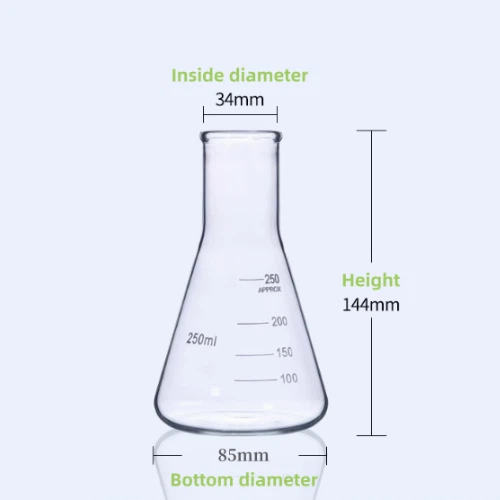
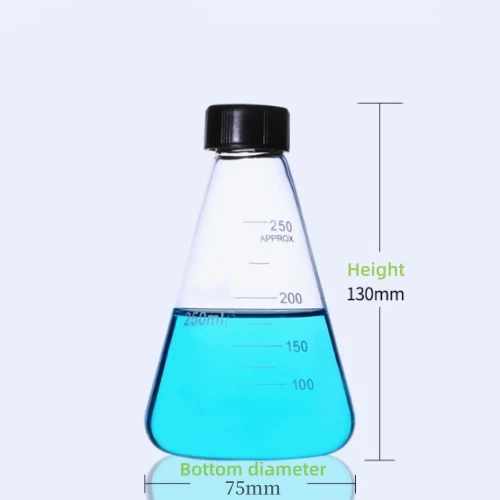

Borosil Conical Flask
1) Narrow-mouth Bottle: 50ml~10000ml;
2) Big B Bottle: 50ml~3000ml;
3) Horn Mouth: 50ml~5000ml;
4) Wide-mouth Bottle: 50ml/100ml/250ml/500ml/1000ml;
5) Conical Flask With Cover: 50ml~1000ml;
6) Screw Conical Flask:
a. Black Lid (General Sets): 50ml~1000ml
b. Orange Lid (Thickening Type): 250ml~5000ml;
2. Single and Multi-mouth Round Bottom Flask:
1) Single Mouth Round Bottom Flask: 50ml~10000ml;
2) Inclined Three-mouth Flask: 100ml~10000ml;
3) Inclined Four-mouth Flask: 250ml~20000ml;
4) Straight Three-mouth Flask: 100ml~10000ml;
5) Straight Four-mouth Flask: 250ml~10000ml.
***Price List for whole above, inquire us to get
Description
Technical Parameters
The borosil conical flask, a versatile piece of laboratory equipment, is renowned for its durability, chemical resistance, and precision in scientific applications. Crafted from high-quality borosilicate glass, this flask is characterized by its conical shape, which tapers from a broad base to a narrower neck, facilitating efficient mixing and pouring of contents.
Borosilicate glass, known for its low coefficient of thermal expansion, enables the conical flask to withstand temperature extremes without cracking or breaking. This makes it ideal for procedures involving heating and cooling, such as sterilization, distillation, and other chemical reactions. Its excellent thermal shock resistance ensures safety and reliability in diverse experimental settings.
The smooth, polished interior surface of the conical flask minimizes the adherence of samples, promoting accurate measurements and consistent results. The narrow neck, equipped with a standard ground-glass joint, allows for secure attachment of various accessories like stoppers, caps, or adapters, enhancing versatility and facilitating a wide range of experimental techniques.
Available in various sizes, from small, handheld versions to larger capacities suitable for bulk reactions, it meets the needs of both small-scale research and large-scale production environments. Its clear, transparent material allows for easy visualization of reaction progress and color changes, a crucial aspect in many chemical analyses.
Specifications


Applications
Made of borosilicate glass, which is renowned for its excellent thermal shock resistance. This makes it suitable for a wide range of temperature conditions, ensuring durability and safety during experiments. Featuring a flat base, a wide, rounded body, and a long neck, the conical flask is designed to minimize the risk of tipping over and to facilitate easy pouring and mixing of contents. And often equipped with a cork or ground glass stopper for secure sealing.
- One of the primary uses of the borosil conical flask is in titration experiments. It serves as a container for the solution being titrated, allowing for precise and accurate measurements.
- The wide body of the flask ensures that the titrant is evenly distributed, reducing the chances of splashing and experimental errors.
- Beyond titration, the conical flask is also used in a variety of general experiments. Its design makes it suitable for mixing, heating, and reacting chemicals under controlled conditions.
- The narrow neck of the flask helps in preventing contaminants from entering the solution, ensuring the purity of the experimental results.
- As a reaction vessel for producing gases or carrying out chemical reactions.
- Its stable base and durable material make it capable of handling the pressures and temperatures associated with such reactions.
 |
 |
About Titration
Titration is a quantitative chemical analysis technique widely employed in laboratories to determine the concentration of a specific substance in a solution. It involves the controlled addition of a solution (the titrant) of known concentration to a solution (the analyte) of unknown concentration until a chemical reaction occurs, usually indicated by a change in color due to an indicator or a shift in some other measurable property.
The fundamental principle behind titration is stoichiometry, which ensures that the reactants combine in exact proportions defined by their chemical formulas. The endpoint of the titration, where the reaction is stoichiometrically complete, is often detected using a color-changing indicator, which undergoes a visible transformation when the pH or some other characteristic of the solution reaches a critical value.
Acid-base titration
A fundamental laboratory technique used to determine the concentration of an acid or base. In this process, a known concentration of acid is gradually added to a base (or vice versa) until a stoichiometric endpoint is reached, indicated by a color change of a pH indicator. The volume of titrant added at the endpoint allows for the calculation of the analyte's concentration. This method is precise and widely applied in various fields, including environmental science, pharmaceuticals, and food industry, for assessing acidity, alkalinity, and purity of samples.
Redox titration
A quantitative chemical analysis technique used to determine the concentration of an analyte by employing an oxidation-reduction reaction. In this process, a known concentration of an oxidizing or reducing agent (the titrant) is gradually added to the analyte until a stoichiometric endpoint is reached. This endpoint is often detected using a suitable indicator that changes color due to the change in oxidation state of certain ions. Redox titrations are widely applied in various fields, including environmental science, pharmaceuticals, and industrial analysis, for their ability to accurately measure the concentrations of species that undergo redox reactions.
The precision of a titration experiment depends on factors such as the accuracy of the volumetric measurements, the purity of the reactants, and the sensitivity of the endpoint detection method. Proper handling of glassware, such as burettes and pipettes, and careful observation of the endpoint are crucial for obtaining reliable results.
Titration experiments are essential in various fields, including environmental science, food analysis, forensics, and pharmaceutical research, providing a straightforward and cost-effective means of quantitative chemical analysis.
Other Design Features
 |
 |
 |
 |
The borosilicate conical flask, often referred to as the borosil conical flask, is renowned for its exceptional thermal-shock resistance. This unique property is primarily attributed to the composition and structure of borosilicate glass, which is a type of glass with a high silicon dioxide and boron oxide content.
The incorporation of boron oxide in the glass composition significantly enhances its thermal stability. Unlike ordinary glass, which is prone to cracking when subjected to rapid temperature changes, borosilicate glass can withstand extreme temperature fluctuations without shattering. This is due to its lower coefficient of thermal expansion, which reduces the stress induced by temperature changes.
In the context of the borosil conical flask, this thermal-shock resistance is particularly advantageous. It allows scientists and researchers to perform experiments involving high temperatures or rapid temperature changes without worrying about the flask breaking. This makes it an ideal choice for applications such as heating and cooling cycles in laboratory settings, where reliability and safety are paramount.
Furthermore, the conical design of the flask also contributes to its overall durability. The gradual narrowing of the flask towards the base provides structural stability, further enhancing its ability to resist thermal shock.
Application in gas generation and collection experiments
 |
 |
 |
 |
In chemical experiments, borosil conical flasks are often used as important containers for gas generation and collection because of their good heat resistance, chemical resistance and pressure resistance. The following will describe in detail how to conduct gas generation and collection experiments in Borosil conical bottles, including experimental purposes, experimental principles, experimental procedures, precautions and post-experimental data processing.
Purpose of the experiment
Gas generation and collection experiments using Borosil conical bottles are designed to:
Master the assembly and use of gas generating devices such as Kipp generators.
Learn and practice gas purification, drying and collection techniques.
Deepen understanding of the ideal gas equation of state and Avogadro's Law.
Develop experimental operation skills and improve the ability to record, analyze and process experimental data.
Experimental principle
The experiment is based on the ideal gas state equation and Avogadro's law. The ideal gas equation of state is pV=nRT, where p is the pressure, V is the volume, n is the amount of matter, R is the gas constant, and T is the temperature (in Kelvin). Avogadro's law states that at the same temperature and pressure, the mass ratio of different gases of the same volume is equal to the ratio of their molecular weights.
Experimental steps
Prepare Borosil conical bottle, Kipp generator, gas washing bottle, drying tube, electronic balance, pallet balance, barometer, thermometer and other instruments.
Prepare the required chemical reagents, such as marble, hydrochloric acid (for the preparation of carbon dioxide), CuSO4 solution, NaHCO3 solution and anhydrous CaCl2 (for the purification and drying of gases).
Put the marble into the container of the Kipp generator and add the appropriate amount of hydrochloric acid.
Assemble the Kipp generator and check its airtightness.
Open the cock of the Pu generator, so that hydrochloric acid and marble contact and react to produce carbon dioxide gas.
The resulting carbon dioxide gas is sequentially passed through CuSO4 solution (to remove impurities such as H2S), NaHCO3 solution (to remove remaining hydrochloric acid), and anhydrous CaCl2 (dry gas).
The purified and dried carbon dioxide gas is passed through the air duct into the water cylinder to discharge the air inside.
Adjust the water level in the wash bottle to the appropriate height, then insert the vent into the bottom of the Borosil cone bottle.
Continue to inject carbon dioxide gas until the conical bottle is filled with gas and all air is discharged.
Plug tapered bottle with stopper and weigh record.
Repeat the gas collection and weighing operation until the mass difference between the two weights before and after is within a predetermined range (such as within 2mg) to ensure that the gas collection is complete.
Precautions
Safe operation
Appropriate personal protective equipment, such as lab gloves and goggles, should be worn at all times throughout the experiment. Avoid direct contact with chemicals or heat sources to prevent accidental injury.
01
Instrument inspection
Before use, we should carefully check whether the Borosil conical bottle, Kipp generator and other instruments are intact to ensure that they can work normally.
02
Gas purification
Before collecting the gas, it must be ensured that the gas has been adequately purified and dried to avoid the impact of impurities on the experimental results.
03
Accurate weighing
When weighing the mass of conical bottles and gases, electronic balances or tray balances with higher accuracy should be used to ensure the accuracy and stability of the weighing process.
04
Data processing and analysis
Calculation of gas mass
Calculate the mass of the gas in the Borosil conical bottle according to the weighing results (m=G2-G1-m air, where G2 is the mass of the gas-filled conical bottle, G1 is the mass of the empty conical bottle plus air, m air can be obtained by the ideal gas state equation).
Calculating the molecular weight of the gas
According to Avogadro's law and the ideal gas equation of state, the molecular weight of carbon dioxide can be calculated (Mco2=mco2/m air ×29.0).
Error analysis
Error analysis of experimental results to find out possible sources of error (such as weighing error, incomplete gas purification, etc.), and assess their impact on experimental results.
Through the detailed introduction of the above steps and precautions, we can have a more in-depth understanding of how to perform gas generation and collection experiments in Borosil conical bottles. This not only helps us master experimental skills and methods, but also improves our ability to record, analyze and process experimental data.
Borosil conical flasks remain indispensable in laboratories due to their durability, versatility, and safety. From titrations to cell cultures, their design and material properties enable precise, reproducible experiments.
Hot Tags: borosil conical flask, China borosil conical flask manufacturers, suppliers, factory, Single Punch Tablet Press, SS316 Reactor, 50l Rotary Evaporator, Short Path Distillation Kit Turn Key, 5l Glass Reactor, High Pressure Autoclave Reactor
Previous
Bubble Flask ChemistrySend Inquiry


