


What Are The Common Problems With Spray Dryers?
Nov 07, 2025
Leave a message
The process of converting liquid slurries into dried powders is used across multiple industries. Specialized drying equipment, also known as a spray dryer, is used to enhance drying efficiency and reduce processing time without compromising the purity and quality of the slurry compounds. Spray dryers turn the liquid slurry into a fine spray using atomizers and subject it to a hot medium, which converts it into dried powder form. Moreover, they are used to dry a wide range of slurry materials, including polymers, food items, biological compounds, pigments, and more.

In this blog, we will cover the common problems encountered with spray dryers during both laboratory research and large-scale production. It will help you resolve these issues at an early stage, before they lead to malfunctions, equipment failure, and compromised production quality.
What is a Spray Dryer and its Applications
Before we delve into the issues with spray dryers, let's first understand what a spray dryer is. Covering both lab-scale research and industrial-scale production, spray dryers are popularly used in different industries. They reduce time consumption, material wasteage/degradation, and energy consumption while ensuring the highest-quality end product.
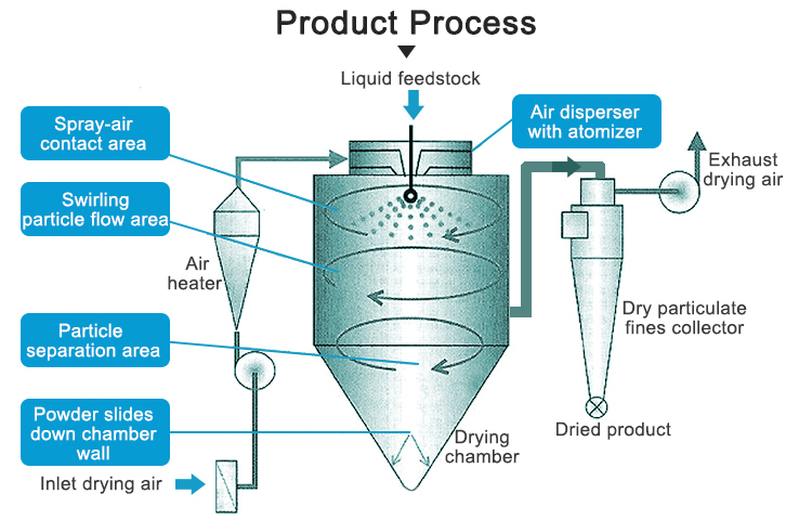
The following flowchart demonstrates the different phases of the spray drying process:
Raw Material (Liquid Feed)
│
▼
Feed Preparation Tank
(dissolving, mixing, filtering)
│
▼
Feed Pump / Atomizer
(converts liquid into fine droplets)
│
▼
Hot Air Supply System
(air heater + air distributor to chamber)
│
▼
Drying Chamber (main operation)
(droplets contact hot air → evaporation)
│
▼
Separation of Dried Particles
(cyclone separator/bag filter/scrubber)
┌────────┴─────────┐
▼ ▼
Collected Dry Powder Exhaust Air
(final product) (with fines removed)
Applications of Spray Drying across different industries and its benefits are summarized in the following table:
|
Industry |
Applications |
Key Benefits |
|
Pharmaceutical |
Drugs, antibiotics, enzymes, probiotics |
Stable, uniform powders; fast reconstitution |
|
Food & Beverages |
Milk, coffee, tea, flavors, protein, baby formula |
Retains nutrients & flavor; soluble & convenient |
|
Chemical |
Detergents, dyes, catalysts, polymers, pigments |
Uniform, dust-free powders; efficient production |
|
Biotechnology |
Proteins, enzymes, vaccines, probiotics |
Preserves bioactivity; sterile powders |
|
Cosmetics & Personal Care |
Extracts, fragrances, active ingredients |
Stable powders; easy blending; long shelf-life |
|
Waste Management |
Effluents, waste slurry, by-products |
Reduces waste; recovers materials; eco-friendly |

7 Common Problems with Spray Dryers and How to Resolve Them
Factors such as improper operations, inadequate maintenance, inefficient atomization, and equipment limitations introduce challenges during the production process. These challenges and problems affect the production schedule and lead to subpar product quality. Let's understand what these problems are and how you can either resolve or prevent them:
1. Cross-product Contamination
This is commonly seen in production lines where multiple products are processed sequentially. The powder from one product is carried to another product through the air, reducing the product quality. Another prominent reason for the contamination issue is inadequate cleaning of the drying equipment. This results in residue accumulation, which then gets mixed with the next product batch.
How to Prevent:
Clean the spray drying equipment vessel after each batch and sterilize the equipment using appropriate abrasion-free chemicals.
In facilities with multiple products, ensure that the final product is stored in well-sealed containers. This will prevent the powder from escaping into the air.
2. Inferior Results after Upscaling Production
Reproducing lab results in commercial production requires meticulous planning and the necessary equipment. Additionally, factors such as temperature control and atomization pose significant challenges at larger-scale production. This problem typically arises due to inefficient pilot plant production and low-quality drying equipment.
How to Resolve:
First and foremost, collect sufficient data regarding the critical production parameters, including temperature, nozzle type, feed rate, viscosity, and other relevant factors.
Instead of jumping straight to commercial production, try intermediate pilot-plant production.
3. Mismatched Atomization Type
Atomization is a crucial part of the spray drying process. It determines the discharge speed of the liquid slurry for drying and also controls the droplet size. Therefore, choosing the wrong type of atomization nozzle can lead to uneven particle size and increase the deposition of the slurry on the walls.
How to Prevent:
Select the suitable type of atomization nozzle based on the slurry's viscosity, solid content, particle size requirements, chamber design, and feed rate.
Achieve Chem's professional consultation and guidance can help you with selecting the correct atomization type, along with other crucial factors.
4. Large Agglomerates in the Final Powder
The presence of large particle agglomerates significantly reduces product quality and stability. High moisture conditions, low temperatures, and imprecise equipment design contribute to this issue.
How to Prevent:
Select the temperature condition according to the product type and its viscosity.
Optimize the atomization process
Closely monitor the inlet and outlet temperatures
5. Moisture Residue in the Final Product
Incomplete drying and inefficiency during the process result in increased moisture content in the final product. As a result, the whole process will be repeated, thereby increasing the overall energy consumption.
How to Avoid:
Maintain the right airflow
Make sure the inlet temperature is high enough to vaporize the water droplets
Keep the slurry mist inside the drying chamber for an adequate amount of time, depending on the feed properties
Interested in learning Spray Dryer for your Lab?[Send an Inquiry now]
Professional Guidance for Spray Dryer Installation by Achieve Chem
Experiencing problems and challenges during production is quite common among industrial manufacturers. At Achieve Chem (Rich Smart Tech), we cover every production aspect, whether it is a pre-purchase consultation, manufacturing supreme quality equipment, or providing installation guidance. As the leading spray drying manufacturer, we have provided solutions to different industrial manufacturers.

Want to exceed your production capacity and yield quality? Contact us!
FAQs
Q.1: What are the key components of spray drying equipment?
A: The following list contains all the major components of spray drying equipment:
Feed Pump / Supply System – Delivers the liquid feed at a controlled rate.
Atomizer – Converts liquid feed into fine droplets or mist for efficient drying.
Drying Chamber – Provides a heated environment for rapid evaporation of moisture.
Hot Air Inlet – Supplies hot air for drying the droplets.
Bag Filter/Exhaust System – Collects remaining powder and prevents dust emissions.
Powder Collector – Stores the final dried product.
Control Panel – Monitors temperature, airflow, feed rate, and pressure for consistent operation.
Q.2: What is the role of a Pilot-scale Spray Dryer in the upscaling process?
A: Pilot-scale dryers allow you to test whether the product quality can be reproduced at a larger scale. They are an intermediate step between lab production and commercial production. Consequently, they allow you to test larger-scale production without higher investments and taking risks.
Q.3: What are the benefits of spray drying over drying techniques?
A: Spray drying is considered faster, safer, and more efficient than most drying techniques. Here are the reasons behind this:
Rapid Drying – Quickly converts liquid feed into dry powder.
Uniform Particle Size – Produces consistent, fine powders.
Better Product Stability – Minimizes thermal degradation for heat-sensitive materials.
Scalable Production – Suitable for both small and large-scale manufacturing.
Controlled Moisture Content – Produces powders with low, uniform moisture.
Hygienic and Contamination-Controlled – Closed system reduces microbial contamination.
Q.4: Why should I choose customized spray dryers?
A: Customized drying equipment is optimized for your particular production requirements. As a result, not only can you achieve the desired yield results, but you can also do it with lower energy consumption.
Achieve Chem's proficient R&D team and the cutting-edge manufacturing facilities offer you customized spray drying equipment. As a result, you will be able to enhance your production capacity and also achieve unmatched product quality.