


How To Improve The Evaporation Efficiency Of Rotary Evaporators?
Dec 01, 2023
Leave a message
Rotating evaporator is a commonly used equipment in the laboratory, mainly used for efficiently and quickly concentrating solutions or recovering organic solvents. It rotates the evaporator bottle to form a thin film of the solution inside the evaporator, thereby increasing the evaporation area and improving the evaporation efficiency. Mainly composed of heating device, rotating device, condenser, vacuum pump, etc. The working principle is to use a heating device to heat the evaporation bottle in the rotating device, so that the solution forms a thin film in the evaporation bottle and increases the evaporation area. Meanwhile, the negative pressure generated by the vacuum pump will accelerate the evaporation rate of the solvent. The evaporated solvent will be condensed and collected by the condenser. Rotation speed is one of the key factors affecting the evaporation efficiency of a rotary evaporator. Properly increasing the rotational speed can increase the flow rate of the solution in the evaporator, thereby increasing the evaporation area and efficiency of the solvent. However, too fast rotation speed may cause liquid splashing or produce too much foam, affecting the evaporation effect. Therefore, it is necessary to choose the appropriate rotation speed based on experimental requirements and actual situations.
(Product link: https://www.achievechem.com/rotary-evaporator)
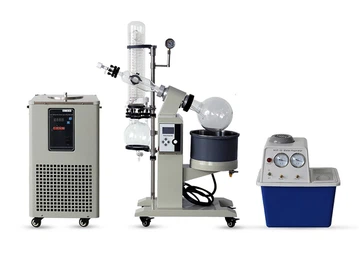
Rotating evaporator is a commonly used laboratory equipment for efficiently and quickly concentrating solutions or recovering organic solvents. Improving the evaporation efficiency of the rotary evaporator is helpful for the smooth progress of the experimental process and the accurate acquisition of experimental results. Here are some methods to improve the evaporation efficiency of rotary evaporators:
1. Choose the appropriate solvent:
Choosing the appropriate solvent is one of the key steps to improve the evaporation efficiency of rotary evaporators. In the experimental process, the selection of solvents needs to be based on the principle of similar solubility, that is, selecting a solvent with similar physical properties to the target solvent as the rotor material. This can make the solvent easier to penetrate and diffuse during the evaporation process, thereby increasing the evaporation area and efficiency.
In addition to considering the principle of similar solubility, it is also necessary to consider factors such as the boiling point, vapor pressure, and stability of the solvent. The boiling point of a solvent is one of the important factors in the evaporation process. Choosing a solvent with a lower boiling point can shorten the evaporation time and improve the evaporation efficiency. However, a low boiling point may make it difficult for the solvent to evaporate completely, while a high boiling point may cause the solvent to decompose or produce too much foam during evaporation. Therefore, it is necessary to choose an appropriate solvent boiling point based on experimental requirements and actual conditions.
Steam pressure is also one of the factors affecting evaporation efficiency. High vapor pressure means that solvents are more likely to evaporate, but it may also result in significant solvent loss during the evaporation process. Therefore, it is necessary to choose a solvent with appropriate vapor pressure to balance the relationship between evaporation efficiency and solvent loss.
Finally, the stability of the solvent is also a factor to consider. Some solvents may decompose or deteriorate when exposed to high temperatures or air, which can affect the accuracy of experimental results. Therefore, it is necessary to choose a solvent with good stability to ensure the smooth progress of the experimental process.
2. Adjust rotation speed:
Adjusting the rotation speed is a crucial step in the operation of a rotary evaporator, as it directly affects the evaporation efficiency of the evaporator. The increase in rotational speed can increase the flow rate of the solution in the evaporator, thereby increasing the evaporation area of the solvent and improving the evaporation efficiency.
 As the rotational speed increases, the movement of the solution in the evaporator becomes more active, and the contact between the liquid and the heating surface becomes more frequent and sufficient, which helps to accelerate the evaporation of the solvent. Meanwhile, as the rotational speed increases, the liquid film formed by the solution in the evaporator becomes more uniform, further improving the evaporation efficiency.
However, the increase in rotational speed is not without limitations. Too fast rotation speed may cause liquid splashing or excessive foam. Liquid splashing may pollute the equipment and reduce the thermal efficiency of the equipment, while too much foam may block the condenser and affect the condensation effect.
Therefore, when adjusting the rotation speed, it is necessary to choose the appropriate rotation speed based on the experimental requirements and actual situation. For some experiments that require the retention of active ingredients, too fast a rotation speed may cause the active ingredients to be destroyed, so it is necessary to choose a lower rotation speed. For some experiments that require rapid evaporation, a higher rotational speed can be chosen to improve efficiency.
3. Control heating temperature: Heating temperature also has a significant impact on the evaporation efficiency of rotary evaporators. Properly increasing the heating temperature can increase the evaporation rate of solvent, but too high heating temperature may lead to solvent decomposition or excessive foam. Therefore, it is necessary to choose an appropriate heating temperature based on experimental requirements and actual conditions.
4. Optimizing rotor design: The design of the rotor also has a significant impact on the evaporation efficiency of the rotary evaporator. Optimizing the structure of the rotor, such as increasing the evaporation area on the rotor surface, changing the shape of the rotor, etc., can significantly improve the evaporation efficiency. In addition, selecting suitable rotor materials and surface treatment methods can also enhance heat transfer performance and prevent solution adhesion.
5. Control air flow rate: The air flow rate has a certain impact on the evaporation efficiency of the rotary evaporator. Properly increasing the air flow rate can increase the speed of solvent evaporation, but too fast the air flow rate may cause liquid splash or produce too much foam. Therefore, it is necessary to choose the appropriate air flow rate based on experimental requirements and actual conditions.
6. Regular cleaning and maintenance: Regular cleaning and maintenance of rotary evaporators can maintain the equipment in good condition and improve evaporation efficiency. Regular cleaning of the rotor surface, inspection of sealing rings for wear, and replacement of damaged components can help maintain the performance and efficiency of the equipment.
7. Using a vacuum system: Equipping a vacuum system on a rotary evaporator can help reduce the boiling point of the solvent, thereby improving evaporation efficiency. By generating negative pressure, solvents can boil and evaporate rapidly at lower temperatures. This can not only reduce energy consumption, but also accelerate evaporation rate and improve recovery rate.

8. Optimizing the experimental operation process: A reasonable experimental operation process is also one of the key factors to improve the evaporation efficiency of the rotary evaporator. During the experiment, the correct operating sequence and standards should be followed to avoid unnecessary operational errors. In addition, an appropriate amount of zeolite or anhydrous sodium sulfate can be added as needed to promote stable evaporation of the solvent.
9. Other auxiliary measures can be adopted: In addition to the above methods, other auxiliary measures can also be used to improve the evaporation efficiency of the rotary evaporator. For example, measures such as using magnetic or mechanical stirring to increase the uniformity and stability of the solution, using a condenser to collect evaporated solvents, and using desiccants to remove moisture from the equipment can all help improve the performance and efficiency of the equipment.
In summary, improving the evaporation efficiency of rotary evaporators requires comprehensive consideration of multiple factors. By selecting appropriate solvents, adjusting rotation speed and heating temperature, optimizing rotor design, controlling air flow rate, regularly cleaning and maintaining equipment, and adopting other auxiliary measures, the evaporation efficiency of the rotary evaporator can be significantly improved, thereby better meeting experimental requirements and obtaining accurate experimental results.