


How Does A Rotary Evaporator Work? | Principle & Applications
Jul 13, 2024
Leave a message
How Does a Rotary Evaporator Work? – Full Working Principle & Guide
A rotary evaporator, commonly known as a rotovap, stands as an indispensable tool in laboratory settings, revered for its ability to effectively extract solvents from samples. This sophisticated instrument operates through precise mechanisms that ensure optimal solvent removal while preserving sample integrity. By utilizing a combination of rotational motion, controlled heating in a water or oil bath, and a vacuum system, rotary evaporators enable researchers to concentrate, purify, and isolate compounds with high efficiency and accuracy. This article delves into its functioning, exploring key mechanisms and applications.

What Is a Rotary Evaporator?
A rotary evaporator is a device that uses rotation, heating, and vacuum to lower the boiling point of solvents, allowing them to evaporate at much lower temperatures than under normal pressure. This makes it ideal for concentration, purification, solvent recovery, and sample preparation.
It is widely used in organic chemistry, pharmaceutical R&D, essential oil extraction, food testing, environmental analysis, and material science.
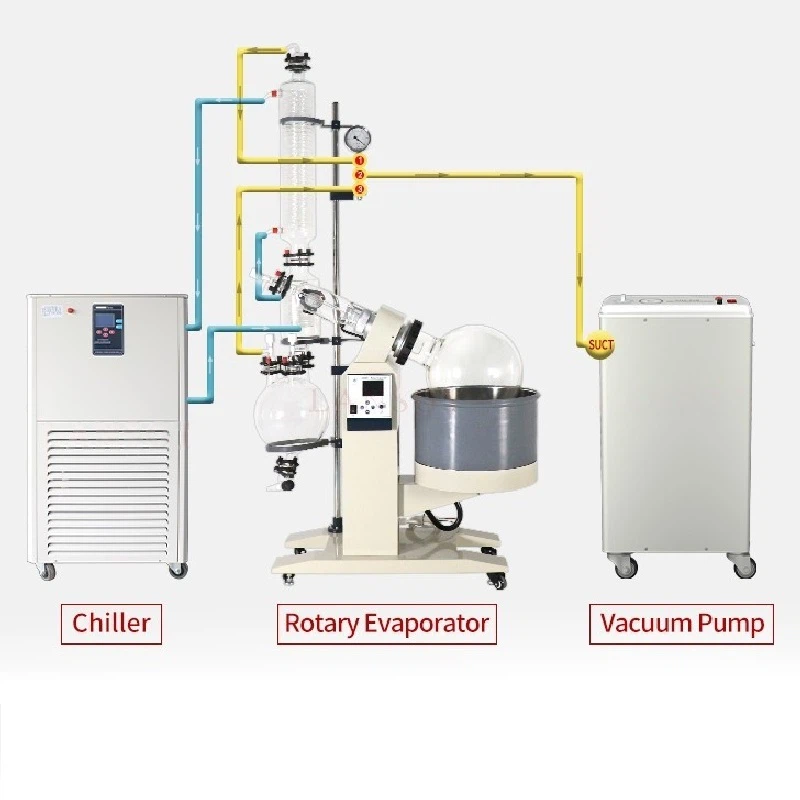
Key Components of a Rotary Evaporator
A rotary evaporator is a sophisticated piece of laboratory equipment designed for solvent removal under reduced pressure conditions. It consists of several crucial components, each contributing to its efficient operation and safety:

Interested in one rotary evaporator for your lab/factory?[Check the specification now]
Rotating Flask
The heart of the rotary evaporator, the rotating flask holds the sample to be evaporated. It is typically made of glass to withstand the rigors of chemical reactions and is capable of rotating smoothly to enhance solvent evaporation.
Water or Oil Bath
Surrounding the rotating flask is a temperature-controlled bath, either filled with water or oil. This bath provides uniform heating to the flask, promoting even distribution of heat throughout the sample. The choice between water and oil baths depends on the required temperature range and the solvent properties.
Condenser Unit
Positioned above the rotating flask, the condenser unit is crucial for converting evaporated solvents from vapor back into liquid form. It achieves this by cooling the vapor using either air or a coolant circulating within the condenser. The condensed liquid collects in a separate flask, ready for further processing or analysis.
Vacuum Pump
Essential for creating the reduced pressure environment inside the rotary evaporator, the vacuum pump lowers the boiling point of the solvent, facilitating faster evaporation. It removes evaporated solvents from the system, maintaining efficient operation throughout the evaporation process.
Cooling System
To prevent overheating and ensure optimal performance, rotary evaporators are equipped with a cooling system. This system may involve a circulating chiller that cools the condenser and the solvent collection flask, maintaining them at the desired temperature levels.

Each of these components plays a pivotal role in the functionality of the rotary evaporator, ensuring precise control over solvent evaporation and maintaining the integrity of the samples being processed. Together, they enable efficient solvent recovery, purification of compounds, and concentration of samples, making rotary evaporators indispensable in various scientific and industrial applications.
How Does the Evaporation Process Work in a Rotary Evaporator?
The evaporation process in a rotary evaporator is a meticulously controlled sequence of operations designed to efficiently remove solvents from samples while preserving their integrity. This process unfolds through several well-defined steps:
![Rotary evaporator working process flow]](/uploads/40193/news/p202603311506393e52c.png?size=700x0 "Rotary evaporator working process flow]")
Interested in one rotary evaporator for your lab/factory?[Ask Engineer now]
Sample Placement
The process begins with the placement of the sample into a rotating flask, typically made of glass to withstand chemical reactions and facilitate uniform heat distribution.
Heated Bath Immersion
The rotating flask is partially immersed in a temperature-controlled bath filled with either water or oil. This bath provides consistent heating to the sample, ensuring even evaporation of the solvent.
Rotation and Evaporation
As the flask rotates at a controlled speed, the solvent begins to evaporate due to the combined effect of heat from the bath and reduced pressure inside the system created by the vacuum pump. The rotation facilitates the spreading of the sample across the inner surface of the flask, maximizing the exposure of the solvent to heat and vacuum.
Creation of Reduced Pressure
The vacuum pump plays a crucial role in creating a reduced pressure environment within the rotary evaporator. By lowering the pressure, the boiling point of the solvent decreases, allowing it to evaporate at lower temperatures without affecting the sample's integrity.
Condensation
The evaporated solvent vapor rises and enters the condenser unit located above the rotating flask. Here, the vapor is cooled either by circulating coolant or air, causing it to condense back into liquid form. This condensed liquid collects in a separate receiving flask, ready for further processing or analysis.
Solvent Recovery and Collection
The efficiency of the condensation process ensures that the recovered solvent is of high purity and concentration, making rotary evaporators ideal for applications requiring precise solvent recovery and sample concentration.
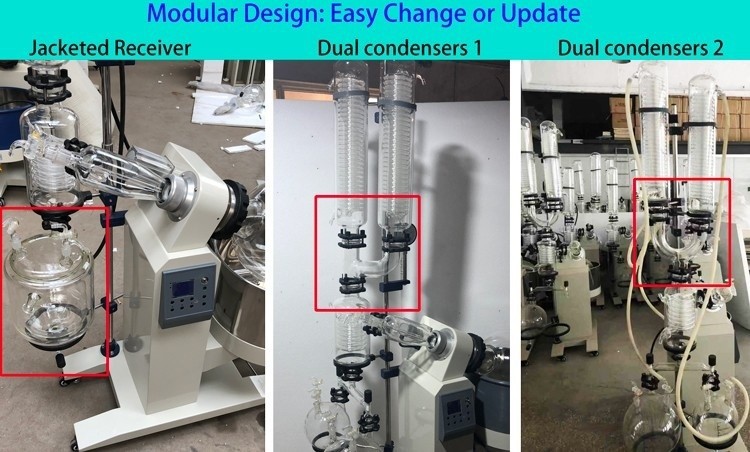
This methodical approach to solvent evaporation in rotary evaporators not only enhances efficiency but also minimizes the risk of sample degradation. It is particularly advantageous in research and industrial settings where maintaining sample purity and concentration is critical.
Interested in one rotary evaporator for your lab/factory?[Ask Engineer now]
Main Applications of Rotary Evaporators
Rotary evaporators are versatile instruments widely employed across diverse industries and research fields due to their ability to efficiently handle solvent evaporation tasks while offering several key benefits:
Applications
Organic Chemistry Laboratories:
Rotary evaporators are essential tools in organic chemistry labs for various applications such as solvent recovery, purification of organic compounds, and concentration of samples. They facilitate the removal of solvents from reaction mixtures, enabling researchers to isolate and analyze pure substances effectively.
Pharmaceutical Industry:
In pharmaceutical research and development, rotary evaporators play a crucial role in drug formulation and analysis. They are used to concentrate and purify active pharmaceutical ingredients (APIs), extract natural products for drug synthesis, and prepare samples for pharmacological testing. This enhances the efficiency and precision of drug development processes.
Environmental Testing:
Rotary evaporators are employed in environmental laboratories for analyzing pollutants and contaminants in air, water, and soil samples. They enable the extraction and concentration of analytes from complex matrices, facilitating accurate detection and quantification of environmental pollutants. This is vital for environmental monitoring and regulatory compliance efforts.
Food Analysis and Processing:
In the food industry, rotary evaporators are utilized for extracting and concentrating flavors, fragrances, and active compounds from natural sources. They help in developing food additives, enhancing food quality, and ensuring product safety by removing residual solvents. Additionally, rotary evaporators are used in research settings to study food composition and improve extraction techniques.
Advantages of Using a Rotary Evaporator
Enhanced Efficiency:
Rotary evaporators offer significant time savings and operational efficiency compared to traditional evaporation methods. Their ability to operate under vacuum reduces solvent evaporation temperatures, speeding up the process without compromising sample integrity.
01
Reduced Solvent Consumption:
By operating under vacuum conditions, rotary evaporators minimize solvent loss during evaporation. This not only conserves expensive solvents but also reduces environmental impact and lowers operational costs.
02
Precision and Safety:
Rotary evaporators allow for precise control over temperature and vacuum levels, ensuring gentle and controlled solvent evaporation. This is particularly advantageous when handling sensitive or volatile compounds that may degrade under harsh conditions.
03
Versatility:
The adaptability of rotary evaporators to different sample types and sizes makes them versatile instruments in research and industrial settings. They can accommodate a wide range of applications, from routine laboratory procedures to complex extraction processes, supporting innovation and discovery in various scientific disciplines.
04
Interested in one rotary evaporator for your lab/factory?[Check the specification now]
FAQs About Rotary Evaporators
Q1: What is the difference between a rotary evaporator and a regular evaporator?
A: A rotary evaporator uses vacuum and rotation to evaporate solvents at low temperatures, while common evaporators use high heat that can damage samples.
Q2: What types of solvents can a rotovap remove?
A: It can remove ethanol, methanol, ethyl acetate, water, dichloromethane, and most lab solvents.
Q3: Is a vacuum pump necessary for a rotary evaporator?
A: Yes. Vacuum lowers boiling points and enables efficient, gentle evaporation.
Q4: Can I use a rotary evaporator for essential oil extraction?
A: Yes, it is widely used for extracting and concentrating plant essential oils.
Q5: What safety tips should I follow when using a rotovap?
A: Check seals, avoid overloading flasks, control temperature and vacuum steadily, and use proper cooling.
Conclusion
Understanding how a rotary evaporator works helps you use it more efficiently, choose the right model, and improve experimental accuracy.From component structure to working steps and real‑world applications, the rotovap remains a cornerstone of modern laboratory work.

If you are looking for a high‑efficiency, durable, and cost‑effective rotary evaporator for your lab or production line, feel free to contact us for professional models and customized solutions.
References
1. "Principles and Applications of Rotary Evaporation" - American Chemical Society
2. "Rotary Evaporator: Technique, Mechanism, and Applications" - ResearchGate
3. "Fundamentals and Applications of Rotary Evaporation" - Wiley Online Library
4. "Introduction to Rotary Evaporators" - Lab Manager
5. "Rotary Evaporators: How They Work and Their Applications" - Sciencing