


Can Methanol Be Rotovapped?
Apr 13, 2024
Leave a message
Yes, methanol can be evacuated utilizing a rotating evaporator, commonly alluded to as a rotovap. A revolving evaporator is a research facility device utilized to evacuate solvents from arrangements through dissipation beneath diminished weight and controlled temperature. Methanol, being a unstable dissolvable with a generally moo bubbling point (64.7°C or 148.5°F), can be effectively vanished and evacuated from a arrangement utilizing a rotovap.

Preparation of Arrangement
The arrangement containing methanol is put in a round-bottomed carafe, which is at that point joined to the rotating evaporator.
Application of Vacuum
The framework is fixed, and a vacuum pump is utilized to diminish the weight interior the jar. This brings down the bubbling point of the methanol, permitting it to vanish at a lower temperature.

Heating
The arrangement in the jar is tenderly warmed, either with a water shower or a warming mantle, to increment the rate of vanishing. The temperature is carefully controlled to anticipate overheating or debasement of the test.

Condensation
As methanol evaporates from the solution, it rises into the condenser, where it is cooled and condensed back into liquid form. The condensed methanol is collected in a separate receiving flask.
Collection of Residue: The remaining solution in the round-bottomed flask, now depleted of methanol, is concentrated as the solvent is removed. The desired solute or product may be left behind in the flask.
Cleaning and Storage: After the process is complete, the apparatus is disassembled, and the collected methanol can be properly disposed of or reused if desired. The apparatus is cleaned and stored for future use.

Understanding Rotary Evaporation
Rotary evaporation, often referred to as rotovap or rotavap, is a widely used technique in laboratories and industries for the removal of solvents from liquid samples. It is based on the principle of evaporation under reduced pressure and controlled temperature to efficiently and selectively separate solvents from the desired compounds. Here's a breakdown of how rotary evaporation works:
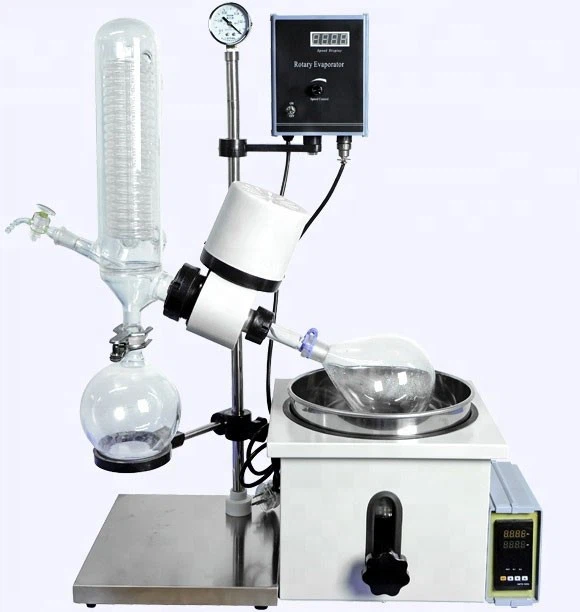
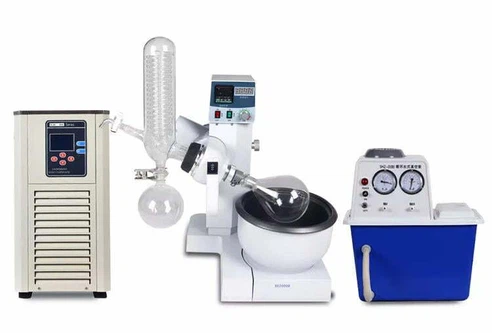
Setup: A rotary evaporator consists of several key components:
Rotating Flask: This is the vessel where the liquid sample, containing the solvent to be removed, is placed. It is typically a round-bottomed flask that can be rotated to enhance evaporation.
Water or Oil Bath: The flask sits in a heated water or oil bath, providing gentle and uniform heating to the sample.
Rotating Evaporating Flask: The entire flask assembly, including the sample, is rotated to increase the exposed surface area and facilitate evaporation.
Condenser: A condenser is attached to the flask to cool and condense the evaporated solvent back into liquid form. It prevents solvent vapors from escaping into the atmosphere.
Vacuum Pump: A vacuum pump is used to lower the pressure inside the system, reducing the boiling point of the solvent and accelerating evaporation.
Application of Vacuum: The system is sealed, and the vacuum pump is turned on to create a vacuum inside the flask. This reduces the pressure, lowering the boiling point of the solvent. For example, at reduced pressure, the boiling point of water decreases from 100°C (212°F) at standard atmospheric pressure to lower temperatures.
Heating: The water or oil bath is heated to a temperature slightly below the boiling point of the solvent. The gentle heating ensures that the sample evaporates slowly and uniformly without overheating or degradation of the desired compounds.
Evaporation: As the sample is heated and the pressure is reduced, the solvent begins to evaporate from the liquid mixture. The rotating flask enhances the surface area exposed to the vacuum, promoting efficient evaporation.
Condensation: The evaporated solvent vapor rises into the condenser, where it is cooled and condensed back into liquid form. The condensed solvent collects in a separate flask, known as the receiving flask.
Collection of Residue: The remaining sample in the rotating flask, now depleted of the solvent, becomes more concentrated as evaporation progresses. The desired compounds or products may be left behind in the flask for further processing or analysis.
Monitoring and Control: Throughout the process, parameters such as temperature, vacuum level, and rotation speed are monitored and adjusted as needed to optimize efficiency and ensure the safety of the operation.
Cleanup and Maintenance: Once evaporation is complete, the apparatus is disassembled, and the collected solvent can be properly disposed of or reused. The components of the rotary evaporator are cleaned and maintained for future use.
The Suitability of Methanol for Rotary Evaporatio
Methanol, a polar solvent with a relatively low boiling point of 64.7°C, presents an intriguing case for rotary evaporation. Its favorable properties, such as high volatility and miscibility with water and many organic solvents, make it an attractive candidate for solvent removal processes. However, certain factors warrant consideration before subjecting methanol to rotovapping.
Safety Considerations
One of the primary concerns associated with methanol is its toxicity. Exposure to methanol vapors or ingestion of even small quantities can lead to severe health consequences, including blindness and neurological damage. Therefore, stringent safety measures must be implemented when handling methanol in the laboratory setting. Adequate ventilation, personal protective equipment (PPE), and adherence to established safety protocols are indispensable to mitigate the risks associated with methanol exposure.
Practical Considerations in Rotovapping Methanol
Despite its toxicity, methanol can indeed be subjected to rotary evaporation under appropriate conditions. However, certain practical considerations must be taken into account to ensure the efficacy and safety of the process. Firstly, it is advisable to conduct rotovapping of methanol in a fume hood or a well-ventilated area to minimize exposure to vapors. Additionally, using a rotary evaporator equipped with a vacuum pump capable of generating the necessary vacuum levels is essential for efficient solvent removal. Moreover, monitoring the evaporation process closely and controlling parameters such as temperature and vacuum level is crucial to prevent bumping or excessive foaming, which may compromise the integrity of the experiment.
Applications of Methanol Rotovapping in the Laboratory
Despite its challenges, rotovapping of methanol finds diverse applications in laboratory settings. From the concentration of botanical extracts and natural products to the purification of synthesized compounds, methanol rotary evaporation offers a versatile and efficient means of solvent removal. Furthermore, the compatibility of methanol with various analytical techniques, such as chromatography and spectroscopy, further enhances its utility in laboratory research.

Conclusion
In conclusion, while methanol poses inherent safety concerns due to its toxicity, it can indeed undergo rotary evaporation under controlled conditions. By adhering to stringent safety protocols and employing appropriate equipment and techniques, researchers can harness the benefits of methanol rotary evaporation in various laboratory applications. However, caution must be exercised to mitigate the associated risks and ensure the safety of personnel. With careful consideration and prudent practices, methanol rotovapping remains a valuable tool in the arsenal of laboratory chemists.
References:
"Methanol Safety Data Sheet." Sigma-Aldrich. [https://www.sigmaaldrich.com/catalog/product/sial/34860?lang=en®ion=US]
Jochum, Thomas et al. "Safe use of methanol in academia." Analytical and Bioanalytical Chemistry, vol. 409, no. 25, 2017, pp. 5919-5920. [https://doi.org/10.1007/s00216-017-0489-2]
Kruve, Anneli et al. "Tutorial Review on Validation of Liquid Chromatography–Mass Spectrometry Methods: Part I." Analytica Chimica Acta, vol. 870, 2015, pp. 29-44. [https://doi.org/10.1016/j.aca.2015.02.019]