



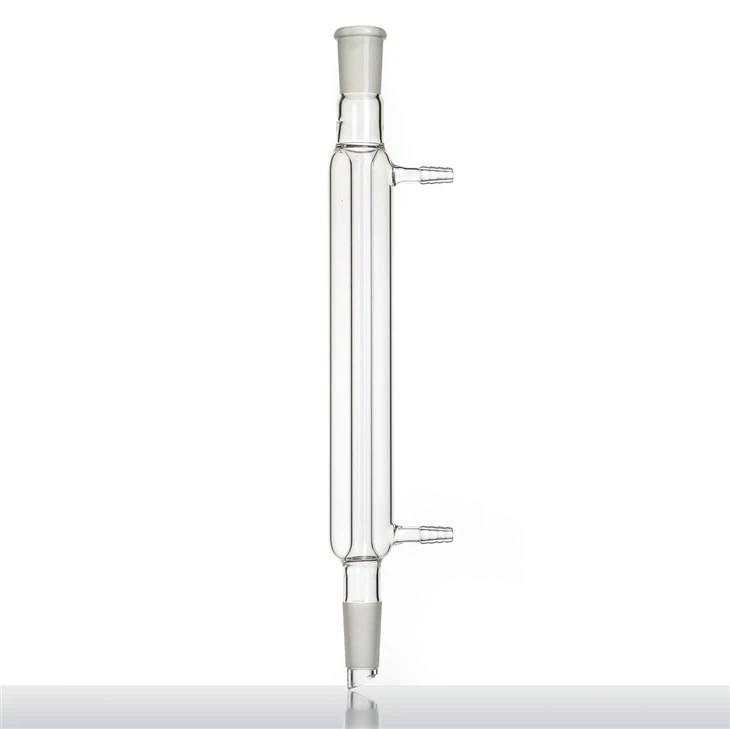


Straight Condenser
(1)150mm/200mm/300mm/400mm/500mm/600mm---19*2
(2)200mm/300mm/400mm/500mm/600mm---24*2
(3)400mm/500mm/600mm---29*2
2. Allihn Condenser
(1)150mm/200mm/300mm/400mm/500mm/600mm---19*2
(2)200mm/300mm/400mm/500mm/600mm---24*2
(3)500mm/600mm---29*2
3. Graham Condenser:
(1)150mm/200mm/300mm/400mm/500mm/600mm---19*2
(2)200mm/300mm/400mm/500mm/600mm---24*2
(3)500mm/600mm---29*2
***Price List for whole above, inquire us to get
Description
Technical Parameters
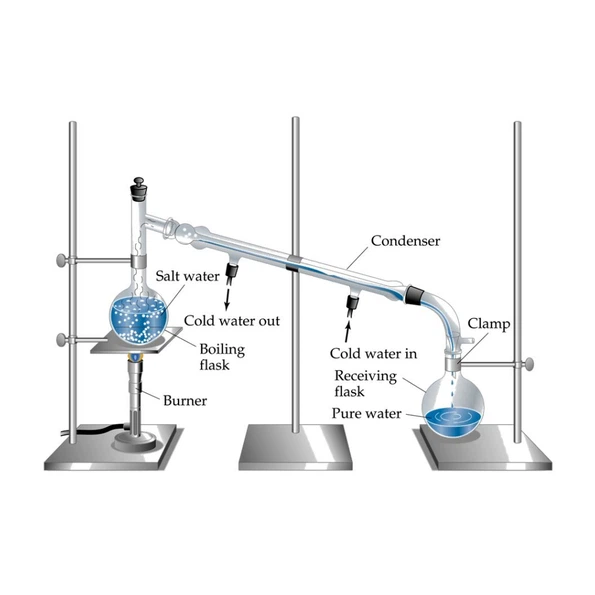
Straight condenser is a common heat exchange device used to cool and convert gases or vapors into liquids. It is usually composed of a set of pipes or bundles, with cooling medium flowing inside and in contact with the gas or steam to be cooled for heat transfer.
Product Advantages & Disadvantages
The design of chemical glass condensers is usually based on several important considerations, including cooling efficiency, fluidity, pressure, and temperature. Different types of condensers may have slight differences in structure and performance, such as the differences between straight condensers (such as spiral condensers) and indirect condensers (such as electronic condensers).
The straight cool condenser has some other advantages and disadvantages:

Advantages
◆ High design flexibility: The through condenser can be designed according to different process requirements, such as the material, length, diameter, quantity, etc. of the pipeline, which can be freely selected to adapt to different industrial applications.
◆ Space saving: Due to its straight layout, through condensers are usually more compact and occupy less space than other types of condensers, making them suitable for environments with limited space.
Disadvantages
◆ Direct through condensers also have some drawbacks, such as the need for complex designs and high-strength materials to ensure safety when handling high-pressure gases.
◆ In addition, when processing high-temperature gases, the direct condenser also needs to pay attention to the temperature and flow rate of the cooling medium to ensure effective heat transfer.
Product Design
Straight Condenser is a common heat exchange device with a wide range of application areas and advantages. During use, it is necessary to design and select according to specific process conditions and requirements to maximize its performance and efficiency.
When designing and selecting a through condenser, the following key factors need to be considered:
Cooling medium
Choosing a suitable cooling medium is very important. Common cooling media include water, air, refrigerant, etc. Select appropriate cooling media based on specific application requirements and process conditions to ensure effective heat exchange.
Temperature difference
Temperature difference is an important factor in heat transfer during the condensation process. A larger temperature difference can improve heat conduction efficiency, but it may also lead to an excessively high temperature rise in the cooling medium.
Flow rate
The flow rate of the cooling medium has a significant impact on the heat transfer efficiency. Higher flow rates can increase the surface area of heat conduction, thereby improving heat exchange efficiency. However, excessively high flow rates may increase the pressure drop and energy consumption of the system.
Material selection
Direct through condensers usually require the use of corrosion-resistant and high-temperature resistant materials to cope with different process conditions. Common materials include stainless steel, copper alloys, nickel alloys, etc.
Conclusion
In summary, straight condenser is a common heat exchange device that achieves heat transfer and condensation by contacting gas or steam with a cooling medium, cooling and converting gas or steam into liquid. It has important applications in various fields to improve energy efficiency and equipment performance. When designing and selecting, factors such as cooling medium, temperature difference, flow rate, material selection, and design parameters need to be considered.
In addition, in practical applications, maintenance and cleaning issues of the through condenser also need to be considered. Regular inspection and cleaning of the condenser can prevent problems such as pipeline blockage and corrosion, maintain its normal operation, and extend its service life.

The difference between a straight tube condenser and other condensers is mainly reflected in the following aspects:
Structure and shape
A straight tube condenser, as the name suggests, is mainly in the shape of a straight tube, with a cylindrical appearance.
However, other condensers, such as horizontal shell and tube condensers and plate condensers, have different shapes and structures from straight tube condensers. These condensers may have flat, rectangular or other specific design shapes to adapt to different application scenarios and installation requirements.
Installation and footprint
Due to its vertical installation characteristics, the straight tube condenser occupies a relatively small footprint and can save space.
In contrast, horizontal shell and tube condensers require horizontal installation and may occupy more ground area.
Cooling effect and heat transfer performance
Different types of condensers may have differences in heat transfer performance and cooling effect.
A straight tube condenser usually has a high heat transfer coefficient because it can ensure that cooling water flows at a higher flow rate inside the tube, thereby improving heat transfer efficiency.
However, the specific heat transfer performance also depends on the design, materials, and usage conditions of the condenser.
Requirements for water quality
Different types of condensers may have different requirements for the quality of cooling water.
For example, straight tube condensers have relatively low requirements for cooling water quality, while horizontal shell and tube condensers have higher requirements for water quality. This is because the cooling water of the horizontal shell and tube condenser flows in a countercurrent manner with the refrigerant inside the tube.
If the water quality is poor, it may lead to insufficient utilization of the heat transfer area or equipment corrosion.
Overall, there are differences between straight condenser and other condensers in terms of structure, installation, cooling effectiveness, maintenance, application areas, and water quality requirements. When selecting a condenser, it is necessary to consider the specific application scenario and requirements comprehensively.
There are also some noteworthy aspects of the straight tube condenser:
● Widely used
Due to its efficient and stable performance, straight tube condensers are widely used in various industrial fields, such as refrigeration, air conditioning, chemical industry, power, metallurgy, etc. In these fields, straight tube condensers can effectively control the temperature during the process, ensuring smooth production.
● Good pressure resistance performance
Straight tube condensers are usually made of metal materials and have high pressure resistance performance. This enables it to operate stably in high-pressure environments, meeting the needs of various complex processes.
● Good sealing performance
The design of the straight tube condenser focuses on sealing performance, which can effectively prevent medium leakage. This not only ensures the safe operation of the equipment, but also avoids environmental pollution and resource waste.
● Strong adaptability
The straight tube condenser can be customized according to actual needs, such as changing the size, increasing the number of tube passes, changing the material, etc. This enables it to adapt to different process requirements and working environments.
● Long term stable operation
The straight tube condenser has a long service life and stable performance. Under normal use, it can operate stably for a long time, reducing the frequency of equipment replacement and maintenance, and lowering production costs.
In summary, the straight tube condenser plays an important role in the industrial field due to its wide application, good pressure resistance and sealing performance, strong adaptability, long-term stable operation, and good compatibility with automation control systems.
At the same time, with the improvement of environmental awareness and continuous technological progress, the straight tube condenser will pay more attention to environmental protection, emission reduction, and performance optimization in future development.
Hot Tags: straight condenser, China straight condenser manufacturers, suppliers, factory, Teflon Autoclave, Rotary Distillation, High Pressure Chemical Reactor, High Pressure Reactor, Jacketed Lab Reactor, Double Jacketed Reactor
Previous
Allihn CondenserSend Inquiry


