



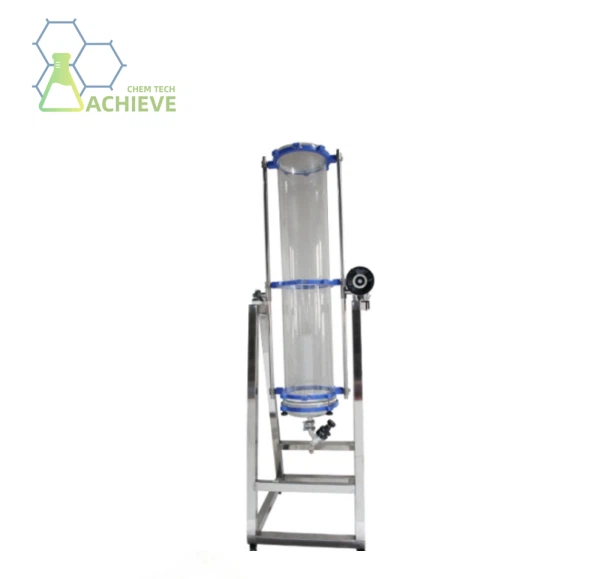


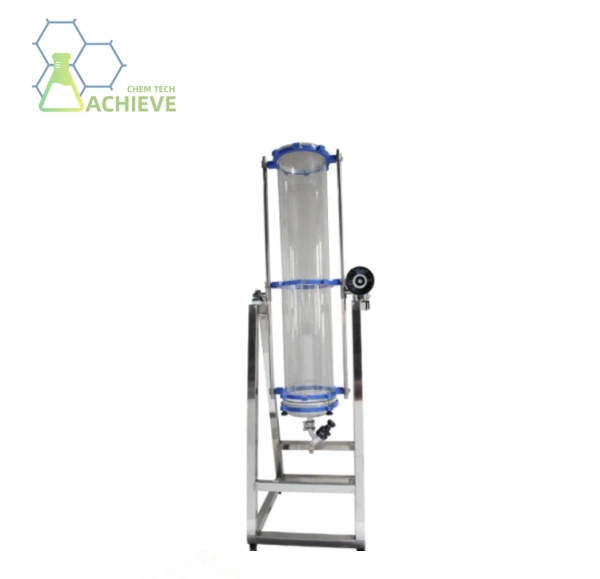
Spin Column Chromatography
2.Chromatographic Column (Rotation Type)
3.Chromatographic Column (Manual)
***Price List for whole above, inquire us to get
Description
Technical Parameters
Spin column chromatography, known as centrifugal column chromatography in Chinese, is an important separation technique in the field of biochemistry and molecular biology. The technique involves placing a small chromatography column in a centrifuge tube and utilizing centrifugal force instead of traditional gravity to achieve rapid chromatography of small amounts of samples. Centrifugal column chromatography is commonly used for applications such as gel filtration desalting and adsorption chromatography, and is particularly suited to the handling of micro-volume samples.
Parameter


In centrifugal column chromatography, the sample mixture is separated by centrifugal force through a stationary phase and a mobile phase within the chromatography column. The stationary phase is usually composed of adsorbents such as silica gel and alumina, while the mobile phase is a liquid solvent. Depending on the partition coefficients of the components in the sample between the stationary phase and the mobile phase, the speed of movement of the components within the column varies, thus realizing the separation of the components.
Centrifugal column chromatography is widely used in biochemistry and molecular biology because of its ease of operation, fast separation speed and low sample consumption. By selecting appropriate stationary and mobile phases and optimizing centrifugation conditions, centrifugal column chromatography can effectively separate and purify target compounds, providing high-quality samples for subsequent biochemical analyses and experiments.

Biochemistry and Molecular Biology
Nucleic acid extraction and purification:
DNA extraction: Efficient extraction of high quality genomic DNA from biological samples such as cells, tissues and blood.
RNA extraction: Extraction of total RNA or specific types of RNA, such as mRNA.
Plasmid DNA purification: purify plasmid DNA from bacterial cultures.
PCR product cleanup: Remove impurities such as primers, nucleotides and enzymes from PCR products.
Protein and peptide purification:
Using centrifugal column chromatography, the separation and purification of proteins can be achieved according to their physicochemical properties, such as size, charge and hydrophilicity.
It is particularly suitable for the purification of trace proteins, such as the extraction of target proteins from complex biological samples.
Removal of small molecules and carbohydrates:
During sample preparation, it is often necessary to remove small molecule impurities and carbohydrates to improve the purity and quality of the sample. Centrifugal column chromatography can effectively accomplish this goal.
Liquid Mass Spectrometry Sample Pre-treatment:
In liquid mass spectrometry analysis, the purity and concentration of the sample is critical to the analytical results. Centrifugal column chromatography can be used for the purification or pre-treatment of small volumes of samples (e.g., 10 μl to 150 μl) for liquid mass spectrometry to improve the purity of the sample and the accuracy of the analytical results.
Other applications:
Centrifugal column chromatography can also be used in experimental scenarios such as radiolabel removal, nick translation, affinity separation, desalting, and buffer replacement.
In addition, centrifugal column chromatography has been widely used in the biotechnology industry for the extraction and purification of biologically active ingredients in the development and production of biopharmaceuticals due to its ease of operation, fast separation speed and low sample consumption.
explanation of the purification process and its significance
Spin column chromatography plays a vital role in the purification of proteins and peptides.
Purification Process
Sample Preparation:
First, a mixture containing the target protein or peptide is extracted from the biological sample.
The sample may need to undergo some pre-treatment steps such as removal of impurities such as particulate matter, lipids and nucleic acids to improve the purification efficiency.
Centrifugal column selection and loading:
Select a suitable centrifugal column based on the physicochemical properties of the target protein or peptide. Stationary phases for centrifugal columns may include gels of different pore sizes, affinity ligands, or other types of adsorbents.
Load the stationary phase into the centrifugation column and ensure that it is evenly distributed.
Sample Loading and Centrifugation:
Load the pretreated sample onto the centrifuge column.
Centrifuge the column using a centrifuge to perform a centrifugation operation to pass the sample through the stationary phase under centrifugal force.
Elution and Collection:
The centrifugation column is eluted using an appropriate eluent to elute the target protein or peptide from the stationary phase.
Collect the eluate, which may contain high purity target proteins or peptides.
Further processing:
If desired, the collected eluate may be subjected to further processing, such as concentration, desalting, or buffer replacement.
Significance
Improved purity:
Centrifugal column chromatography effectively removes impurities from the sample, such as small molecules, other proteins, nucleic acids, etc., thereby increasing the purity of the target protein or peptide.
Fast and efficient:
Compared with the traditional chromatography technology, centrifugal column chromatography has the advantages of easy operation and fast separation speed. It can process a large number of samples in a short time, which is suitable for high-throughput screening and preparation work.
Sample saving:
Centrifugal column chromatography requires less sample volume and is suitable for the purification of trace samples. This is especially important for precious biological samples or hard-to-obtain proteins and peptides.
Protection of protein activity:
During centrifugal column chromatography, the activity of the target protein or peptide can be protected by selecting the appropriate stationary phase and elution conditions. This helps to maintain their biological function and structural integrity.
Applications in research and production:
Centrifugal column chromatography has a wide range of applications in biochemistry, molecular biology, biotechnology and other fields. It can be used not only for the purification of samples in scientific research experiments, but also for the extraction and purification of biologically active ingredients in the development and production of biological drugs.
The purity of protein is extremely important to biological research
In biological research, target proteins are usually mixed with a variety of other proteins and impurities. Removing these non-target components through the purification process can ensure the specificity and accuracy of subsequent experiments. High purity protein samples can reduce interfering factors in experiments, making the results more reliable.
Impurities may affect protein activity or cause protein degradation. The purification process removes these harmful substances, resulting in proteins with high biological activity. This is particularly important for drug discovery and biotechnology applications, as the activity of a protein directly determines its function and effect in the organism.
In biomedical research, it is often necessary to study the structure, function and interaction of specific proteins. High purity protein samples are the basis for these studies. Through the purification process, sufficient quantities and purities of target proteins can be obtained to meet these research needs. This is of great significance for revealing the regulatory mechanisms of proteins in organisms, the role of diseases in the process of disease development, and so on.
Advanced purification techniques have improved the yield and activity of proteins, promoting breakthroughs in medical research and industrial applications. Continuous improvements in purification methods enable more efficient, cost-effective and scalable production of high-quality proteins, driving innovation and discovery in a wide range of scientific fields. For example, in biopharmaceutical development, purifying proteins is a critical step in drug development and production. High purity protein drugs can reduce side effects and immune responses and improve drug safety and efficacy.
In addition to biomedical research, protein purity is also important in other application scenarios. For example, in environmental monitoring, protein-based biosensors can be used to detect pollutants; in the food and cosmetics industry, due to the risk of allergic reactions, the content of proteins and impurities must meet certain safety standards. These application scenarios also require high purity protein samples to ensure accuracy and reliability.
In summary, protein purity is extremely important for biological research. It is not only related to the specificity and accuracy of experiments, but also directly affects the biological activity and chemical integrity of proteins. Therefore, in biological research, the purification process of proteins must be emphasized to ensure the reliability and scientificity of experimental results.
Hot Tags: spin column chromatography, China spin column chromatography manufacturers, suppliers, factory, Hydrothermal Synthesis Autoclave Reactor, High Pressure Hydrogenation Reactor, Hydrothermal Reactor, Hydrothermal Synthesis Reactor, Jacketed Glass Reactor, Hydrothermal Autoclave Reactor
Previous
Guard Column In ChromatographySend Inquiry


