



Erlenmeyer Culture Flask
1) Narrow-mouth Bottle: 50ml~10000ml;
2) Big B Bottle: 50ml~3000ml;
3) Horn Mouth: 50ml~5000ml;
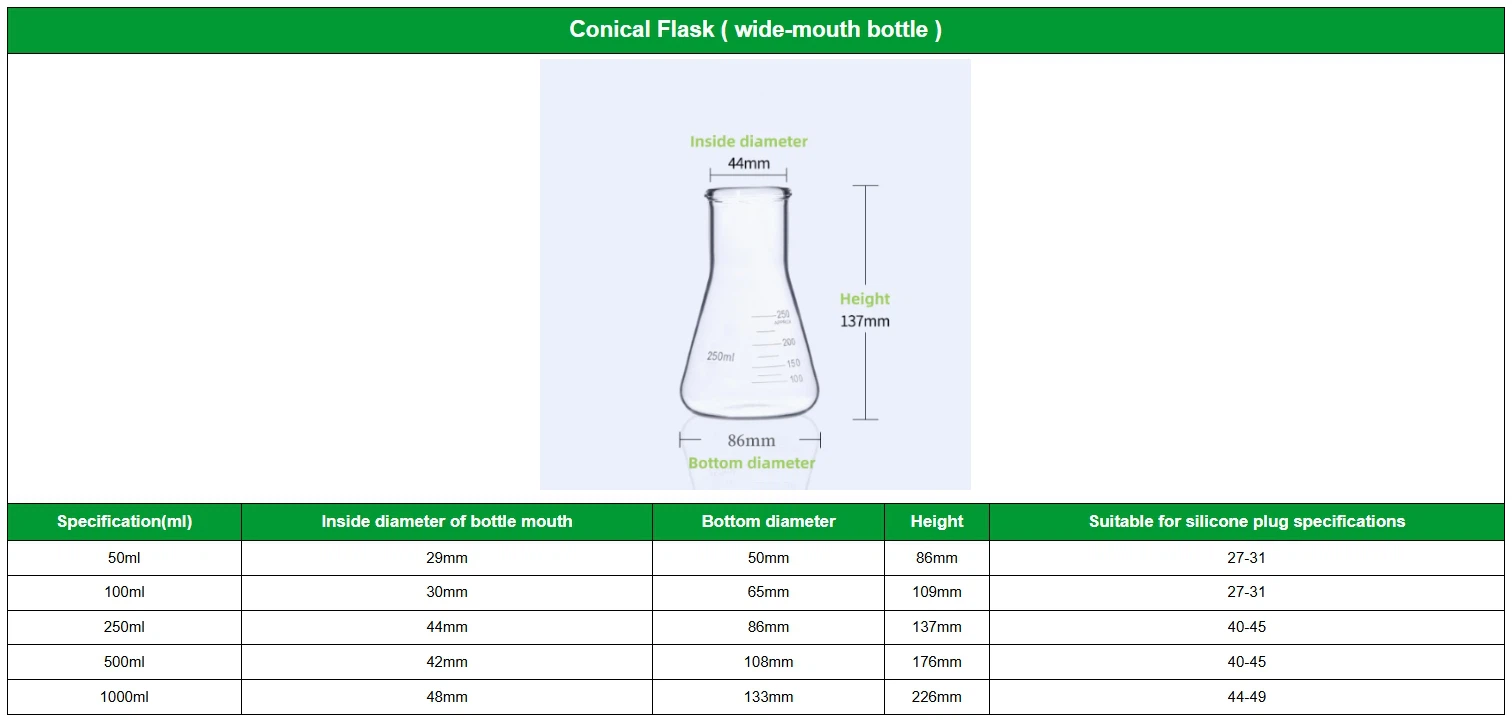
4) Wide-mouth Bottle: 50ml/100ml/250ml/500ml/1000ml;
5) Conical Flask With Cover: 50ml~1000ml;
6) Screw Conical Flask:
a. Black Lid (General Sets): 50ml~1000ml
b. Orange Lid (Thickening Type): 250ml~5000ml;
2. Single and Multi-mouth Round Bottom Flask:
1) Single Mouth Round Bottom Flask: 50ml~10000ml;
2) Inclined Three-mouth Flask: 100ml~10000ml;
3) Inclined Four-mouth Flask: 250ml~20000ml;
4) Straight Three-mouth Flask: 100ml~10000ml;
5) Straight Four-mouth Flask: 250ml~10000ml.
***Price List for whole above, inquire us to get
Description
Technical Parameters
Erlenmeyer culture flask are typically made of durable, low-extract materials such as polycarbonate (PC) and polypropylene copolymer (PPCO). These materials have a lower risk of breakage than glass and can remain intact even if bumps occur in the lab. Materials such as polycarbonate also have good optical clarity, which makes it easy to observe cell culture. Erlenmeyer culture bottles are usually sterile and ready-to-use, and are sterilized by irradiation to ensure sterility and prevent leakage.
Introduction

The Erlenmeyer culture flask, also known as the conical flask, is a ubiquitous piece of laboratory equipment that has played a pivotal role in various scientific disciplines, particularly in biology, chemistry, and microbiology.
Named after the German chemist Emil Erlenmeyer, who patented its design in 1861, this flask has become an indispensable tool for researchers worldwide due to its unique design and functionality.
The conical flask was granted a patent in 1861 and quickly gained popularity among scientists due to its practical design. Over time, the term "Erlenmeyer flask" became synonymous with the conical flask, a testament to its enduring legacy in scientific research.
We will delve into the history, design features, applications, and significance of the Erlenmeyer culture flask, exploring its impact on scientific research and education.
Design Features
The Erlenmeyer culture flask is characterized by several design features that contribute to its versatility and effectiveness.
● Conical Shape: The conical shape of the flask is its most distinctive feature. It allows for efficient mixing of contents during agitation, as the swirling motion created by stirring or shaking distributes the media evenly throughout the flask.
● Wide Base: The wide base provides stability, preventing the flask from tipping over during agitation or when placed on a shaker. This stability is crucial for maintaining sterile conditions and ensuring the safety of the experiment.
● Narrow Neck: The narrow neck of the flask minimizes the surface area exposed to the environment, reducing the risk of contamination. It also makes it easier to manipulate the flask, such as pouring media or transferring cultures, without spilling.
● Graduated Markings: Many Erlenmeyer flasks are graduated with volume markings, allowing for precise measurement of the media or culture. This feature is particularly useful in experiments that require precise control over the volume of reagents or samples.
● Borosilicate Glass: Most Erlenmeyer flasks are made from borosilicate glass, which is known for its high resistance to thermal shock and chemical corrosion. This durability ensures that the flask can withstand the rigors of laboratory use, including exposure to extreme temperatures and harsh chemicals.
Parameter list


Applications
Erlenmeyer flasks (often referred to simply as Erlenmeyer flasks or conical bottles) have a wide range of applications in cell culture experiments. Although traditional cell cultures more often use flat - or round-bottomed petri dishes, culture bottles, or rolling bottle systems, Ehlenmeyer culture bottles can also play an important role under certain conditions or in small-scale experiments.
Application scenario
● Small scale cell culture: Ellenmeyer culture vials offer a convenient and economical option when performing small-scale cell cultures in the laboratory. Researchers can grow small numbers of cells in these conical vials for initial experimental exploration or condition optimization.
● Cell suspension culture: For cell types that require suspension culture (such as certain types of cancer cells or stem cells), the tapered design of Ehlenmeyer culture bottles helps to distribute cells evenly in the medium and reduces the likelihood of cell deposits at the bottom of the bottle. In addition, its short neck design reduces the risk of liquid spillage during agitation or oscillation.
● Mixing and aeration: In cell culture experiments that require frequent mixing or ventilation, Ehlenmeyer culture bottles can be used with magnetic stirrers or oscillators to promote an even distribution of oxygen and nutrients in the medium while reducing cell aggregation and precipitation.
● Cell culture under special conditions: Under certain special conditions, such as the need to simulate a microgravity environment or three-dimensional cell culture, Ehrenmeyer culture bottles can be modified with specific devices to meet experimental needs.
Matters needing attention
● Aseptic operation: In cell culture experiments, aseptic manipulation is crucial. Ehrenmeyer culture bottles should be thoroughly cleaned and disinfected prior to use to ensure sterility.
● Medium selection: Select the appropriate medium according to the cell type and experimental needs, and ensure its stability and suitability in Ehrenmeyer culture bottles.
● Culture condition control: The success of cell culture largely depends on the control of culture conditions. When using Ehrenmeyer culture bottles for cell culture, conditions such as temperature, humidity, and gas environment (such as CO₂ concentration) should be strictly controlled to provide a suitable growth environment.
● Cell observation and counting: The cell growth is observed regularly and necessary cell count and morphological analysis is performed to evaluate the culture effect and adjust the culture conditions.
● Cell passage and cryopreservation: When cells reach a certain density, they should be cultured in time to maintain cell growth activity. At the same time, some cells can also be frozen as needed for later use.
The difference between an Ellenmeyer flask and a traditional petri dish
Erlenmeyer flasks and traditional petri dishes have their own unique characteristics and application scenarios in cell culture experiments, and the main differences between them are reflected in the following aspects:
|
|
● Shape and design ● Capacity and scale |
|
● Application scenario
2) Plastic culture bottles and petri dishes are lightweight and durable, but may not be suitable for all types of experiments.
|
|


Notice
When using Erlenmeyer culture bottles, in order to ensure the accuracy and safety of the experiment, the following matters need to be noted:
● Aseptic operation
1) Sterile environment: All operations should be carried out in a laminar flow cabinet or ultra-clean workbench to ensure sterile conditions.
2) Disinfection treatment: The culture bottle and its accessories should be thoroughly disinfected before use, and the outer surface is usually wiped with 70% ethanol to ensure the sterile state.
● Cell suspension and medium treatment
1) Cell suspension transfer: The cell suspension is transferred to the culture bottle through a sterile straw, taking care to avoid contamination.
2) Medium addition: Add an appropriate amount of medium, generally 3 to 5 ml, the specific amount depends on the cell type and experimental needs. Shake the flask gently to distribute the cells evenly.
● Setting of cultivation conditions
1) Temperature and gas concentration: Place the flask in a constant temperature incubator and set the appropriate temperature and CO2 concentration to meet the needs of cell growth.
2) Bottle cap tightness: Ensure that the bottle cap is tightly closed to prevent poor gas exchange from affecting cell growth.
● Operation details and precautions
1) Handle gently: The texture of the culture bottle may be relatively fragile, and it should be handled gently when cleaning and handling to avoid damage.
2) Avoid contamination: Keep sterile during operation to prevent bacterial and fungal contamination. Avoid condensation water dripping caused by bacteria.
3) Speed and baffle design: When the culture volume is large, in order to avoid a large number of bubbles at a high speed and affect cell vitality, the speed needs to be reduced. In this case, the Erlenmeyer triangle shaker with a baffle design can be selected to improve the efficiency of gas exchange.
4) Expiration date: Pay attention to the expiration date of the culture bottle, which may affect cell growth.
Conclusion
In conclusion, the Erlenmeyer culture flask is a testament to the ingenuity and perseverance of scientists who strive to improve the tools and methods of their trade. Its conical shape, efficient mixing capabilities, and wide range of applications have made it an indispensable tool in laboratories worldwide. From microbiology and biochemistry to chemistry and biotechnology, the Erlenmeyer flask continues to play a crucial role in advancing scientific knowledge and fostering innovation. As researchers continue to push the boundaries of their fields, the Erlenmeyer flask will undoubtedly remain a vital component of their laboratory arsenal.
Hot Tags: erlenmeyer culture flask, China erlenmeyer culture flask manufacturers, suppliers, factory, Chemical Equipment, 20 Liter Rotary Evaporator, High Pressure Stirred Reactor, 10 Liter Short Path Distillation, Rotovap Distillation, Hydrothermal Autoclave Reactor
Previous
Conical Flask ErlenmeyerNext
10l Erlenmeyer FlaskSend Inquiry


