



10l Erlenmeyer Flask
1) Narrow-mouth Bottle: 50ml~10000ml;
2) Big B Bottle: 50ml~3000ml;
3) Horn Mouth: 50ml~5000ml;
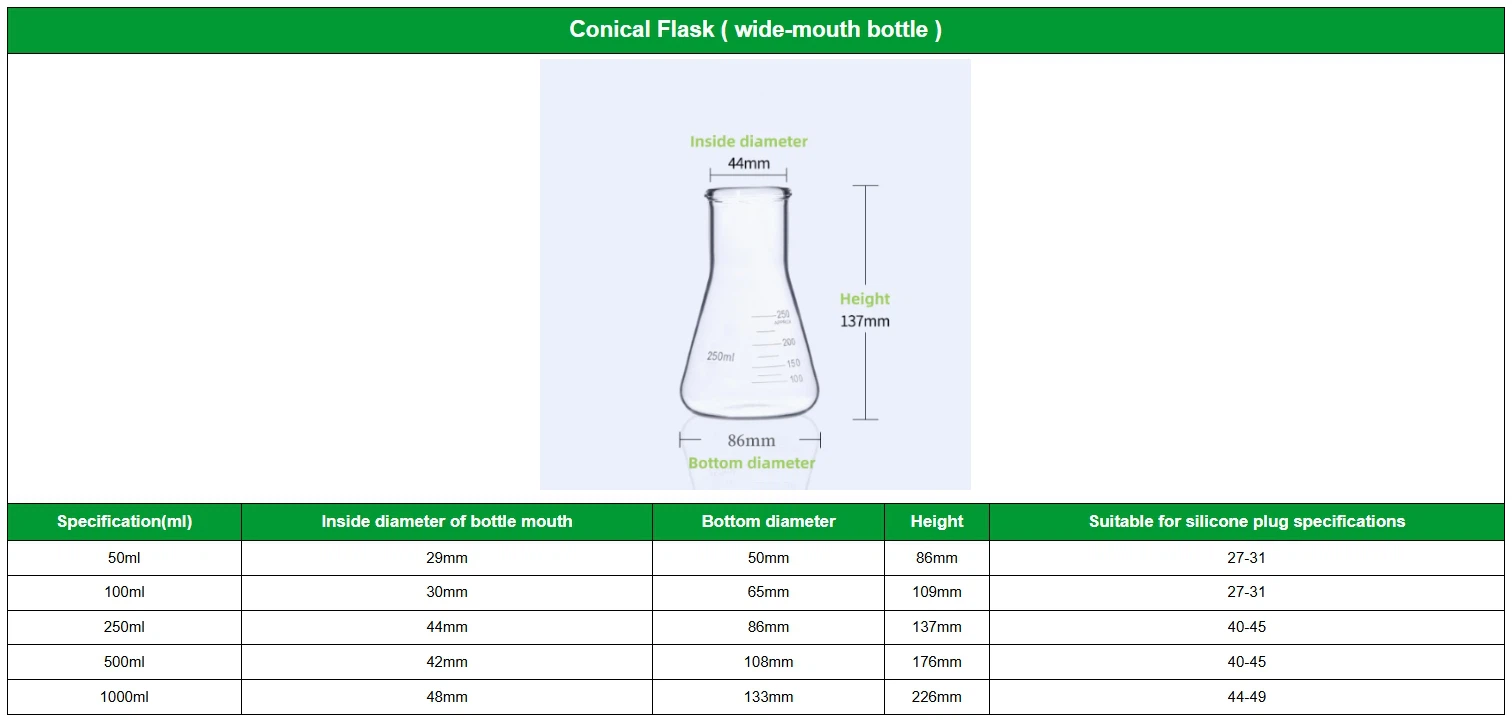
4) Wide-mouth Bottle: 50ml/100ml/250ml/500ml/1000ml;
5) Conical Flask With Cover: 50ml~1000ml;
6) Screw Conical Flask:
a. Black Lid (General Sets): 50ml~1000ml
b. Orange Lid (Thickening Type): 250ml~5000ml;
2. Single and Multi-mouth Round Bottom Flask:
1) Single Mouth Round Bottom Flask: 50ml~10000ml;
2) Inclined Three-mouth Flask: 100ml~10000ml;
3) Inclined Four-mouth Flask: 250ml~20000ml;
4) Straight Three-mouth Flask: 100ml~10000ml;
5) Straight Four-mouth Flask: 250ml~10000ml.
***Price List for whole above, inquire us to get
Description
Technical Parameters
In the vast landscape of scientific equipment, few items embody the essence of versatility and practicality as elegantly as the Erlenmeyer flask. Among its myriad sizes, the 10L Erlenmeyer flask stands out as a stalwart in many research and industrial laboratories, serving as a vital container for a wide range of chemical reactions, fermentations, and cell cultures. With its characteristic conical shape, sturdy design, and ample capacity, this flask has become an indispensable tool for scientists and researchers across disciplines.
The origins of the Erlenmeyer flask can be traced back to the late 19th century, when Emil Erlenmeyer, a German chemist, introduced this iconic piece of laboratory glassware. Initially designed to facilitate the mixing and heating of liquids during chemical reactions, the flask's conical shape quickly gained popularity due to its ability to prevent splashing and allow for better stirring.
Over time, as scientific practices evolved, so did the Erlenmeyer flask, with various sizes and modifications being developed to cater to diverse experimental needs. The 10L variant, with its generous capacity, emerged as a favorite among researchers conducting large-scale reactions or cultivating microorganisms on a substantial scale.
Applications

The versatility of the 10L Erlenmeyer flask is exemplified by its myriad applications across various scientific disciplines:
◆ Chemistry: In organic and inorganic chemistry, the 10L flask is ideal for conducting large-scale syntheses, allowing researchers to produce sufficient quantities of compounds for further analysis or commercialization.
◆ Biology and Biochemistry: In microbiology and cell culture laboratories, the flask serves as a primary vessel for cultivating bacteria, yeast, and other microorganisms, as well as for growing mammalian and plant cells. The conical shape facilitates gas exchange during aerobic fermentations and cell respiration.
◆ Biotechnology: In the field of biotechnology, the 10L Erlenmeyer flask finds use in the production of enzymes, antibiotics, and other bioproducts through fermentation processes.
◆ Environmental Science: Researchers studying biodegradation, wastewater treatment, or microbial ecology often employ the 10L flask to simulate natural environments and observe microbial interactions.
◆ Education: In academic settings, the flask serves as a valuable teaching tool, allowing students to perform hands-on experiments and observe chemical and biological processes at scale.
Parameter list


Sodium hydroxide reacts with carbon dioxide
The reaction of sodium hydroxide with carbon dioxide using a conical bottle is a typical chemical experiment designed to observe and understand the chemical reaction between the two substances. Here are the basic steps and procedures of the experiment:
Experiment preparation
◆ Material preparation:
1) Conical bottle: Choose a conical bottle of appropriate size to ensure that it is clean and free of impurities.
2) Sodium hydroxide solution: Prepare a solution of sodium hydroxide (NaOH) of a certain concentration, usually using water as the solvent.
3) Carbon dioxide gas: Can be prepared by a chemical reaction (such as calcium carbonate reacting with diluted hydrochloric acid), or by using ready-made carbon dioxide cylinders.
4) Conduits and clamps: used to connect the gas source to the conical bottle and to control the gas intake.
5) Phenolphthalein indicator (optional) : Used to detect whether the solution is alkaline after the reaction, so as to indirectly determine whether the reaction has occurred.
◆ Safety preparation:
1) Wear appropriate personal protective equipment, such as lab coats, goggles, and gloves.
2) Ensure that the test area is well ventilated to eliminate harmful gases that may be generated.
Experimental procedure
◆ Connecting device: The CO2 gas source is connected to the conical cylinder using a conduit and clamps are installed in place to control the gas intake.
◆ Add sodium hydroxide solution: Add an appropriate amount of sodium hydroxide solution to the conical bottle, taking care not to exceed the capacity limit of the conical bottle.
◆ Through carbon dioxide gas: Open the clamp and slowly pour carbon dioxide gas into the conical bottle. In order to observe the reaction process, the gas can be injected in batches, and the change of the solution in the conical bottle can be observed after each injection.
◆ Observe the reaction:
1) Sodium hydroxide reacts with carbon dioxide to form sodium carbonate (Na₂CO₃) and water. This reaction itself has no significant color change or precipitation generation, but can be detected by other methods.
2) If a phenolphthalein indicator is used, a few drops can be added to the solution before the reaction. When the sodium hydroxide is completely reacted with carbon dioxide, the solution will no longer be alkaline, and the color of the phenolphthalein indicator will change from red to colorless (if the initial solution was alkaline and red).
3) In addition, it is also possible to indirectly judge whether the reaction occurs by measuring the change in the volume of gas in the conical bottle before and after the reaction. But this method requires more sophisticated experimental devices and measurement tools.
◆ Record the result:
Record the phenomena and data observed during the experiment, such as the change of color of the solution, the change of gas volume, etc.
◆ Disposal of waste liquid:
After the end of the experiment, the waste liquid and waste shall be disposed according to the laboratory regulations. Sodium hydroxide solution and sodium carbonate solution are alkaline solutions and need to be properly handled to avoid harm to the environment and human body.
Safety Considerations
While the 10L Erlenmeyer flask is a robust and reliable piece of equipment, its safe use requires adherence to strict protocols. Here are some key safety considerations to keep in mind:
◆ Proper Handling: Always wear appropriate protective gear, such as lab coats, gloves, and eye protection, when handling the flask. Avoid dropping or knocking over the flask, as its size and weight can pose a significant hazard if mishandled.
◆ Temperature Control: When heating or cooling the flask, use a heat source or coolant that is compatible with borosilicate glass and ensure even temperature distribution to prevent thermal stress.
◆ Pressure Management: If the flask is used in pressurized systems, ensure that it is equipped with appropriate pressure-release mechanisms to prevent explosions.
◆ Chemical Compatibility: Before using the flask with any chemical, verify its compatibility with borosilicate glass to avoid corrosion or leaching of contaminants.
◆ Disposal and Cleaning: Follow proper procedures for cleaning and disposing of the flask and its contents, especially if they contain hazardous substances.

Heating method and application of water bath
 |
 |
 |
 |
In the chemistry laboratory, the 10-liter conical bottle, as a large-capacity glass instrument, is often used in various chemical reactions and experiments. Due to its large volume, direct heating may lead to uneven heating, and even cause explosion and other safety problems. As a result, water bath heating is a safe and effective way to heat a 10-litre conical bottle. The following will introduce the water bath heating method and its application of 10 litre conical bottle in detail.
The principle and advantages of water bath heating
Water bath heating is the process of placing an object that needs to be heated (such as a conical bottle) in a container of water, and heating the object indirectly by heating the water in the container. This approach has several advantages:
Uniform heating
Water bath heating can make the conical bottle heated evenly to avoid local overheating resulting in bottle rupture.
Accurate temperature control
By adjusting the temperature of the water, the reaction temperature in the conical bottle can be accurately controlled to meet the experimental requirements.
High safety
Water bath heating is relatively safe, avoiding the risk of explosion that may be caused by direct heating.
Method of water bath heating
Choose a water bath with a large enough capacity to fully accommodate the 10-litre conical bottle, and the water bath should be higher than the height of the conical bottle so that the water can completely cover the bottom of the conical bottle when heated.
Add an appropriate amount of water to the water bath to submerged the bottom of the conical bottle and leave a certain space. In general, the water surface should be about 5 cm above the bottom of the conical bottle to ensure the heating effect.
Place the 10-litre conical bottle carefully into the water bath so that it is suspended, so that the bottom of the conical bottle does not touch the bottom of the water bath. Auxiliary tools such as brackets or barbed wire can be used to support the conical bottle.
Turn on the heat switch of the water bath and start heating the water. During the heating process, the change of water temperature should be continuously observed, and the heating power or temperature controller should be adjusted according to the experimental requirements to maintain a constant water temperature.
During the heating process, the solution in the conical bottle can be stirred according to the needs of the experiment to promote the reaction. At the same time, the temperature and reaction in the conical bottle should be regularly monitored to ensure the smooth progress of the experiment.
The application scenario of water bath heating
Organic synthesis reaction
In organic synthesis experiments, many reactions need to be performed at specific temperatures. Water bath heating can provide a stable, uniform temperature environment to meet the requirements of these reactions.
Biochemical experiments
In biochemical experiments, some enzymatic reactions or protein denaturation experiments need to be performed at a constant temperature. Water bath heating provides precise temperature control to ensure the accuracy of experimental results.
Analytical Chemistry experiments
In analytical chemistry experiments, such as titration experiments, the sample needs to be heated. Water bath heating can provide mild, uniform heating conditions to avoid sample decomposition or deterioration due to overheating.
Precautions for water bath heating
Safe operation
During the heating process, it should be ensured that the power cord and plug of the water bath are safe and reliable to avoid the occurrence of safety accidents such as electric shock.
Wear appropriate personal protective equipment, such as lab coats, gloves, and goggles.
01
Temperature control
The water temperature should be precisely controlled according to the requirements of the experiment to avoid the failure of the experiment due to too high or too low temperature.
During the heating process, the change of water temperature should be continuously observed, and the heating power or temperature controller should be adjusted in time.
02
Pollution prevention
During the heating process, the water in the water bath should be avoided from splashing into the conical bottle, so as not to contaminate the sample or affect the experimental results.
After use, the water bath and conical bottle should be cleaned in time to avoid residues affecting the next experiment.
03
Equipment maintenance
The water bath should be regularly maintained and maintained to ensure its normal operation and extend its service life.
If the water bath is found to be faulty or abnormal, it should be stopped in time and contact professionals for maintenance.
04

Summary
Water bath heating is a safe and effective way to heat a 10 liter conical bottle. Through reasonable selection of water bath, control of water temperature and heating power, pay attention to safety and prevent pollution and other measures, we can ensure the smooth progress of the experiment and the accuracy of the results. At the same time, water bath heating has a wide application prospect in the fields of organic synthesis, biochemistry experiment and analytical chemistry experiment.
Hot Tags: 10l erlenmeyer flask, China 10l erlenmeyer flask manufacturers, suppliers, factory, High Pressure Lab Reactor, Hydrothermal Autoclave Reactor, Hydrothermal Autoclave, Double Jacketed Glass Reactor, Double Glass Reactor, High Pressure Autoclave Reactor
Previous
Erlenmeyer Culture FlaskSend Inquiry


