



Condenser Used In Chemistry Lab
(1)150mm/200mm/300mm/400mm/500mm/600mm---19*2
(2)200mm/300mm/400mm/500mm/600mm---24*2
(3)400mm/500mm/600mm---29*2
2. Allihn Condenser
(1)150mm/200mm/300mm/400mm/500mm/600mm---19*2
(2)200mm/300mm/400mm/500mm/600mm---24*2
(3)500mm/600mm---29*2
3. Graham Condenser:
(1)150mm/200mm/300mm/400mm/500mm/600mm---19*2
(2)200mm/300mm/400mm/500mm/600mm---24*2
(3)500mm/600mm---29*2
***Price List for whole above, inquire us to get
Description
Technical Parameters
In laboratory environments, condenser used in chemistry lab is a crucial glassware primarily used for cooling hot vapors or liquids. This device plays an irreplaceable role in experimental processes in multiple fields such as chemistry, physics, and biology. The condenser in the laboratory usually consists of two layers of glass tubes, one inside and one outside, with the inner layer being a smaller glass tube used to pass the fluid to be cooled; The outer layer is a larger glass tube used for introducing coolant. The two ends of the inner glass tube are usually equipped with frosted glass joints for easy connection with other glass instruments. The outer glass tube is equipped with two hose interfaces for connecting and discharging coolant, usually a mixture of tap water or cooled water and antifreeze.
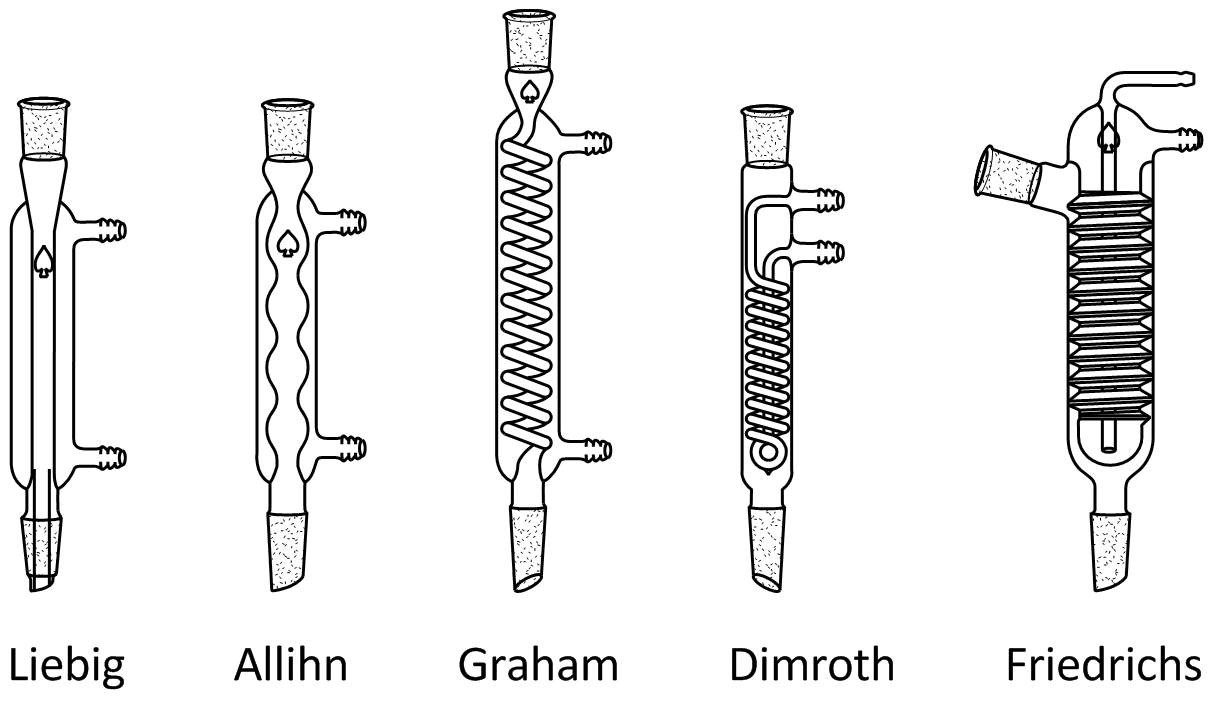
The working principle of it is based on the principle of heat exchange. When hot steam or liquid flows in the inner glass tube, the cooling liquid in the outer glass tube exchanges heat with the hot fluid in the inner tube through reverse flow (i.e. the cooling liquid enters from the lower part of the condenser tube and flows out from the upper part). After absorbing heat, the coolant rises in temperature and flows out of the condenser tube, while the fluid in the inner tube cools and condenses due to the release of heat. This reverse flow design helps maintain a stable and efficient thermal gradient, reducing damage from thermal shock to adjacent glass instruments.
Basic principles & structures
In laboratory environments, the condenser used in chemistry lab plays a crucial role as a key heat exchange device. Especially low-temperature condensers, which can generate and maintain extremely low temperature environments, play an irreplaceable role in numerous scientific experiments and research.

A low-temperature condenser, as the name suggests, is a condensing device that can operate at lower temperatures. It uses refrigerant or cooling medium to carry away the heat of the substance to be cooled through heat exchange, thereby reducing its temperature and achieving the desired low temperature state. They are usually composed of condenser tubes, cooling medium circulation systems, temperature control systems, and safety protection devices.
It is the core component of a low-temperature condenser, with refrigerant or cooling medium flowing inside. When the high-temperature substance to be cooled flows through the condenser tube, its heat is transferred to the refrigerant or cooling medium through the tube wall, and then carried out of the system and dissipated into the environment.
The cooling medium circulation system is responsible for delivering the cooling medium to the condenser tube and ensuring its continuous flow to maintain a stable cooling effect. The temperature control system is used to monitor and regulate the operating temperature of the condenser, ensuring that it is always maintained within the set low temperature range.
Uses
Low temperature condensers have a wide range of applications in laboratories, including but not limited to the following aspects:
Materials Science Research
In the field of materials science, low-temperature condensers are widely used in the research and development of superconducting materials, low-temperature phase change materials, and new functional materials. By providing an extremely low temperature environment, changes in physical and chemical properties of materials that are difficult to observe under conventional conditions can be observed, providing important theoretical basis and experimental data support for the design, synthesis, and application of materials.
Chemical reaction research
Some chemical reactions have higher selectivity and yield under low temperature conditions. A low-temperature condenser can provide a stable low-temperature environment for these reactions, promote their progress, and reduce the generation of by-products. For example, in organic synthesis, they are often used to control the reaction temperature to optimize the reaction pathway and improve yield.
Biomedical research
The demand for low-temperature environments in the biomedical field is equally urgent. Low temperature condensers play an important role in cell culture, tissue preservation, and drug development. Lowering the temperature can slow down the metabolic rate of cells and prolong their survival time, providing stable experimental conditions for biomedical research. Meanwhile, a low-temperature environment also helps maintain the stability and activity of drugs, providing strong support for drug development.
Physics research
In the field of physics, low-temperature condensers are important tools for exploring the fundamental properties of matter and quantum phenomena. For example, in superconducting physics, condenser used in chemistry lab is used to prepare and maintain superconducting state samples; In the field of quantum computing, it provide the necessary low-temperature environment for stable storage and manipulation of quantum bits.
Practical application examples

● Research on Superconducting Materials
Superconducting materials are a type of material with zero resistance under specific conditions. In order to study the properties and potential applications of superconducting materials, scientists need to use low-temperature condensers to provide an extremely low temperature environment.
For example, in the process of studying copper oxide superconductors, scientists used a low-temperature condenser to cool the sample to below liquid nitrogen temperature (about 77K), and observed a sharp decrease in sample resistance and the occurrence of superconductivity.
This discovery not only promotes the development of superconducting physics, but also lays the foundation for the application of superconducting materials in fields such as power transmission and maglev trains.
● Organic synthesis reactions
It also play an important role in the field of organic synthesis. For example, when conducting certain Grignard reactions that require strict control of reaction temperature, scientists use low-temperature condensers to cool the reaction system to the desired temperature to ensure the smooth progress of the reaction.
By precisely controlling the reaction temperature, the yield and selectivity of the reaction can be significantly improved, and the generation of by-products can be reduced, thereby improving the purity and quality of the product.


● Cell culture and preservation
Low temperature condensers are widely used in cell culture and tissue preservation in the biomedical field. By culturing cells under low temperature conditions, their metabolic rate can be slowed down and their survival time can be prolonged.
This is of great significance for research in fields such as cell biology, molecular biology, and regenerative medicine. At the same time, low-temperature condensers can also be used for tissue and organ preservation, providing a reliable source of donors for clinical transplantation surgery.
● Low temperature quantum computing
With the continuous development of quantum computing technology, the application of condenser used in chemistry lab in the field of quantum computing is becoming increasingly widespread. Quantum bits in quantum computers require extremely low temperatures to maintain stable quantum states and perform effective quantum operations.
Therefore, scientists need to use low-temperature condensers to provide a stable low-temperature environment for quantum computers to ensure their normal operation and efficient computation.
For example, quantum computers developed by companies such as IBM use advanced low-temperature condensation technology to maintain the stability and coherence of quantum bits.

A condenser is a crucial piece of laboratory equipment used in chemistry to cool hot vapors or gases back into liquid form. Its primary function is to facilitate condensation by transferring heat from the vapor to a cooling medium, typically water. Commonly employed in distillation, reflux, and extraction processes, condensers prevent the loss of volatile substances and enable the collection of purified liquids.
There are several types of condensers, each suited for specific applications. The Liebig condenser, a straightforward design, consists of a straight tube surrounded by a water jacket for efficient cooling. The Graham condenser features a coiled inner tube, increasing the surface area for heat exchange and enhancing efficiency. For high-vacuum applications, the Allihn condenser, with its bulbous inner structure, maximizes condensation.
In distillation setups, condensers are positioned vertically, with the vapor entering the bottom and exiting as a liquid from the bottom outlet. Proper functioning requires a continuous flow of cool water through the jacket to maintain temperature differentials. Regular maintenance, such as checking for leaks or blockages, ensures optimal performance. By enabling the separation and purification of mixtures, condensers are indispensable in organic synthesis, chemical analysis, and industrial processes.
Hot Tags: condenser used in chemistry lab, China condenser used in chemistry lab manufacturers, suppliers, factory, Stainless Steel Chemical Reactor, Single Press Tablet Machine, Chemglass Jacketed Reactor, Zp17 Rotary Tablet Press, Short Path Distillation, Pill Press Equipment
Previous
Lab Glass CondenserSend Inquiry


