




Chemistry Rotary Evaporator
(1)1L/2L---Manual lifting with irony base/Manual lifting with SS base/Electric lifting
(2)3L/5L/10L/20L/30L/50L---Manual Lifting/Electric Lifting
***Price List for whole above, inquire us to get
2. Customization:
(1)Design support
(2)Directly supply the Senior R&D organic intermediate, shorten your R&D time and cost
(3)Share the advanced purifying technology with you
(4)Supply the high quality chemicals and analysis reagent
(5)We want to assist you on Chemical Engineering (Auto CAD, Aspen plus etc.)
3. Assurance:
(1)CE and ISO certification Registered
(2)Trademark: ACHIEVE CHEM(since 2008)
(3)Replacement parts within 1-year for free
Description
Technical Parameters
Chemistry rotary evaporator is a commonly used laboratory equipment, also known as the following aliases:
1) Vacuum rotary evaporator: Because rotary evaporator is usually equipped with vacuum system, evaporation and concentration can be carried out at low pressure, so it is often called vacuum rotary evaporator.
2) Rotary concentrator: It is mainly used to evaporate and concentrate liquid samples, so it is also called rotary concentrator.
3) Rotary distiller: The principle of rotovap is similar to the distillation process. By rotating the solution in the evaporation bottle, the components with different boiling points are separated and purified, so it is sometimes called rotary distiller.

Product Introduction
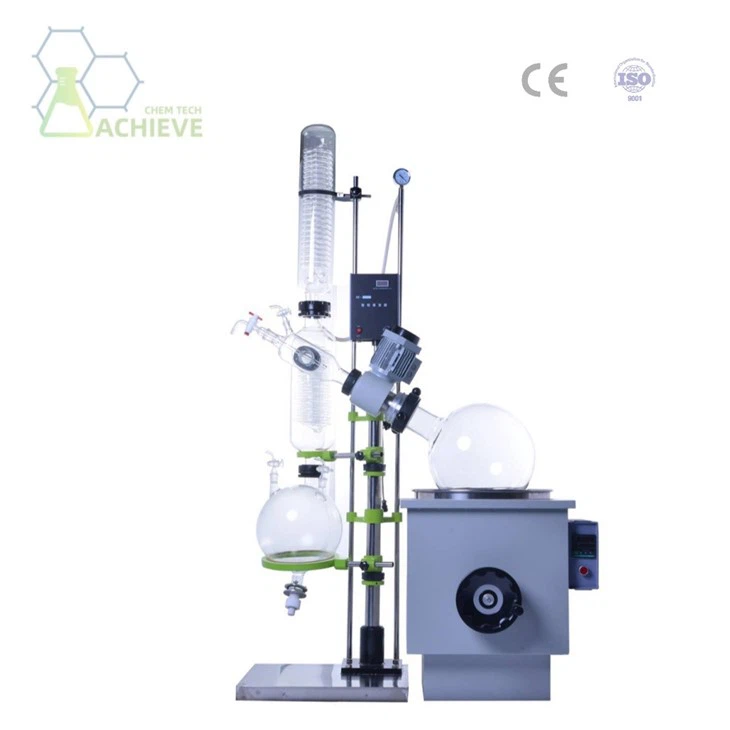
Chemistry rotary evaporator is a kind of laboratory equipment used for evaporation and concentration of solvents.
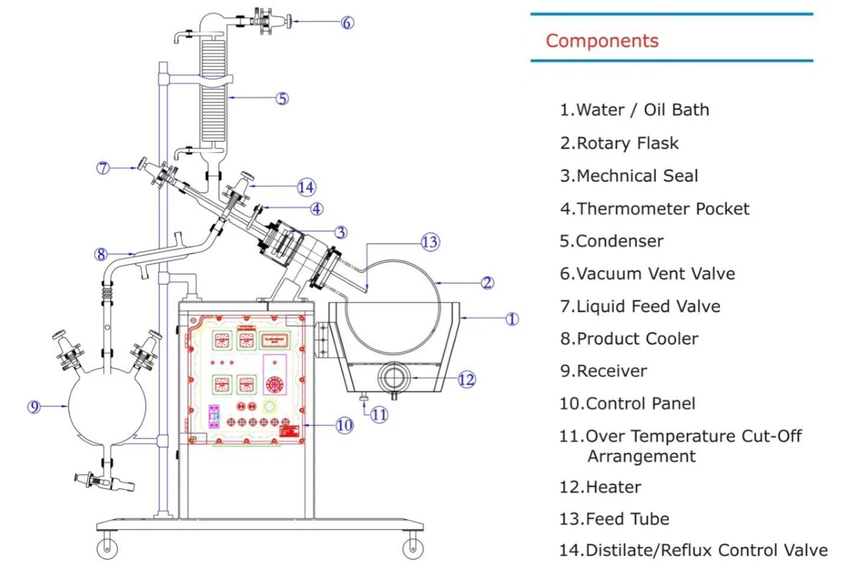
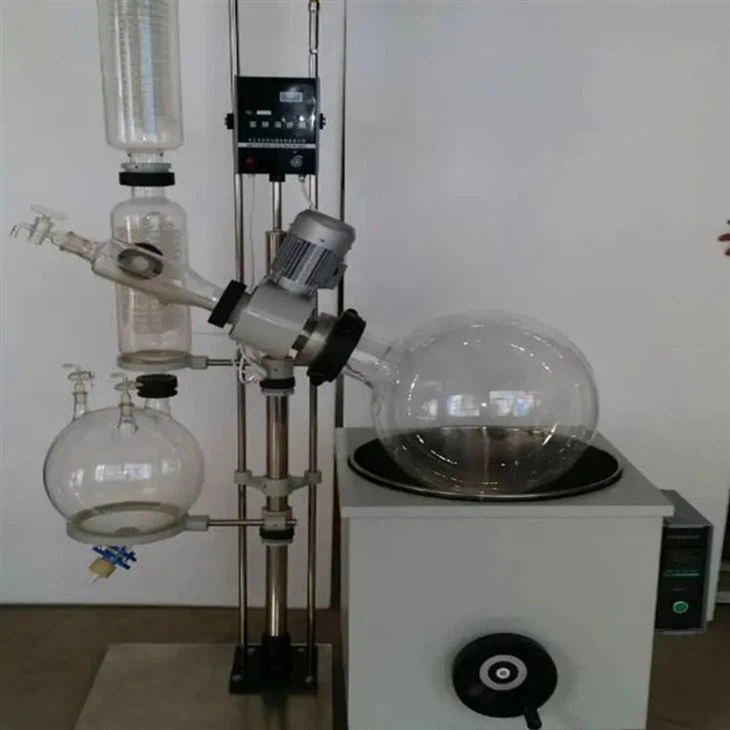
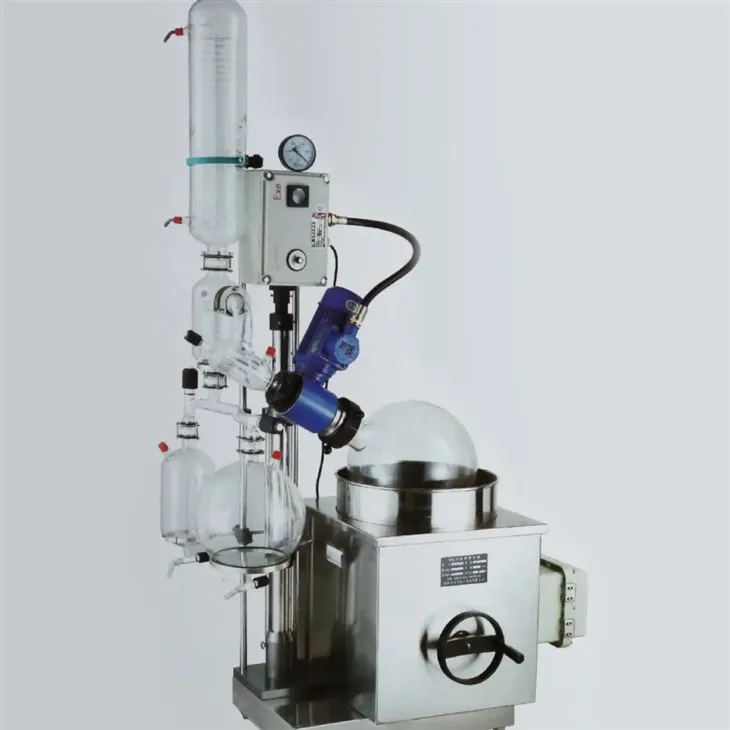
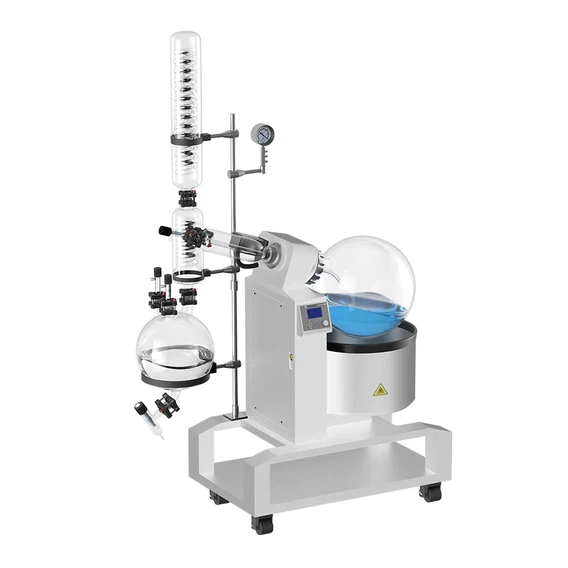
The rotovap is mainly composed of evaporator, condenser, collecting bottle, thermometer and vacuum pump.
The evaporator is a container with a large round bottom, which is filled with the liquid to be evaporated. There is a small round hole in the center of one side of the container, which is connected with a short pipe, which is the rotating shaft. The evaporator rotates around this axis, just like a merry-go-round.
The condenser is a spiral pipe, which rotates around the evaporator, and the distance between them is very close. When the evaporator rotates, the gas evaporated from the hot liquid will be sucked into the condenser and cooled and liquefied in the condenser.
The collecting bottle is under the condenser, and the bottle mouth is upward. When the condenser rotates above the collecting bottle, the condensed liquid will drop into the collecting bottle.
A thermometer is used to measure the temperature of the evaporator. The vacuum pump is used to generate negative pressure and make the liquid in the evaporator evaporate at a lower temperature.
Product Specifications
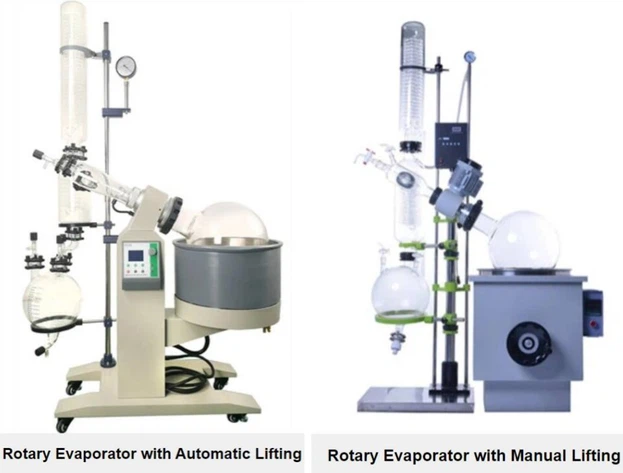
All kinds of "Rotovap", Price List, you can choose online HERE
Calibration Specifications
The calibration specification of chemistry rotary evaporator is usually formulated according to the needs of laboratory and quality management system. The following are some common calibration specifications for reference:
|
|
◆ Temperature calibration: Ensure that the heating temperature of the evaporator is consistent with the set temperature. You can use a standard thermometer or calibration instrument, put it in a rotavap for comparative measurement, and adjust the temperature control system of the instrument.
◆ Rotation speed calibration: The rotation speed of the rotary evaporator chemical has an important influence on the efficiency of solvent evaporation. Use a speedometer or similar calibration instrument to measure the actual rotation speed of the lab rotary evaporator and compare it with the set rotation speed. Adjust the rotary drive as needed to ensure the required rotation speed.
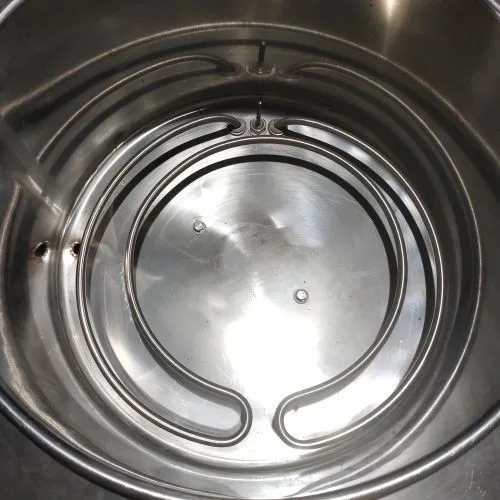
◆ Calibration of heating uniformity: Check the temperature uniformity of rotary evaporator during heating. Use tools such as temperature probe or infrared thermometer to measure the temperature of different parts and confirm the uniformity of temperature. If necessary, the heater can be adjusted or heat transfer medium can be added to improve the heating uniformity.
◆ Calibration of condensation efficiency: The performance of condenser has an important influence on solvent recovery. By checking the cooling water flow rate, cooling effect and solvent recovery rate of the condenser, the condensation efficiency can be evaluated. According to the need, clean, replace condenser or adjust cooling system to improve condensation efficiency.
◆ Calibration of safety function: Ensure the safety function of evaporator equipment works normally. Including the inspection and test of the functions of over-temperature protection, leakage protection and power-off memory of the control system, so as to ensure that the equipment can stop in time or protect the safety of operators under abnormal conditions. |
Applications in Chemistry
The rotary evaporator is a versatile tool with a wide range of applications in chemistry and related fields. Here are some of its primary uses:
|
◆ Solvent Removal: The rotary evaporator is commonly used to remove volatile solvents from mixtures. This is particularly useful in the synthesis of organic compounds, where solvents need to be removed to obtain the pure product.
◆ Concentration of Solutions: The rotary evaporator can be used to concentrate solutions by evaporating the solvent. This is often done to increase the concentration of a specific compound in a mixture.
◆ Drying of Solids: The rotary evaporator can be used to dry solids by evaporating the solvent from a slurry or suspension. This is useful in the preparation of dry, powdered samples for further analysis or use.
◆ Reaction Processes: The rotary evaporator can be used in reaction processes that require stirring and heating. The rotation of the distillation flask ensures uniform mixing and heating of the reactants, leading to more efficient reactions.
◆ Purification of Compounds: The rotary evaporator can be used to purify compounds by distilling them under reduced pressure conditions. This can help remove impurities and obtain a purer product. |
|

Troubleshooting
In the process of using chemistry rotary evaporator, some common problems may be encountered. The following are several possible problems and corresponding solutions:
◆ The solvent evaporation speed is too slow.
1) Check the heating temperature: ensure that the heating temperature is high enough to improve the evaporation speed.
2) Check the vacuum pump: ensure that the vacuum pump works normally and generates enough vacuum.
3) Check the condenser: Make sure that the condenser can effectively cool and condense the evaporated solvent.
◆ Solvent evaporation speed is too fast.
1) Reduce the heating temperature: reducing the heating temperature can reduce the evaporation rate of solvent.
2) Adjust the vacuum pump: reduce the pumping speed of the vacuum pump to slow down the evaporation speed.
3) Adjust the condenser temperature: increase the condenser temperature, improve the condensation efficiency and slow down the solvent evaporation rate.
◆ Liquid overflow.
1) Reduce the amount of solution: ensure that the capacity of the rotary evaporator can accommodate the solution, and do not add too many samples.
2) Adjust the rotation speed: reduce the rotation speed to reduce the possibility of liquid overflow.
3) Careful operation: be careful when adding samples or solvents to avoid splashing and excessive shaking.
◆ Condenser blockage.
1) Cleaning the condenser: decompose the condenser and clean it with an appropriate solvent to remove impurities accumulated in the condenser.
2) Replace the condenser: If the cleaning fails, consider replacing the condenser with a new one.
3) Check the vacuum pump: make sure that the vacuum pump is running normally, so as to ensure enough air flow through the condenser.
Conclusion
The rotary evaporator is an essential tool in chemistry laboratories, providing a versatile and efficient means of distilling volatile solvents under reduced pressure conditions. Its design ensures efficient heat transfer and evaporation, making it ideal for a wide range of applications, including solvent removal, concentration of solutions, drying of solids, reaction processes, and purification of compounds.
Proper maintenance and troubleshooting of a rotary evaporator are crucial to ensure its long-term performance and reliability. Regular cleaning, lubrication, inspection of seals, and checking of the vacuum pump are essential steps in maintaining the equipment. By following these tips and understanding the working principle of the rotary evaporator, researchers can maximize its potential and achieve more efficient and accurate experimental results.
In conclusion, the rotary evaporator is a powerful and indispensable tool in the field of chemistry. Its ability to efficiently distill volatile solvents under reduced pressure conditions makes it a valuable asset in laboratories worldwide. With proper maintenance and troubleshooting, researchers can continue to harness the power of this essential laboratory tool to push the boundaries of scientific discovery.
Hot Tags: chemistry rotary evaporator, China chemistry rotary evaporator manufacturers, suppliers, factory, Hydrothermal Synthesis Reactor, Hydrothermal Reactor Autoclave, 50l Rotary Evaporator, 50L Jacketed Reactor, Rotovap Machine, SS Reactor Manufacturer
Previous
Laboratory Vacuum EvaporatorSend Inquiry


