



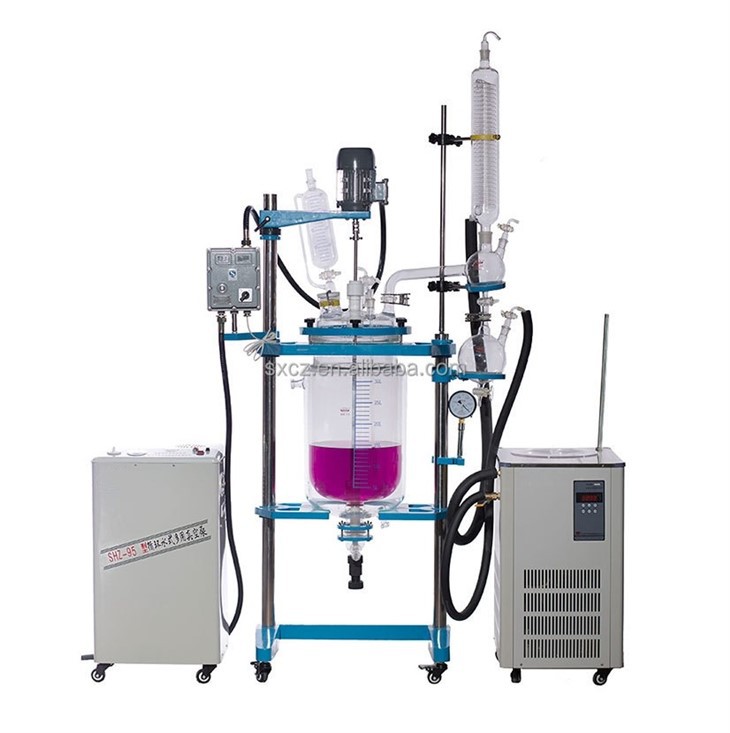
50L Double Layer Glass Reactor
(1)1L/2L/3L/5L---Standard
(2)10L/20L/30L/50L/100L---Standard/EX-proof/Lifting Kettle
(3)150L/200L---Standard/EX-proof
***Price List for whole above, inquire us to get
2. Customization:
(1)Design support
(2)Directly supply the Senior R&D organic intermediate, shorten your R&D time and cost
(3)Share the advanced purifying technology with you
(4)Supply the high quality chemicals and analysis reagent
(5)We want to assist you on Chemical Engineering (Auto CAD, Aspen plus etc.)
3. Assurance:
(1)CE and ISO certification Registered
(2)Trademark: ACHIEVE CHEM(since 2008)
(3)Replacement parts within 1-year for free
Description
Technical Parameters
Products Description
This 50L double layer glass reactor is built around one idea: the reactionhappens in the inner vessel, and a separate outer jacket does the work of keeping it at a set temperature - hot oil, hot water, or a coolant, whatever your process needs. That's the real difference between this and a bare glass flask sitting in a heating mantle. You're not guessing at temperature, you're holding it.
The 50L size is a common pilot-scale step-up from bench-top 10L/20L units,before moving into production-scale kettles. It's set up with six ports on
the cover, a 5L drip funnel for controlled dosing, a PT100 probe for live temperature readout, and a bottom discharge valve so you're not lifting or tipping the vessel to get material out once the run is done.
This reactor is able to withstand high temperatures and pressures while remaining inert to most chemical reagents, avoiding unwanted chemical reactions. Therefore, it is highly favored in the field of chemical research, widely used in organic chemistry, inorganic chemistry, polymer chemistry and many other branches.
In experiments, it is often used in conjunction with a variety of catalysts, solvents and other auxiliary materials to optimize the effects of chemical reactions. It is also equipped with measuring and control devices such as thermometers, manometers and valves, providing experimenters with a precise means of monitoring and control.

|
|
|


What You're Actually Getting
The reactor comes as a body + cover set (1 set each), fitted with six standard openings on the cover:
1. Liquid feeding port - DN25, for adding solvents or liquid reagents mid-reaction without breaking the seal on the main opening
2. Evaporation port - DN40, the wider bore handles vapor flow during distillation or reflux, connecting through to your condenser
3. Drip port - DN25, mates with the included 5L drip funnel for metered, controlled addition
4. Temperature port - DN25, houses the PT100 probe for real-time internal temperature readout
5. Solid feeding port - DN75, wide enough to add catalysts, powders or solid reagents without disassembling the setup
6. Stirring port - #50, where the mixing shaft passes through the seal into the vessel

The mixing shaft itself is stainless steel on the inside with a PTFE sleeve on the outside - gives you the strength of steel without it sitting directly in contact with whatever's in the reactor. Sealing at the shaft and cover openings is handled by a full-PTFE mixing alloy sealing plug set, which is the part that actually determines whether you keep vacuum or not over a long run. Upper and lower covers are held down with dedicated clamp sets, and the whole vessel sits on a stainless steel support frame with a fixed slider - so the reactor position stays put once you've set it, instead of drifting during stirring. A low tray sits under the reactor body, mainly there to catch anything if a seal ever fails.
Stirring & Control
Stirring is driven by a motor and speed regulator mounted on the support frame, connected through a rotating interface to the mixing rod.
Speed is set through a digital speed regulation inverter, so you're reading an actual number instead of eyeballing a dial - useful if you need to reproduce the same stirring rate run after run.
Power spec: single phase 220V, 50/60Hz, 140W.

Vacuum & Condensate Handling
A vacuum-pumping elbow lets you pull the system down for vacuum distillation or to work with oxygen- or moisture-sensitive materials.
For runs where you need to trap solvent vapor rather than lose it, an external glass cold trap with a matching collection bottle and bracket
can be added as a customized option - it sits between the reactor and your vacuum pump, catching condensate before it reaches the pump.
Once the reaction's done, material comes out through the bottom discharging valve - no need to tip or lift a 50L glass vessel to empty it

Specification Of 50L jacketed glass reactor
| Item | Qty |
|---|---|
| 50L double glass reactor body | 1 Set |
| 50L glass reactor cover | 1 Set |
| Liquid feeding port (DN25) | 1 |
| Evaporation port (DN40) | 1 |
| Drip port (DN25) | 1 |
| Temperature port (DN25) | 1 |
| Solid feeding port (DN75) | 1 |
| Stirring port (#50) | 1 |
| Drip funnel, 5L | 1 pc |
| Collection bottle, 5L | 1 pc |
| Temperature probe, PT100 | 1 pc |
| Full PTFE mixing alloy sealing plug | 1 Set |
| Mixing rod (SS core, PTFE-coated exterior) | 1 pc |
| Upper & lower cover clamps | 1 Set |
| Reactor bottom support and low tray | 1 Set |
| Reactor cover clamp pieces | 1 Set |
| Stainless steel support frame with fixed slider | 1 Set |
| Motor + speed regulator + support frame + rotating interface | 1 Set |
| Digital speed regulation inverter | 1 Set |
| Vacuum-pumping elbow | 1 pc |
| Bottom discharging valve | 1 pc |
| External glass cold trap + collection bottle + bracket (customized) | 1 pc |
| Voltage | Single phase 220V, 50/60Hz, 140W |
| Product packing list | 1 Copy |
| Product manual | 1 Copy |
Process Development
It occupies an important position in the field of process development and has a wide range of applications. The following are the main positions and specific applications of this equipment in the field of process development.

◆ Important experimental tool
Important experimental tool: It is an indispensable experimental tool in the process development. It can provide a stable and reliable reaction environment for researchers to conduct various chemical reactions and process optimization experiments.
◆ Flexibility and expandability:
It has a moderate capacity, which can meet the needs of most process development tests, but also has a certain degree of flexibility and expandability. This allows researchers to choose the right reactor according to their experimental needs, thus improving the efficiency and success rate of their experiments.
It has an important position and wide application in the field of process development. With the continuous development of science and technology and the continuous optimization of the process, I believe that the equipment will play a more important role in the field of process development in the future.
Organic Synthesis
In the field of organic synthesis, it can be used to synthesize various organic compounds, such as drug intermediates, dyes, fragrances and so on. By precisely controlling the reaction conditions (e.g. temperature, pressure, stirring speed, etc.), researchers can optimize the synthesis process and improve product quality and yield.
Drug R&D
In the field of drug research and development, it can be used for the preparation of drug raw materials, intermediates, as well as for tests such as drug synthesis and purification. Its transparency enables researchers to directly observe the reaction process, thus adjusting the experimental parameters in time to ensure the smooth progress of the drug development process.
Catalyst research
In the field of catalyst research, it can be used to evaluate the performance and stability of catalyst. By simulating the actual reaction conditions, researchers can study the catalytic activity, selectivity and service life of catalysts and other key indicators, providing strong support for the optimization and application of catalysts.
Environmental research
In the field of environmental research, it can be used to simulate the degradation process of pollutants and study wastewater treatment technology.
Its controllable characteristics enable researchers to precisely control the reaction conditions, so as to study the degradation mechanism of pollutants and the principles of wastewater treatment technology, and make contributions to the cause of environmental protection.
Where It Gets Used
A 50L double layer reactor at this scale usually shows up in labs moving past bench-top testing - R&D teams scaling up a synthesis route, QC/pilot lines running repeat batches before committing to production equipment, or contract labs handling variable jobs where they need one vessel that covers synthesis, distillation, extraction and crystallization work without swapping equipment. Because the jacket handles temperature and the six ports cover feeding, venting, dosing, and monitoring separately, it holds up reasonably well across different process types - exothermic reactions where you need active cooling, reflux work where the evaporation port and condenser setup matter, or slow crystallization where you're holding a steady low temperature for hours.
Chemical production involves numerous complex processes and chemical reactions, which may lead to safety accidents if a little carelessness is not practiced. Therefore, employees must have solid professional knowledge and skillful operation skills, as well as a high degree of safety awareness.
By simulating the real chemical production environment, the chemical safety skills training allows employees to learn and master safety knowledge and skills in practice, and improve their ability to cope with emergencies.
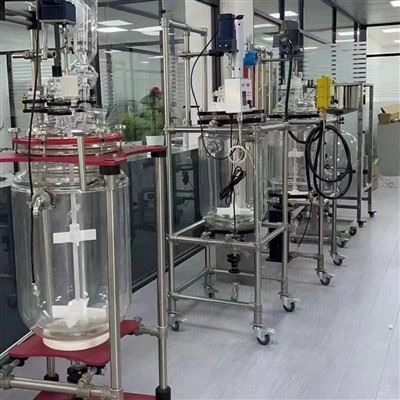

The intelligent chemical park training base built by Beijing Obier has comprehensive chemical training machine, which can provide complete chemical safety skills training, taking pipeline disassembling and assembling training device, glass reactor and stainless steel reactor as an example:
This system mainly consists of tanks, pumps, pipelines, valves, instruments, disassembly tools, cleaning equipment, pressure testing , workbench, tools and materials shelves, toolboxes, etc., not only to exercise the ability to disassemble chemical centrifugal pumps, pipeline disassembly and assembly capabilities, but also to train the cleaning of the process pipeline, replacement and other safe work projects, blind pumping and blocking, fire, and other special projects, as well as the centrifugal pump supporting pipe automation, instrumentation, valve installation operations. Instrumentation, valve installation operations.
About our company
Our Achieve Chem are a professional manufacturer of 50L double-layer glass reactors, dedicated to R&D, production and sales of high-quality glass reaction equipment. Our factory covers an area of about 6,000 square meters, equipped with advanced production lines and strict quality control systems. We focus on stable performance, safe operation and customized solutions for laboratory and industrial use. All products meet CE and ISO standards, with reliable quality and comprehensive after-sales service. We are committed to providing efficient and durable glass reactor solutions for global customers.
Our workshop


Compare Properties
|
Problem |
Reason |
Solution |
|
The stirring shaft is stuck |
Insufficient lubrication or wear of the bearing |
Replenish the grease and replace the bearings if necessary |
|
Seal leakage |
Insufficient lubrication or aging of the sealing surface |
Re-lubricate the sealing surface and replace the aged sealing parts |
|
The valve does not open and close flexibly |
Insufficient lubrication of the valve stem or accumulation of impurities |
Clean the valve stem and apply grease |
|
The reducer is making abnormal noises |
Insufficient gear oil or gear wear |
Replenish or replace the gear oil and check the condition of the gears |
Products Description
Q1.What's the difference between this and a single-layer glass reactor?
A:A single-layer glass reactor has no built-in jacket, so you need to wrap it with an external heating mantle or place it in a water bath for temperature control. This 50L double-layer glass reactor has a built-in jacket, allowing heating or cooling fluid to circulate directly around the inner chamber for more efficient temperature regulation.
Q2.Can I run this under vacuum?
A:Yes, this reactor is equipped with a vacuum-pumping elbow to support vacuum operation. If you are distilling solvent and aim to recover it instead of letting it enter the vacuum pump, you can use it with the optional external cold trap.
Q3.What temperature medium can I use in the jacket?
A:You can use hot water, hot oil, or a refrigerant/coolant circulator in the jacket according to your heating or cooling needs. The jacket itself is compatible with all kinds of temperature media, and the specific temperature range is determined by your circulator.
Q4.Is customization available?
A:Yes, customization is available. The external cold trap and collection bottle assembly included in the equipment list is a customized add-on instead of a fixed standard configuration, and you can configure it based on whether your process requires solvent recovery.
Hot Tags: 50L Double Layer Glass Reactor, China 50L Double Layer Glass Reactor manufacturers, suppliers, factory, 10 Liter Short Path Distillation, 1l Short Path Distillation Kit, Hydrothermal Reactor, 50l Rotovap, Rotovap Machine, High Pressure Autoclave Reactor
Previous
Large Rotary EvaporatorNext
Small RotovapSend Inquiry


