



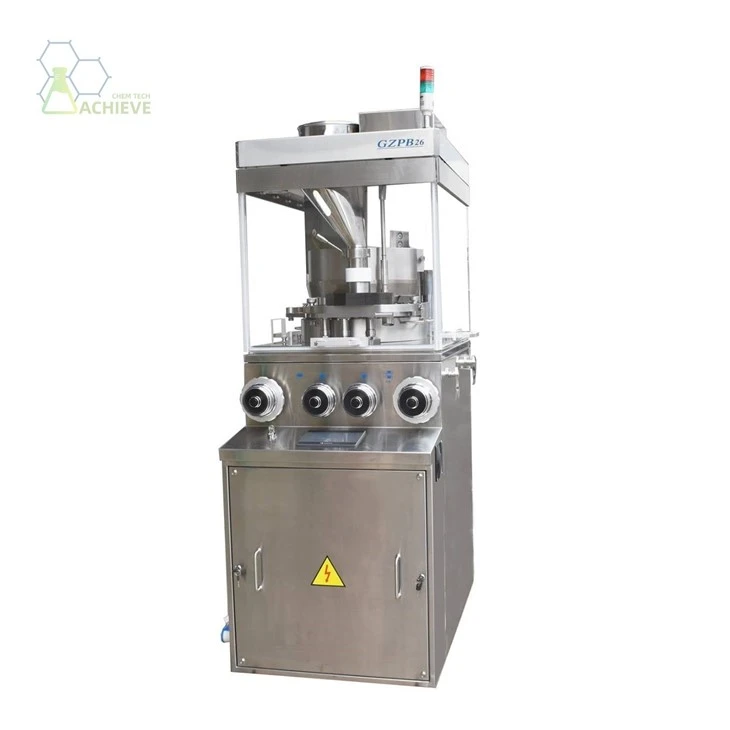


Tablet Machine Press Equipment
(1)Number of Stations: 5/7/9/12/19
(2)Production Capacity: 9000/12600/16200/17000/40000(PC/H)
***Price List for whole above, inquire us to get
2. Customization:
(1)Design support
(2)Directly supply the Senior R&D organic intermediate, shorten your R&D time and cost.
(3)Share the advanced purifying technology with you
(4)Supply the high quality chemicals and analysis reagent
(5)We want to assist you on Chemical Engineering (Auto CAD, Aspen plus etc.)
3. Assurance:
(1)CE and ISO certification Registered
(2)Trademark: ACHIEVE CHEM(since 2008)
(3)Replacement parts within 1-year for free
Description
Technical Parameters
Tablet machine press equipment is a device used to manufacture solid tablets or other shaped compressed formulations. It is one of the commonly used machines in the pharmaceutical industry. The working principle of Tablet Machine Press is to compress powdered or granular pharmaceutical raw materials in a mold through pressure and extrusion, forming sturdy tablets.
It plays an important role in the pharmaceutical industry, helping drug manufacturers produce high-quality tablets in an efficient and consistent manner.

We provide Tablet machine press equipment, please refer to the following website for detailed specifications and product information.
Product: https://www.achievechem.com/tablet-press-machines/rotary-tablet-press-machine.html
The production process of Chinese medicine tablets
The production process of Chinese medicine tablets is a complex and delicate process that involves multiple steps designed to ensure the quality and efficacy of the final product. The following is a detailed introduction to the production process of Chinese medicine tablets:
► Raw material preparation and treatment
1) Selection of Chinese medicine raw materials:
Select Chinese medicinal materials that meet the medical standards to ensure the quality and purity of raw materials.
According to the prescription requirements, select the appropriate proportion of main drug and auxiliary drug.
2) Cleaning and drying of raw materials:
Clean the Chinese medicinal materials to remove the soil and impurities on the surface.
The cleaned Chinese medicinal materials were dried to facilitate subsequent crushing and extraction.
3) Grinding and sifting:
Use a large medicine powder machine to crush the Chinese medicine into a powder that meets the requirements.
The particles are graded through the screen to ensure uniform particle size of the powder.
► Extraction and concentration
1) Withdraw:
The crushed Chinese medicinal materials were mixed with water or appropriate solvent to extract.
Extraction methods include water decoctions, alcohol extraction, etc. According to the nature of medicinal materials and prescription requirements to choose the appropriate method.
2) Concentrated:
The extract is concentrated to remove excess water or solvents.
The concentration process may require filtration, precipitation, etc., to remove impurities.
► Granulation and drying
1) Granulation:
The concentrated liquid or medicinal powder is evenly mixed with appropriate excipients (such as wetting agent, binder, etc.).
Through the pelleting mechanism into soft material, and then through the screen to make particles.
Granulation methods include wet granulation, dry granulation and so on, according to the prescription requirements and material properties to choose the appropriate method.
2) Dry:
The prepared particles are dried to remove water.
The drying temperature and time should be strictly controlled to avoid the destruction of pharmaceutical ingredients.
► Pressing and coating
1) Tablet pressing:
The dried particles are processed by a tablet press.
There are various types of tablet press, including single stamping machine and rotary tablet press.
The pressure, weight and other parameters should be controlled during the tablet pressing process to ensure the quality and hardness of the tablet.
2) Coating:
The tablets that need to be coated are coated to protect them from moisture and deterioration.
Coating materials include sugar coating, film coating, etc., according to the prescription requirements and market demand to choose the appropriate material.
Pressure System
The pressure system of tablet machine press equipmentcan be adjusted in the following ways:
Pressure regulating device
Most tablet machines are equipped with a pressure regulating device, usually a handle, knob, or button. By operating this device, the pressure can be adjusted.
The specific adjustment method may vary depending on the tablet model. Please refer to the device's user manual or consult the manufacturer.
Pressure sensors and feedback control
Some advanced tablet machines may be equipped with pressure sensors and feedback control systems.
These systems can monitor pressure in real-time and automatically adjust according to set parameters. By setting the upper and lower pressure limits, it is possible to ensure that the tablet is pressed within the appropriate range.
Mold adjustment
The design and size of the mold can also affect the pressure. By changing the mold or adjusting the pressure distribution of the mold, the way pressure is applied can be changed, thereby affecting the quality and hardness of the tablet.
Pressure testing
To ensure the normal operation of the pressure system, regular pressure testing can be conducted. This can be achieved by using professional pressure testing instruments that can accurately measure pressure output and compare it with the equipment settings.
|
|
|


The pressure system of the tablet press can be adjusted in various ways to meet different production needs. The following are some common adjustment methods:
Manual adjustment
This is the most basic adjustment method, which observes the pressure on the pressure gauge by manually rotating the valve or adjusting the pressure spring, in order to achieve precise adjustment effect.
Automatic adjustment
Use electronic sensors and feedback controllers to monitor and adjust pressure. This method can achieve accurate and stable pressure regulation, and can also adjust and record data in real time.
Hydraulic regulation
Using a hydraulic system to precisely control pressure. The pressure value needs to be accurately set first, and then it can be directly adjusted on the pressure gauge.
In the specific operation, there are also some specific adjustment steps as follows:
Turn on the power and preheat for a period of time.
Rotate the pressure adjustment knob counterclockwise until the pressure gauge indicates "0".
Add the raw materials to the hopper and gradually adjust the pressure adjustment knob to gradually increase the pressure gauge reading until the desired pressure value is reached.
While adjusting the pressure, observe the compression situation to ensure that the thickness and weight of the tablet are within the allowable range.
In addition, pressure adjustment can also be achieved by replacing the pressure regulating piston, replacing the pressure spring, or adjusting the pressure control valve. These methods all require selecting appropriate adjustment methods based on specific production needs and equipment conditions.
Please note that pressure regulation is an important step in use. Improper pressure regulation can lead to uneven thickness and weight differences in the compressed tablets, thereby affecting the quality and efficacy of the tablets. Therefore, when adjusting the pressure, careful operation is necessary to ensure the best pressure control effect is achieved.
Production Improvement
The following measures can be taken to improve the production efficiency of tablet machine press equipment:
|
|
◆ Process optimization By optimizing the process flow, waste and bottlenecks in production can be reduced. For example, optimizing the pre-treatment and mixing process of raw materials to ensure uniform particle size and composition mixing. In addition, optimize tablet parameters such as pressure, speed, and mold design to improve tablet consistency and production efficiency. ◆ Automation technology Introducing automation technology into tablet production lines can improve production efficiency and reduce human errors. Automation technology can include automatic feeding, automatic pressure and speed adjustment, automatic tablet arrangement, and tablet collection. These technologies can improve the running speed and stability of production lines, and reduce the time and effort required for manual operations. ◆ Training and skill enhancement Provide operators with sufficient training and skill enhancement to enable them to proficiently operate and adjust the tablet machine. Familiarity with the functions and operating procedures of equipment can improve production efficiency and ensure correct parameter settings and operating methods. ◆ Data analysis and optimization Use data analysis tools and techniques to monitor and analyze key indicators and parameters in the production process. By collecting and analyzing data, potential problems and improvement points can be identified, and corresponding optimization measures can be taken to improve production efficiency and quality. |

Production Quality Control
Here are some common quality control methods and steps:
|
|
|
|
|


◆ Raw material inspection
Inspection of raw materials used in pharmaceuticals, including active ingredients, excipients, solvents, etc. The raw materials must meet the requirements of relevant pharmacopoeia or specifications, such as purity, content, microbial limits, etc.
◆ Process control
Control key parameters of the production process, such as pressure, speed, temperature, humidity, etc. These parameters have a significant impact on the shape, hardness, solubility, and other properties of the tablet. Set appropriate ranges based on process parameters and monitor and record them.
◆ Online testing
During the production process, tablets can be monitored and tested in real-time through online testing instruments. For example, automatic detection and control can be achieved using parameters such as tablet weight, hardness, thickness, and diameter.
◆ Sample sampling
Regularly extract samples from production batches for testing and analysis. Sample sampling should comply with relevant sampling plans and procedures, an啊d ensure the representativeness of the samples.
◆ Laboratory testing
Send the samples to the quality control laboratory for testing of various physical, chemical, and microbiological indicators. This includes drug content determination, solubility, purity, impurity detection, microbial limits, etc.
The above are the general steps and methods for quality control of tablets, and the specific quality control process and methods may vary depending on different pharmaceutical companies and drug types. Develop corresponding quality control plans and procedures based on the characteristics of drugs and regulatory requirements, and strictly implement them.
Hot Tags: tablet machine press equipment, China tablet machine press equipment manufacturers, suppliers, factory, 16 Station Tablet Compression Machine, Hand Tablet Press Machine, Manual Tablet Punching Machine, Pill Press Equipment, Single Punch Tablet Press, Tablet Punching Machine
Previous
Hand Tablet PressSend Inquiry


