


An Essential Tool in Chemical and Pharmaceutical Laboratories
Oct 24, 2024
Leave a message
Introduction
Rotary evaporators, also known as rotavaps or rotavapors, are indispensable instruments in chemical and pharmaceutical laboratories. These devices are particularly useful for the distillation of volatile solvents under reduced pressure, facilitating the concentration and purification of reaction products. Among the various applications of rotary evaporators, the distillation of ethanol stands out due to its widespread use in organic synthesis, drug manufacturing, and solvent recovery processes.
This article aims to provide a comprehensive overview of the ethanol rotary evaporator, covering its principles, construction, operational procedures, advantages, disadvantages, and applications.

We provide Rotary Evaporators, please refer to the following website for detailed specifications and product information.
Product: https://www.achievechem.com/chemical-equipment/rotary-evaporators.html
Principles of Operation
The basic principle of a rotary evaporator is vacuum distillation. This process involves heating a solvent to its boiling point under reduced pressure, which is lower than atmospheric pressure. The distillation flask, typically a round-bottom or Eggplant flask with a standard ground-glass joint, is continuously rotated during the distillation process. This rotation creates a thin film of the solution on the inner wall of the flask, enhancing the evaporation rate by increasing the surface area exposed to heat.
|
|
The key components of a rotary evaporator include: ● Rotary Motor: Powers the rotation of the distillation flask. ● Evaporation Flask: Holds the sample solution and rotates to create a thin film. ● Evaporation Tube: Supports the flask and allows the vacuum system to draw out the evaporated solvent. ● Vacuum System: Reduces the pressure inside the system to lower the boiling point of the solvent. ● Fluid Heating Bath: Provides heat to the distillation flask, usually through water or oil. ● Condenser: Cools the evaporated solvent, converting it back into a liquid form. ● Collection Flask: Collects the condensed solvent.
In the case of ethanol distillation, the rotary evaporator operates by reducing the pressure in the system, lowering the boiling point of ethanol. The distillation flask, containing a mixture of ethanol and other compounds, is heated while rotating. The rotation creates a thin film of the mixture on the flask's inner wall, which allows efficient heat transfer and evaporation. The evaporated ethanol is then condensed and collected in the receiver flask. |
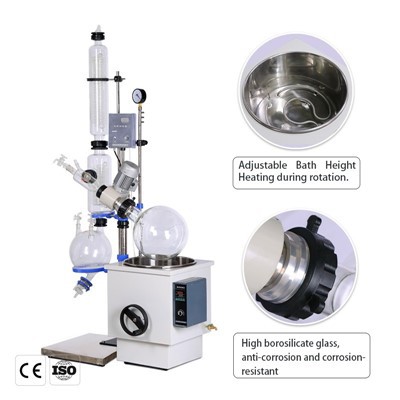
Construction and Design
Rotary evaporators are designed to ensure efficient and safe distillation of volatile solvents. The construction and design of these devices focus on creating a controlled environment for the distillation process, including pressure control, temperature regulation, and effective condensation.
● Rotary Motor and Flask Rotation
The rotary motor is the heart of the evaporator, providing the power needed to rotate the distillation flask. The flask rotates at a constant speed, typically between 50 and 160 revolutions per minute (rpm), creating a thin film of the solution on its inner wall. This thin film maximizes the surface area exposed to heat, promoting efficient evaporation.
● Heating Bath
The heating bath, usually filled with water or oil, surrounds the distillation flask and provides the necessary heat for evaporation. The temperature of the heating bath can be controlled using a thermostat, allowing precise regulation of the distillation process. For ethanol distillation, the heating bath temperature is adjusted to slightly above the boiling point of ethanol under the desired vacuum.
● Vacuum System
The vacuum system is crucial for reducing the pressure inside the evaporator, which in turn lowers the boiling point of the solvent. The vacuum can be created using a water aspirator or a mechanical vacuum pump. The pressure inside the evaporator can be adjusted using a vacuum controller, allowing for precise control of the distillation process.
● Condenser and Collection Flask
The condenser is responsible for cooling the evaporated solvent, converting it back into a liquid form. The condenser is usually a glass coil cooled by water or ice, ensuring efficient condensation of the solvent vapor. The condensed solvent is then collected in the receiver flask, which can be easily removed and replaced as needed.
Applications
|
Rotary evaporators have a wide range of applications in chemical and pharmaceutical laboratories, including the distillation of ethanol. Below are some of the key applications of rotary evaporators: ● Organic Synthesis: In organic synthesis, rotary evaporators are used to remove volatile solvents from reaction mixtures, facilitating the purification and isolation of reaction products. Ethanol is commonly used as a solvent in organic synthesis reactions, and rotary evaporators are essential for its removal. ● Drug Manufacturing: In the pharmaceutical industry, rotary evaporators are used to concentrate and purify drug intermediates and active pharmaceutical ingredients (APIs). Ethanol is often used as a solvent in these processes, and its removal is crucial for obtaining high-quality products. ● Solvent Recovery: Rotary evaporators are also used for solvent recovery, allowing researchers to reuse solvents and reduce waste. Ethanol, being a volatile and relatively inexpensive solvent, is often recovered and reused in subsequent reactions. ● Environmental Analysis: In environmental science, rotary evaporators are used to concentrate samples for analysis. Ethanol can be used as a solvent in these processes, facilitating the extraction and concentration of analytes from environmental samples. |
|

Ethanol-Specific Considerations
When using a rotary evaporator for ethanol distillation, several factors need to be considered to ensure optimal performance and safety.
● Ethanol Boiling Point: The boiling point of ethanol is affected by pressure. Under reduced pressure, the boiling point decreases, allowing distillation at lower temperatures. However, care must be taken to avoid exposing the ethanol to excessively high temperatures, which can cause decomposition or loss of purity.
● Ethanol Viscosity: Ethanol has a relatively low viscosity, which facilitates its evaporation and condensation. However, if the ethanol contains impurities or is mixed with other high-viscosity compounds, the distillation process may be affected.
● Ethanol Flammability: Ethanol is a flammable solvent, and proper safety measures must be taken to prevent fires and explosions. This includes using explosion-proof equipment, ensuring proper ventilation, and avoiding ignition sources.
● Ethanol Toxicity: Ethanol is a toxic compound, and care must be taken to handle it safely. Operators should wear appropriate protective equipment, such as gloves and goggles, and avoid skin contact and inhalation.
Conclusion
Rotary evaporators are indispensable tools in chemical and pharmaceutical laboratories, offering efficient and safe distillation of volatile solvents such as ethanol. These devices utilize the principles of vacuum distillation and thin-film evaporation to achieve high evaporation rates and purity. With careful setup, monitoring, and maintenance, rotary evaporators can provide reliable and reproducible results for a wide range of applications. However, users should be aware of the potential limitations and safety considerations associated with these devices, particularly when dealing with flammable and toxic compounds like ethanol. Overall, rotary evaporators are valuable instruments that contribute to the advancement of chemical and pharmaceutical research and development.